
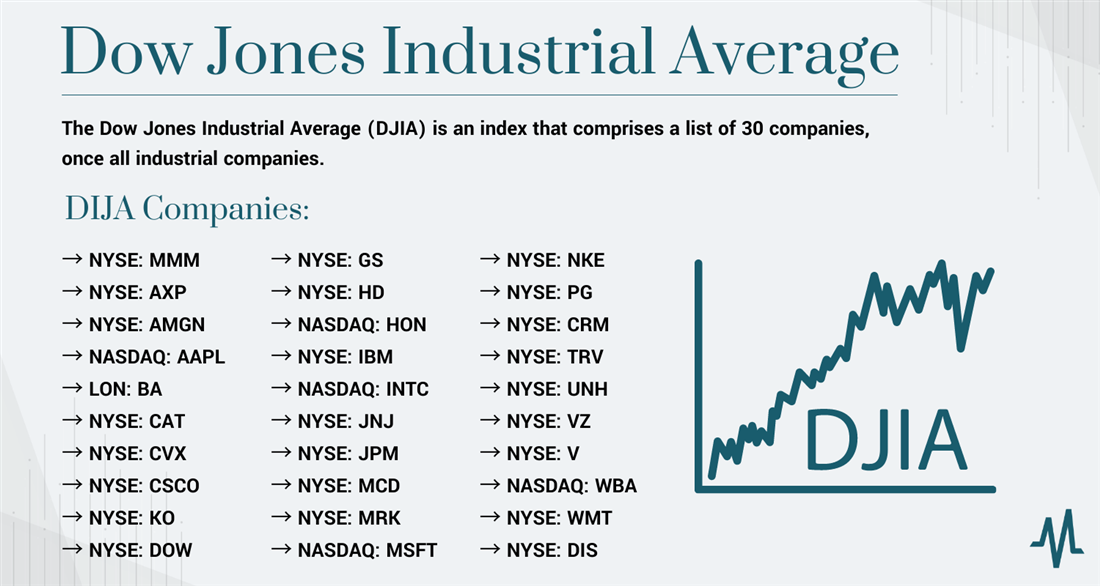
The Dow Jones Industrial Average (DJIA), often referred to simply as “the Dow,” is perhaps the most recognized financial index in the world. Established in 1896 by Charles Dow and Edward Jones, it serves as a pulse check for the American economy. While its name suggests a focus on heavy industry, the modern Dow is a diverse cross-section of the U.S. corporate landscape, featuring 30 “blue-chip” companies that lead their respective sectors. Understanding which stocks make up the Dow, and how they are selected, is essential for any investor looking to gauge the health of the broader market.

Understanding the Blue-Chip Benchmark
The Dow Jones Industrial Average is unique among major indices because of its longevity and its specific methodology. Unlike the S&P 500 or the Nasdaq Composite, which include hundreds or thousands of companies, the Dow focuses on a concentrated group of 30 massive, stable, and influential firms. These are often referred to as “blue-chip” stocks—companies with a long history of reliable earnings and, frequently, consistent dividend payments.
The History and Purpose of the DJIA
When Charles Dow first published the index, it contained only 12 companies, most of which were in heavy industries like railroads, cotton, gas, and sugar. At the time, industrial production was the primary driver of the American economy. Over the last century, as the United States transitioned from an agrarian and industrial economy to one driven by technology, services, and healthcare, the Dow evolved.
The purpose of the index remains the same: to provide a clear, concise snapshot of the market’s performance. Because the 30 components are leaders in their fields, their collective movement generally reflects the sentiment of institutional and retail investors regarding the domestic economy.
How the Dow Differs from Other Indices
The most significant distinction of the Dow is that it is a price-weighted index. In a market-capitalization-weighted index, such as the S&P 500, a company’s influence is determined by its total market value (share price multiplied by outstanding shares). In the Dow, the influence of a stock is determined solely by its price per share.
This means that a company with a high share price, such as UnitedHealth Group or Goldman Sachs, has a much larger impact on the index’s daily fluctuations than a company with a lower share price, such as Verizon or Cisco, even if the latter has a larger total market valuation. This quirk of the Dow is a frequent point of discussion among financial analysts, as it makes the index sensitive to stock splits and specific price movements rather than pure company size.
The Current 30 Components: A Snapshot of the American Economy
The Dow is regularly updated to ensure it remains representative of the current economic environment. As of the most recent rebalancing, the 30 stocks cover a wide array of sectors, including technology, healthcare, finance, consumer goods, and energy.
Technology and Growth Leaders
Technology has become the dominant force in the modern Dow. While the index was once dominated by steel and oil, today it features the titans of the digital age.
-
Microsoft (MSFT) and Apple (AAPL): These two are the heavyweights of the tech sector, representing the backbone of software, cloud computing, and consumer hardware.
-
Amazon (AMZN): A recent addition to the index, Amazon replaced Walgreens Boots Alliance to better reflect the shift toward e-commerce and cloud services (AWS).
-
Salesforce (CRM): Representing the shift toward Software-as-a-Service (SaaS) and enterprise cloud solutions.
-
Intel (INTC) and Cisco (CSCO): These companies represent the infrastructure of the internet and semiconductor manufacturing.
Healthcare and Financial Pillars
The financial and healthcare sectors carry significant weight in the Dow, largely due to the high share prices of their primary representatives.
-
UnitedHealth Group (UNH): Currently one of the most influential stocks in the Dow due to its high triple-digit share price, UnitedHealth represents the massive managed healthcare and insurance industry.
-
Goldman Sachs (GS) and JPMorgan Chase (JPM): These represent the pinnacle of investment and commercial banking. Goldman Sachs, in particular, exerts significant influence on the index’s movements.
-
Visa (V) and American Express (AXP): These companies represent the consumer credit and payment processing landscape, which is a vital indicator of consumer spending health.
Consumer Staples and Industrial Giants
Despite the name “Industrial” becoming a bit of a misnomer, the Dow still holds onto its roots with several manufacturing and consumer-facing powerhouses.

-
Boeing (BA): A critical component representing the aerospace and defense industry.
-
Caterpillar (CAT): The global leader in construction and mining equipment, often viewed as a bellwether for global industrial activity.
-
Walmart (WMT) and Home Depot (HD): These retail giants provide insight into the strength of the American consumer.
-
Coca-Cola (KO) and Procter & Gamble (PG): Known as “defensive” stocks, these companies produce essential goods that consumers buy regardless of the economic climate.
The Selection Process: How Stocks Join the Elite 30
One of the most misunderstood aspects of the Dow is how a company actually becomes a “Dow stock.” Unlike the S&P 500, which has strict quantitative rules regarding market cap and liquidity, the Dow’s selection process is more qualitative.
The Role of the Averages Committee
The components of the Dow are selected by a committee at S&P Dow Jones Indices. There are no rigid rules for inclusion, but the committee follows general guidelines. They look for companies that have an excellent reputation, demonstrate sustained growth, and are of interest to a large number of investors. The goal is to maintain an index that reflects the “industrial” (in the broad sense of the word) heartbeat of the U.S. economy.
Criteria for Inclusion
While the process is subjective, the committee generally adheres to the following:
-
U.S. Incorporation: The company must be headquartered and incorporated in the United States.
-
Sector Representation: The committee strives to keep the index diversified. If a specific sector, like technology or healthcare, grows to represent a larger portion of the GDP, the committee may swap out an underperforming company from a shrinking sector for a leader in the growing sector.
-
Price Considerations: Because the index is price-weighted, the committee avoids stocks with extremely high prices that would distort the index, as well as stocks with very low prices that would have no impact. This is why many Dow companies perform stock splits to keep their share price in a range that is “compatible” with the index’s structure.
The Price-Weighted Methodology
To understand the Dow, one must understand how the “average” is actually calculated. It is not a simple average of the 30 stock prices divided by 30. If it were, stock splits and dividends would cause the index to drop artificially.
Understanding the Divisor
To account for corporate actions like stock splits, mergers, and spinoffs, the Dow uses a mathematical constant known as the “Dow Divisor.” When a company in the index splits its stock (e.g., a 2-for-1 split), the share price is halved. Without an adjustment, the Dow would appear to lose points overnight. The Divisor is adjusted so that the value of the index remains the same before and after the split. Over decades of adjustments, the Divisor has shrunk to a value much less than one. This means that a one-dollar move in any Dow stock translates to a multi-point move in the index itself.
Impact of Stock Splits on the Index
Stock splits are a major event for the Dow. When Apple or Walmart undergoes a stock split, their weight in the index decreases because their share price is lower. This creates a unique dynamic: a company can be the most valuable in the world by market cap (like Apple) but only be a middle-of-the-pack influencer in the Dow if its share price is lower than that of its peers. This is why the addition or removal of stocks is often timed around major corporate restructurings or price shifts.
Why the Dow Still Matters to Modern Investors
Critics often argue that the Dow is an outdated relic. They point to its small sample size (30 stocks) and its “illogical” price-weighting system as reasons to prefer the S&P 500. However, the Dow remains relevant for several key reasons.
A Tool for Market Sentiment
The Dow consists of companies that are “household names.” When the average person asks, “How did the market do today?” they are usually looking for a single number that summarizes the mood of Wall Street. Because the Dow tracks the most established and profitable companies, it serves as a highly effective gauge of investor confidence. When the Dow is up, it generally means that the “pillars” of the economy are performing well.
Limitations and Considerations
For the serious investor, the Dow is a tool, not the entire toolbox. Its concentration means it can be heavily influenced by the misfortune of just one or two companies. For instance, if Boeing faces regulatory hurdles that tank its stock price, the Dow might show a significant loss even if the rest of the market is rallying.
Furthermore, the Dow does not include transportation or utilities companies, as those are tracked by their own specific indices (the Dow Jones Transportation Average and the Dow Jones Utility Average). To get a truly comprehensive view of the market, investors often look at the Dow in conjunction with the S&P 500 and the Nasdaq.
Ultimately, the stocks that make up the Dow Jones Industrial Average represent the elite tier of American business. From the tech innovation of Microsoft to the retail dominance of Walmart and the financial power of JPMorgan Chase, these 30 companies provide a concentrated look at the economic forces shaping our world. For those looking to build a portfolio of “blue-chip” stability, the Dow components remain the gold standard for long-term investing.
aViewFromTheCave is a participant in the Amazon Services LLC Associates Program, an affiliate advertising program designed to provide a means for sites to earn advertising fees by advertising and linking to Amazon.com. Amazon, the Amazon logo, AmazonSupply, and the AmazonSupply logo are trademarks of Amazon.com, Inc. or its affiliates. As an Amazon Associate we earn affiliate commissions from qualifying purchases.