
The Dow Jones Industrial Average (DJIA), often simply referred to as “the Dow,” stands as one of the most recognizable and frequently cited stock market indices globally. For decades, it has served as a critical barometer for the health of the U.S. stock market and the broader economy. Composed of 30 significant publicly owned companies, understanding its components is fundamental for investors seeking insight into market trends, economic stability, and potential investment opportunities. While its methodology differs from market-capitalization-weighted indices, the Dow’s influence on investor sentiment and its role in financial news remain profound.
Understanding the Dow Jones Industrial Average (DJIA)
Established in 1896 by Charles Dow, editor of The Wall Street Journal and co-founder of Dow Jones & Company, the DJIA was initially designed to track the performance of industrial sector stocks. Over its more than a century of existence, the index has evolved dramatically, shedding its strict “industrial” label to encompass a diverse array of leading companies across various sectors, reflecting the shifting landscape of the American economy.
The most distinctive feature of the DJIA is its price-weighted methodology. Unlike the S&P 500, which is market-capitalization-weighted (meaning companies with larger market values have a greater impact on the index), the Dow is influenced more by the absolute share price of its components. This means a $1 change in a higher-priced stock will have a greater effect on the index’s value than a $1 change in a lower-priced stock, regardless of their market capitalization. To account for stock splits and other structural changes, a “Dow Divisor” is used to maintain historical continuity and ensure that the index’s movements accurately reflect the underlying performance of its components.
Historical Significance and Evolution
The Dow’s enduring appeal lies in its long history and its representation of large, well-established “blue-chip” companies. These are typically firms with a strong reputation, stable earnings, and a history of reliable performance. While its small number of components (30) makes it less comprehensive than broader indices like the S&P 500, it offers a quick snapshot of a segment of the market composed of industry leaders. Its evolution from tracking railroads and heavy manufacturing to including technology, finance, and healthcare giants illustrates the dynamic nature of economic leadership and innovation over time.
Criticisms and Limitations
Despite its prominence, the DJIA faces several criticisms. The primary concern is its price-weighted nature, which many argue does not accurately reflect the economic significance of its constituent companies. A company with a high stock price but a relatively smaller market capitalization can exert more influence than a company with a lower stock price but a massive market cap. Additionally, with only 30 companies, the index lacks the broad diversification of other benchmarks, potentially offering a limited view of the overall market’s health or specific sector trends. However, for many investors and observers, its longevity and the quality of its components continue to make it a valuable, albeit imperfect, indicator.
The Current Roster of Dow 30 Components and Their Significance
The selection of companies for the Dow 30 is not based on a rigid set of rules but rather on a committee’s discretion, prioritizing reputation, sustained growth, investor interest, and broad sector representation within the U.S. economy. These companies are titans of their respective industries, often household names with global operations, consistent profitability, and a track record of innovation.
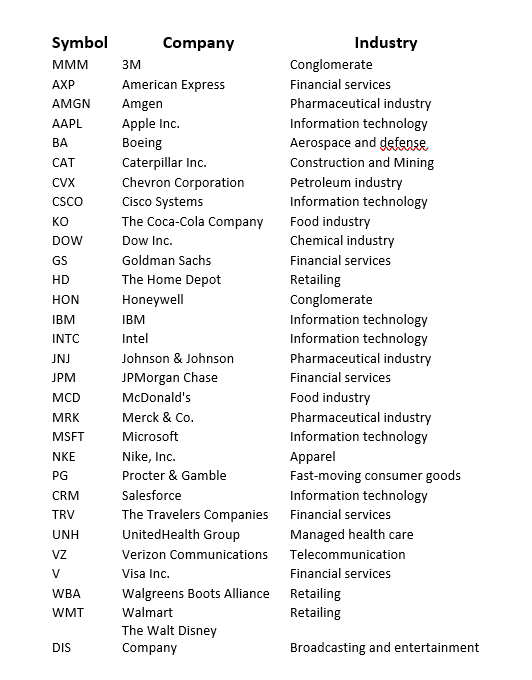
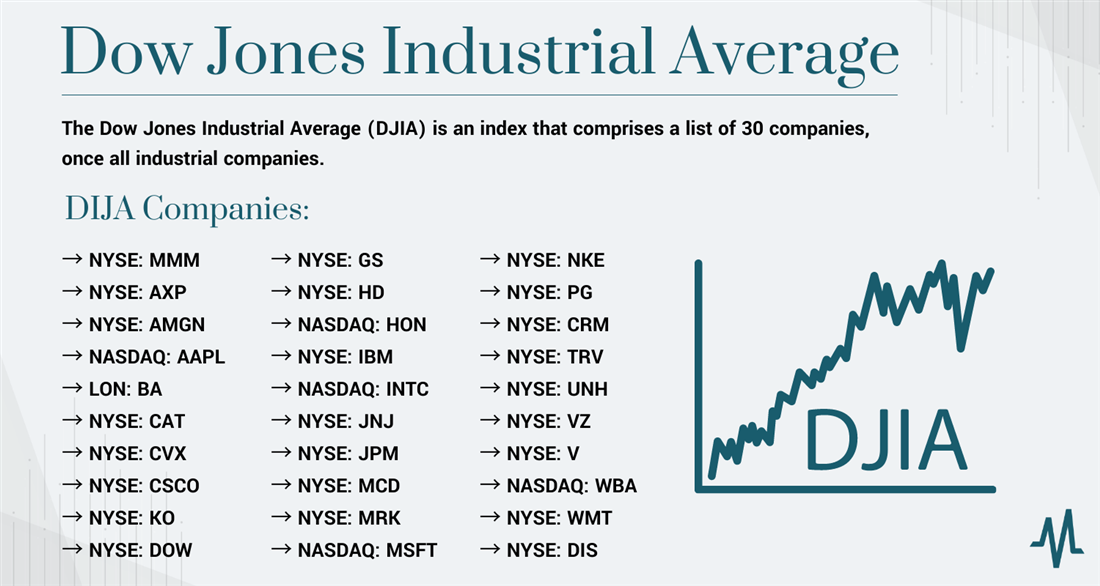
As of recent compositions, the Dow 30 includes a diverse range of sectors, moving far beyond its “industrial” roots:
- Technology: Apple (AAPL), Microsoft (MSFT), Salesforce (CRM), Intel (INTC)
- Financials: JPMorgan Chase (JPM), Visa (V), Goldman Sachs (GS), American Express (AXP)
- Healthcare: Johnson & Johnson (JNJ), UnitedHealth Group (UNH), Merck & Co. (MRK), Amgen (AMGN)
- Consumer Discretionary/Staples: Home Depot (HD), Nike (NKE), Walmart (WMT), McDonald’s (MCD), Coca-Cola (KO), Procter & Gamble (PG)
- Industrials: Boeing (BA), Caterpillar (CAT), 3M (MMM), Honeywell (HON)
- Communication Services: Verizon (VZ), Walt Disney (DIS)
- Energy: Chevron (CVX)
- Materials: Dow Inc. (DOW)
Note: The exact composition can change, and investors should always refer to official sources for the most current list.
This list showcases the breadth of the American economy, from innovative tech giants to resilient consumer brands, critical healthcare providers, and essential industrial mainstays. Each company represents a significant force within its sector, often acting as a bellwether for industry trends and economic shifts.
Why Dow Components Matter to Investors
For individual and institutional investors, the Dow 30 companies hold particular appeal for several reasons:
- Blue-Chip Status: These firms are generally considered stable, mature investments with a history of earnings and dividend payments, making them attractive to long-term investors and those seeking income.
- Market Leadership: Being part of the Dow signifies a company’s leadership position within its industry, often reflecting strong competitive advantages and robust business models.
- Visibility and Liquidity: Dow components are among the most heavily traded stocks, offering high liquidity for investors. Their frequent mention in financial news also provides ample information for analysis.
- Diversification (within the Dow): While not broadly diversified across the entire market, the companies within the Dow offer some sector diversification, providing a snapshot of economic activity across several key industries.
Investing in Dow components can be part of a strategy focused on stability and growth from established market leaders, though it’s crucial to remember that even blue chips can experience volatility.
How Dow 30 Components Are Selected and Adjusted
The process of selecting and modifying the Dow 30 is overseen by a committee at S&P Dow Jones Indices. Unlike indices with quantitative, rule-based selection criteria, the Dow’s committee uses qualitative judgment, focusing on several key attributes for potential candidates:

- Reputation and History: Companies must have an excellent reputation and demonstrate sustained growth.
- Size and Influence: They should be large, influential companies with significant interest from a broad base of investors.
- Sector Representation: The committee aims to ensure adequate representation of the broader U.S. stock market and economy across different industries.
- U.S. Headquartered: While not an absolute rule, companies are typically U.S.-based.
Changes to the Dow are relatively infrequent, reflecting the committee’s preference for stability within the index. When changes do occur, they are often significant events that can cause short-term volatility in the stocks involved. Companies may be removed if they are acquired, face prolonged financial distress, or if their sector representation diminishes, making way for a new industry leader or a company from an underrepresented sector.
Impact of Index Changes
When a company is added to or removed from the Dow, it can have several impacts:
- Increased Visibility: Companies added to the Dow often experience a bump in their stock price due to increased attention from investors and the buying activity of index funds and ETFs that track the Dow.
- Institutional Investment: Inclusion in the Dow can lead to increased institutional ownership as fund managers align their portfolios with the index.
- Reflecting Economic Shifts: Changes in the Dow’s composition often mirror broader economic shifts, such as the rise of technology or the decline of traditional manufacturing. For example, the removal of General Electric, an original Dow component, after more than a century, underscored its diminished industrial prominence, while the addition of Salesforce highlighted the growing importance of cloud computing and enterprise software.
These adjustments ensure that the Dow, despite its limitations, continues to reflect the evolving landscape of American corporate leadership and economic drivers.
Investing Implications and Strategies
For investors, the Dow 30 offers various avenues and considerations. It’s often viewed as a proxy for the health of the U.S. large-cap market, but its specific composition requires a nuanced approach.
Direct vs. Indirect Investment
Investors can gain exposure to the Dow in a few ways:
- Individual Stocks: One can directly purchase shares of any of the 30 companies in the index. This allows for selective investment in specific industries or companies an investor believes in. However, it requires careful research and monitoring of each company’s financial performance and market position.
- Exchange-Traded Funds (ETFs) and Mutual Funds: For those seeking broad exposure to all 30 components without picking individual stocks, ETFs like the SPDR Dow Jones Industrial Average ETF Trust (DIA) track the performance of the DJIA. These funds offer diversification across the Dow components and simplify the investment process, providing exposure to the entire index with a single purchase.
- Derivatives: More advanced investors might use options or futures contracts based on the DJIA for speculation or hedging purposes, though these carry higher risks.
The “Blue-Chip” Appeal and Diversification
Investing in Dow components typically aligns with a strategy focusing on stability, quality, and potential dividend income. These companies are generally less volatile than smaller, growth-oriented stocks and can be a foundational part of a diversified portfolio. However, relying solely on the Dow 30 for diversification is insufficient. While it covers various sectors, 30 stocks do not represent the thousands of publicly traded companies, nor do they fully capture the growth potential of mid-cap or small-cap companies, or international markets.
A robust investment strategy should combine exposure to large-cap blue-chip stocks with investments in broader market indices (like the S&P 500 or total market funds), international equities, bonds, and potentially alternative assets, tailored to an individual’s risk tolerance and financial goals.
Beyond the Dow: A Broader Investment Perspective
While the Dow 30 holds significant historical and financial importance, it’s crucial for investors to place it within a broader context. A comprehensive investment strategy goes beyond observing or investing solely in the 30 companies that constitute this index.
Other Key Indices
To gain a more complete picture of market performance and to achieve adequate diversification, investors often consider other major indices:
- S&P 500: Composed of 500 large U.S. companies, the S&P 500 is market-capitalization-weighted and provides a much broader representation of the U.S. equity market than the Dow. It is often considered the best single gauge of large-cap U.S. equities.
- Nasdaq Composite: This index tracks all stocks listed on the Nasdaq stock exchange, heavily weighted towards technology and growth companies. It offers insight into the performance of the innovation-driven sectors of the economy.
- Russell 2000: Representing 2,000 small-cap U.S. companies, this index is vital for understanding the performance of smaller, often more volatile, but potentially high-growth businesses.
Understanding the components and methodologies of these different indices allows investors to build portfolios that truly reflect their investment objectives and risk appetites.
Long-Term Financial Planning
Ultimately, the goal of understanding indices like the Dow 30 is to inform a well-thought-out financial plan. Investing is not just about picking individual stocks or tracking daily market movements but about setting clear financial goals (e.g., retirement, home purchase, education), establishing a suitable asset allocation, and maintaining a long-term perspective. The Dow, with its storied history and blue-chip components, serves as an excellent starting point for understanding significant market players, but it is one piece of a much larger, dynamic investment puzzle.
aViewFromTheCave is a participant in the Amazon Services LLC Associates Program, an affiliate advertising program designed to provide a means for sites to earn advertising fees by advertising and linking to Amazon.com. Amazon, the Amazon logo, AmazonSupply, and the AmazonSupply logo are trademarks of Amazon.com, Inc. or its affiliates. As an Amazon Associate we earn affiliate commissions from qualifying purchases.