
In the rapidly evolving landscape of fintech, few names have achieved the ubiquity and influence of SoFi. Short for Social Finance, Inc., SoFi has transitioned from a niche startup focused on student loan refinancing into a comprehensive financial “super app” that challenges the traditional banking establishment. For modern consumers, particularly those in the Millennial and Gen Z demographics, SoFi represents a shift away from brick-and-mortar limitations toward a digital-first philosophy that integrates banking, investing, and lending into a single, cohesive interface.
The rise of SoFi is more than just a success story in Silicon Valley; it is a case study in how financial technology can reshape personal finance management. By prioritizing user experience, competitive interest rates, and a broad suite of services, SoFi aims to be the primary financial hub for its members. To understand what SoFi is today, one must look at its evolution, its core offerings, and the specific value it provides to those looking to optimize their money in a digital age.

The Evolution of SoFi: From Student Loans to Financial Powerhouse
SoFi was founded in 2011 by four students at the Stanford Graduate School of Business. The initial concept was rooted in the idea of “social finance”—leveraging alumni to provide more affordable student loans to current students. This peer-to-peer lending model was designed to bypass the rigid and often high-interest structures of traditional banks. By focusing on borrowers with high earning potential who were underserved by conventional credit scoring models, SoFi carved out a lucrative niche.
Origins and the Disruption of Lending
The company’s early success was built on student loan refinancing. At a time when student debt was ballooning, SoFi offered a way for graduates to consolidate their debt at lower rates, saving them thousands of dollars over the life of their loans. This established a foundation of trust with a highly desirable demographic: young, high-earning professionals. As the brand grew, it recognized that these individuals needed more than just debt management; they needed a place to grow their wealth.
Building the Financial Ecosystem
Over the last decade, SoFi has aggressively expanded its product line. Through strategic acquisitions—such as the purchase of the payment processing platform Galileo and the acquisition of Golden Pacific Bancorp—SoFi secured a national bank charter in early 2022. This was a pivotal moment in the company’s history, allowing it to hold deposits directly and compete on equal footing with major institutions like JPMorgan Chase or Bank of America. Today, SoFi is no longer just a lender; it is a full-service financial institution offering everything from high-yield savings accounts to sophisticated investment tools.
Core Banking Features: Checking and Savings Redefined
The centerpiece of the SoFi experience for most users is the banking suite, known as SoFi Checking and Savings. Unlike traditional banks that often separate these functions with different rules and minimum balances, SoFi integrates them to simplify the user’s financial life while maximizing their return on capital.
High-Yield APY and the Single-Account Approach
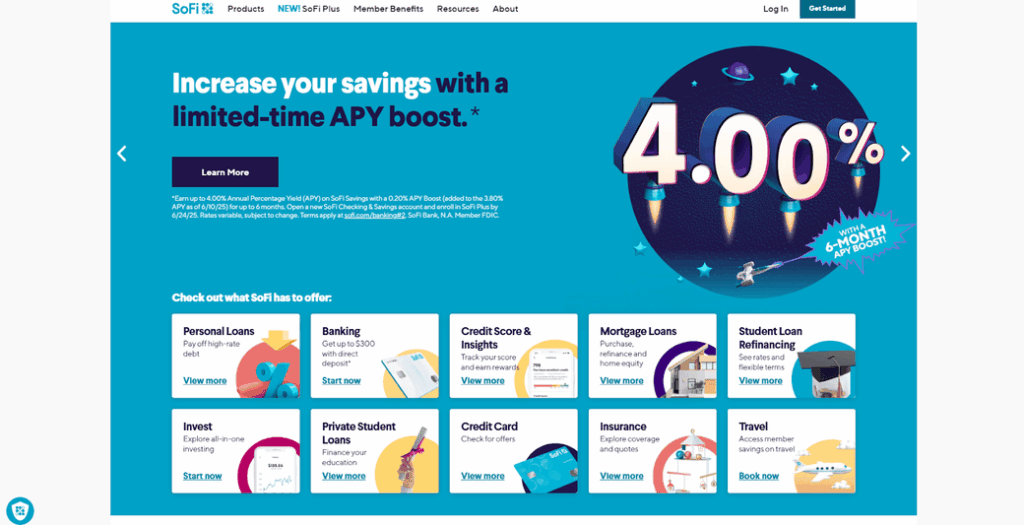
One of the primary draws of SoFi is its competitive Annual Percentage Yield (APY). In a climate where traditional “Big Bank” savings accounts often offer negligible interest, SoFi frequently provides rates that are significantly higher than the national average. To unlock the highest tiers of interest, users typically need to set up a qualifying direct deposit.
This model encourages users to make SoFi their primary financial home. The account structure also includes “Vaults,” which allow users to earmark money for specific goals—such as an emergency fund, a wedding, or a house down payment—without needing to open multiple separate accounts. This digital-first approach to budgeting within the banking app reflects a deep understanding of modern financial habits.
Fee Structures and Member Perks
SoFi has built much of its reputation on a “no-fee” philosophy. There are generally no monthly account fees, no minimum balance fees, and no overdraft fees (within certain limits). Additionally, SoFi provides access to a massive network of fee-free ATMs.
Beyond the lack of fees, SoFi emphasizes “Member Benefits.” This includes access to certified financial planners at no additional cost—a service that typically carries a high premium elsewhere. This focus on holistic financial health, rather than just transaction processing, distinguishes SoFi from both traditional banks and many of its fintech competitors.
The SoFi Invest Platform: Accessibility for Modern Investors
As users stabilize their cash flow through SoFi’s banking services, many naturally progress toward the SoFi Invest platform. The goal of this segment is to democratize investing, making it accessible to those who might be intimidated by traditional brokerage houses.

Active Investing vs. Automated Portfolios
SoFi Invest offers two primary paths: active investing and automated investing. Active investing allows users to buy and sell individual stocks and Exchange-Traded Funds (ETFs) with zero commissions. A standout feature here is “Stock Bits,” which allows for fractional share trading. This means a user can invest as little as $1 in expensive stocks like Amazon or Berkshire Hathaway, lowering the barrier to entry for diversification.
For those who prefer a hands-off approach, SoFi’s automated investing serves as a robo-advisor. By answering a series of questions about risk tolerance and financial goals, users receive a managed portfolio that automatically rebalances over time. Unlike many other robo-advisors that charge a management fee (often around 0.25%), SoFi’s automated investing currently charges no management fee, making it one of the most cost-effective options on the market.
Alternative Assets and Educational Tools
SoFi has also integrated alternative assets into its ecosystem. While the focus remains on traditional equities and ETFs, the platform has historically provided avenues for crypto exposure and has recently expanded into offering access to Initial Public Offerings (IPOs) for retail investors—a privilege usually reserved for high-net-worth individuals or institutional clients.
The platform is heavily supplemented by educational content. From daily market briefings to in-depth articles on retirement planning, SoFi attempts to bridge the gap between “having an account” and “understanding the market.” This educational layer is critical for retaining users as they move through different stages of their financial journey.
Lending Solutions: The Foundation of the Brand
Despite its expansion into banking and investing, lending remains a core pillar of SoFi’s business model. The company utilizes a sophisticated underwriting process that looks beyond just a FICO score, often considering factors like cash flow and professional history to offer better rates to its members.
Student Loan Refinancing and Personal Loans
SoFi continues to be a leader in student loan refinancing. By allowing borrowers to combine multiple federal and private loans into a single new loan with a lower interest rate, SoFi helps users reduce their monthly payments or pay off their debt faster.
Personal loans are another major offering. These are often used for debt consolidation, home improvements, or major life events. Because SoFi targets a specific credit profile, they are often able to offer higher loan amounts and more competitive rates than traditional credit card issuers, making them a popular choice for those looking to exit high-interest revolving debt.
The Mortgage and Home Equity Landscape
Expanding its reach into the real estate market, SoFi offers mortgages and refinancing options. The digital-first application process is designed to be faster and more transparent than the traditional mortgage experience. By integrating the mortgage process into the same app where a user tracks their savings and investments, SoFi provides a panoramic view of how a home purchase fits into a user’s total financial picture.
Is SoFi Right for You? Evaluating the Modern Digital Bank
While SoFi offers an impressive array of features, the decision to use it depends on an individual’s specific needs and comfort level with digital banking.
Pros and Cons of a Branchless Experience
The most significant advantage of SoFi is the convenience and the “all-in-one” nature of the app. Being able to see your paycheck arrive, move money into a “Vault,” invest in a diversified portfolio, and track your credit score in one place is incredibly efficient. The higher-than-average APYs and lack of fees provide tangible monetary value.
However, the lack of physical branches can be a drawback for some. While SoFi offers robust customer support via phone and chat, individuals who prefer face-to-face interactions or those who frequently deal with large cash deposits may find a digital-only bank limiting. Furthermore, while SoFi’s interest rates are high, they are often tied to direct deposit requirements, which might not suit freelancers or those with irregular income streams.
Security, Stability, and the Future of Fintech
As a chartered bank, SoFi deposits are FDIC-insured up to $250,000 (and even higher through their brokerage network). This provides the same level of security found at any major national bank. As the company continues to grow, it is likely to integrate even more services, potentially expanding into deeper insurance products or enhanced business banking features.
In conclusion, “What SoFi” represents is the modern evolution of the bank. It is no longer just a place to store money; it is a tool designed to help users optimize every dollar they earn. By lowering fees, increasing accessibility to markets, and providing a seamless digital interface, SoFi has positioned itself as a formidable player in the personal finance space, catering to a generation that demands more from their financial institutions than just a plastic card and a monthly statement.
aViewFromTheCave is a participant in the Amazon Services LLC Associates Program, an affiliate advertising program designed to provide a means for sites to earn advertising fees by advertising and linking to Amazon.com. Amazon, the Amazon logo, AmazonSupply, and the AmazonSupply logo are trademarks of Amazon.com, Inc. or its affiliates. As an Amazon Associate we earn affiliate commissions from qualifying purchases.