
Tapping threads into a workpiece is a fundamental machining process, essential for creating internal screw threads that allow for assembly with bolts, screws, or other threaded components. While the concept seems straightforward, achieving successful and durable threads hinges on precise execution, and a critical element of this precision is selecting the correct drill bit size for the corresponding tap. This article will delve into the technical considerations and practical methods for determining the appropriate drill bit size when using a 3/8 tap, a common fastener size encountered in a wide range of applications from DIY projects to industrial manufacturing.
Understanding the Fundamentals of Tapping
Before we address the specific question of a 3/8 tap, it’s crucial to understand the underlying principles of thread formation through tapping. Tapping involves using a tool called a tap, which has cutting edges that progressively cut helical grooves into a pre-drilled hole, forming the internal threads. For this process to be successful, the hole must be drilled to a precise diameter. This diameter is known as the “tap drill size.”
The Importance of the Tap Drill Size
The tap drill size is paramount because it dictates the amount of material removed by the tap.
-
Too Small a Drill Bit: If the pre-drilled hole is too small, the tap will encounter excessive resistance. This can lead to several undesirable outcomes:
- Tap Breakage: The tap can snap under immense pressure, a costly and frustrating event, especially with hardened steel taps.
- Poor Thread Quality: The tap may not be able to cut the full thread profile, resulting in shallow, weak, or incomplete threads.
- Damage to the Workpiece: Excessive force required to tap can distort or damage the material being threaded.
- Operator Fatigue and Injury: Forcing a tap can be physically demanding and increase the risk of accidents.
-
Too Large a Drill Bit: Conversely, if the pre-drilled hole is too large, the tap will not have enough material to engage with and form the threads. This leads to:
- Loose or Stripped Threads: The resulting threads will be too large for the mating fastener, leading to a loose connection that can easily strip.
- Inability to Achieve Thread Depth: The tap will not be able to cut to the desired thread depth, rendering the threaded hole functionally useless.
- Wasted Material: A poorly threaded hole often necessitates scrapping the workpiece and starting over.
The ideal tap drill size is a compromise. It must be large enough to allow the tap to cut freely without excessive force, yet small enough to ensure that the tap can form the necessary thread height and provide adequate thread engagement.
Thread Standards and Their Impact
The precise tap drill size is not arbitrary; it is directly influenced by the thread standard being used. The most common thread standards are the Unified Thread Standard (UTS) and the Metric Thread Standard. For a 3/8 tap, we are almost exclusively dealing with the UTS.
Within UTS, there are two primary categories for screw threads:
- Coarse Threads (UNC): These have a larger pitch (fewer threads per inch) and are generally used in situations where ease of assembly and resistance to vibration are important. They are also more tolerant of minor damage.
- Fine Threads (UNF): These have a finer pitch (more threads per inch) and offer greater tensile strength and a more precise fit. They are often used in applications where vibration is a concern and where a higher clamping force is required.
The designation “3/8” refers to the nominal major diameter of the thread, which is 3/8 of an inch. However, the tap drill size will differ slightly depending on whether the 3/8 tap is for UNC or UNF threads.
Calculating and Identifying the 3/8 Tap Drill Size
The tap drill size is determined by calculating the minor diameter of the thread. The minor diameter is the diameter of the root of the thread. For a standard external thread, the minor diameter is the tap drill size. For internal threads, the tap drill size needs to remove material to create a void that the tap will then displace to form the thread crests.
Formulas for Tap Drill Size Calculation
While charts and online calculators are readily available and often the most practical approach, understanding the underlying formulas provides valuable insight.
For standard Unified threads (both UNC and UNF), the tap drill size can be calculated as follows:
Tap Drill Diameter = Major Diameter – (1.299038 x Pitch)
Where:
- Major Diameter: The nominal outside diameter of the thread (in this case, 3/8 inch or 0.375 inches).
- Pitch: The distance between the crests of adjacent threads, measured parallel to the axis of the thread. Pitch is the inverse of Threads Per Inch (TPI).
Let’s apply this to our 3/8 tap:
3/8 UNC (Coarse) Tap Drill Size
The standard Threads Per Inch (TPI) for 3/8 UNC is 16.
Therefore, the pitch for 3/8 UNC is 1 / 16 inches.
Tap Drill Diameter (UNC) = 0.375 inches – (1.299038 x (1/16))
Tap Drill Diameter (UNC) = 0.375 inches – (1.299038 x 0.0625)
Tap Drill Diameter (UNC) = 0.375 inches – 0.08119 inches
Tap Drill Diameter (UNC) = 0.29381 inches
Converting this to a fractional drill bit size, the closest standard fractional drill bit is 5/16 inch (0.3125 inches). However, this is slightly larger than the calculated ideal. More accurately, a 19/64 inch drill bit (0.296875 inches) is very close to the calculated ideal. In practice, for 3/8 UNC, a #5 (0.196 inches) or a #F (0.234 inches) letter drill bit might also be used depending on the desired thread engagement and the material, but the most common and practical is a 5/16 inch or a 19/64 inch drill bit. It’s important to note that manufacturers often provide specific recommendations for their taps.
3/8 UNF (Fine) Tap Drill Size
The standard Threads Per Inch (TPI) for 3/8 UNF is 24.
Therefore, the pitch for 3/8 UNF is 1 / 24 inches.
Tap Drill Diameter (UNF) = 0.375 inches – (1.299038 x (1/24))
Tap Drill Diameter (UNF) = 0.375 inches – (1.299038 x 0.041667)
Tap Drill Diameter (UNF) = 0.375 inches – 0.05413 inches
Tap Drill Diameter (UNF) = 0.32087 inches
Converting this to a fractional drill bit size, the closest standard fractional drill bit is 21/64 inch (0.328125 inches). A 5/16 inch drill bit (0.3125 inches) is also commonly used. For 3/8 UNF, the recommended drill bit size is typically 1/4 inch (0.250 inches) for a less precise tap or a #7 (0.201 inches) or #F (0.234 inches) letter drill bit if a more robust thread is required, but 21/64 inch is a good starting point for a standard fit. A 1/4 inch drill bit (0.250 inches) is often cited as a common size for 3/8 UNF.
Practical Methods for Determining Tap Drill Size
While the formulas are informative, in a practical setting, the following methods are more commonly employed:
1. Tap Drill Charts and Tables
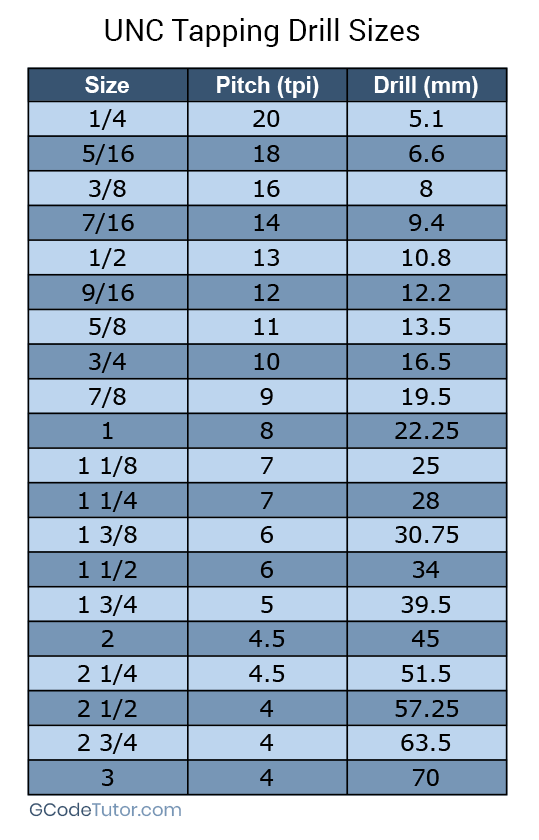
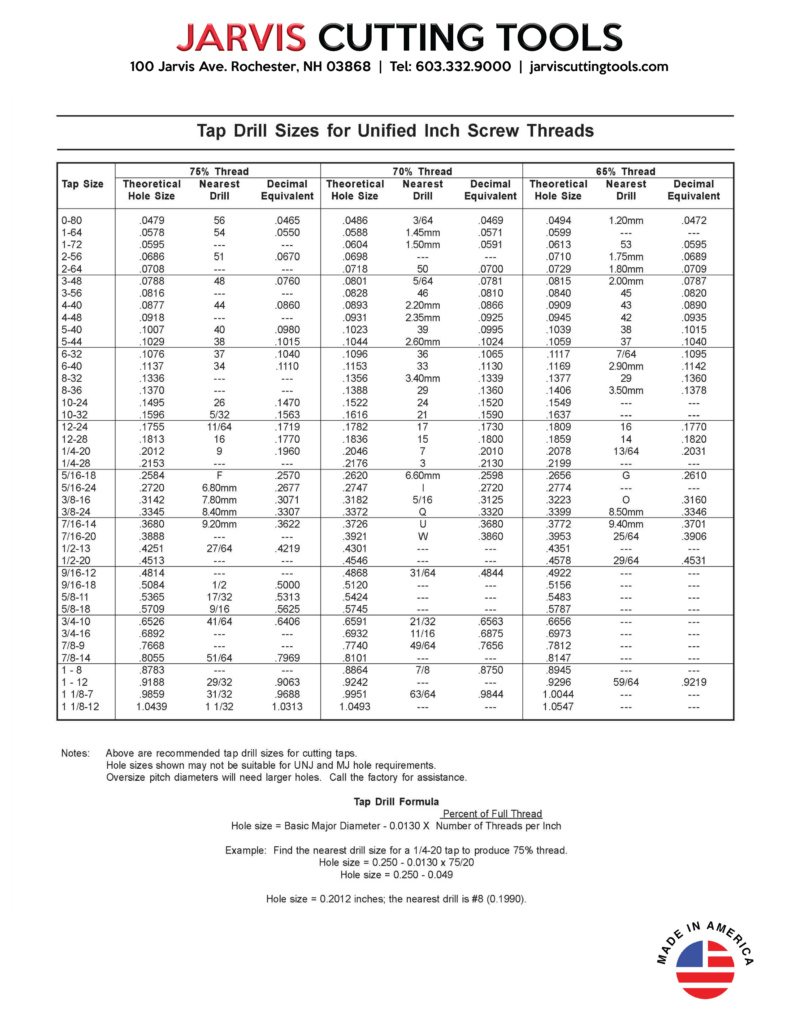
The most reliable and widely used method is to consult a tap drill chart or table. These charts are readily available in machining handbooks, engineering references, and online. They list tap sizes and their corresponding recommended drill bit sizes for both UNC and UNF threads, often including imperial and metric equivalents.
For a 3/8 Tap:
- 3/8 UNC: Look for the row corresponding to 3/8. The recommended drill bit size will typically be 5/16 inch (0.3125 inches) or 19/64 inch (0.296875 inches).
- 3/8 UNF: Look for the row corresponding to 3/8. The recommended drill bit size will typically be 21/64 inch (0.328125 inches) or 1/4 inch (0.250 inches).
It’s crucial to note that some charts might offer slight variations. Always cross-reference if possible or refer to the tap manufacturer’s specifications.
2. Manufacturer’s Specifications
Tap manufacturers often provide detailed specifications for their products. This can include recommended tap drill sizes for various materials, thread pitches, and desired thread engagement levels. If you have purchased a specific brand of tap, checking its packaging or the manufacturer’s website is an excellent way to ensure you are using the correct drill bit.
3. Online Tap Drill Calculators
Numerous websites offer free online tap drill calculators. These tools allow you to input the tap size (e.g., 3/8), the thread standard (UNC or UNF), and sometimes the material type. The calculator will then provide the recommended drill bit size, often in fractional, decimal, and drill bit gauge formats. These are incredibly convenient for quick reference in the workshop.
Factors Influencing the Optimal Drill Bit Size
While charts and formulas provide excellent starting points, several real-world factors can influence the ideal drill bit size for a 3/8 tap. Experienced machinists and fabricators often make slight adjustments based on these considerations.
Material Properties
The material you are tapping into has a significant impact on the forces involved and the resulting thread quality.
- Softer Materials (e.g., Aluminum, Brass, Plastics): These materials are more ductile and easier to machine. A slightly larger drill bit might be acceptable or even beneficial to reduce cutting forces and prevent galling (material tearing). However, excessively large holes will still result in weak threads. For softer materials, sticking to the recommended size is generally best for optimal thread strength.
- Harder Materials (e.g., Steel, Stainless Steel): These materials require more force to tap. Using a drill bit that is at the upper end of the recommended range or even slightly larger can help prevent tap breakage and make the tapping process smoother. However, care must be taken not to oversize the hole to the point of compromising thread strength. Lubrication is also critical when tapping hard materials.
- Brittle Materials (e.g., Cast Iron, Some Ceramics): These materials are prone to chipping and cracking. The tapping process must be carefully controlled to avoid excessive stress. Often, a precise drill bit size is essential to prevent fracture.
Desired Thread Engagement
Thread engagement refers to the percentage of the theoretical thread height that is actually formed. Standard thread engagement for steel is typically around 60-75%.
- Higher Thread Engagement (Deeper Threads): Requires a smaller drill bit. This results in stronger threads but increases cutting forces and the risk of tap breakage.
- Lower Thread Engagement (Shallower Threads): Allows for a slightly larger drill bit, reducing cutting forces. However, this can compromise the strength and load-bearing capacity of the threaded joint.
The standard tap drill sizes are calculated to achieve a good balance of thread engagement and ease of cutting for most common applications.
Tap Type and Condition
The type and condition of the tap itself can also influence the ideal drill bit size.
- New vs. Worn Taps: A new, sharp tap will cut more freely than a worn tap. If using a slightly duller tap, you might consider a slightly larger drill bit to ease the cutting load.
- Tap Chamfer: Taps have a chamfered end to facilitate starting the thread. Different tap types (e.g., plug taps, taper taps, bottoming taps) have varying chamfer lengths. The initial drilling should account for this lead-in.
- Tap Material: High-speed steel (HSS) taps are common and perform well in a variety of materials. Carbide taps are even harder and can be used for very demanding applications but are more brittle.
Practical Steps for Drilling and Tapping
Once the correct drill bit size is determined, the drilling and tapping process requires careful execution to achieve a successful outcome.
Step 1: Select the Correct Drill Bit
Based on the charts, calculations, or online tools, choose the appropriate drill bit for your 3/8 UNC or 3/8 UNF tap. Ensure the drill bit is sharp and of good quality.
Step 2: Prepare the Workpiece
- Marking: Clearly mark the center of the hole where you intend to drill and tap. A center punch is recommended to guide the drill bit and prevent it from wandering.
- Clamping: Securely clamp the workpiece to a stable surface. This is crucial for safety and accuracy. A vise is ideal for this purpose.
Step 3: Drill the Pilot Hole
- Drill Press vs. Hand Drill: For maximum accuracy and perpendicularity, a drill press is preferred. If using a hand drill, strive to hold the drill as perpendicular as possible to the workpiece surface.
- Drilling Depth: Drill the hole to the required depth. For through holes, ensure the drill bit passes completely through. For blind holes, drill to the desired depth, considering the thread length required and any flute space needed at the bottom. The length of the tap’s chamfer should be factored in; you need to drill deep enough to allow the full thread to be formed.
- Lubrication: Use an appropriate cutting fluid or lubricant, especially when drilling into metals. This reduces heat, prevents galling, and improves chip evacuation, leading to a cleaner hole.
Step 4: Prepare for Tapping
- Deburr the Hole Entrance: Slightly deburr the entrance of the drilled hole with a larger drill bit or a countersink to remove any sharp edges that could interfere with the tap’s starting.
- Lubricate the Tap: Apply cutting fluid to the tap’s cutting edges.
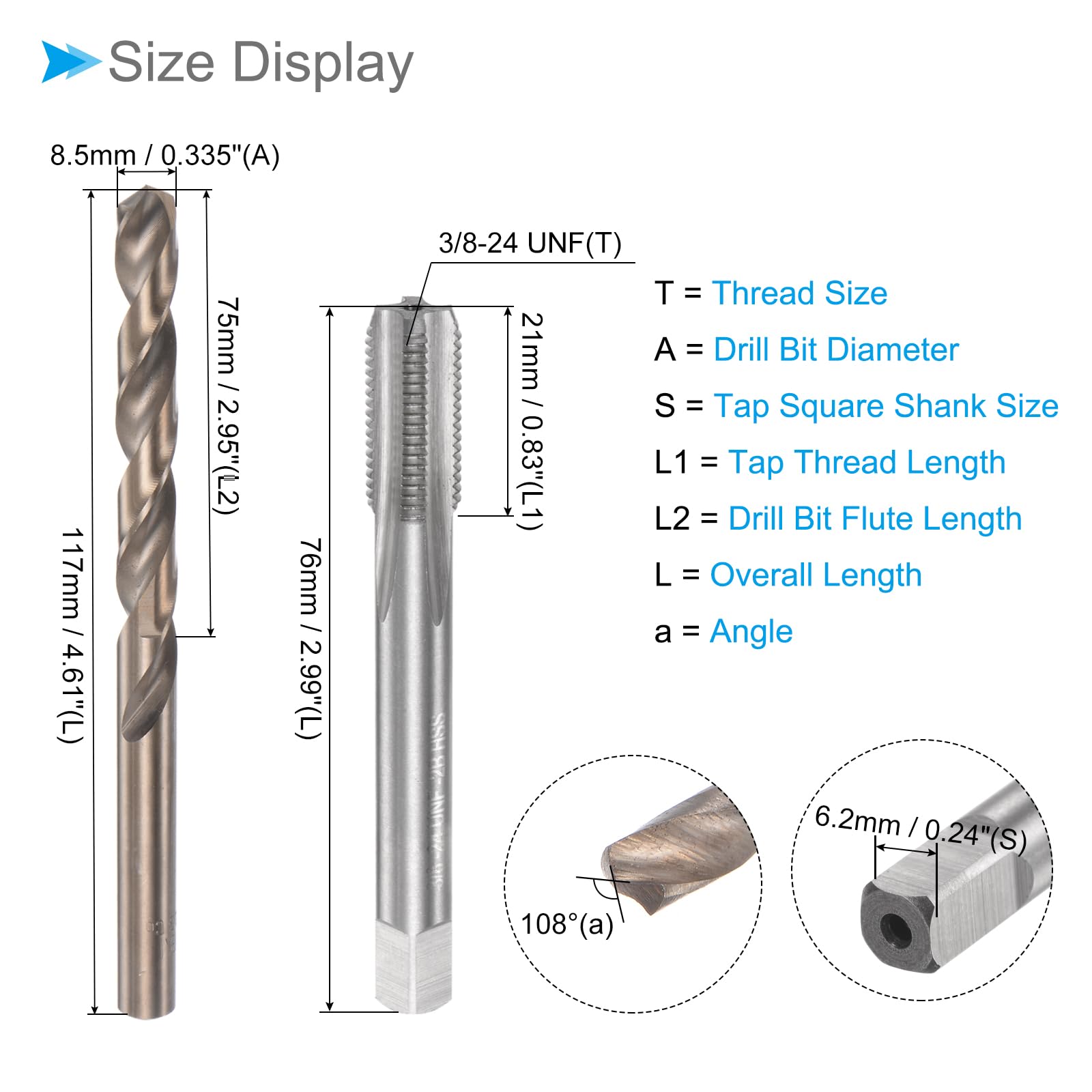
Step 5: The Tapping Process
- Align the Tap: Carefully align the tap with the drilled hole. Ensure it is perfectly perpendicular.
- Start Tapping: Apply gentle downward pressure and begin turning the tap clockwise. Use a tap wrench or a suitable holder.
- Back Off Frequently: For every full turn or half turn of the tap, rotate it counter-clockwise about a quarter turn. This is crucial for breaking the chips formed, preventing them from clogging the flutes, and reducing the risk of tap breakage. This technique is known as “backing out” or “chip breaking.”
- Use Cutting Fluid: Continuously apply cutting fluid throughout the tapping process.
- Feel the Resistance: Pay attention to the feel of the tap. If you encounter excessive resistance, stop immediately, back out the tap, clear the chips, re-lubricate, and try again.
By understanding the technical principles behind thread formation and carefully selecting the correct drill bit size, you can significantly improve the success rate and quality of your tapping operations. Whether you are working with a 3/8 UNC or a 3/8 UNF tap, precision in your preparatory drilling is the foundation for strong, reliable threads.
aViewFromTheCave is a participant in the Amazon Services LLC Associates Program, an affiliate advertising program designed to provide a means for sites to earn advertising fees by advertising and linking to Amazon.com. Amazon, the Amazon logo, AmazonSupply, and the AmazonSupply logo are trademarks of Amazon.com, Inc. or its affiliates. As an Amazon Associate we earn affiliate commissions from qualifying purchases.