
Navigating the complexities of your paycheck can often feel like deciphering a secret code, especially when it comes to the “additional amount withheld.” This seemingly small detail on your Form W-4 holds significant power over your annual tax situation, influencing whether you receive a substantial refund, owe a hefty sum, or land squarely in the sweet spot of accurate tax payments. Understanding what to put for additional withholding isn’t just about avoiding a tax bill; it’s a fundamental aspect of proactive personal financial management, ensuring your money works for you throughout the year, rather than sitting idle with the government or leading to unwelcome surprises.
The goal is to align your total annual tax withholding as closely as possible with your actual tax liability. This isn’t always straightforward, as income, deductions, credits, and life circumstances can fluctuate. Deciding on an additional amount to withhold can be a strategic move to prevent underpayment, manage income from multiple sources, or simply optimize your cash flow. This comprehensive guide will demystify the process, helping you make an informed decision that supports your broader financial goals.
Understanding Your Paycheck Withholding Basics
Before you can effectively decide on an additional withholding amount, it’s crucial to grasp the fundamentals of how your current paycheck withholding is determined. This foundational knowledge empowers you to manipulate the system to your advantage.
The Role of Form W-4
At the core of your federal income tax withholding is Form W-4, Employee’s Withholding Certificate. When you start a new job, or when your financial situation changes, you complete this form to inform your employer how much federal income tax to withhold from each paycheck. The W-4 helps your employer estimate your annual tax liability based on the information you provide, such as your filing status, dependents, other income, and deductions. Step 4(c) of this form is specifically where you can instruct your employer to withhold an additional amount of tax from each paycheck.
Federal Income Tax Withholding
Your employer calculates federal income tax withholding based on the information you provide on your W-4 and IRS tax tables. The more allowances or credits you claim, the less tax is withheld, and vice versa. It’s a delicate balance; too little withheld can lead to owing taxes and potential penalties, while too much withheld means you’re giving the government an interest-free loan throughout the year.
State Income Tax Withholding (If Applicable)
Beyond federal taxes, many states also levy income taxes. If you live in one of these states, you’ll likely complete a separate state withholding form (which may or may not be the same as your federal W-4). The principles are generally similar: you provide information to help your employer calculate state income tax withholding. An additional amount might need to be withheld for state taxes as well, depending on your situation and state rules.
FICA Taxes (Social Security and Medicare)
It’s important to distinguish federal and state income taxes from FICA taxes (Federal Insurance Contributions Act), which fund Social Security and Medicare. These taxes are a fixed percentage of your income (up to a certain limit for Social Security) and are generally not adjustable via your W-4. They are withheld regardless of your withholding elections for income tax.
Why Consider Additional Withholding?
The decision to withhold an additional amount from your paycheck isn’t arbitrary; it’s a strategic move often motivated by specific financial circumstances and tax planning goals.
Avoiding Underpayment Penalties
One of the most common and compelling reasons to increase your withholding is to avoid underpayment penalties from the IRS. If you don’t pay enough tax throughout the year (through withholding or estimated tax payments), you could face a penalty. This often happens to individuals with complex tax situations, significant income from non-W2 sources (like self-employment, investments, or rental properties), or those who experienced a large tax bill in a prior year. The IRS generally requires you to pay at least 90% of your current year’s tax liability or 100% of your previous year’s tax liability (110% for high-income taxpayers) through withholding or estimated payments to avoid a penalty.
Managing Taxable Income from Multiple Sources
If you have multiple sources of income—such as a side hustle, a second job, investment income (dividends, capital gains), or pension distributions—your primary employer’s withholding might not adequately cover your total tax liability. Each income source might be withheld at a lower rate, assuming it’s your only income, leading to significant under-withholding when all incomes are combined. An additional withholding amount on your main paycheck can help balance this out.
Anticipating Major Life Changes
Life events can dramatically impact your tax situation. Getting married, getting divorced, having a child, purchasing a home, or your spouse starting or stopping work can all alter your deductions, credits, and overall tax liability. Proactively adjusting your withholding, including adding an additional amount, can prevent surprises at tax time. For instance, if you get married and both spouses work, you might need to increase withholding if you previously each filled out your W-4 as if you were single.
Personal Preference for a Smaller Refund (or Owing Less)
Some individuals prefer to avoid a large tax refund. While a refund might feel like a bonus, it essentially means you’ve overpaid your taxes throughout the year, lending the government your money interest-free. By adjusting your additional withholding, you can aim for a smaller refund, or even owe a small amount, keeping more of your money in your pocket during the year to save, invest, or spend. Conversely, if you prefer not to owe taxes at all, increasing your withholding can be a way to ensure you’ve covered your bases.
Meeting Specific Financial Goals
While not the primary purpose, some individuals might use additional withholding as a form of “forced savings” to ensure they have enough set aside for estimated tax payments or to meet a specific financial obligation, though generally other savings methods are more financially sound for earning interest.
How to Determine the Right Additional Amount
Accurately determining the right additional amount to withhold is critical. It involves a bit of projection and utilizing available tools.
Review Your Previous Year’s Tax Return
Your most recent tax return is an excellent starting point. Look at your total tax liability for the year (Line 24 on Form 1040) and compare it to the total amount of federal income tax withheld from your paychecks (Line 25a) plus any estimated tax payments made. If you owed a significant amount, you likely need to increase your withholding. If you received a large refund, you might have withheld too much. This historical data gives you a baseline for adjustment.

Utilize the IRS Tax Withholding Estimator
The IRS Tax Withholding Estimator tool (available on the IRS website) is arguably the most powerful resource for this task. It’s free, anonymous, and relatively easy to use. You’ll need information from your most recent pay stubs, a copy of your last year’s tax return (Form 1040), and details about any other income or deductions you anticipate for the current year. The estimator walks you through a series of questions and then provides a personalized recommendation for how to fill out your W-4, including the precise additional amount to withhold from each paycheck to hit your target (e.g., small refund, small amount owed).
Account for Significant Income Changes
If you expect a substantial increase or decrease in your income this year (e.g., a raise, a bonus, starting a second job, or losing a job), these changes must be factored in. A higher income usually means a higher tax bracket and more tax liability. Similarly, if you anticipate significant capital gains from investments or other taxable income not subject to regular withholding, you’ll need to increase your additional amount to cover these taxes.
Factor in Deductions and Credits
While the W-4 has sections for itemized deductions and tax credits, sometimes an additional withholding amount is needed if you expect fewer deductions or credits than last year, or if your W-4 deductions don’t perfectly capture your situation. For instance, if you previously claimed a significant child tax credit that you no longer qualify for, your withholding might need to increase.
Consider Your Filing Status and Dependents
Ensure your filing status (Single, Married Filing Separately, Married Filing Jointly, Head of Household, Qualifying Widow(er)) and the number of qualifying dependents are accurate on your W-4. Any changes to these can significantly alter your tax liability and, consequently, the additional amount you need to withhold.
The “Sweet Spot”: Aim for Accuracy
The ideal scenario is for your total withholding and payments to be very close to your actual tax liability. A small refund ($100-$300) indicates good accuracy, as does owing a small amount at tax time. A large refund means you’ve given the government an interest-free loan, and a large amount owed could result in penalties. The IRS estimator helps you find this sweet spot.
Implementing and Adjusting Your Additional Withholding
Once you’ve determined the ideal additional amount, the next steps involve implementing it and understanding that it’s not a set-it-and-forget-it task.
Completing Form W-4
To implement an additional withholding amount, you will need to submit a new Form W-4 to your employer. Locate Step 4(c) on the form, titled “Extra withholding.” Here, you will enter the specific dollar amount you wish your employer to withhold in addition to the tax calculated from the rest of your W-4 entries, per paycheck. Make sure this is the amount per pay period, not the annual amount.
Submitting to Your Employer
Once you’ve completed and signed the updated W-4, submit it to your employer’s HR or payroll department. They are responsible for processing this change and adjusting your future paychecks accordingly.
Monitoring Your Pay Stubs
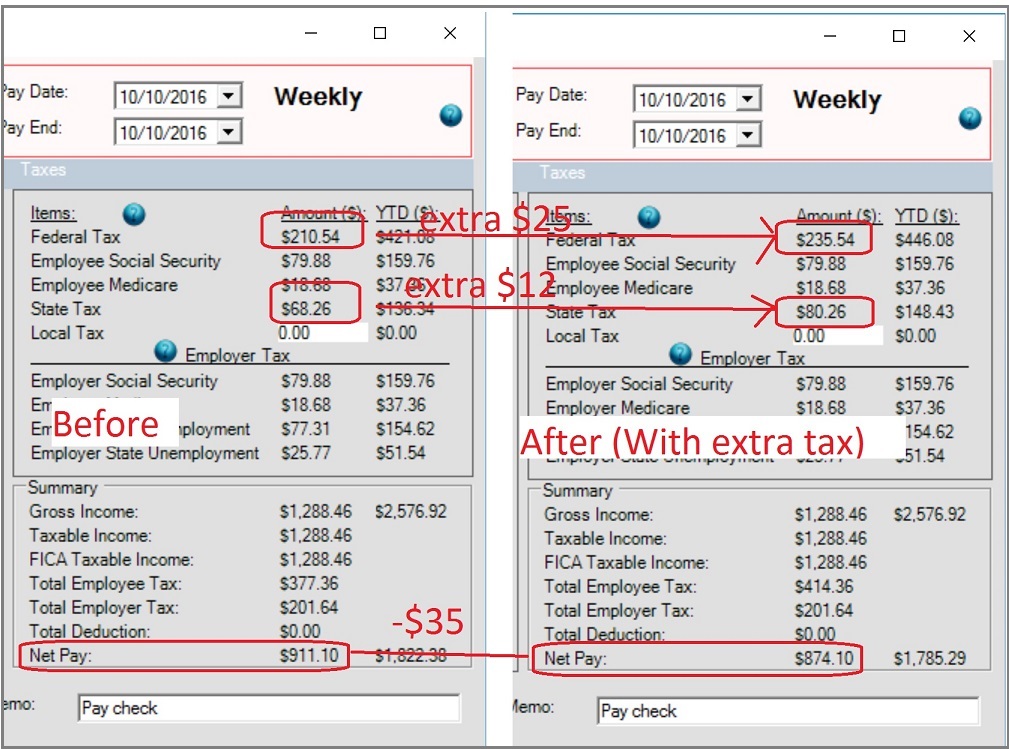
After submitting your new W-4, it’s crucial to review your subsequent pay stubs. Check the “federal income tax” or “federal withholding” line item to ensure the additional amount you specified has been applied correctly. It might take one or two pay cycles for the change to take effect.
When to Revisit Your W-4
Your W-4 is not a static document. Life events, changes in income, or shifts in tax law warrant revisiting and potentially updating your withholding. Common triggers include:
- Marriage or divorce
- Birth or adoption of a child
- Purchasing a home
- Changes in income (e.g., new job, raise, second job, significant bonus)
- Significant changes in deductible expenses
- Major investment gains or losses
- At least annually, ideally at the end of the year or beginning of the new year, to ensure your withholding is on track for the upcoming tax year.
The Impact of Too Much Additional Withholding
While it might seem safe to err on the side of caution and withhold extra, over-withholding has its drawbacks. The main one is that you’re essentially lending money to the government for free. That money could have been earning interest in a savings account, invested for growth, or used to pay down high-interest debt throughout the year. While a large refund can feel good, it often signifies missed opportunities for financial optimization.
Common Misconceptions and Best Practices
Finally, let’s address some prevailing myths and reinforce the best practices for managing your tax withholding.
Myth: A Large Refund is Good
Many taxpayers view a large tax refund as a positive outcome. In reality, a large refund simply means you’ve significantly overpaid your taxes throughout the year. While it might feel like a windfall, it represents money that could have been in your possession, earning interest or contributing to your financial goals. The financially savvy approach is to aim for a refund that is minimal, or even to owe a small amount.
Myth: You Can’t Change Your W-4 Mid-Year
This is incorrect. You can update your Form W-4 at any point during the year whenever your personal or financial situation changes. It’s a dynamic tool designed to be adjusted as needed to ensure accurate withholding.
Best Practice: Annual Review
Make it a habit to review your tax withholding at least once a year. The end of the year, or early in the new year before your first paycheck of the new tax year, is an ideal time. Use your previous year’s tax return and the IRS Tax Withholding Estimator to project your current year’s liability and make any necessary adjustments.

Best Practice: Seek Professional Advice
If your financial situation is particularly complex, or if you’re unsure about how to accurately complete your W-4, consider consulting a qualified tax professional. They can provide personalized guidance and help you optimize your withholding strategy.
In conclusion, understanding what to put for the additional amount withheld from your paycheck is more than just a tax compliance task; it’s a vital component of sound personal financial planning. By proactively managing your W-4 and utilizing available resources like the IRS Tax Withholding Estimator, you can ensure your tax payments are accurate, avoid penalties, and keep more of your hard-earned money working for you throughout the year. Take the time to get it right – your financial well-being depends on it.
aViewFromTheCave is a participant in the Amazon Services LLC Associates Program, an affiliate advertising program designed to provide a means for sites to earn advertising fees by advertising and linking to Amazon.com. Amazon, the Amazon logo, AmazonSupply, and the AmazonSupply logo are trademarks of Amazon.com, Inc. or its affiliates. As an Amazon Associate we earn affiliate commissions from qualifying purchases.