
Understanding what a $20 an hour wage translates to in terms of annual salary, and more importantly, what it means for your personal finances, is a fundamental step in financial planning. While the raw mathematical conversion is straightforward, the true value of $20 an hour is influenced by a myriad of factors including taxes, cost of living, and individual financial decisions. This article delves into the comprehensive financial landscape of earning $20 an hour, offering insights into budgeting, deductions, and strategies for financial growth.
The Raw Numbers: Annualizing a $20/Hour Wage
At its core, calculating an annual salary from an hourly wage requires a simple multiplication, but it’s crucial to understand the assumptions behind these figures and the distinctions that matter for your financial reality.
Standard Full-Time Calculation
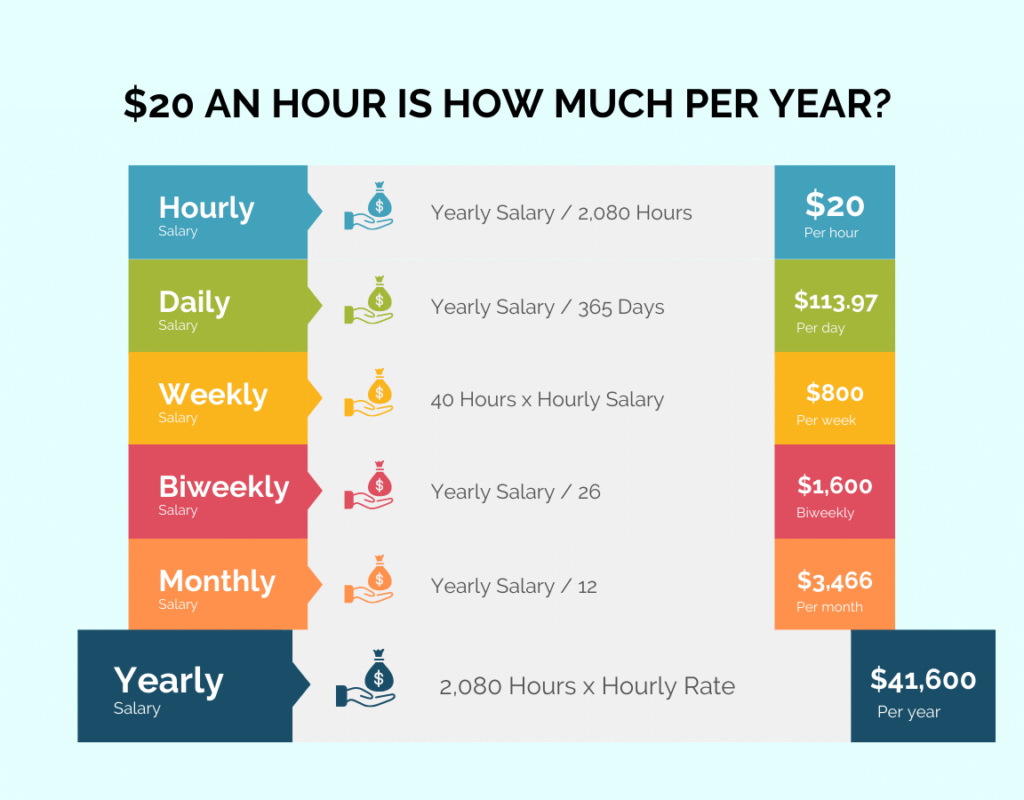
The most common calculation assumes a full-time work schedule. A standard full-time work week consists of 40 hours. Most employers operate on a 52-week annual cycle. Therefore, the gross annual salary for someone earning $20 an hour under these conditions is calculated as follows:
$20/hour * 40 hours/week = $800/week
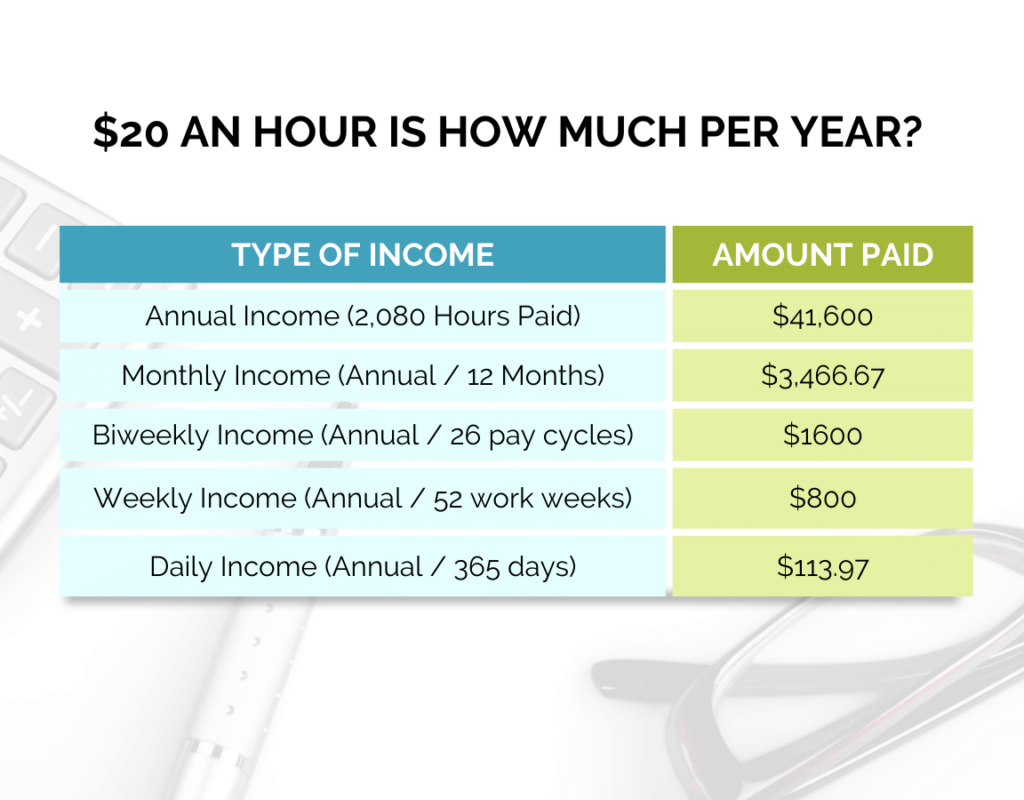
$800/week * 52 weeks/year = $41,600/year
So, a full-time employee earning $20 an hour can expect a gross annual salary of $41,600. On a monthly basis, this equates to approximately $3,466.67 ($41,600 / 12 months). This figure represents your gross income, meaning the total amount earned before any deductions are taken out.
Accounting for Variations
While the 40-hour, 52-week standard is common, real-world work schedules can vary significantly.
- Overtime: If you consistently work more than 40 hours a week, and your employer pays time-and-a-half for overtime (1.5 times your regular rate), your actual annual income will be higher. For example, working 50 hours a week with 10 hours of overtime would mean: (40 hours * $20/hour) + (10 hours * $30/hour) = $800 + $300 = $1,100/week, leading to an annual gross of $57,200.
- Part-Time Work: Conversely, working less than 40 hours a week will result in a lower annual income. A 20-hour work week at $20 an hour would yield $20,800 annually ($20 * 20 * 52).
- Unpaid Leave or Seasonal Work: Jobs with significant unpaid leave, seasonal layoffs, or inconsistent hours will also impact the total annual income, often making the fixed $41,600 figure an overestimation. It’s essential to consider your actual working hours over a year for a more accurate projection.
Gross vs. Net Income: A Critical Distinction
The $41,600 figure is a gross salary. This is the amount before taxes and other deductions are applied. Many individuals mistakenly budget based on their gross income, leading to financial shortfalls. Your “take-home pay” or net income is what you actually receive in your bank account, and it will be considerably lower than your gross income due to mandatory and voluntary deductions. Understanding this distinction is paramount for effective financial planning and budgeting.
Deconstructing Your Take-Home Pay: Taxes and Deductions
The journey from your gross annual salary of $41,600 to your actual take-home pay involves navigating a complex web of taxes and other deductions. These deductions can significantly reduce the amount of money you have available for living expenses and savings.
Federal and State Income Taxes
The largest portion of deductions typically comes from income taxes.
- Federal Income Tax: The U.S. federal income tax system is progressive, meaning higher earners pay a larger percentage of their income in taxes. For a $41,600 gross salary, you’ll fall into certain tax brackets, but the exact amount withheld depends on your filing status (single, married filing jointly, head of household) and the allowances you claim on your W-4 form. For 2023, a single filer earning $41,600 would likely be subject to the 10% and 12% marginal tax rates, meaning only portions of their income are taxed at each rate. For example, the first $11,000 might be taxed at 10%, and the remainder up to $44,725 at 12%.
- State Income Tax: In addition to federal taxes, most states also impose an income tax. The rates and structures vary widely, from states with no income tax (e.g., Florida, Texas, Washington, Nevada, Wyoming, South Dakota, Alaska) to those with high progressive rates (e.g., California, New York). A person earning $20 an hour in a state like California will have a significantly lower take-home pay than someone in Texas, purely due to state taxes.
Payroll Taxes (FICA)
These are mandatory contributions to specific federal programs:
- Social Security: This tax funds retirement, disability, and survivor benefits. Employees currently contribute 6.2% of their earnings up to an annual limit ($168,600 for 2024). For a $41,600 salary, this amounts to $2,579.20 annually.
- Medicare: This tax funds health insurance for seniors and some people with disabilities. Employees currently contribute 1.45% of all earned income, with no upper limit. For a $41,600 salary, this amounts to $603.20 annually.
Combined, FICA taxes represent 7.65% of your gross pay, totaling approximately $3,182.40 for $41,600.
Other Common Deductions
Beyond taxes, several other deductions can impact your net pay:
- Health Insurance Premiums: If your employer offers health insurance, your share of the premium is often deducted directly from your paycheck, usually pre-tax, which slightly reduces your taxable income. The cost can range from minimal to several hundred dollars per month depending on the plan and coverage.
- Retirement Contributions: If you contribute to a 401(k) or similar employer-sponsored retirement plan, these contributions are typically deducted pre-tax, reducing your current taxable income and helping you save for retirement.
- Other Pre-Tax Benefits: This can include contributions to a Flexible Spending Account (FSA) or Health Savings Account (HSA), commuter benefits, or life insurance premiums.
- Union Dues: If applicable, union membership dues are also deducted.
Estimating Your Net Income
Given these deductions, estimating your net income becomes crucial. While exact figures vary by state and individual circumstances (like dependents), a reasonable estimate for someone earning $41,600 annually might see their gross income reduced by 15% to 25% or even more, depending on state taxes and benefit elections. For example, if total deductions amount to 20%, your take-home pay would be around $33,280 annually, or approximately $2,773 per month. This is the figure you should use for your personal budget.
Budgeting and Lifestyle on $20 an Hour
Living on a $20 an hour wage, which translates to a gross annual income of $41,600 (or roughly $33,000 net after deductions), requires careful financial planning and a clear understanding of your expenses. The feasibility and comfort of this income level are heavily influenced by your cost of living and lifestyle choices.
The 50/30/20 Rule Applied
A popular budgeting framework, the 50/30/20 rule, suggests allocating your after-tax income as follows:
- 50% for Needs: Essential expenses like housing, utilities, groceries, transportation, and healthcare. For a monthly net income of $2,773, this means approximately $1,386.50.
- 30% for Wants: Discretionary spending such as dining out, entertainment, hobbies, and personal shopping. This would be around $831.90.
- 20% for Savings & Debt Repayment: Building an emergency fund, saving for retirement, and paying down high-interest debt. This equates to about $554.60.
This rule provides a solid starting point, but its applicability can vary significantly based on individual circumstances and, most importantly, location.
Major Expense Categories
Let’s break down how a $20/hour income might cover typical expenses:
- Housing: This is often the largest expense. Rent for a modest apartment (studio or one-bedroom) can range from under $800 in low-cost areas to over $1,500 in moderate-cost areas, and well over $2,000 in high-cost cities. If your housing costs exceed the 50% “needs” allocation, it puts severe pressure on other categories. Shared living situations or living in less expensive surrounding areas often become necessities.
- Transportation: Car payments, insurance, gas, and maintenance can easily consume several hundred dollars a month. Public transport, carpooling, or living within walking/biking distance of work can be significant cost-savers.
- Food: Groceries and dining out can vary. A strict grocery budget might be $300-$400 per month for one person, but eating out frequently can quickly double or triple this.
- Utilities: Electricity, gas, water, internet, and cell phone bills typically add up to $200-$400 per month.
- Healthcare: Even with employer-sponsored insurance, co-pays, deductibles, and prescription costs can be unpredictable.
- Other Necessities: Personal care, clothing, and other miscellaneous items also need to be factored in.
The Impact of Location
The most critical factor influencing the viability of a $20/hour wage is the cost of living in your geographic area.
- High-Cost Areas (e.g., major cities like NYC, San Francisco, Boston): Earning $20 an hour in these cities can be extremely challenging, often requiring multiple jobs, roommates, or significant financial assistance. Housing alone can easily consume 70-80% of your net income, leaving very little for other essentials, let alone savings or wants.
- Moderate-Cost Areas (e.g., many suburban areas or mid-sized cities): A $20/hour wage can provide a comfortable, though not luxurious, lifestyle. You might be able to afford a small apartment, cover basic expenses, and even save a modest amount, especially if you’re diligent with budgeting.
- Low-Cost Areas (e.g., rural areas or smaller towns): In these regions, $20 an hour can offer a relatively good standard of living. Housing is more affordable, and general expenses are lower, allowing for more disposable income and greater opportunities for savings and financial growth.
Realistic Expectations and Adjustments
It’s crucial to set realistic expectations. For many, $20 an hour will necessitate careful financial management, prioritization, and potentially sacrifices in discretionary spending. If living in a high-cost area, adapting your lifestyle, such as sharing housing, minimizing transportation costs, cooking at home, and seeking affordable entertainment, becomes paramount. Regular budget reviews and adjustments are essential to ensure you are living within your means and making progress towards your financial goals.
Maximizing Your Financial Potential at $20 an Hour
Earning $20 an hour is a solid starting point for many careers, but it also presents an opportunity to build a strong financial foundation and plan for future growth. Through strategic saving, debt management, and income enhancement, you can significantly improve your financial standing.
Building an Emergency Fund
The first and most critical step in securing your financial health is establishing an emergency fund. This fund should ideally cover 3 to 6 months’ worth of essential living expenses (rent, utilities, food, transportation). For someone with a net income of $2,773/month and essential needs of $1,386.50 (following the 50/30/20 rule), a 3-month emergency fund would be approximately $4,159.50. This money should be kept in an easily accessible, high-yield savings account, separate from your checking account. An emergency fund acts as a crucial buffer against unexpected job loss, medical emergencies, or large unplanned expenses, preventing you from falling into debt.
Debt Management Strategies
If you have high-interest debt, such as credit card balances or personal loans, prioritizing their repayment is essential. The interest accruing on these debts can quickly erode your income and hinder your ability to save.
- Debt Avalanche Method: Pay off the debt with the highest interest rate first, while making minimum payments on all other debts. Once the highest-interest debt is cleared, move to the next highest. This method saves you the most money on interest.
- Debt Snowball Method: Focus on paying off the smallest debt first, regardless of interest rate, while making minimum payments on others. Once that debt is paid, roll the amount you were paying into the next smallest debt. This method provides psychological wins and motivation.
Consider consolidating high-interest debts into a lower-interest personal loan or a balance transfer credit card (if eligible and disciplined) to reduce your overall interest payments.
Exploring Supplementary Income Streams
To accelerate savings or better cope with a high cost of living, consider generating additional income.
- Side Hustles: Leverage existing skills or learn new ones to earn extra money. Examples include freelancing (writing, graphic design, web development), dog walking, pet sitting, tutoring, ride-sharing, food delivery, or selling handmade goods online.
- Gig Economy: Platforms like Upwork, Fiverr, TaskRabbit, or DoorDash offer flexible opportunities to earn income on your own schedule.
- Part-Time Work: Picking up extra shifts or a second part-time job can significantly boost your annual income, turning $20 an hour into a more substantial sum.
Investing for the Future
Even at $20 an hour, it’s never too early to start investing for retirement. The power of compound interest means that money invested early grows exponentially over time.
- Employer-Sponsored Retirement Plans (e.g., 401(k)): If your employer offers a 401(k) with a matching contribution, contribute at least enough to get the full match. This is essentially free money and provides an immediate return on your investment.
- Individual Retirement Accounts (IRAs): Consider opening a Roth IRA or Traditional IRA. Roth IRAs allow after-tax contributions that grow tax-free and are withdrawn tax-free in retirement, making them excellent for those who expect to be in a higher tax bracket later in life.
- Automate Savings: Set up automatic transfers from your checking account to your savings or investment accounts each payday. This “pay yourself first” strategy ensures you’re consistently saving before you have a chance to spend the money.

Upskilling and Career Advancement
Perhaps the most impactful long-term strategy is to increase your hourly rate.
- Professional Development: Seek opportunities to gain new skills, certifications, or specialized training relevant to your field. Many employers offer tuition reimbursement or professional development programs.
- Networking: Build relationships with colleagues and professionals in your industry. Networking can open doors to new opportunities, mentorship, and career advancement.
- Performance Reviews and Raises: Actively prepare for performance reviews. Document your achievements and contributions to demonstrate your value, and be prepared to negotiate for a raise that reflects your improved skills and market value.
- Job Hopping: Sometimes, the fastest way to increase your salary is by seeking new employment with a different company that offers higher pay for similar roles or opportunities for advancement.
By diligently applying these financial strategies, earning $20 an hour can be a launching pad for long-term financial stability and growth, rather than just a means to cover immediate expenses.
aViewFromTheCave is a participant in the Amazon Services LLC Associates Program, an affiliate advertising program designed to provide a means for sites to earn advertising fees by advertising and linking to Amazon.com. Amazon, the Amazon logo, AmazonSupply, and the AmazonSupply logo are trademarks of Amazon.com, Inc. or its affiliates. As an Amazon Associate we earn affiliate commissions from qualifying purchases.