
Radio, at its core, is a marvel of technology that enables us to transmit information wirelessly across vast distances. It leverages electromagnetic waves to carry sounds, data, and signals through the air, across space, and even through certain materials, connecting individuals and systems without the need for physical cables. Far more than just the device in your car or home, “radio” encompasses an intricate system of principles, components, and applications that have fundamentally reshaped modern communication, navigation, and entertainment. From its groundbreaking origins to its ubiquitous presence in today’s hyper-connected world, understanding what radio is means appreciating its foundational role in the digital age and its continuous evolution.
The Fundamental Principles of Radio Communication
To grasp the essence of radio, one must first understand the scientific bedrock upon which it stands. Radio communication is built upon a sophisticated interplay of physics and engineering, transforming intangible waves into meaningful information.
Electromagnetic Waves and Their Propagation
The heart of radio technology lies in electromagnetic waves. These waves are a form of energy that oscillates and propagates through space at the speed of light, comprising oscillating electric and magnetic fields perpendicular to each other and to the direction of energy propagation. Unlike sound waves, electromagnetic waves do not require a medium to travel; they can traverse the vacuum of space, which is why we can receive signals from satellites and celestial bodies. Different frequencies within the electromagnetic spectrum correspond to different types of waves, from very low frequency (VLF) waves used for submarine communication to extremely high frequency (EHF) waves employed in satellite communication and radar. Radio waves occupy a specific portion of this spectrum, typically ranging from 3 kHz to 300 GHz.
Modulation and Demodulation: Encoding Information
The raw electromagnetic wave itself doesn’t carry information; it’s merely a carrier. To embed intelligence – whether voice, music, or data – onto this carrier wave, a process called modulation is employed. Modulation involves systematically varying one or more properties of the carrier wave (amplitude, frequency, or phase) in accordance with the message signal.
- Amplitude Modulation (AM) varies the strength (amplitude) of the carrier wave while keeping its frequency constant.
- Frequency Modulation (FM) varies the frequency of the carrier wave while keeping its amplitude constant.
- Phase Modulation (PM) varies the phase of the carrier wave, often used in digital communication.
At the receiving end, the reverse process, demodulation, extracts the original message signal from the modulated carrier wave. This allows the receiver to interpret the information that was encoded by the transmitter.
Transmitters and Receivers: The Core Components
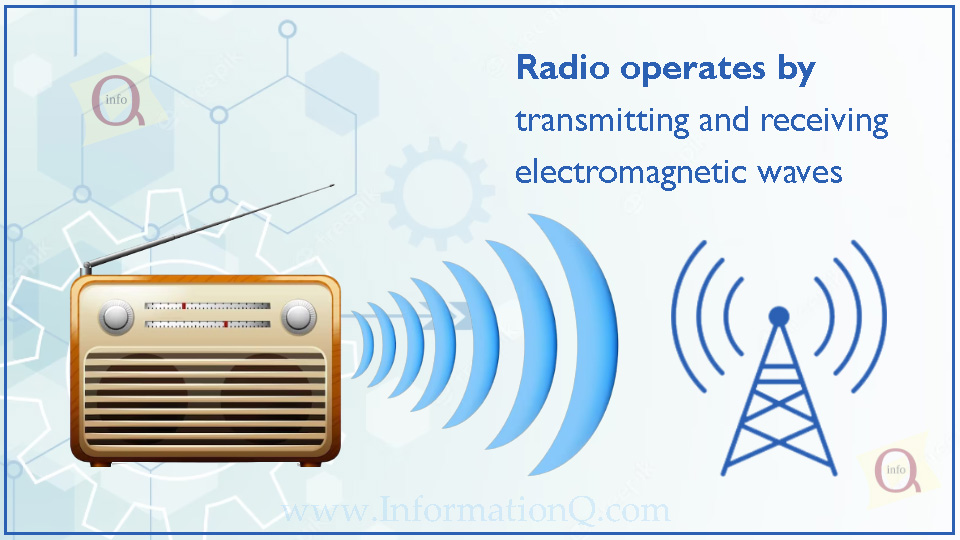
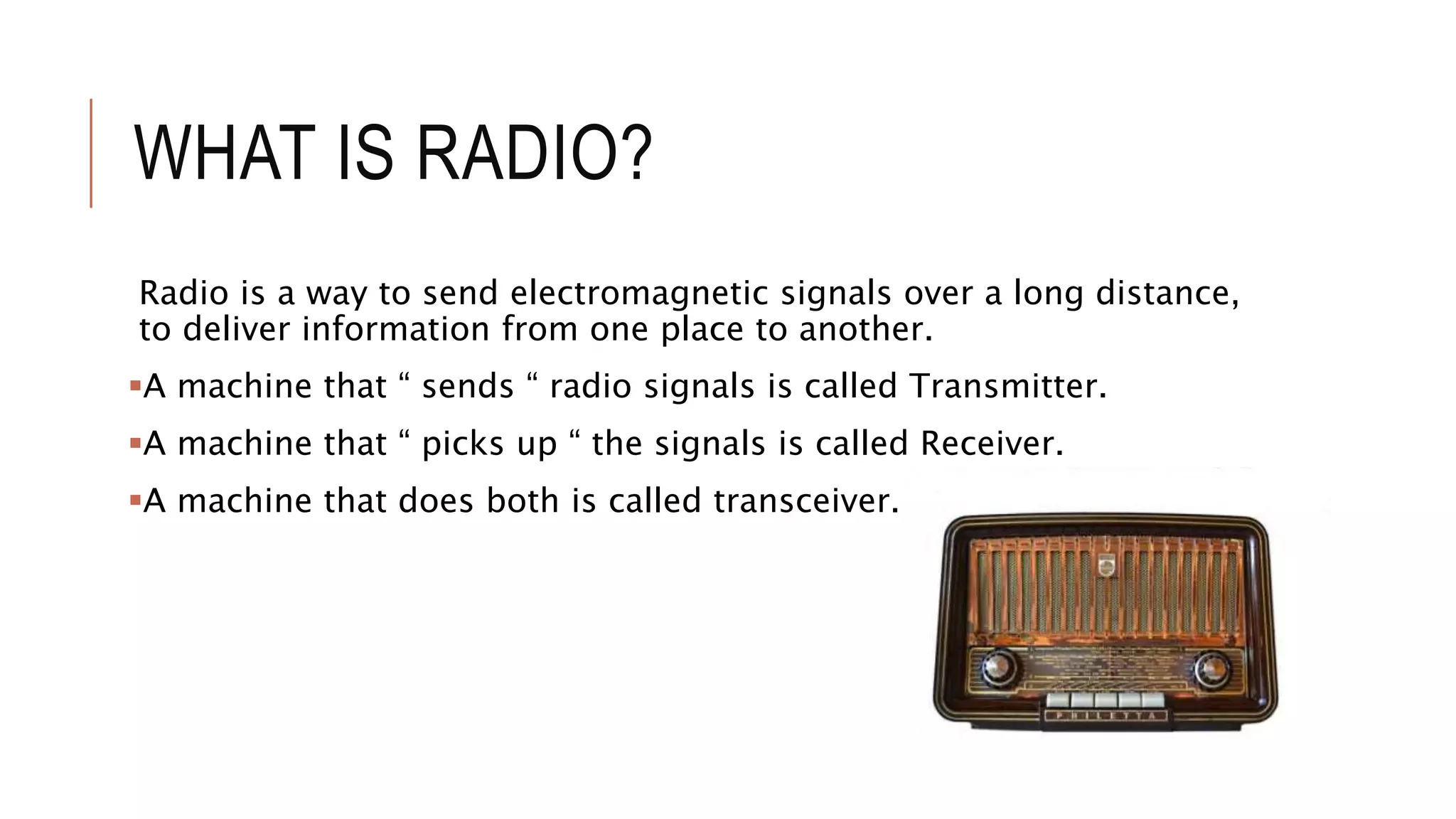
Every radio communication system consists of at least two primary components: a transmitter and a receiver.
- A transmitter takes the information signal, modulates it onto a high-frequency carrier wave, amplifies the resulting modulated wave, and sends it to an antenna. The antenna then converts the electrical signal into electromagnetic waves, which radiate into space.
- A receiver performs the inverse function. Its antenna captures the electromagnetic waves, converting them back into electrical signals. These signals are then amplified and passed through a demodulator, which extracts the original information. Filters are crucial to select the desired frequency and reject interference from other signals, allowing you to tune into a specific radio station or communication channel.
A Brief History of Radio: From Spark Gaps to Global Networks
The journey of radio is a testament to human ingenuity, spanning over a century of scientific discovery and technological innovation. Its evolution has consistently pushed the boundaries of what’s possible in wireless connectivity.
Early Pioneers and Discoveries
The theoretical foundation for radio was laid in the mid-19th century by James Clerk Maxwell, who predicted the existence of electromagnetic waves. Heinrich Hertz experimentally confirmed these predictions in the late 1880s, demonstrating the generation and reception of radio waves. However, it was Guglielmo Marconi who, building upon the work of many predecessors, successfully developed practical radio telegraphy in the 1890s, culminating in the first transatlantic wireless transmission in 1901. His work effectively birthed the era of practical wireless communication, proving that information could travel without wires across vast oceans.
The Golden Age of Broadcast Radio
The early 20th century saw rapid advancements. The invention of the vacuum tube enabled amplification and continuous wave transmission, paving the way for voice and music broadcasts. The 1920s ushered in the “Golden Age of Radio,” with the proliferation of radio stations and receivers in homes worldwide. Radio became a central source of news, entertainment, and cultural connection, uniting communities and even nations through shared listening experiences. It transcended geographical barriers, bringing live events, dramas, and music directly into people’s living rooms.
Evolution into Modern Wireless Technologies
While broadcast radio remained popular, the underlying principles of radio technology continued to evolve. World Wars spurred significant innovation in radar, encrypted communication, and navigation systems. Post-war, the transistor revolutionized electronics, leading to smaller, more efficient radio devices. The advent of satellite communication in the latter half of the 20th century dramatically expanded the reach and capacity of radio, enabling global telephony, television broadcasting, and the foundation for modern internet connectivity. Every subsequent wireless technology – from cellular phones to Wi-Fi and Bluetooth – is a direct descendant of these early radio innovations.
Diverse Applications of Radio Technology Today
Far from being a relic of the past, radio technology is deeply embedded in the fabric of modern life, underpinning an astonishing array of critical applications that often go unnoticed.
Broadcast Media: AM, FM, and Digital Radio
The most recognizable application of radio remains broadcast media. AM (Amplitude Modulation) radio, known for its long-distance reach and susceptibility to atmospheric interference, provides news, talk shows, and music. FM (Frequency Modulation) radio, with its superior sound quality and resistance to static, dominates music and local programming. More recently, Digital Radio Broadcasting (DRB) standards like DAB (Digital Audio Broadcasting) and HD Radio offer CD-quality sound, more stations on the same spectrum, and additional data services like song titles and weather information, merging traditional broadcast with digital clarity.
Telecommunications: Cellular, Wi-Fi, and Satellite
Beyond entertainment, radio waves are the invisible backbone of modern telecommunications. Cellular networks use radio frequencies to connect mobile phones to base stations, forming the global mobile communication grid. Wi-Fi (Wireless Fidelity) utilizes specific radio frequencies to enable high-speed local area networking, connecting devices to the internet without cables. Satellite communication relies on powerful radio transceivers in orbit to relay signals across continents, facilitating everything from intercontinental phone calls to remote sensing and global positioning systems.
Navigation and Remote Sensing: GPS, Radar, and IoT
Radio technology is indispensable for precise navigation and sensing. The Global Positioning System (GPS), a constellation of satellites, transmits radio signals that allow receivers on Earth to pinpoint their exact location. Radar (Radio Detection and Ranging) uses radio waves to detect objects, measure their range, and determine their speed and direction, critical for air traffic control, weather forecasting, and military applications. Furthermore, the burgeoning Internet of Things (IoT) extensively employs short-range radio technologies like Bluetooth, RFID (Radio-Frequency Identification), and Zigbee to connect a vast network of smart devices, sensors, and actuators, enabling smart homes, industrial automation, and health monitoring.
Emergency Services and Scientific Exploration
Critical public safety operations heavily rely on radio. Two-way radio communication is vital for police, fire departments, and emergency medical services, providing instant and reliable communication in crisis situations. In science, radio astronomy uses large radio telescopes to detect cosmic radio waves, offering insights into distant galaxies, black holes, and the origins of the universe, unveiling aspects of the cosmos invisible to optical telescopes.
The Digital Transformation of Radio
The digital revolution has profoundly reshaped radio, moving it beyond analog signals into a realm of higher fidelity, greater efficiency, and unparalleled flexibility.
The Rise of Digital Audio Broadcasting (DAB)
Digital Audio Broadcasting (DAB) represents a significant leap from traditional AM/FM. It converts audio signals into a digital format before transmission, offering improved sound quality, reduced interference, and more efficient use of spectrum. This efficiency allows broadcasters to offer multiple programs (or “ensembles”) within the bandwidth previously occupied by a single analog station, leading to a wider choice for listeners and new data services. DAB, and its enhanced version DAB+, is prevalent in many parts of Europe, Asia, and Australia.
Internet Radio and Podcasting: On-Demand Audio
The internet has democratized audio distribution, giving rise to internet radio and podcasting. Internet radio streams audio content over the internet, allowing listeners to access thousands of stations globally, often niche or independent, without geographical limitations of traditional broadcast. Podcasting, on the other hand, involves on-demand audio content that listeners can download or stream at their convenience. Both have decoupled audio consumption from real-time broadcasting, offering personalization and an unprecedented breadth of content, challenging the traditional radio model by giving listeners control over what and when they listen.
Software-Defined Radio (SDR) and Cognitive Radio
Software-Defined Radio (SDR) is a radio communication system where components that have been traditionally implemented in hardware (like mixers, filters, modulators, demodulators) are instead implemented by means of software on a personal computer or embedded system. This flexibility allows a single SDR device to tune into a vast range of frequencies and modes, adapting its functionality through software updates rather than hardware changes. Building on SDR, Cognitive Radio (CR) takes this a step further. CR systems are intelligent radios that can sense their operating environment, learn from it, and adapt their transmission parameters (e.g., frequency, power, modulation) dynamically to optimize performance, avoid interference, and efficiently utilize the radio spectrum. These advancements promise a future of highly adaptable, efficient, and intelligent wireless communication systems.
The Future of Radio: Innovation and Interconnectivity
Radio’s journey is far from over. It continues to evolve, adapting to new technological landscapes and user demands, promising even more integrated and personalized experiences.
Convergence with Other Technologies
The future of radio will be characterized by increasing convergence. It will seamlessly integrate with artificial intelligence for personalized content curation, smart home ecosystems for intuitive control, and advanced data analytics for insights into listener preferences. Expect radio to become an even more embedded feature within connected vehicles, smart speakers, and wearables, offering contextual and location-aware content.
Enhanced Accessibility and Personalization
As digital platforms and AI advance, radio will become even more accessible and personalized. Listeners will experience highly tailored content feeds, dynamically generated playlists, and interactive programs that respond to their preferences and moods. Voice interfaces will make interacting with radio content effortless, while augmented reality could overlay audio experiences onto our physical world.

Spectrum Management Challenges and Opportunities
As wireless demand continues to surge, efficient spectrum management remains a critical challenge. The finite nature of radio frequencies necessitates innovative solutions. Cognitive radio, dynamic spectrum access, and advanced modulation techniques will be key to optimizing spectrum utilization, enabling more devices and services to coexist without interference. The push towards 5G and future “G” technologies further underscores the importance of efficient radio spectrum use, as these networks rely heavily on sophisticated radio technologies to deliver ultra-fast, low-latency communication for a truly interconnected world.
In conclusion, “what radio is” extends far beyond simple broadcast; it is a foundational technology that has shaped the modern world, enabling a silent symphony of electromagnetic waves to carry the information that powers our lives. From its scientific inception to its present-day manifestations across diverse applications, radio remains a vibrant, evolving field, continually innovating to connect, inform, and entertain us in ever more sophisticated ways. Its future promises even deeper integration and intelligence, ensuring its continued relevance as an indispensable pillar of global connectivity.
aViewFromTheCave is a participant in the Amazon Services LLC Associates Program, an affiliate advertising program designed to provide a means for sites to earn advertising fees by advertising and linking to Amazon.com. Amazon, the Amazon logo, AmazonSupply, and the AmazonSupply logo are trademarks of Amazon.com, Inc. or its affiliates. As an Amazon Associate we earn affiliate commissions from qualifying purchases.