
The relationship between the United States military and the broader civilian population has shifted significantly over the last several decades. For those interested in macroeconomic trends, labor market dynamics, and the fiscal implications of national defense, understanding the scale of the U.S. Armed Forces in relation to the total population is essential. While military spending remains one of the largest line items in the federal budget—often acting as a massive driver of economic activity and industrial policy—the actual percentage of Americans serving in uniform is historically low.
The Current Statistical Landscape
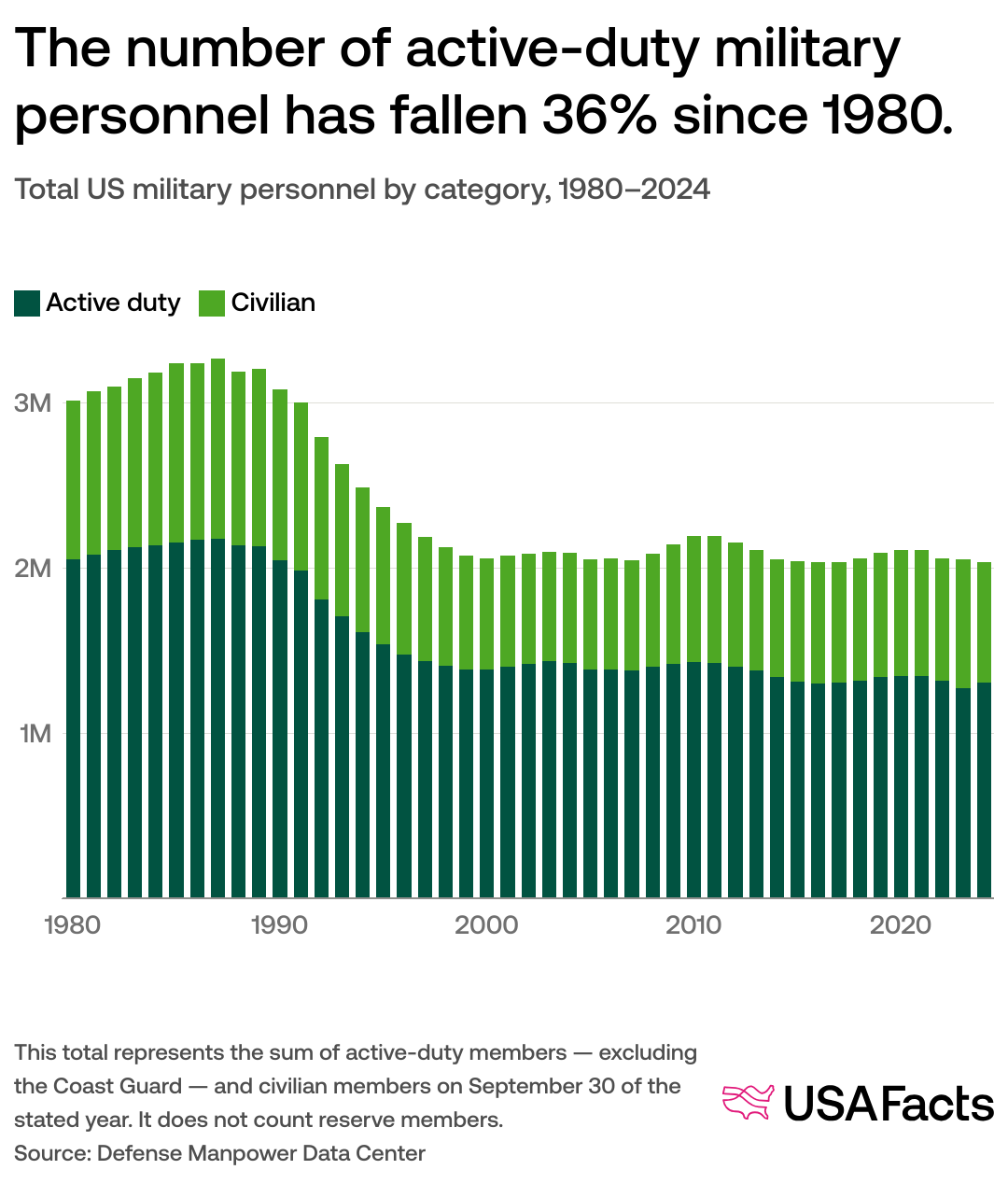
To grasp the current reality, one must look at the raw numbers provided by the Department of Defense and the U.S. Census Bureau. As of recent reporting periods, the total number of active-duty military personnel fluctuates around 1.3 million individuals. When factoring in the National Guard and Reserve components, that number increases to approximately 2.1 million.

When compared against a total U.S. population hovering near 335 million, the math reveals a stark reality: less than 0.7% of the total U.S. population is currently serving in the armed forces. If one narrows the focus strictly to active-duty personnel, that figure drops to roughly 0.4%.
This is a profound shift from the post-World War II era or the height of the Vietnam War, during which the draft and higher mobilization rates meant that a much larger segment of the populace had direct ties to military service. Today, the U.S. military functions as an all-volunteer force, operating as a specialized labor sector that serves as a massive engine for federal spending while engaging a relatively small fraction of the workforce.
The Economic Impact of a Small Standing Force
From a financial perspective, the size of the military does not necessarily correlate linearly with its cost. While the percentage of the population serving is at a historic low, the budgetary footprint remains immense. This creates a unique dynamic where a highly specialized, capital-intensive organization is funded by a tax base that is increasingly detached from the day-to-day operations of that organization.
Defense Spending as a Macroeconomic Driver
The U.S. defense budget, often exceeding $800 billion annually, functions as a massive government stimulus program. Even with a small percentage of the population serving, the secondary economic impact is felt through the “military-industrial complex.” Thousands of private companies—ranging from small-business subcontractors to massive defense conglomerates—derive the entirety or a significant portion of their revenue from Pentagon contracts.
For an investor or financial analyst, the “military size vs. budget” discrepancy is crucial. Because the military is now an all-volunteer force, the government must compete with the private sector for labor. This has led to an increase in compensation, housing allowances, and benefit packages designed to recruit and retain high-skill personnel. These costs are a primary driver of the fiscal budget, proving that a smaller force does not equate to a cheaper one in a modern, technology-driven economy.
The “All-Volunteer” Labor Market
The transition to an all-volunteer force changed the fundamental economics of service. In previous generations, the military was a broad cross-section of the population. Today, it behaves more like a niche labor sector that requires premium compensation to attract talent from a competitive civilian market. This shift has significant implications for how federal funds are allocated, moving away from simple conscript logistics toward high-tech procurement, veteran healthcare, and pension obligations.
The Fiscal Burden: Pensions and Healthcare
One of the most significant long-term financial commitments for the U.S. government is the obligation to those who have served. While the current percentage of the population in the military is low, the cumulative number of veterans and their families entitled to federal benefits represents a massive fiscal liability that impacts long-term national solvency.
The Cost of Retirement and Benefits
The Department of Veterans Affairs (VA) manages a budget that has expanded significantly to keep pace with the healthcare needs of aging veterans and those from more recent conflicts. For investors looking at long-term government debt and fiscal sustainability, the “hidden” cost of the military is not just the hardware—it is the human capital.
When a nation maintains a volunteer military, it commits to a lifetime of benefits for those individuals. Unlike a private corporation that can terminate pension liabilities through bankruptcy or restructuring, the federal government’s commitment to veterans is a perpetual financial obligation. As the percentage of the population in uniform remains static or shrinks, the ratio of retirees to active-duty personnel has profound implications for how tax dollars are distributed.
Productivity and Economic Reintegration
From a personal finance and human capital perspective, the transition from military service to civilian employment is a significant economic event. The military acts as an educational and vocational training pipeline for over 200,000 individuals returning to the workforce annually. The investment the government makes in these individuals—in terms of technical training, leadership development, and higher education through the GI Bill—creates a specific economic impact on the civilian labor force. Understanding the percentage of the population moving through this cycle provides insight into workforce trends in technical and logistics-heavy industries.
Investment Trends and the Defense Sector
For those involved in the financial markets, the discrepancy between the number of people in uniform and the scale of defense spending creates unique investment opportunities. The “size” of the military is measured in personnel, but the “strength” of the sector is increasingly measured in R&D and technological superiority.
Procurement vs. Personnel
Modern defense strategy emphasizes “force multipliers”—the idea that technology can replace headcount. This is why, despite the percentage of the population in the military being low, the defense budget continues to climb. We are seeing a shift from traditional infantry-heavy models to intelligence-driven, automated, and software-integrated systems.
Investors focusing on aerospace, cybersecurity, and artificial intelligence often find that their portfolios are indirectly tied to the U.S. military, even as the number of active-duty soldiers remains at historically low levels. The “Military-Industrial-Technology” nexus is a more accurate way to look at the sector today than the old model of “boots on the ground.”
Managing Fiscal Risk
The reality of a small percentage of the population serving in the military also creates a political and fiscal tension. Because the vast majority of the population does not serve, there is often less direct public oversight of military spending compared to other areas like education or social safety nets. For the investor, this means the defense budget can be more resilient to political fluctuations, though it is always subject to the broader economic constraints of the national debt and rising interest rates.
Conclusion: The New Normal
The fact that less than 1% of the U.S. population is in the military is not a sign of a shrinking national priority; it is a sign of a fundamental evolution in how the nation exercises its power and manages its labor. We have moved from a era of mass mobilization to an era of specialized, high-tech, and high-cost military operations.
For the purposes of personal and business finance, this distinction is everything. It explains why defense budgets remain astronomical despite a smaller military footprint. It explains the intense competition for human capital in the tech sector, which often recruits directly from military ranks. And, perhaps most importantly, it highlights that while the percentage of the population in uniform is low, the fiscal and economic reach of the military remains a dominant force in the American financial landscape. As we look toward the future of government spending and national strategy, the focus will likely remain on technology and efficiency, ensuring that this small percentage of the population remains the most well-funded and technologically advanced workforce in the world.
aViewFromTheCave is a participant in the Amazon Services LLC Associates Program, an affiliate advertising program designed to provide a means for sites to earn advertising fees by advertising and linking to Amazon.com. Amazon, the Amazon logo, AmazonSupply, and the AmazonSupply logo are trademarks of Amazon.com, Inc. or its affiliates. As an Amazon Associate we earn affiliate commissions from qualifying purchases.