
The question “What percentage of the world is the US?” is deceptively simple, yet it opens a Pandora’s Box of comparative metrics. While a direct numerical answer might relate to landmass or population, its true significance emerges when we examine the US’s disproportionate influence and share across crucial global economic and technological landscapes. This article will delve into these percentages, not as mere statistics, but as indicators of the US’s profound impact on the world stage, focusing primarily on the Money and Tech niches, as they are inextricably linked to the US’s global standing.
The US’s Share of the Global Economic Pie
When we talk about “the world,” a significant portion of that is defined by economic output and financial activity. The United States, for decades, has held a dominant position in the global economy, and understanding its percentage share is crucial to grasping its influence.
Gross Domestic Product (GDP): The Cornerstone of Economic Power
The most commonly cited metric for a nation’s economic size is its Gross Domestic Product (GDP). This represents the total monetary value of all the finished goods and services produced within a country’s borders in a specific time period.
Nominal GDP: The Dollar Value of Influence
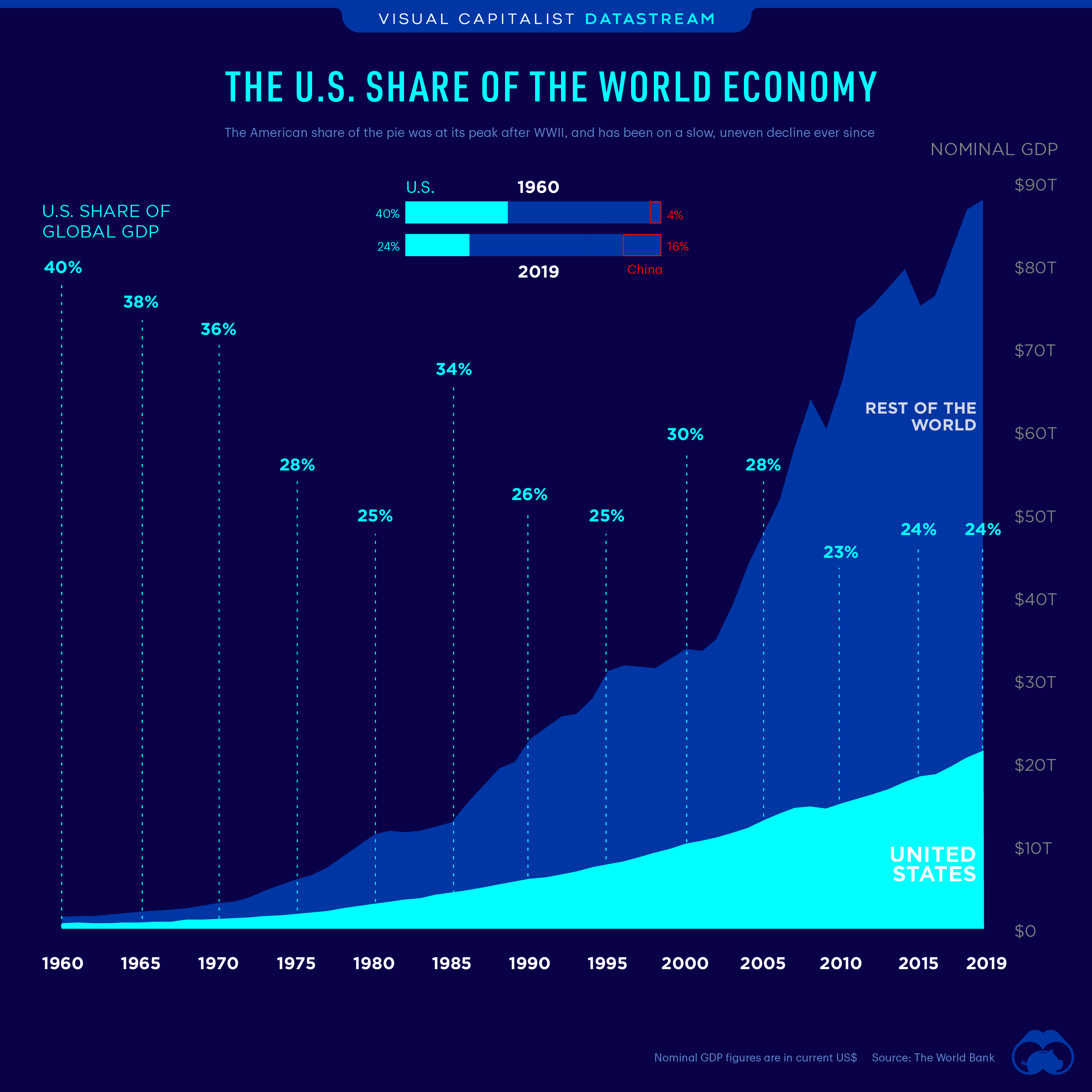
In terms of nominal GDP, the United States consistently ranks as the largest economy in the world. As of recent data, the US accounts for approximately 24-25% of the global nominal GDP. This means that nearly a quarter of all the economic value generated worldwide is produced within the United States. This figure has fluctuated over the years but has remained remarkably high, underscoring the sheer scale of American consumption, production, and innovation.
This dominance translates into significant purchasing power on a global scale. US consumers, businesses, and government entities are major importers and investors, influencing supply chains and economic growth in other nations. Companies worldwide often tailor their products and strategies to cater to the American market, recognizing its immense potential.
Purchasing Power Parity (PPP) GDP: A More Nuanced View
While nominal GDP provides a snapshot of economic size in current market exchange rates, Purchasing Power Parity (PPP) GDP offers a different perspective by adjusting for differences in the cost of living and inflation rates between countries. PPP aims to equalize the purchasing power of different currencies.
When measured by PPP, the US’s share of global GDP, while still substantial, is slightly lower, typically around 16-17%. This is because the cost of goods and services can be lower in some other countries, allowing for more to be purchased with the same amount of money. However, even this adjusted figure highlights the immense economic engine that is the United States. The difference between nominal and PPP GDP also reveals insights into the relative cost of living and the efficiency of production within the US compared to other economies.
Global Trade: The US as a Major Consumer and Exporter
The US plays a pivotal role in international trade, acting as both a massive consumer market and a significant exporter of goods and services.
Import Dominance: Fueling Global Production
The United States is the world’s largest importer of goods and services. Its vast consumer base and robust manufacturing sector require a constant inflow of raw materials, components, and finished products from around the globe. While precise percentages vary annually based on global economic conditions, the US often accounts for 10-15% of global imports. This makes American demand a critical driver for many economies, influencing production levels and trade policies worldwide.
Export Powerhouse: Spreading US Innovation and Products
Simultaneously, the US is a leading exporter, particularly in high-value sectors like technology, machinery, aircraft, and agricultural products. Its share of global exports typically hovers around 8-10%. This export activity not only contributes to the US economy but also disseminates American technologies, brands, and production methods globally.
Financial Markets: The Epicenter of Global Capital
The financial system of the United States, particularly Wall Street, has long been the engine of global capital markets. The size and liquidity of these markets attract investment from all over the world.
Stock Market Capitalization: Where Global Wealth is Valued
The US stock market, dominated by exchanges like the New York Stock Exchange (NYSE) and Nasdaq, holds a commanding percentage of global stock market capitalization. This figure can fluctuate significantly with market performance, but it often represents over 40% of the total value of publicly traded companies worldwide. This means that a substantial portion of global wealth is invested and valued within the US financial system, giving American investors and companies immense influence.

Foreign Exchange Markets: The Dollar’s Reign
The US dollar remains the world’s primary reserve currency. This means that a significant percentage of international transactions, foreign exchange reserves held by central banks, and commodity pricing (like oil) are denominated in US dollars. While not a direct “percentage of the world” in the same vein as GDP, the dollar’s omnipresence in global finance gives the US unparalleled leverage and facilitates its economic reach.
The US’s Technological Footprint: Innovation, Adoption, and Influence
Beyond its economic might, the United States stands as a global leader in technological innovation, development, and adoption. This technological dominance shapes industries, consumer behavior, and the very fabric of global connectivity.
Research and Development (R&D) Investment: The Engine of Future Growth
The percentage of global R&D spending originating from the United States is a critical indicator of its innovative capacity. While China has rapidly increased its R&D investment, the US still represents a significant portion, often accounting for 25-30% of global R&D expenditure. This investment fuels breakthroughs in artificial intelligence, biotechnology, software development, and numerous other cutting-edge fields.
Private Sector Innovation: Silicon Valley’s Global Reach
A substantial portion of this R&D investment comes from the private sector, particularly from technology giants headquartered in the US. These companies not only invest heavily in their own research but also acquire promising startups and foster ecosystems of innovation. This has led to the creation of technologies and platforms that are used by billions worldwide, effectively shaping the digital landscape for a significant percentage of the global population.
Government and Academic Contributions: The Foundation of Discovery
While private sector innovation is highly visible, US government funding for scientific research through agencies like the National Science Foundation (NSF) and the National Institutes of Health (NIH), alongside the output of American universities, provides a crucial foundation for many technological advancements. This dual approach of public and private investment ensures a continuous stream of new knowledge and applied technologies.
Technology Adoption and Market Penetration: A Global Standard
The US is not just a creator of technology; it’s also a massive consumer and early adopter. This high adoption rate for new gadgets, software, and digital services often sets global trends.
Software and App Ecosystems: The Dominance of US Platforms
Many of the world’s most widely used software applications and digital platforms – from operating systems and productivity suites to social media and entertainment streaming services – originate from the US. The user base for these platforms extends far beyond American borders, meaning a substantial percentage of the global population interacts daily with US-developed technology. For example, while specific numbers fluctuate, the market share of US-based operating systems (Windows, macOS) and mobile operating systems (Android, iOS) combined reaches well over 90% of the global market for personal computing and mobile devices. Similarly, social media platforms originating in the US have billions of active users worldwide.
E-commerce and Digital Services: Transforming Global Commerce
The US has been at the forefront of the e-commerce revolution, with companies like Amazon and eBay setting the standards for online retail. This has influenced the development of e-commerce infrastructure and consumer expectations globally. The percentage of global e-commerce transactions that originate from or are processed through US-based platforms, while hard to pinpoint precisely, is undeniably significant, reflecting the country’s role in shaping how the world shops and transacts digitally.
Artificial Intelligence (AI) Leadership: Shaping the Future
The United States is a recognized global leader in artificial intelligence research, development, and deployment. The percentage of leading AI research papers published by US institutions, the number of AI startups attracting significant venture capital, and the adoption of AI in various industries all point to American dominance in this transformative field.
AI Talent Pool: Attracting Global Expertise
US universities and tech companies are magnets for top AI talent from around the world. This concentration of expertise further solidifies the US’s position in AI advancement. The percentage of groundbreaking AI discoveries and commercially viable AI applications that emerge from US-based entities is a testament to this leadership.
AI Integration Across Industries: A Paradigm Shift
From autonomous vehicles and advanced medical diagnostics to personalized marketing and sophisticated financial modeling, AI developed or heavily influenced by US companies is being integrated into numerous global industries. This integration is not just about technological advancement; it represents a shift in how work is done, services are delivered, and decisions are made worldwide.
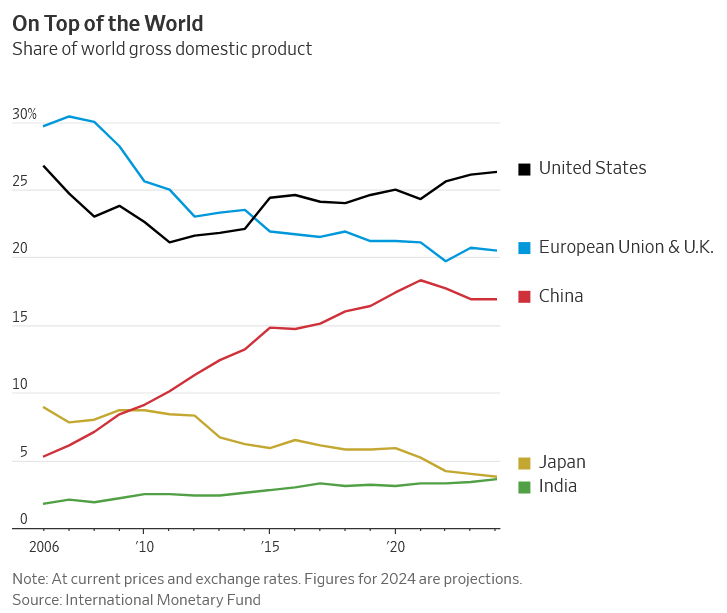
In conclusion, when we ask “What percentage of the world is the US?”, the answer extends far beyond simple demographics. It speaks to the US’s outsized influence on the global economic and technological stage. Its substantial share of global GDP, its pivotal role in international trade and finance, and its undisputed leadership in technological innovation and adoption all contribute to an answer that highlights its profound and pervasive impact on the modern world. These percentages are not static figures; they are dynamic indicators of an ongoing evolution, reflecting both the enduring strengths of the US and the rising influence of other global players. Understanding these figures provides a crucial lens through which to view the complex interplay of power, innovation, and prosperity in the 21st century.
aViewFromTheCave is a participant in the Amazon Services LLC Associates Program, an affiliate advertising program designed to provide a means for sites to earn advertising fees by advertising and linking to Amazon.com. Amazon, the Amazon logo, AmazonSupply, and the AmazonSupply logo are trademarks of Amazon.com, Inc. or its affiliates. As an Amazon Associate we earn affiliate commissions from qualifying purchases.