
The question of “what percentage Native American” is required to receive benefits is one of the most complex intersections of identity, law, and personal finance in the United States. For many individuals discovering their heritage, the primary motivation is cultural reconnection; however, the practical reality often involves navigating a labyrinth of financial benefits, social services, and resource allocations.
In the realm of personal finance and government administration, there is no single universal “percentage” that grants access to benefits. Instead, eligibility is a fragmented landscape determined by federal law, individual tribal sovereignty, and the specific nature of the benefit in question. To manage one’s financial future effectively as a person of Indigenous descent, it is crucial to understand the mechanics of blood quantum, tribal enrollment, and the diverse portfolio of financial resources available to those who qualify.
The Framework of Blood Quantum and Financial Eligibility
At the heart of the eligibility discussion is the concept of “blood quantum.” This is a metric used to define the degree of “Indian blood” a person possesses, calculated based on their documented ancestry. While controversial, blood quantum remains a primary tool for determining financial eligibility for various programs.
The Origins and Mechanics of Blood Quantum
Blood quantum was originally introduced by the federal government as a means of limiting the number of people eligible for treaty obligations and land allotments. Today, it serves as a baseline for many administrative processes. To calculate this, one looks at the “base rolls”—census-like documents created by the government at specific points in history. If an ancestor was listed as “full blood,” their children’s percentage is halved progressively through the generations.
From a financial planning perspective, knowing your blood quantum is the first step in auditing your eligibility for federal programs. Many federal services require a minimum of one-fourth (1/4) degree of Indian blood, though this is not a universal rule.
Tribal Sovereignty and Membership Criteria
Under the principle of tribal sovereignty, federally recognized tribes have the exclusive right to determine their own membership requirements. This creates a diverse financial landscape:
- High Quantum Requirements: Some tribes require a 1/2 or 1/4 blood quantum for enrollment, prioritizing the concentration of tribal resources among a smaller population.
- Lineal Descent: Other tribes, such as the Cherokee Nation or the Choctaw Nation of Oklahoma, utilize “lineal descent.” This means if you can prove a direct biological link to an ancestor on the base rolls (such as the Dawes Rolls), you are eligible for membership regardless of your blood quantum percentage.
- Financial Impact of Enrollment: Being an “enrolled member” is often the “golden key” to financial benefits. Without formal enrollment, even someone with a high blood quantum may find themselves barred from specific tribal distributions.
Types of Financial Benefits and Federal Assistance
When discussing “benefits,” it is important to categorize them into federal services (funded by the U.S. government) and tribal services (funded by individual tribal nations). Each has its own set of financial prerequisites.
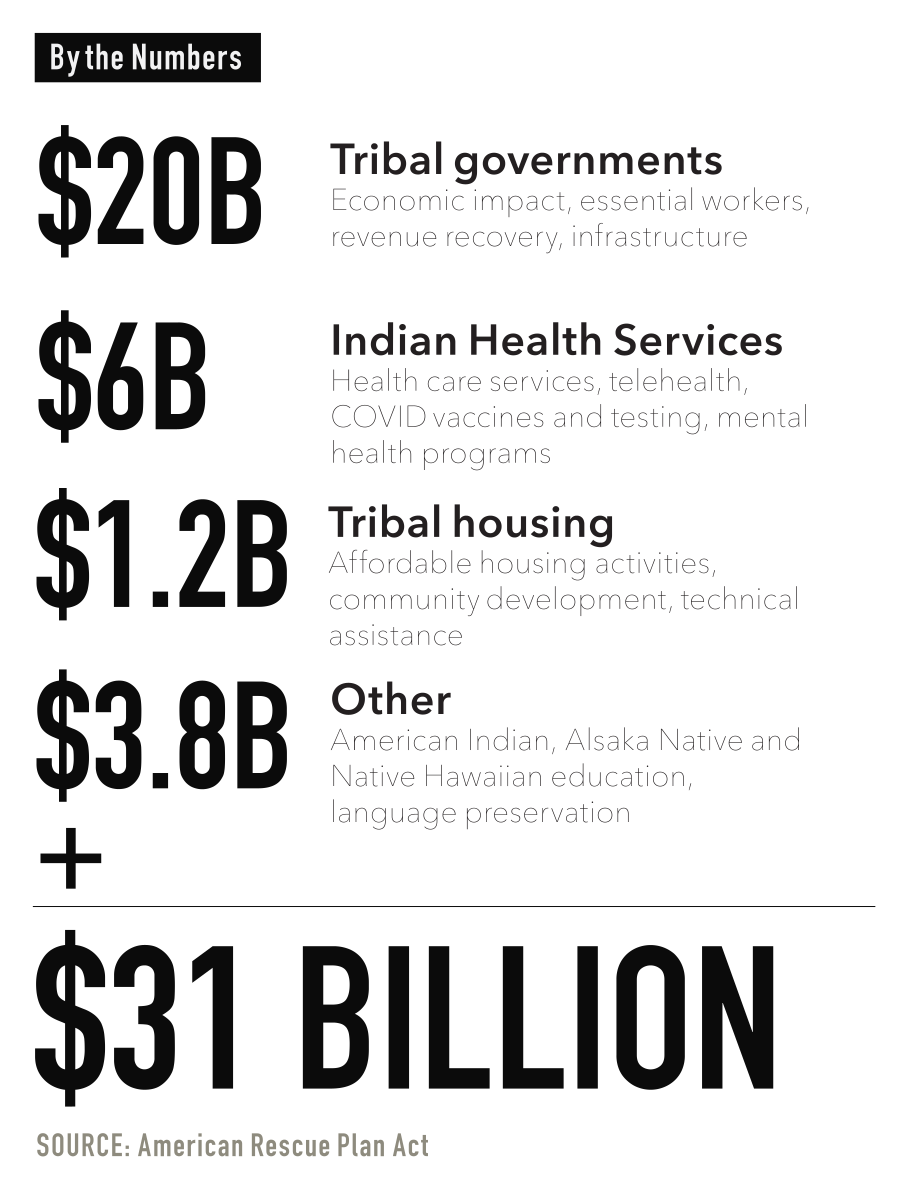
Federal Health and Social Services
The Indian Health Service (IHS) provides healthcare to federally recognized American Indians and Alaska Natives. Generally, to receive IHS services, an individual must be a member of a federally recognized tribe or possess a Certificate of Degree of Indian Blood (CDIB) showing a certain percentage of ancestry.
In terms of personal finance, IHS access can significantly reduce a household’s healthcare expenditures, acting as a form of supplemental insurance. Similarly, the Department of Housing and Urban Development (HUD) offers the Indian Housing Block Grant (IHBG) program, which provides financial assistance for low-income housing. These benefits are usually means-tested, meaning they depend on both your tribal status and your individual income levels.
Educational Grants and Scholarships
Education is one of the most significant financial levers for tribal members. The Bureau of Indian Education (BIE) and various private organizations offer specialized funding:
- BIE Higher Education Grant Program: Requires membership in a federally recognized tribe.
- American Indian College Fund: Often requires a minimum blood quantum (typically 1/4) or tribal enrollment.
- Tribal-Specific Scholarships: Many tribes use their own revenue to fund 100% of their members’ tuition, books, and boarding. For a family’s long-term financial plan, this can eliminate the need for student loans, providing a massive head start in wealth accumulation.
The Economic Reality of Per Capita Payments and Gaming Revenue
One of the most discussed financial aspects of tribal membership is the “per capita” payment. This is a direct distribution of tribal profits—often from gaming, timber, or mineral resources—to individual members.
The Indian Gaming Regulatory Act (IGRA)
Since the passage of the IGRA in 1988, some tribes have generated significant wealth through casino operations. Under federal law, these profits must be used for tribal government operations, social welfare, and local economic development. However, if a tribe has an approved Revenue Allocation Plan (RAP), they can distribute a portion of the net gaming revenue to members as per capita payments.
Understanding the Financial “Windfall”
The amount of these payments varies wildly. Some members of smaller, highly successful gaming tribes may receive six-figure annual distributions, while members of larger tribes may receive nothing at all, as the revenue is spread too thin or reinvested into infrastructure.
From a financial management standpoint, per capita payments are treated as taxable income by the IRS. Recipients must plan for tax liabilities and avoid the “windfall effect,” where sudden wealth is spent rather than invested. For many, these payments serve as a basic income floor, allowing for investment in small businesses or retirement accounts.
Strategic Financial Planning for Tribal Benefits
Navigating these benefits requires a proactive approach to personal finance. It is not enough to simply “be” Native American; one must manage the documentation and the resulting assets with precision.
The CDIB as a Financial Asset
The Certificate of Degree of Indian Blood (CDIB) is an official document issued by the Bureau of Indian Affairs (BIA). While it does not grant tribal membership, it is the standard proof of “percentage” used for many federal financial programs. Obtaining a CDIB is a rigorous process involving birth certificates, marriage licenses, and genealogical research. In the context of financial tools, the CDIB is as essential as a social security card or a passport for accessing specific resource pools.
Asset Management and Disenrollment Risks
A unique financial risk in this niche is “disenrollment.” Because tribes are sovereign, they can change their membership rules. If a tribe raises its blood quantum requirement, some members may lose their status and, consequently, their financial benefits (such as per capita payments or health coverage).
Diversification is the key financial strategy here. One should never rely solely on tribal distributions for their entire livelihood. A robust financial plan should include traditional investment vehicles (401ks, IRAs, and brokerage accounts) to ensure stability regardless of changes in tribal political or legal climates.
Navigating the Administrative Path to Financial Recognition
For those seeking to understand their percentage for the purpose of receiving benefits, the process is more administrative than biological. DNA tests (like AncestryDNA or 23andMe) are generally not accepted by tribes or the BIA as proof of eligibility. They may indicate Indigenous heritage, but they do not provide the paper trail required for financial disbursements.
Step 1: Genealogical Research
The “Money” side of this journey begins with the “Paper” side. You must trace your lineage to an ancestor listed on a federal roll. For many, this is the Dawes Roll (1898–1914) for the Five Civilized Tribes, or the Guion Miller Roll. These documents serve as the “financial ledger” of the past that dictates the eligibility of the present.
Step 2: Application for the CDIB and Tribal Enrollment
Once the lineage is established, you apply for the CDIB through the BIA. Simultaneously, you apply for membership with the specific tribe. This is where the “percentage” question is finally answered. If the tribe requires 1/8 and you are 1/16, you may be eligible for a CDIB but not for tribal enrollment, which will exclude you from per capita payments but might still allow access to some federal grants.
Step 3: Maximizing the Financial Portfolio
Once enrolled, a member should conduct a “benefit audit.” This involves:
- Contacting the tribal enrollment office for a list of available grants.
- Registering with the nearest IHS facility to offset healthcare costs.
- Consulting with a financial advisor who understands the tax implications of tribal distributions.

Conclusion: Financial Empowerment Through Identity
The question of “what percentage” is not merely a matter of blood; it is a matter of documented eligibility for a specialized set of financial tools and resources. Whether the threshold is 1/2, 1/4, or simple lineal descent, these benefits represent a form of economic restitution and tribal self-determination. By understanding the interplay between blood quantum, federal law, and tribal sovereignty, individuals can effectively integrate these unique resources into their broader personal finance strategy, ensuring that their heritage also contributes to their long-term financial security and prosperity.
aViewFromTheCave is a participant in the Amazon Services LLC Associates Program, an affiliate advertising program designed to provide a means for sites to earn advertising fees by advertising and linking to Amazon.com. Amazon, the Amazon logo, AmazonSupply, and the AmazonSupply logo are trademarks of Amazon.com, Inc. or its affiliates. As an Amazon Associate we earn affiliate commissions from qualifying purchases.