
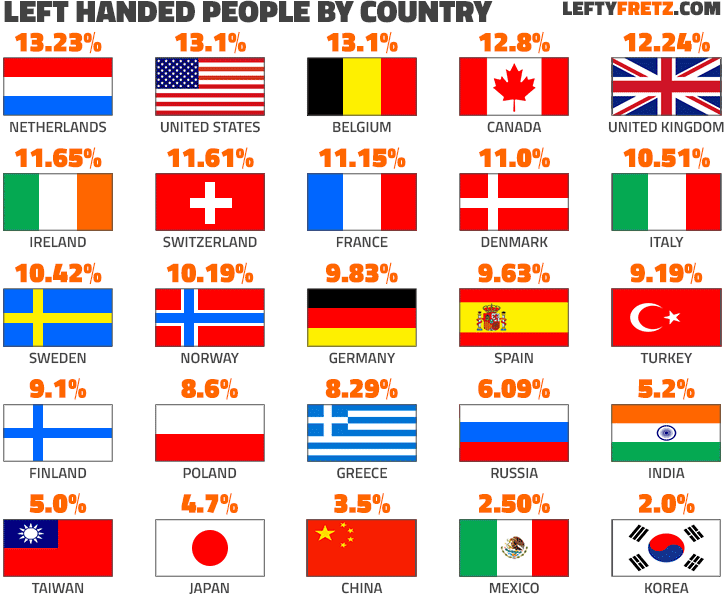
In the study of human biology and behavior, few statistics are as consistent or as impactful as the distribution of handedness. For decades, researchers have confirmed that approximately 90% of the global population is right-handed. While this might seem like a mere biological quirk, it serves as the foundational blueprint for almost every piece of technology we interact with today. From the curvature of a high-performance gaming mouse to the “Thumb Zone” on a smartphone display, the digital world is built by the right-handed, for the right-handed.

Understanding that 90% of people are right-handed is not just a statistical exercise; it is a critical data point for hardware engineers, UI/UX designers, and software developers. In a world increasingly driven by human-computer interaction (HCI), the “Left-Handed 10%” represents a significant demographic that often finds itself navigating a digital landscape designed against its natural intuition. This article explores how this 90/10 split influences technology trends, hardware ergonomics, and the future of inclusive software design.
The Ergonomics of Hardware: Designing for the 90% Standard
Hardware design is a game of physical constraints. When a company like Logitech or Apple designs a physical tool, they must account for the anatomy of the user. Because 90% of the market favors the right hand, industrial design has historically pivoted toward “right-hand first” ergonomics to maximize comfort for the largest possible user base.
The Peripheral Dilemma: Mice and Keyboards
The computer mouse is perhaps the most glaring example of right-hand bias in technology. Most ergonomic mice are sculpted with a thumb rest on the left side, specifically designed to fit the palm of a right hand. For the right-handed majority, this reduces repetitive strain and increases precision. However, for the left-handed minority, these devices are often unusable.
While “ambidextrous” mice exist, they often sacrifice the ergonomic benefits of a specialized shape to remain neutral. In the high-stakes world of competitive eSports, where millisecond reactions matter, the 90% statistic dictates which products receive the most R&D funding, often leaving left-handed gamers with fewer high-performance options.
Mobile Hardware: Button Placement and Camera Modules
The evolution of the smartphone has also been dictated by right-handed dominance. Consider the placement of power buttons and volume rockers. On most flagship devices, these are positioned to be easily toggled by a right-handed user’s thumb or index finger. Furthermore, the internal layout of camera modules and motherboards is often optimized for how a right-handed person holds their phone to take a photo—minimizing the chance of fingers obscuring the lens. As devices get larger, these small design choices become more significant, influencing how we physically grip our most essential tech.
Gaming Gear and Specialized Inputs
Beyond the PC, console controllers represent a fascinating compromise. Controllers like those for the PlayStation 5 or Xbox Series X are symmetrical in shape, but the “action” buttons (the primary inputs) are almost always located on the right side. This design acknowledges that while both hands are needed for navigation, the dominant right hand should handle the most complex or frequent interactions. This layout has become so standardized that even left-handed players have largely adapted to a right-dominant input scheme.
Software and UI/UX: Navigating the Thumb Zone
In software development, the 90% statistic shifts from physical ergonomics to cognitive and gestural ergonomics. UI (User Interface) and UX (User Experience) designers use the concept of the “Thumb Zone”—the area of a screen that a user can easily reach with their thumb while holding a device with one hand—to place the most important buttons.
Mobile Interface Design: The Reachability Problem
Since the majority of users hold their phones in their right hand, designers often place “Critical Action” buttons (like “Buy Now” or “Submit”) in the lower-right or center-right areas of the screen. This ensures that 90% of users can complete a transaction with minimal effort. For the left-handed user, these same buttons are located in the most difficult-to-reach “red zone” of the screen.

Tech giants have attempted to solve this through software features like “Reachability” on iOS or “One-Handed Mode” on Android. These tools shift the entire UI downward or sideways, acknowledging that a one-size-fits-all approach doesn’t work when the biological reality is skewed toward one side.
Gestural Navigation and Accessibility
Modern OS navigation relies heavily on “swiping.” On many platforms, a swipe from the left edge of the screen moves you “back.” This gesture is arguably more natural for a right-handed thumb to execute. As software moves away from visible buttons toward invisible gestures, the underlying assumption of right-handedness becomes even more embedded in the code. Accessibility settings are now catching up, allowing users to mirror layouts or rebind gestures, but these are often secondary features rather than the default experience.
Customization: Why Software-Defined Handedness Matters
The rise of “Software-Defined Hardware” allows for better inclusivity. For example, the Apple Watch allows users to choose which wrist they wear the device on and which side the Digital Crown faces. By simply flipping the UI 180 degrees via software, the device becomes perfectly ergonomic for a left-handed person. This represents a major trend in tech: using software flexibility to overcome physical, right-handed-centric manufacturing.
Artificial Intelligence and the Future of Interaction
As we move into the era of Artificial Intelligence (AI) and Virtual Reality (VR), the implications of the 90% right-handed statistic are becoming even more complex. AI models are trained on human data, and if that data is skewed, the AI’s understanding of human movement will be skewed as well.
Data Biases in Hand-Tracking AI
Hand-tracking technology, used in devices like the Apple Vision Pro or Meta Quest, relies on computer vision models trained on millions of images of human hands. If the training data primarily features right-handed movements, the AI may be marginally less accurate at predicting or tracking the nuances of left-handed gestures. Developers are now working to ensure that “Handedness Agnostic” datasets are used to prevent “algorithmic bias” in gesture recognition.
VR/AR Environments: The Challenge of Spatial Interaction
In Virtual Reality, the concept of a “dominant hand” is vital for immersion. When a user enters a digital space, the system often defaults to placing virtual tools—like a sword in a game or a pen in a productivity app—in the right hand. Innovative tech companies are now building “Handedness Detection” into their initial calibration phases. By analyzing which hand a user reaches with first, the system can dynamically reorganize the digital environment to suit the user’s biological preference.
The Future of Inclusive Tech Design
The tech industry is beginning to move beyond the “90% standard” toward a philosophy of Universal Design. This approach suggests that by designing for the edges of the population (the 10% of left-handers, or people with limited mobility), companies actually create a better product for everyone.
Universal Design Principles
Universal Design in tech means creating hardware and software that does not require “adaptation” by the user. We see this in the rise of symmetrical foldable phones, voice-activated interfaces, and neural-link technologies that bypass manual dexterity altogether. When interaction is handled by voice (AI assistants) or eye-tracking, the 90/10 handedness split becomes irrelevant.
Haptic Feedback and Multi-modal Interfaces
The future of tech is “multi-modal.” This means providing multiple ways to achieve the same result. If a right-handed gesture is the default, a haptic (vibration) cue or a voice command can serve as a backup for those who find the gesture uncomfortable. This level of redundancy ensures that technology remains a tool for empowerment rather than a source of frustration for the 10% of the population that isn’t right-handed.
In conclusion, while the fact that 90% of people are right-handed has historically led to a “right-biased” digital world, the current trajectory of technology is toward total personalization. As AI becomes more intuitive and hardware becomes more modular, the “90% standard” will slowly fade, replaced by devices that understand the unique physical identity of every individual user, regardless of which hand they use to click, swipe, or type.
aViewFromTheCave is a participant in the Amazon Services LLC Associates Program, an affiliate advertising program designed to provide a means for sites to earn advertising fees by advertising and linking to Amazon.com. Amazon, the Amazon logo, AmazonSupply, and the AmazonSupply logo are trademarks of Amazon.com, Inc. or its affiliates. As an Amazon Associate we earn affiliate commissions from qualifying purchases.