
In the world of finance, percentages are the primary language of measurement. Whether you are tracking the growth of a retirement portfolio, calculating the interest on a mortgage, or determining the profitability of a side hustle, understanding what percent one number is of another is the fundamental building block of financial literacy. Percentages provide context that raw numbers cannot; they allow for comparison across different scales and timeframes, turning abstract data into actionable intelligence.
For many, the phrase “what percent of a number” evokes memories of high school algebra. However, in the context of personal and business finance, this simple calculation is the difference between a sound investment and a costly mistake. Mastery over these figures allows an individual to move beyond being a passive consumer of financial products and become an active architect of their own wealth.

The Foundation of Financial Literacy: Why Percentages Matter
At its core, a percentage is a ratio that represents a fraction of 100. In finance, this ratio is used to describe change, cost, and allocation. When we ask “what percent of my income should go to housing?” or “what percent of my portfolio is in equities?”, we are seeking to understand the relationship between a part and a whole.
Understanding the Equation in Budgeting
The most common application of percentage math in daily life is the 50/30/20 budgeting rule. This framework suggests that 50% of your after-tax income should go to needs, 30% to wants, and 20% to savings or debt repayment. To implement this, you must be able to calculate what percent of your total monthly “number” (your net income) is being consumed by specific categories.
If your monthly take-home pay is $5,000 and your rent is $1,750, you determine the percentage by dividing the part by the whole ($1,750 / $5,000 = 0.35) and multiplying by 100 to get 35%. Recognizing that your housing is 35% of your income—rather than just “seventeen hundred dollars”—allows you to compare your spending against national averages or personal goals. It provides a benchmark for sustainability.
Deciphering Discounts and Interest Rates
Consumers encounter percentages most frequently through interest rates and retail discounts. Understanding the true cost of a loan requires more than just looking at the monthly payment; it requires calculating the Annual Percentage Rate (APR). When a credit card offers a 24% APR, you are essentially paying 2% of your average daily balance every month.
On the flip side, navigating sales requires the same mental agility. A “30% off” sign on a $120 item means you are keeping 70% of that number. Being able to quickly calculate that $12 is 10% of $120, and thus $36 is 30%, empowers you to make rapid, informed spending decisions without relying on a calculator.
Navigating the Investment Landscape: Calculating Returns and Yields
In the realm of investing, percentages are the only way to measure performance accurately. Comparing a $500 gain on a $5,000 investment to a $500 gain on a $50,000 investment reveals the disparity in efficiency: one is a 10% return, while the other is a mere 1%.
Return on Investment (ROI): The Gold Standard of Performance
Return on Investment is the most vital percentage any investor needs to calculate. The formula is straightforward: (Current Value – Original Cost) / Original Cost * 100. If you buy a stock for $1,000 and it grows to $1,250, your ROI is 25%.
However, professional investors often look at “annualized” returns. If that 25% growth took five years to achieve, your average annual return is roughly 4.5% (considering compounding). Comparing this percentage against the S&P 500 average (historically around 10%) tells you whether your investment strategy is outperforming the market or lagging behind. Without calculating “what percent” of your capital you are earning back, you are essentially flying blind.
Dividend Yields and Bond Coupons: Income Generation
For those seeking passive income, the “yield” is the percentage that matters most. A dividend yield is calculated by taking the annual dividend payment and dividing it by the current stock price. If a company pays $4.00 per share annually and the stock is trading at $100, the yield is 4%.
This percentage allows an investor to compare a stock’s income potential against a high-yield savings account or a Treasury bond. If a savings account offers 5% interest with zero risk, a stock yield of 4% might not be attractive unless there is significant potential for price appreciation. Percentages enable this “apples-to-apples” comparison across diverse asset classes.
Portfolio Allocation: The Percentages of Risk Management
Risk management is entirely a game of percentages. Diversification is the process of ensuring that no single asset class represents too large a percentage of your total net worth. A standard “moderate” portfolio might be 60% stocks and 40% bonds.
As the market fluctuates, these percentages shift. If stocks have a phenomenal year, they might grow to represent 70% of your portfolio. This increases your risk profile. Rebalancing is the act of selling a portion of the “winning” asset to return to your target percentages. By focusing on the percentage rather than the dollar amount, investors can remove emotion from the process and stick to a disciplined strategy.

Business Finance: Margin, Markup, and Profitability
For entrepreneurs and side-hustlers, the difference between a “markup” and a “margin” is a common point of confusion that can lead to financial ruin. Both are expressed as percentages, but they represent very different things.
Gross vs. Net Profit Margin
Profit margin is a calculation of what percent of your total revenue is actual profit. If a product sells for $100 and it costs $60 to produce, your gross profit is $40. The gross profit margin is 40% ($40 / $100).
Net profit margin goes deeper, subtracting all operating expenses, taxes, and interest. If, after all those costs, you are left with $10, your net profit margin is 10%. Business owners must track these percentages religiously. A company can have millions of dollars in revenue, but if the net profit margin is only 1%, the business is extremely vulnerable to even minor price fluctuations or economic downturns.
Tax Implications: Calculating Your Effective Rate
Taxation is perhaps the most complex “what percent” calculation in finance. In many countries, income tax is progressive, meaning different portions of your income are taxed at different percentages.
Your “marginal” tax rate is the percentage paid on the very last dollar you earned. However, your “effective” tax rate is the actual percentage of your total income that goes to the government. If you earn $100,000 and pay $15,000 in taxes, your effective rate is 15%, even if your top marginal bracket is 22% or 24%. Understanding this distinction is crucial for tax planning and determining the true take-home value of a raise or a new business venture.
The Power of Compound Interest: Exponential Growth and Percentages
Albert Einstein famously called compound interest the “eighth wonder of the world.” The reason it is so powerful is that it involves earning a percentage on top of a percentage.
The Rule of 72: A Shortcut for Future Projections
The Rule of 72 is a quick way to estimate how long it will take for an investment to double at a fixed annual percentage rate. You simply divide 72 by the annual interest rate. For example, if your investment earns 6% annually, it will take 12 years to double (72 / 6 = 12). If you can bump that return to 9%, your money doubles in just 8 years. This simple percentage-based rule demonstrates how even small increases in a percentage rate can lead to massive differences in long-term wealth.
Inflation’s Impact: The Hidden Percentage That Erodes Wealth
While we focus on the percentage growth of our assets, we must also consider the percentage “shrinkage” caused by inflation. Inflation is the rate at which the general level of prices for goods and services rises. If you earn 5% on a savings account but inflation is running at 6%, your “real” rate of return is actually -1%.
Understanding “what percent” your purchasing power is decreasing is essential for long-term planning. To maintain your lifestyle in retirement, you cannot just look at the raw dollar amount in your bank account; you must calculate how that number stacks up against the cumulative percentage increase in the cost of living over decades.
Tools and Strategies for Financial Percentage Calculation
In the modern era, we have various tools to handle these calculations, but the strategy behind them remains human.
Leveraging Spreadsheets and Financial Calculators
For complex financial planning, software like Excel or Google Sheets is indispensable. Using simple formulas like =(B2-A2)/A2 can automate the calculation of percentage growth across hundreds of data points. Digital security and software tools allow us to track these percentages in real-time, providing a “dashboard” view of our financial health. Apps that aggregate your accounts often provide these percentages automatically, showing you what percent of your net worth is liquid versus illiquid.
Mental Math for Everyday Financial Decisions
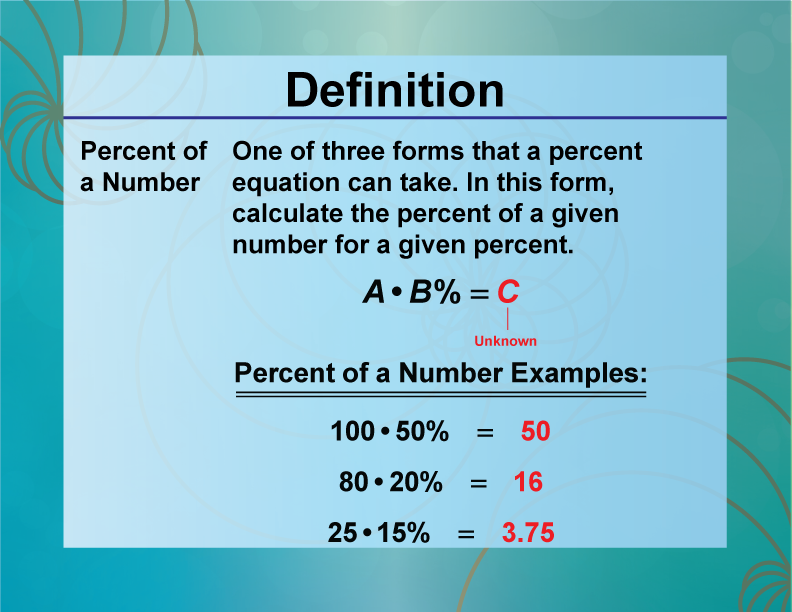
Despite the prevalence of tools, the ability to perform mental percentage calculations remains a “superpower” in business and personal finance. The simplest way to calculate percentages mentally is the 10% method. To find 10% of any number, simply move the decimal point one place to the left ($45.00 becomes $4.50).
Once you have 10%, you can find almost any other percentage. Need 5%? Take half of the 10% figure. Need 20%? Double it. This mental agility allows you to evaluate deals, calculate tips, and assess interest charges on the fly, ensuring that you are always in control of the numbers, rather than the numbers being in control of you.
In conclusion, “what percent of a number” is more than a mathematical query; it is a lens through which we view our financial reality. By mastering these calculations, individuals can move from uncertainty to clarity, making informed decisions that lead to long-term stability and growth. Whether you are an employee, an investor, or an entrepreneur, the ability to think in percentages is the ultimate financial tool.
aViewFromTheCave is a participant in the Amazon Services LLC Associates Program, an affiliate advertising program designed to provide a means for sites to earn advertising fees by advertising and linking to Amazon.com. Amazon, the Amazon logo, AmazonSupply, and the AmazonSupply logo are trademarks of Amazon.com, Inc. or its affiliates. As an Amazon Associate we earn affiliate commissions from qualifying purchases.