
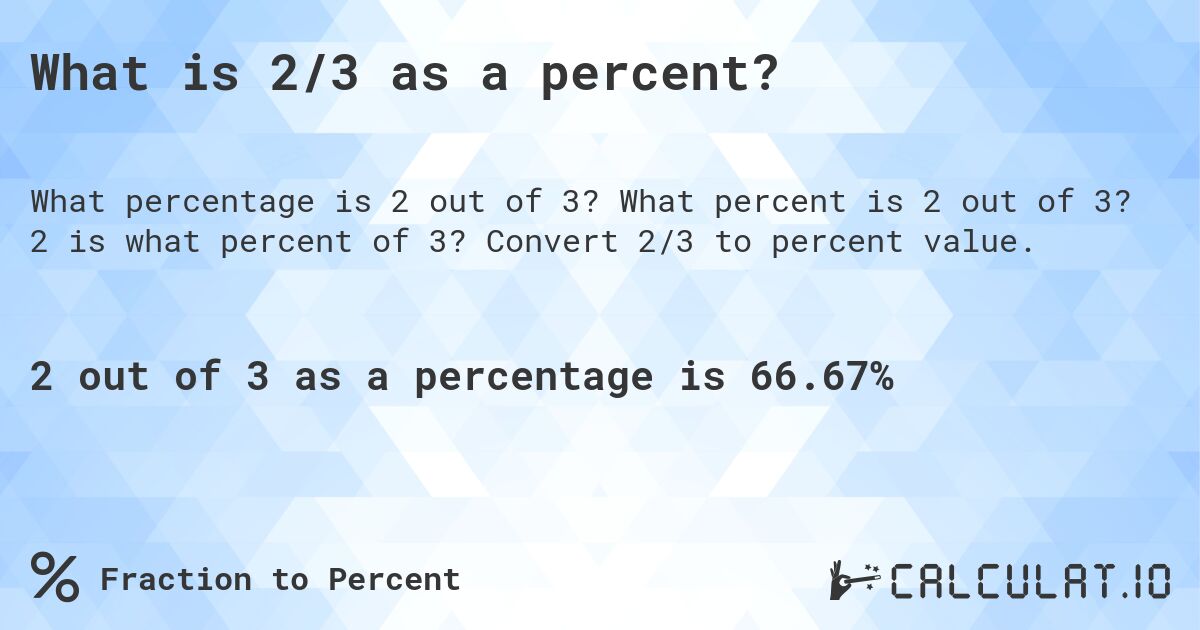
In the world of finance, precision is the difference between a calculated risk and a reckless gamble. When we ask the question, “what percent is 2 out of 3,” the mathematical answer is straightforward: 66.666…%, typically rounded to 66.67%. However, in the context of personal finance, investment strategy, and business operations, this figure represents much more than a repeating decimal. It represents a critical threshold—a “two-thirds” majority that often dictates the health of a budget, the viability of an investment portfolio, and the success rate of a trading strategy.
Understanding the weight of 66.67% allows investors and earners to better conceptualize their progress. Whether you are measuring a debt-to-income ratio, calculating the probability of a market movement, or determining the percentage of your portfolio allocated to high-growth assets, mastering the nuances of this specific ratio is essential for long-term wealth accumulation.
The Numerical Foundations of 66.67% in Finance
To calculate what percent 2 is out of 3, you divide the numerator (2) by the denominator (3), resulting in 0.6666… To convert this decimal into a percentage, you multiply by 100. The result, 66.67%, is one of the most common ratios found in financial modeling.
In financial terms, hitting a 66.67% mark often signals a significant majority. In corporate governance, for instance, a two-thirds “supermajority” is frequently required to pass major changes, such as a merger or a change to the company’s bylaws. For the individual investor, seeing a 66.67% return on investment (ROI) is a landmark achievement, signaling that the asset has grown by two-thirds of its original value.
Beyond the raw numbers, the 2-out-of-3 ratio serves as a benchmark for sustainability. If 66.67% of your financial decisions are correct, you are performing at a level that far exceeds the average retail investor. In the high-stakes world of finance, where the “50/50” coin flip is the baseline, moving the needle to 2 out of 3 creates a mathematical advantage that, when compounded, leads to exponential wealth.
The Significance of the Repeating Decimal
In accounting, the repeating nature of 2/3 can sometimes lead to minor discrepancies if not handled with standard rounding practices. Most financial institutions round to the nearest hundredth, making 66.67% the standard. This small 0.01% difference might seem negligible, but in high-frequency trading or large-scale corporate valuations, these fractions of a percent can represent millions of dollars in liquidated value or interest payments.
Applying the Two-Thirds Ratio to Budgeting and Debt Management
When analyzing personal cash flow, the 2-out-of-3 ratio often appears in the context of “safety margins.” Financial advisors frequently look at how much of a person’s income is spoken for before they even have a chance to save.
The Debt-to-Income (DTI) Threshold
Lenders and mortgage providers pay close attention to ratios. While many conventional loans require a DTI ratio of 36% or lower, some aggressive lending programs allow for higher limits. If your total debt obligations—including your mortgage, car payments, and credit cards—reach 66.67% of your gross monthly income, you are in a high-risk category. At this “2 out of 3” mark, two-thirds of every dollar you earn is immediately diverted to creditors, leaving only one-third for taxes, food, utilities, and savings. Understanding that 2 out of 3 equals 66.67% helps individuals realize how little breathing room they have when their debt consumes this much of their financial life.
The 2/3 Rule for Variable Expenses
In a robust financial plan, some experts suggest that fixed costs (housing, insurance, basic utilities) should never exceed two-thirds of your take-home pay. By keeping these “must-pay” items at or below 66.67%, you ensure that the remaining 33.33% is available for discretionary spending and, more importantly, aggressive investing. If your fixed costs climb above the two-thirds mark, your ability to weather a financial storm—such as a job loss or a medical emergency—is severely compromised.
Tax Efficiency and Ratios
For those in higher income tax brackets, the “2 out of 3” concept often applies to net take-home pay. In some jurisdictions, after federal, state, and local taxes, along with Social Security and Medicare contributions, a high-earner may only keep roughly 66.67% of their gross earnings. This realization is often the catalyst for exploring tax-advantaged investment vehicles like 401(k)s, IRAs, or municipal bonds, which aim to push that retention percentage higher.
The 2 Out of 3 Win Rate: Probability in Trading and Investing
In the world of active trading—whether it be stocks, forex, or commodities—the “win rate” is a primary metric of success. A win rate of 2 out of 3 (66.67%) is considered exceptional.
Risk-Reward Ratios and Probability
Many novice traders believe they need a 90% success rate to build wealth. However, professional wealth managers understand that a 66.67% win rate, combined with a disciplined risk-reward ratio, is a powerhouse for capital growth. If you win 2 out of every 3 trades, and your wins are larger than your losses, the mathematical outcome is a steeply rising equity curve.

For example, if an investor risks $1,000 to make $1,000 (a 1:1 ratio), a 66.67% win rate results in a net profit of $1,000 every three trades (Win $1k + Win $1k – Loss $1k). Over a series of 300 trades, this translates to $100,000 in profit. Understanding that “2 out of 3” is a realistic yet highly profitable target helps traders maintain emotional discipline during the unavoidable 1-out-of-3 loss.
Diversification: The Three-Pillar Approach
Many institutional investors use a “three-pillar” strategy for asset allocation. They may split their capital into three equal parts:
-
Equities (Stocks)
-
Fixed Income (Bonds)
-
Alternative Assets (Real Estate, Gold, or Crypto)
If 2 out of 3 of these asset classes are performing well, the portfolio remains in a state of growth even if one sector is experiencing a downturn. This “two-thirds” majority provides a buffer against market volatility. By ensuring that 66.67% of your assets are not correlated, you protect your principal investment from systemic collapses in a single industry.
Business Strategy and the “Pick Two” Conundrum
In business finance and project management, the 2-out-of-3 ratio is famously encapsulated in the “Project Management Triangle” or the “Iron Triangle.” This concept dictates that there are three primary constraints on any project:
-
Speed (How fast it is done)
-
Quality (How well it is done)
-
Cost (How cheaply it is done)
The financial reality for most businesses is that you can only ever have 2 out of 3. If you want it fast and high-quality, it will not be cheap. If you want it cheap and fast, it will not be high-quality. If you want it high-quality and cheap, it will not be fast.
Strategic Allocation of Capital
From a business finance perspective, a company must decide where to place its “2 out of 3” focus to maintain profitability. A luxury brand may choose Quality and Speed, accepting high Costs as a necessary part of its business model, which it then passes on to the consumer to maintain a 66.67% gross margin. Conversely, a discount retailer focuses on Speed and Cost, often sacrificing high-end Quality to ensure high-volume turnover. Understanding these ratios allows business owners to calculate their break-even points and set prices that reflect the reality of their operational constraints.
The SaaS “Rule of 40” and Growth Ratios
In the world of software-as-a-service (SaaS) and tech investing, financial health is often measured by the “Rule of 40,” which states that a company’s growth rate plus its profit margin should exceed 40%. While this isn’t a direct “2 out of 3” calculation, the principle of balancing different financial levers is the same. Investors look for companies where at least 66.67% of their revenue is recurring (ARR), as this provides a level of financial predictability that one-off sales cannot match.
Retirement Planning: The 66% Income Replacement Target
One of the most critical applications of the “what percent is 2 out of 3” question lies in retirement planning. For decades, a common rule of thumb has been the “Replacement Ratio.”
Sustaining Lifestyle Post-Career
Most financial planners suggest that a retiree needs to replace between 60% and 80% of their pre-retirement income to maintain their standard of living. The 66.67% (2 out of 3) mark is often seen as the “sweet spot” for a comfortable, though perhaps not lavish, retirement.
The logic is that once you retire, you no longer have the costs associated with working (commuting, professional attire, etc.), and you are likely no longer saving a portion of your income for retirement. Therefore, living on 2 out of every 3 dollars you used to earn is mathematically viable. If an individual earned $100,000 per year during their peak career, a retirement plan that generates $66,667 per year from Social Security, pensions, and portfolio drawdowns is generally considered a success.
The 4% Rule vs. The 2/3 Goal
While the 4% rule tells you how much you can safely withdraw from your nest egg, the 2/3 goal tells you why you are withdrawing it. If your retirement accounts can consistently generate 66.67% of your former salary, you have achieved financial independence. To reach this, you must understand how your current savings rate (the percentage of the 1/3 you aren’t spending today) compounds over time to produce that future 2/3.

Conclusion: The Power of the Two-Thirds Perspective
Whether you are calculating the percentage of a trade’s success, determining how much of your income is swallowed by debt, or planning for a replacement income in the future, the “2 out of 3” ratio is a cornerstone of financial literacy. At 66.67%, this figure represents a dominant force in any financial equation.
By keeping your fixed costs below 66.67%, aiming for a win rate that approaches 2 out of 3 in your investments, and understanding the “pick two” trade-offs in business, you move beyond simple arithmetic into the realm of strategic wealth management. The next time you see the number 2/3, remember that it is not just 66.67%—it is the threshold of financial control and the mathematical key to sustainable growth.
aViewFromTheCave is a participant in the Amazon Services LLC Associates Program, an affiliate advertising program designed to provide a means for sites to earn advertising fees by advertising and linking to Amazon.com. Amazon, the Amazon logo, AmazonSupply, and the AmazonSupply logo are trademarks of Amazon.com, Inc. or its affiliates. As an Amazon Associate we earn affiliate commissions from qualifying purchases.