
Bitcoin, often hailed as digital gold and the progenitor of the cryptocurrency movement, operates on a revolutionary and meticulously designed technological infrastructure. It’s not just a digital currency; it’s a decentralized network, a global ledger, and a groundbreaking software protocol all rolled into one. At its core, Bitcoin runs on its own proprietary network, known simply as the Bitcoin network, which is built upon the foundational technology of a blockchain. Understanding this network is crucial to grasping Bitcoin’s resilience, security, and transformative potential within the realm of digital technology.
Far from being hosted on a traditional server or controlled by a single entity, the Bitcoin network is a peer-to-peer (P2P) distributed system. This means that every participant (or “node”) running the Bitcoin software contributes to the network’s operation, security, and data integrity. This distributed architecture is what gives Bitcoin its unique properties, distinguishing it from conventional financial systems and centralizing technologies. This article delves deep into the technological underpinnings of the Bitcoin network, exploring its core components, operational mechanisms, and broader implications for digital security and innovation.

The Bitcoin Blockchain: A Foundational Technology
The heart of the Bitcoin network is the blockchain, a distributed public ledger that records all Bitcoin transactions in a secure and immutable manner. Conceptualized by its pseudonymous creator, Satoshi Nakamoto, the blockchain is an ingenious solution to the “double-spending” problem inherent in digital currencies, ensuring that each unit of Bitcoin can only be spent once.
Decentralization as a Core Principle
The most defining characteristic of the Bitcoin network is its decentralization. Unlike banks or payment processors, there is no central authority governing Bitcoin. Instead, control is distributed across all participants. This means:
- No Single Point of Failure: The network can continue to operate even if a large number of nodes go offline.
- Censorship Resistance: No single entity can unilaterally block or reverse transactions.
- Transparency: All transactions are publicly visible on the blockchain, though user identities remain pseudonymous.
- Trustlessness: Users do not need to trust a third party to facilitate transactions; they can trust the cryptographic security and the network’s consensus mechanism.
This distributed trust model is a paradigm shift from traditional centralized systems, offering a robust and resilient framework for value transfer.
The Role of Cryptography
Cryptography is the backbone of the Bitcoin network’s security and functionality. Every aspect, from securing individual wallets to verifying transactions and chaining blocks, relies heavily on advanced cryptographic techniques.
- Public-Key Cryptography: This allows users to have a public address (similar to an account number) and a private key (like a password). Transactions are signed with the private key, proving ownership without revealing the key itself.
- Cryptographic Hashes: These mathematical functions convert data of any size into a fixed-size string of characters. Hashes are used to link blocks together (each block contains the hash of the previous block), to represent transaction data efficiently, and to ensure data integrity. Any change, no matter how small, to the input data results in a completely different hash, making tampering immediately detectable.
These cryptographic elements ensure that transactions are secure, irreversible, and verifiable by anyone on the network.
How Transactions are Processed and Verified
When a user initiates a Bitcoin transaction, several steps occur on the network:
- Creation: The transaction details (sender, receiver, amount) are created and cryptographically signed by the sender using their private key.
- Broadcast: The signed transaction is then broadcast to the Bitcoin network, meaning it’s sent to nearby nodes.
- Validation: Nodes independently verify the transaction against a set of network rules (e.g., does the sender have enough Bitcoin? Is the signature valid? Has the Bitcoin already been spent?).
- Inclusion in a Block: Once validated, the transaction waits in a memory pool (mempool) to be included in a new block by a “miner.”
- Block Confirmation: When a miner successfully adds a new block containing the transaction to the blockchain, the transaction is considered confirmed. As more blocks are added on top, the transaction’s immutability strengthens, making it practically impossible to reverse.
This multi-step process, distributed across the network, ensures the integrity and security of every Bitcoin transfer.
Mining and Consensus: Securing the Network
The process of adding new blocks of transactions to the blockchain and securing the network is known as mining. Bitcoin mining is a competitive endeavor that serves a dual purpose: it creates new Bitcoin (as a reward to miners) and validates and confirms transactions, thereby securing the entire network.
Proof-of-Work Explained
Bitcoin employs a consensus mechanism called Proof-of-Work (PoW). Miners compete to solve a complex computational puzzle, which essentially involves finding a specific number (a “nonce”) that, when combined with the block’s data and hashed, produces a result below a certain target. This target is dynamically adjusted to maintain an average block creation time of approximately 10 minutes.
- Computational Effort: Solving this puzzle requires significant computational power and energy.
- Verification Ease: While hard to find, verifying the solution is trivial for any node on the network.
- Security: The immense computational effort required makes it economically unfeasible for a malicious actor to alter past transactions, as they would need to outpace the collective mining power of the entire network.
PoW is often debated for its energy consumption, but it remains Bitcoin’s cornerstone for achieving decentralized security and immutability.
Miners’ Role in Network Security
Miners are not just creating new Bitcoin; they are the guardians of the network. Their incentives are aligned with the network’s health and security:
- Transaction Validation: Miners gather unconfirmed transactions from the mempool, validate them, and assemble them into a candidate block.
- Block Creation: They then expend computational effort (PoW) to find a valid hash for that block.
- Network Synchronization: Once a miner finds a valid block, they broadcast it to the network. Other nodes verify the block’s validity (including the PoW solution and all transactions within it) and, if valid, add it to their copy of the blockchain.
- Economic Incentives: Miners are rewarded with newly minted Bitcoin (block reward) and transaction fees for successfully adding a new block. This economic incentive encourages honest participation and contributes to the network’s robust security.
Without miners, the Bitcoin blockchain would cease to update, and transactions would go unconfirmed.
The Halving Mechanism
An integral part of Bitcoin’s monetary policy, coded directly into its protocol, is the halving event. Approximately every four years (or every 210,000 blocks), the block reward paid to miners for creating a new block is cut in half.
- Scarcity: This deflationary mechanism ensures a predictable, declining supply of new Bitcoin, reinforcing its digital scarcity, similar to precious metals.
- Inflation Control: It limits the total supply of Bitcoin to 21 million units, preventing inflation caused by arbitrary issuance.
- Network Economics: While reducing the block reward, it incentivizes miners to continue operating through transaction fees and the potential appreciation of Bitcoin’s value due to scarcity.
The halving is a fundamental aspect of Bitcoin’s long-term economic model, influencing its technological stability and perceived value.
Network Architecture and Nodes
The Bitcoin network is a complex tapestry of interconnected computers, each playing a role in maintaining the ledger. These computers are known as “nodes,” and their function varies depending on the type of software they run.
Full Nodes vs. Lightweight Clients
Nodes are the communication points of the Bitcoin network, but they come in different forms:
- Full Nodes: These are the backbone of the network. A full node downloads and validates every single transaction and block that has ever occurred on the Bitcoin blockchain since its inception (currently over 500 GB of data). They independently verify all rules and enforce them on the network. Running a full node gives users the highest level of security and privacy, as they don’t have to trust any third party for transaction validation.
- Lightweight Clients (SPV Nodes): These clients (often found in mobile wallets) don’t download the entire blockchain. Instead, they rely on full nodes to provide them with information and verify transactions. They only download block headers and use Simplified Payment Verification (SPV) to check if their transactions have been included in a valid block. While convenient, they offer less security and privacy than full nodes, as they implicitly trust the full nodes they connect to.
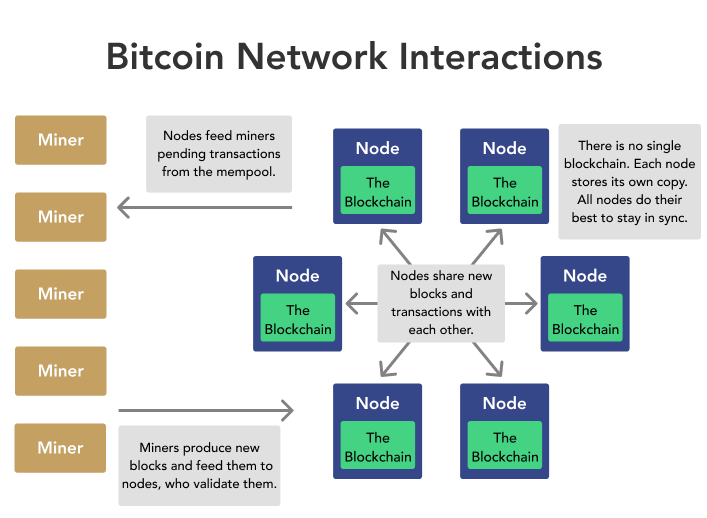
The robustness of the Bitcoin network heavily relies on a sufficient number of active full nodes.
The Importance of Running a Full Node
Running a full node is an act of supporting the decentralization and security of the Bitcoin network.
- Independent Verification: A full node ensures that your Bitcoin and transactions adhere to all network rules, without relying on anyone else. This is crucial for maintaining a truly trustless system.
- Network Health: Each full node contributes to the network’s resilience by broadcasting transactions and blocks, helping to propagate information efficiently.
- Security against Attacks: A higher number of geographically dispersed full nodes makes the network more resistant to various attacks, such as sybil attacks or censorship.
- Privacy: By validating your own transactions, you reduce your reliance on third-party servers, enhancing your financial privacy.
For serious Bitcoin users and advocates of decentralization, running a full node is often considered a civic duty within the Bitcoin ecosystem.
Peer-to-Peer Communication
The Bitcoin network operates on a peer-to-peer communication model, similar to early file-sharing networks.
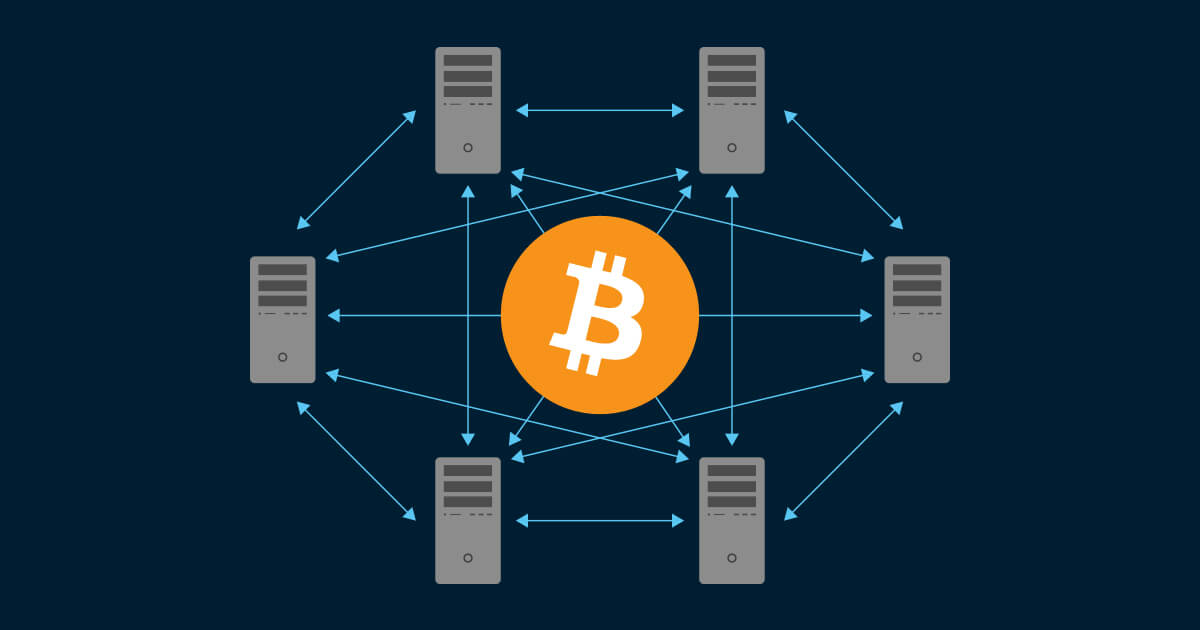
- Direct Connections: Nodes directly connect to each other, forming a mesh network. There’s no central server that all nodes must connect to.
- Information Propagation: When a new transaction or block is generated, it’s broadcast to the nodes connected to the origin. These nodes then relay the information to their connected peers, and so on, until it propagates across the entire network.
- Resilience: This P2P architecture makes the network extremely resilient to outages and attacks. If one node goes offline, the others continue to communicate and maintain the network.
This decentralized communication strategy is fundamental to Bitcoin’s censorship resistance and global reach.
Scaling Solutions and Future Developments
While remarkably robust, the Bitcoin network, in its original form, faced challenges related to transaction throughput and speed, leading to ongoing development and implementation of scaling solutions.
The Lightning Network: Addressing Scalability Challenges
The Lightning Network is a prominent “layer-2” scaling solution built on top of the Bitcoin blockchain. It aims to enable fast, low-cost Bitcoin transactions by creating off-chain payment channels.
- Off-Chain Transactions: Instead of recording every small transaction on the main blockchain, users can open payment channels with each other or with trusted hubs. Multiple transactions can then occur instantly and privately within these channels.
- Final Settlement: Only the opening and closing balances of a payment channel are recorded on the main Bitcoin blockchain.
- Micropayments: This enables efficient micropayments and reduces congestion on the main chain, significantly increasing transaction capacity.
The Lightning Network transforms Bitcoin’s utility for everyday small transactions, positioning it as a more viable digital cash for frequent use.
SegWit and Taproot: Protocol Upgrades
The Bitcoin protocol is not static; it undergoes continuous, community-driven development and upgrades to improve efficiency, security, and functionality.
- Segregated Witness (SegWit): Implemented in 2017, SegWit was a soft fork that optimized block space by “segregating” signature data from transaction data. This effectively increased the transaction capacity of each block without increasing the block size limit, allowing for more transactions to fit into a block and reducing transaction fees. It also fixed transaction malleability, paving the way for layer-2 solutions like the Lightning Network.
- Taproot: Activated in late 2021, Taproot was a significant soft fork that introduced several improvements, most notably Schnorr signatures and a new script type called Tapscript. Taproot enhances privacy by making complex multi-signature transactions and smart contracts indistinguishable from regular single-signature transactions on the blockchain. It also improves efficiency by reducing transaction sizes and offering greater flexibility for future protocol developments.
These upgrades demonstrate the continuous efforts to refine and enhance the Bitcoin network’s technological capabilities.
The Ongoing Evolution of Bitcoin’s Network
The development of the Bitcoin network is a continuous, open-source process involving thousands of developers worldwide. This ongoing evolution focuses on:
- Improving Core Protocol: Enhancements to security, efficiency, and robustness of the underlying blockchain.
- Scaling Solutions: Further research and development into layer-2 and potentially layer-3 solutions to handle global transaction volumes.
- Privacy Enhancements: Exploring and implementing technologies that offer greater privacy to users while maintaining transparency where needed.
- Interoperability: Investigating ways Bitcoin can interact more seamlessly with other decentralized networks and technologies.
The Bitcoin network is a living, evolving system, constantly adapting to meet new challenges and leverage technological advancements, all while adhering to its core principles of decentralization and security.
Bitcoin’s Impact on Digital Security and Innovation
The technological innovations embodied by the Bitcoin network extend far beyond a mere digital currency, influencing the broader landscape of digital security, distributed systems, and the future of online interactions.
Immutable Ledger and Trustlessness
The Bitcoin blockchain’s design creates an immutable ledger, meaning that once a transaction is recorded and confirmed, it cannot be altered or deleted. This immutability, combined with its trustless nature (no need for intermediaries), has profound implications:
- Data Integrity: It provides an unprecedented level of data integrity, useful not only for financial transactions but potentially for any record-keeping requiring verifiable permanence.
- Reduced Counterparty Risk: In a trustless system, the risk associated with relying on a third party to uphold their end of an agreement is significantly mitigated, as the network protocol enforces the rules.
- Digital Sovereignty: Users have direct control over their digital assets, free from the dictates of governments or corporations.
This framework redefines how trust is established and maintained in digital environments.
Paving the Way for Web3 and Decentralized Applications
Bitcoin’s success in building a decentralized, secure network has been a catalyst for the broader blockchain and Web3 movement.
- Inspiration for Altcoins: Bitcoin proved the viability of decentralized digital assets, inspiring thousands of other cryptocurrencies and blockchain projects.
- Decentralized Finance (DeFi): The concept of programmable money and decentralized ledgers, pioneered by Bitcoin, laid the groundwork for the DeFi ecosystem, aiming to recreate traditional financial services in a trustless, permissionless manner.
- NFTs and Digital Ownership: The principles of verifiable digital ownership and scarcity inherent in Bitcoin’s design are fundamental to Non-Fungible Tokens (NFTs) and the broader digital asset space.
- DAO Governance: The idea of a decentralized network governed by its participants, without a central authority, directly influenced the development of Decentralized Autonomous Organizations (DAOs).
Bitcoin’s foundational technology is a blueprint for a future where digital interactions are more transparent, secure, and user-controlled.
The Future of Digital Value Transfer
The Bitcoin network represents a bold new paradigm for digital value transfer, offering a global, permissionless, and censorship-resistant alternative to traditional financial systems. While often perceived primarily as an investment, its true power lies in its technological architecture:
- Global Settlement Layer: It provides a final settlement layer for value transfers that is accessible to anyone with an internet connection, anywhere in the world.
- Resilience and Robustness: Its decentralized nature and Proof-of-Work consensus ensure a level of resilience unmatched by centralized systems.
- Continuous Innovation: The open-source nature of its development guarantees ongoing innovation and adaptation to future technological landscapes.
In conclusion, Bitcoin operates on its own dedicated, decentralized peer-to-peer network, underpinned by a revolutionary blockchain technology. This network is secured by cryptographic principles and maintained by a global community of miners and nodes. Far from being a mere digital currency, the Bitcoin network is a triumph of distributed systems engineering, continuing to evolve and set new standards for digital security, trustless interactions, and the future of digital value transfer in the technological age.
aViewFromTheCave is a participant in the Amazon Services LLC Associates Program, an affiliate advertising program designed to provide a means for sites to earn advertising fees by advertising and linking to Amazon.com. Amazon, the Amazon logo, AmazonSupply, and the AmazonSupply logo are trademarks of Amazon.com, Inc. or its affiliates. As an Amazon Associate we earn affiliate commissions from qualifying purchases.