
The Academy Awards, or Oscars, represent the pinnacle of cinematic achievement, a global stage where the industry’s finest are celebrated. For filmmakers, actors, and production studios, an Oscar is more than just a golden statuette; it’s a powerful validation of artistic merit, a significant boost to a film’s legacy, and a testament to the colossal effort and innovation behind its creation. While many films aspire to win big, only a select few have managed to sweep the awards, etching their names into the annals of Hollywood history with the most wins. This article delves into these record-breaking cinematic masterpieces, exploring not just their extraordinary triumphs but also the fascinating interplay of technology, brand strategy, and financial investment that underpins their journey to unprecedented success.

The pursuit of an Oscar is a complex dance between artistic vision and strategic execution. It involves harnessing cutting-edge technology to bring stories to life, meticulously crafting a brand narrative around the film, and navigating the significant financial investments required for production and a robust awards campaign. Understanding which movies have achieved the ultimate sweep—claiming the highest number of Oscars—offers a unique lens into the evolving landscape of filmmaking and its interconnected industries.
The Illustrious Triumvirate: Films That Reached the Pinnacle
In the long and storied history of the Academy Awards, only three films stand alone at the very top, each having garnered an astonishing eleven Oscars. These films represent different eras of cinema, showcasing distinct technological advancements, branding strategies, and financial landscapes, yet they share a common thread of groundbreaking achievement and universal appeal.
Ben-Hur (1959): A Spectacle Forged by Innovation
William Wyler’s Ben-Hur is a monumental epic that redefined the scope and scale of moviemaking in its time. Released in 1959, it was a massive undertaking, designed to compete with the burgeoning popularity of television by offering an experience that simply couldn’t be replicated on the small screen. Its eleven Oscar wins, including Best Picture, Best Director, and Best Actor for Charlton Heston, were a resounding testament to its ambition and execution.
From a tech perspective, Ben-Hur was a marvel of its era. Filmed in MGM Camera 65 (a widescreen format), it demanded innovative solutions for cinematography, set design, and practical effects. The iconic chariot race sequence, for instance, involved 15,000 extras, 1,000 crew members, and required a custom-built arena spanning 18 acres – a logistical and technical challenge unparalleled at the time. The sheer scale of its production pushed the boundaries of what was achievable in filmmaking, setting new standards for historical epics. The intricate sound design and groundbreaking visual effects (for its time, primarily matte paintings and miniature work) were integral to immersing audiences in its ancient world.
Branding Ben-Hur was a masterclass in grand cinematic presentation. Its title alone evoked images of biblical grandeur and heroic struggle. MGM heavily promoted its “super-spectacle” status, emphasizing the enormous budget ($15 million, the most expensive film ever made at that point) and the unprecedented scale. The marketing campaign leveraged its star power and the epic scope of the story, creating a brand identity synonymous with prestige and must-see cinema. Its success solidified MGM’s brand as a studio capable of delivering monumental entertainment.
Financially, Ben-Hur was a colossal investment, one that paid off handsomely. Despite its exorbitant cost, it became the highest-grossing film of 1959 and one of the highest-grossing films of all time, generating over $147 million worldwide during its initial release. The Oscar wins significantly extended its theatrical run and boosted its long-term revenue streams through re-releases and subsequent home video sales, proving that investing in ambitious, high-quality productions, when executed well, could yield immense returns.
Titanic (1997): Merging Emotion with Digital Frontiers
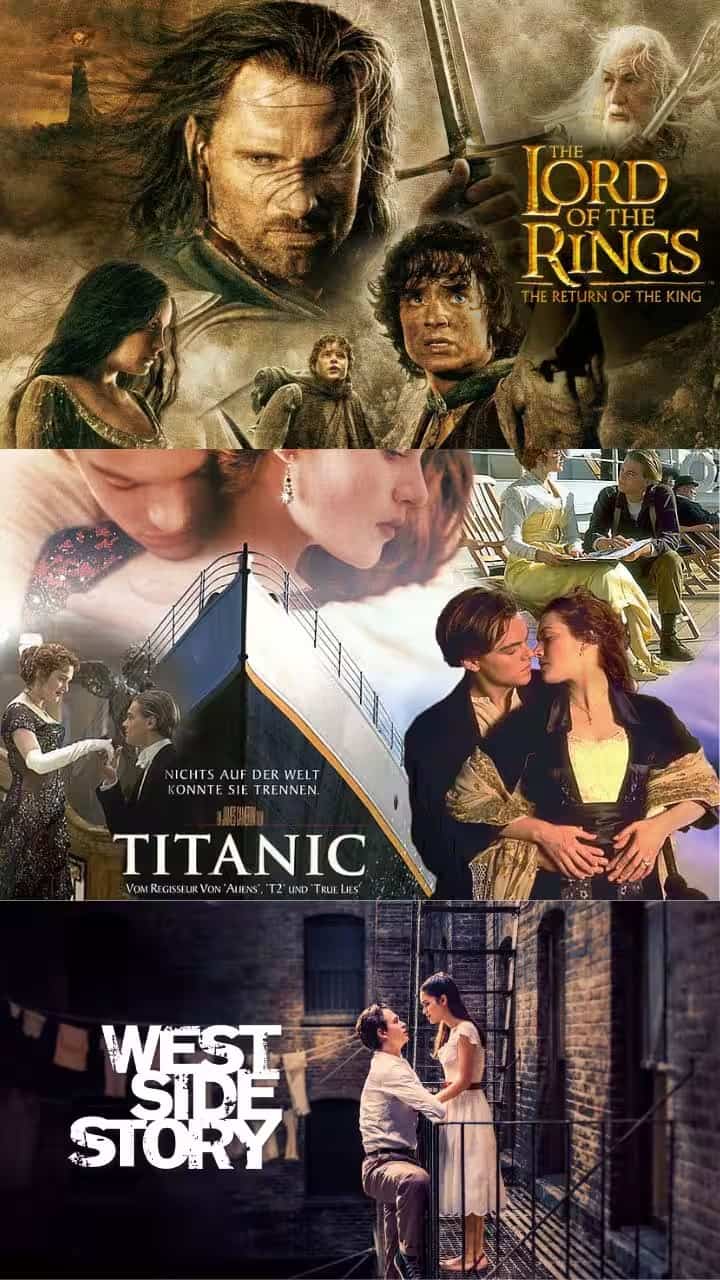
James Cameron’s Titanic, released in 1997, wasn’t just a film; it was a global phenomenon. Its eleven Oscar wins, including Best Picture and Best Director, underscored its masterful blend of historical recreation, compelling romance, and revolutionary visual effects. It became the highest-grossing film of all time, a record it held for twelve years.
Technologically, Titanic was a quantum leap forward, particularly in the realm of CGI and digital effects. While Ben-Hur relied on practical sets and thousands of extras, Titanic leveraged nascent computer graphics to recreate the ill-fated ship and its tragic sinking with astonishing realism. Wētā Digital, Industrial Light & Magic, and Digital Domain collaborated to create seamless visual effects, from the digital ocean and countless digital extras to the meticulously rendered ship models. This marriage of high-stakes drama with state-of-the-art tech allowed for sequences that were previously impossible, immersing audiences in the grandeur and subsequent horror of the event. Furthermore, advancements in film sound technology were crucial in making the ship’s collapse feel viscerally impactful.
The brand of Titanic became synonymous with epic romance and cinematic spectacle. Its success was a testament to Cameron’s vision and the power of its narrative. The film’s branding extended far beyond the cinema, influencing fashion, music (Celine Dion’s “My Heart Will Go On” became an anthem), and popular culture. It transformed its lead actors, Leonardo DiCaprio and Kate Winslet, into global superstars, further cementing their personal brands. Paramount Pictures and 20th Century Fox, the studios behind it, saw their reputations soar, demonstrating the immense value an Oscar-winning blockbuster can add to a corporate identity.
From a money perspective, Titanic was another massive gamble, costing an unprecedented $200 million to produce. However, its box office performance was equally unprecedented, grossing over $2.2 billion worldwide across its various releases. The Oscar wins amplified its commercial success, contributing to extended theatrical runs and record-breaking home video sales. The film proved that investing heavily in both compelling storytelling and groundbreaking technology could create a financial juggernaut, delivering unparalleled returns on investment for its studios and stakeholders.
The Lord of the Rings: The Return of the King (2003): Epic Storytelling, Cutting-Edge Effects, and a Brand Legacy
Concluding our trio of record-holders is Peter Jackson’s The Lord of the Rings: The Return of the King, which made history in 2003 by winning all eleven of its nominated categories, including Best Picture and Best Director. This achievement was particularly remarkable as it crowned an entire trilogy, solidifying its place as one of the most beloved and critically acclaimed fantasy sagas ever brought to screen.
The technology behind The Return of the King, and indeed the entire Lord of the Rings trilogy, was revolutionary. Wētā Digital, based in New Zealand, pioneered techniques for large-scale digital environments, crowd simulation (Massive software), and motion-capture performance (most notably for Gollum). The seamless integration of physical sets, miniatures, and groundbreaking CGI created Middle-earth with an unprecedented level of realism and detail. The sound design, particularly the battle sequences, utilized advanced audio mixing techniques to create an immersive, overwhelming experience. This relentless push for technological innovation was fundamental to translating J.R.R. Tolkien’s complex world into a believable cinematic reality, directly contributing to its critical acclaim and Oscar success.
The brand of The Lord of the Rings was already iconic thanks to Tolkien’s novels. Jackson’s adaptation, however, elevated it to a new global level. The trilogy’s consistent quality, grand scope, and faithful yet innovative interpretation built an unparalleled cinematic brand. The Return of the King‘s Oscar sweep was the ultimate endorsement, solidifying the trilogy’s legacy and making it a benchmark for epic fantasy. The awards reinforced the brand’s cultural significance, leading to vast merchandising opportunities, video games, and continued fan engagement for decades. It also significantly boosted Peter Jackson’s personal brand as a visionary director and Wētā Digital’s brand as a world leader in visual effects.

Financially, the entire Lord of the Rings trilogy was a massive investment, costing an estimated $281 million for the three films. However, it generated over $2.9 billion worldwide, making it one of the most profitable film series ever. The Return of the King‘s eleven Oscars were a significant factor in driving its individual box office success (over $1.1 billion) and the continued sales of the entire trilogy across various formats. The long-term financial value of the intellectual property, enhanced by the Oscar recognition, remains immense, continuing to generate revenue through licensing, streaming rights, and extended universe content, demonstrating the sustained money-making potential of award-winning, globally resonant content.
Beyond the Trophy Count: The Tech, Brand, and Money Ecosystem of Oscar Success
The stories of Ben-Hur, Titanic, and The Return of the King illustrate that Oscar success isn’t just about artistic merit; it’s deeply intertwined with the industrial and economic forces of Hollywood. These films showcase how innovation, strategic branding, and shrewd financial management contribute to their lasting impact.
Technology’s Unseen Hand in Oscar Glory
The evolution of filmmaking technology is a constant driver of what’s possible on screen and, by extension, what earns critical acclaim. From the intricate practical effects and large-format cinematography of Ben-Hur to the groundbreaking CGI of Titanic and Lord of the Rings, each era’s record-breaking films harnessed the most advanced tools available. Today, technology continues to reshape the landscape. High-resolution digital cameras, advanced motion capture, virtual production techniques (like those used in The Mandalorian), and increasingly sophisticated AI tools for post-production (e.g., de-aging, voice synthesis, automated rotoscoping) are becoming standard.
Beyond the visuals, sound design and mixing technologies have become incredibly nuanced, crafting immersive audio experiences that directly contribute to a film’s emotional impact and, frequently, its Oscar nominations for Sound Mixing and Sound Editing. The advent of streaming platforms like Netflix, Amazon Prime Video, and Apple TV+ has also introduced new technological paradigms for distribution and awards campaigning, utilizing data analytics to target specific audiences and optimize campaign spend. The convergence of filmmaking with advanced computing power and digital networking ensures that technological prowess remains a critical, albeit often unseen, factor in winning Oscars.
The Branding Power of an Oscar Win
An Oscar win, particularly for Best Picture or a high number of awards, is an unparalleled brand enhancer. For the film itself, it cements its place in cinematic history, elevating its perceived quality and extending its commercial lifespan. It creates a powerful marketing hook for re-releases, streaming library placement, and home entertainment sales for years, even decades, after its initial run. The “Oscar-winning film” tag is a potent advertising tool.
For the studios and production companies, Oscar recognition significantly bolsters their corporate brand, signaling a commitment to artistic excellence and quality content. This, in turn, can attract top talent, secure future investments, and command higher prices for distribution rights. Individual creators—directors, actors, cinematographers, composers—also experience a dramatic uplift in their personal brand. An “Oscar-winning director” or “Academy Award winner” carries immense prestige, leading to better project opportunities, higher fees, and increased influence within the industry. The entire awards season itself has become a brand spectacle, generating buzz and engagement far beyond the cinephile community.
The Financial Ripple Effect: Investing in Award-Winning Cinema
The money involved in securing Oscar glory is substantial, both in production costs and campaigning. Yet, the financial returns on an Oscar-winning film can be equally immense. A Best Picture win typically translates to a significant box office bump, often millions of dollars, as audiences flock to see the celebrated film. This “Oscar bump” can be crucial for films that might not have been immediate blockbusters but gain traction through critical acclaim.
Beyond initial box office, an Oscar win dramatically increases the long-term asset value of a film. This includes higher valuations for streaming rights, licensing for international markets, merchandise, and potential spin-offs or sequels. For investors in film production, an Oscar-winning project can represent a lucrative return on investment, not just from direct revenue but also from the increased valuation of the production house itself. The cost of Oscar campaigns—which can run into tens of millions of dollars for top contenders—is a strategic financial investment, aimed at influencing Academy voters and, ultimately, driving that post-win revenue surge. This ecosystem highlights that while art may be the primary goal, the economic engine behind it is constantly seeking to maximize the financial rewards of critical success.
The Modern Landscape and Future Outlook
The way films are produced, distributed, and judged for awards is continually evolving. As tech advances, brands become more globalized, and the money flows through new channels, the path to Oscar glory continues to transform.
Data-Driven Campaigns and the Evolving Viewer
Today’s awards campaigns are increasingly data-driven, utilizing analytics to identify key voter demographics, optimize ad placements, and tailor messaging. Streaming services, with their vast subscriber bases and direct-to-consumer models, have disrupted traditional distribution and campaigning. They can leverage their user data to promote films to specific audiences and craft highly targeted Oscar pushes. This technological shift means that winning an Oscar isn’t just about screening a film; it’s about a sophisticated, digitally informed marketing strategy designed to resonate with the diverse body of Academy voters.
Furthermore, the evolving viewer, influenced by social media and global streaming options, now has more access to diverse cinema than ever before. This broader exposure can influence public opinion, which, while not directly voting, can create powerful momentum for certain films. The Academy itself has expanded its international membership, reflecting a more globalized cinematic landscape and influencing the types of films that are recognized.
The Perpetual Value of Cinematic Excellence
Despite these changes, the fundamental appeal of movies that have won the most Oscars remains constant. Films like Ben-Hur, Titanic, and The Lord of the Rings: The Return of the King endure not just for their technical prowess but for their ability to tell compelling stories that resonate across generations. Their multiple Oscar wins cemented their place in cultural memory, ensuring their continued relevance and perpetual revenue streams through various media.
The interplay of technology, brand, and money will only deepen in future Oscar races. Artificial intelligence could revolutionize every stage of filmmaking, from scriptwriting to post-production, offering new creative possibilities and efficiencies. Branding will become even more crucial in a crowded content landscape, with studios and streaming giants vying for attention and prestige. And the financial stakes will remain high, as investors seek to fund the next record-breaking masterpiece that delivers both critical acclaim and substantial returns. The legacy of these Oscar-winning titans reminds us that true cinematic greatness is often a harmonious blend of artistic ambition, cutting-edge innovation, shrewd branding, and strategic financial investment, creating works that stand the test of time and continue to captivate audiences worldwide.
aViewFromTheCave is a participant in the Amazon Services LLC Associates Program, an affiliate advertising program designed to provide a means for sites to earn advertising fees by advertising and linking to Amazon.com. Amazon, the Amazon logo, AmazonSupply, and the AmazonSupply logo are trademarks of Amazon.com, Inc. or its affiliates. As an Amazon Associate we earn affiliate commissions from qualifying purchases.