
The Volkswagen Group does not merely manufacture cars; it manages one of the most complex and successful brand ecosystems in industrial history. To answer the question of which manufacturers VW owns is to explore a sophisticated “House of Brands” strategy that spans from budget-friendly commuters to million-dollar hypercars. By maintaining a diverse portfolio that includes names like Audi, Porsche, Lamborghini, and Bentley, the Volkswagen Group (officially Volkswagen AG) has mastered the art of shared engineering hidden beneath fiercely protected, individual brand identities.
In the world of corporate identity and marketing, the Volkswagen Group serves as a primary case study in how to scale a business without diluting the prestige or the specific market positioning of its subsidiaries. This article examines the strategic architecture of the VW Group, analyzing how it manages its various manufacturers to dominate different market segments simultaneously.

The Architecture of the House of Brands: Strategic Segmentation
The success of the Volkswagen Group lies in its organizational structure. Rather than forcing every subsidiary to look and feel like a “VW,” the group operates through a decentralized brand management model. This allows each manufacturer to retain its national heritage, design language, and target demographic while benefiting from the parent company’s massive R&D budget.
Defining the Volume, Premium, and Sport Groups
The VW Group organizes its subsidiaries into distinct “Brand Groups.” This segmentation is a strategic move to ensure that internal competition—often called brand cannibalization—is kept to a minimum. The “Volume” group consists of Volkswagen, Škoda, SEAT, and Cupra. These brands target the mass market but occupy slightly different psychological spaces in the consumer’s mind.
The “Premium” and “Sport” groups, led by Audi and Porsche respectively, focus on higher margins, advanced technology, and lifestyle aspirations. By categorizing their manufacturers this way, the VW Group can deploy specific marketing strategies and brand voices that resonate with a blue-collar worker in Prague just as effectively as a C-suite executive in Manhattan.
The Synergy Between Shared Platforms and Individual Identity
From a branding perspective, the VW Group’s greatest achievement is the use of modular platforms (like the MQB for internal combustion and the MEB for electric vehicles). While the “skeleton” of an Audi Q4 e-tron and a Volkswagen ID.4 may be nearly identical, the brand identity—the “skin,” the interior touchpoints, the dealership experience, and the marketing narrative—is vastly different. This allows the group to achieve economies of scale in manufacturing while maintaining the high-perceived value of its premium labels.
The Volume Brands: Scaling Consistency and Relatability
The Volume group is the engine room of the Volkswagen Group’s global identity. These brands are designed to be approachable, reliable, and functional. However, even within this group, the branding is meticulously differentiated to capture different corners of the global market.
Volkswagen Passenger Cars: The Core Identity
The Volkswagen brand itself is the “Anchor Brand.” Its identity is built on the concept of “The People’s Car”—a democratic approach to quality German engineering. In terms of brand strategy, VW occupies the middle ground. It is more prestigious than a budget brand but more accessible than a luxury one. The “New Volkswagen” rebranding, which introduced a flat, digital-first logo in recent years, signaled a shift toward a cleaner, software-driven future, emphasizing a brand promise of sustainable mobility for everyone.
Škoda and SEAT: Value vs. Emotion
Škoda, based in the Czech Republic, has been branded as the “Simply Clever” choice. Its corporate identity focuses on pragmatism, space, and value for money. For years, Škoda’s brand strategy was to offer “more car for less money,” successfully shedding its post-Soviet reputation to become a symbol of intelligent consumerism.
Conversely, SEAT (based in Spain) was traditionally positioned as the “emotional” and “youthful” volume brand. However, the recent emergence of Cupra as a standalone brand represents a fascinating case study in brand evolution. Cupra was spun off from SEAT to capture a “contemporary premium” segment—targeting enthusiasts who find VW too conservative but Audi too expensive.
Navigating the Transition to Electric Mobility
Within the volume segment, the branding challenge has shifted toward electrification. The “ID.” sub-brand was created to give Volkswagen a distinct visual and linguistic identity in the EV space. This allows the parent company to transition its brand equity from internal combustion to electric power without alienating its traditional customer base.
The Luxury and Sporting Icons: Protecting Heritage and Prestige
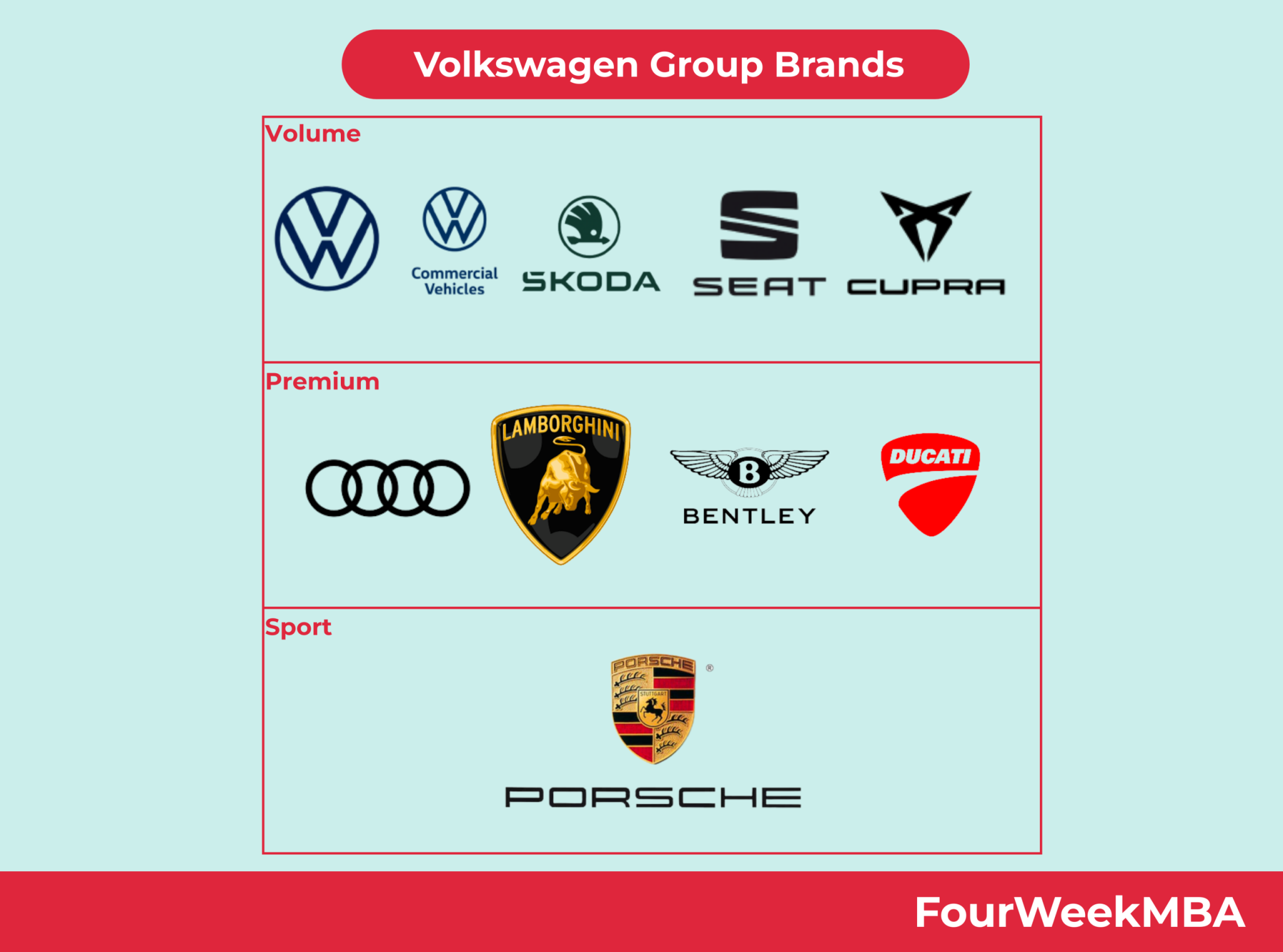
When Volkswagen acquired brands like Bentley, Bugatti (now part of a joint venture with Rimac), and Lamborghini, critics feared the “Germanization” of these storied marques. Instead, the VW Group practiced “Brand Stewardship,” providing the financial stability and technical infrastructure while allowing the brands to maintain their cultural souls.
Audi and Bentley: Defining Modern Premium and Ultra-Luxury
Audi serves as the Group’s “Vorsprung durch Technik” (Progress through Technology) flagship. Its brand identity is rooted in minimalism, light technology, and sophisticated “stealth wealth.” Audi’s role is to bridge the gap between the mass market and the ultra-luxury tier occupied by Bentley.
Bentley, a British icon, represents the “Handcrafted” pillar of the Group’s portfolio. The branding strategy here is the polar opposite of the Volume group. While VW focuses on automation and scale, Bentley emphasizes the artisan, the bespoke, and the heritage of Crewe, England. By keeping Bentley’s identity distinct, VW can compete in the 1% market where “mass production” is a negative brand attribute.
Lamborghini and Porsche: Engineering Aspiration
Lamborghini provides the “Extrovert” persona within the VW portfolio. Its brand strategy is built on drama, performance, and uncompromising design. It is the “bad boy” of the group, and VW’s management has wisely allowed the brand to retain its Italian flair and “Raging Bull” bravado.
Porsche, perhaps the most strategically important brand in the portfolio, occupies a unique space. It is a high-volume luxury sports car manufacturer that manages to maintain an aura of exclusivity. Porsche’s brand strategy is centered on “Tradition and Innovation.” Whether it is the 911 or the electric Taycan, the brand identity remains focused on the driver experience. The 2022 IPO of Porsche further highlighted its strength as a standalone brand with immense cultural and financial capital.
Commercial Vehicles and New Horizons: Broadening the Corporate Footprint
The VW Group’s ownership extends beyond passenger cars into the industrial and service sectors. This diversification protects the corporate identity against fluctuations in the consumer market and positions the group as a “Mobility Provider” rather than just a car company.
TRATON Group: Scania and MAN’s Industrial Identity
Through the TRATON Group, Volkswagen owns heavy-truck manufacturers Scania and MAN. The branding strategy here is B2B (Business to Business). Scania is positioned as the premium, driver-centric truck brand, often referred to as the “King of the Road,” while MAN focuses on efficiency and versatility in transport and construction. By owning both, VW dominates the logistics infrastructure of Europe and South America.
CARIAD and PowerCo: Branding the Future of Mobility
In recent years, the VW Group has launched internal brands that do not sell vehicles but sell capabilities. CARIAD is the group’s software powerhouse, and PowerCo is its battery cell company. From a brand strategy perspective, these entities represent the Group’s attempt to verticalize its supply chain. They are branded to attract top-tier tech talent, signaling that Volkswagen is no longer just a “metal-bending” company, but a tech-first software organization.
Lessons in Brand Management: Balancing Centralization and Autonomy
The Volkswagen Group’s ability to manage such a diverse portfolio offers several vital lessons for any corporate strategist or brand manager. The primary takeaway is that a parent company should be an invisible enabler rather than an overbearing master.
Preventing Brand Cannibalization
The greatest risk of owning twelve brands is that they might steal customers from one another. VW manages this through “Price Laddering.” A customer might start with a Škoda, move to a Volkswagen as their income grows, graduate to an Audi in mid-career, and eventually aspire to a Porsche or Bentley. This lifecycle management ensures that the customer stays within the Volkswagen ecosystem for their entire life, even as their needs and status change.
Navigating Crisis while Maintaining Subsidiary Reputation
The “Dieselgate” scandal of 2015 provided a grueling test for this multi-brand structure. While the “Volkswagen” brand took a massive reputational hit, the compartmentalization of the other brands helped shield them. Porsche and Bentley, though affected by the fallout, maintained their brand desirability because their identities were sufficiently decoupled from the “VW” badge. This illustrates the protective power of a diversified brand portfolio; the failure of one “node” does not necessarily bring down the entire network.

Conclusion: The Unified Identity of a Global Giant
What manufacturers does VW own? The list is long: Volkswagen, Audi, Porsche, Bentley, Lamborghini, Škoda, SEAT, Cupra, Ducati, Scania, and MAN. But more importantly, the VW Group owns the segments those brands represent.
Through a masterful blend of shared technology and distinct storytelling, the Volkswagen Group has created a corporate identity that is both monolithic in its power and diverse in its expression. As the industry moves toward autonomous driving and sustainable energy, the Group’s ability to pivot these iconic brands while maintaining their historical DNA will determine its success in the next century of mobility.
aViewFromTheCave is a participant in the Amazon Services LLC Associates Program, an affiliate advertising program designed to provide a means for sites to earn advertising fees by advertising and linking to Amazon.com. Amazon, the Amazon logo, AmazonSupply, and the AmazonSupply logo are trademarks of Amazon.com, Inc. or its affiliates. As an Amazon Associate we earn affiliate commissions from qualifying purchases.