
The S&P 500 is arguably the most widely recognized and followed stock market index in the world. Far more than just a list of 500 companies, it serves as a critical barometer for the health of the U.S. economy, a benchmark for investment performance, and a cornerstone of countless investment portfolios. For investors, economists, and business leaders alike, understanding what constitutes this prestigious index is fundamental to grasping the pulse of American corporate power and the broader financial landscape. This article will dissect the S&P 500, exploring its components, criteria, dynamic nature, and its profound implications for both individual wealth and national economic narratives.
The S&P 500 Explained: More Than Just 500 Companies
At its core, the S&P 500 is a stock market index that represents the performance of 500 of the largest publicly traded companies in the United States. However, its construction and influence extend far beyond a simple headcount. It’s a meticulously curated list designed to reflect the breadth and depth of the U.S. equity market, offering a robust measure of large-cap stock performance.
Defining the Index: Market-Capitalization Weighted
One of the most crucial aspects of the S&P 500 is that it is a market-capitalization weighted index. This means that companies with larger market capitalizations (stock price multiplied by the number of outstanding shares) have a greater impact on the index’s value than those with smaller market caps. For instance, if Apple, a company with an enormous market capitalization, sees its stock price rise, it will move the S&P 500 index more significantly than a similar percentage increase in a smaller constituent company. This weighting methodology naturally gives prominence to the largest and most influential corporations, ensuring the index accurately reflects where the bulk of investor capital is allocated. It also means that while there are “500” companies, a relatively small number of mega-cap firms often drive a substantial portion of the index’s daily fluctuations and long-term returns.
Eligibility Criteria: What It Takes to Join the Elite
Inclusion in the S&P 500 is not merely a matter of size; it’s a rigorous process governed by a set of stringent criteria established by the S&P Dow Jones Indices Committee. These criteria are designed to ensure the index is representative, investable, and accurately reflects the U.S. large-cap market. Key requirements include:
-
U.S. Company: The company must be based in the United States.
-
Market Capitalization: A minimum market cap threshold is required, which is periodically adjusted. As of recent times, this figure typically stands in the multi-billion dollar range.
-
Liquidity: The stock must be highly liquid, meaning it trades frequently and in high volumes, ensuring that index funds can easily buy and sell shares without significantly impacting the price.
-
Public Float: A substantial portion (at least 50%) of the company’s shares must be available to the public for trading, excluding restricted stock held by insiders.
-
Profitability: The company must have positive reported earnings in its most recent quarter and for the sum of its trailing four consecutive quarters.
-
Sector Representation: The committee also considers sector balance and aims to maintain appropriate industry representation to reflect the overall U.S. economy.
Meeting these criteria is a significant achievement for any company, often leading to increased investor interest and institutional buying once announced for inclusion.
Why 500? A Historical Perspective
While the name “S&P 500” suggests exactly 500 companies, it’s more accurate to think of it as “approximately 500.” The number isn’t rigidly fixed; historically, it has sometimes fluctuated slightly above or below 500 as companies merge, are acquired, or are delisted. The figure 500 itself stems from its origin in 1957, when Standard & Poor’s expanded its previous “S&P 90” index to encompass a broader range of companies, providing a more comprehensive gauge of the U.S. stock market. The goal was to capture approximately 80% of the total market capitalization of publicly traded U.S. equities, a role it continues to fulfill effectively today.
The Anatomy of the Index: Sectors and Diversification
The S&P 500 isn’t just a collection of companies; it’s a meticulously structured cross-section of the American economy. Its sectoral composition provides invaluable insights into the nation’s economic strengths and evolving trends.
Sectoral Representation: A Snapshot of the US Economy
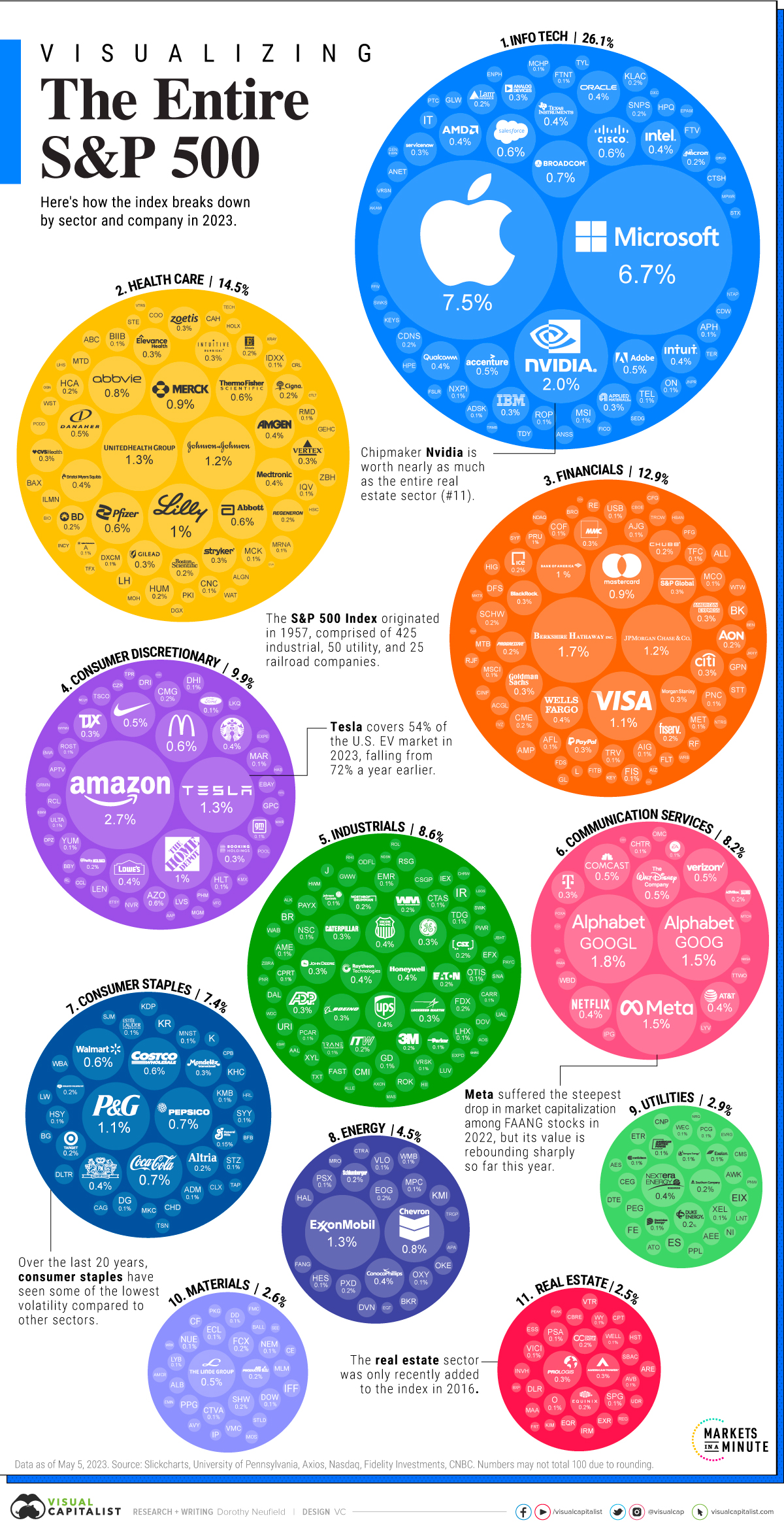
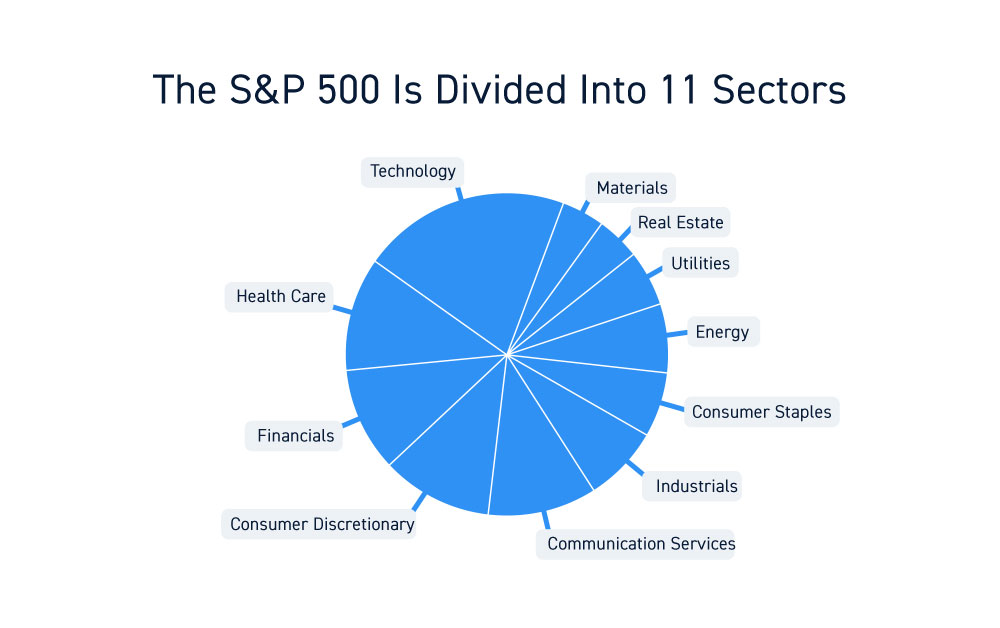
The S&P 500 categorizes its constituent companies into 11 broad sectors based on the Global Industry Classification Standard (GICS). These sectors include:
-
Information Technology: Software, hardware, semiconductors, IT services.
-
Health Care: Pharmaceuticals, biotech, medical devices, healthcare providers.
-
Financials: Banks, insurance companies, investment services.
-
Consumer Discretionary: Retail, automotive, hotels, entertainment.
-
Communication Services: Telecom, media, interactive media, entertainment.
-
Industrials: Aerospace, machinery, construction, transportation.
-
Consumer Staples: Food & beverage, household products, tobacco.
-
Energy: Oil & gas exploration, refining, services.
-
Utilities: Electric, gas, water utilities.
-
Real Estate: REITs, real estate management & development.
-
Materials: Chemicals, construction materials, packaging, mining.
The weighting of these sectors within the index is dynamic, shifting over time to reflect economic changes and market performance. For instance, in recent decades, Information Technology and Communication Services have grown to dominate a significant portion of the index, underscoring the shift towards a technology-driven economy. This sectoral breakdown is vital for investors seeking to understand where economic growth is concentrated and how different parts of the market are performing.
The Role of Diversification for Investors
For investors, the S&P 500 inherently offers a substantial degree of diversification. By owning an S&P 500 index fund or ETF, an investor gains exposure to hundreds of large-cap companies across various industries. This broad exposure helps mitigate the risk associated with investing in individual stocks or a small number of companies. If one company or even an entire sector experiences a downturn, the impact on the overall portfolio is cushioned by the performance of other companies and sectors. This diversification is a key reason why the S&P 500 is often recommended as a core holding for long-term investors, providing a relatively stable and growth-oriented foundation for wealth accumulation.
Top Holdings and Their Influence
While the S&P 500 boasts 500 companies, a handful of mega-cap stocks often exert outsized influence due to the market-capitalization weighting. Companies like Apple, Microsoft, Amazon, Google (Alphabet), Nvidia, Tesla, and Meta Platforms frequently rank among the top holdings. Their sheer size means their stock performance can significantly sway the entire index. This concentration can be a double-edged sword: strong performance from these giants can drive the index higher, but any substantial decline in these bellwether stocks can drag the S&P 500 down considerably, even if smaller companies are performing well. Understanding this concentration is crucial for investors evaluating the index’s risk profile and future prospects.
The Dynamic Nature of the S&P 500: Additions, Deletions, and Rebalancing
The S&P 500 is not a static list; it’s a living entity that constantly evolves to remain relevant and reflective of the U.S. large-cap market. This dynamism is managed through regular review and adjustments by the S&P Dow Jones Indices Committee.
The S&P Dow Jones Indices Committee: The Gatekeepers
The S&P Dow Jones Indices Committee is a group of analysts and economists responsible for maintaining the S&P 500 and other S&P indices. They meet regularly (typically quarterly) and convene ad hoc as needed to consider changes to the index’s constituents. Their decisions are based on the eligibility criteria previously mentioned, along with qualitative factors like maintaining index integrity and representativeness. When a company meets the criteria, shows consistent growth, and fills a representative gap, it may be added. Conversely, companies that no longer meet the criteria, are acquired, declare bankruptcy, or experience significant declines in market cap or liquidity are removed. These decisions are closely watched by the market, as inclusion often triggers a rush of buying from index funds, while exclusion can lead to selling pressure.
Impact of Constituent Changes on the Market
Changes to the S&P 500’s constituents have tangible effects on the market. When a company is announced for inclusion, passive index funds and exchange-traded funds (ETFs) that track the S&P 500 must purchase its shares to accurately reflect the index’s composition. This guaranteed buying can drive up the stock price of the newly added company. Conversely, companies being removed are sold off by these funds, which can put downward pressure on their stock prices. Active fund managers also pay close attention, as many aim to outperform the S&P 500, and changes necessitate re-evaluating their portfolios relative to the new benchmark. This mechanism ensures that the index remains a credible and investable benchmark, even if it creates short-term trading anomalies around announcement dates.
Quarterly Rebalancing: Maintaining Market Reflection
Beyond constituent changes, the S&P 500 undergoes quarterly rebalancing. Because the index is market-capitalization weighted, the relative weighting of each company shifts daily with its stock price. To ensure the index’s weighting accurately reflects the current market caps and to adjust for any corporate actions (like stock splits or dividends), the committee periodically rebalances the index. This process involves adjusting the number of shares for each company in the index, effectively returning each constituent to its proper weighting relative to the overall market at that time. This meticulous maintenance ensures the S&P 500 remains an accurate and consistent measure of large-cap U.S. equity performance over time.
Investing in the S&P 500: Strategies and Considerations
For the vast majority of investors, direct ownership of all 500 companies in the correct proportions is impractical, if not impossible. Fortunately, several accessible and highly efficient avenues exist for gaining exposure to the S&P 500.
ETFs and Mutual Funds: Accessible Pathways
The most common and effective way for individual investors to invest in the S&P 500 is through index funds, specifically Exchange Traded Funds (ETFs) and mutual funds. These funds are designed to replicate the performance of the S&P 500 by holding the same stocks in the same proportions as the index.
-
ETFs (Exchange Traded Funds): These are baskets of securities that trade on stock exchanges, much like individual stocks. Popular S&P 500 ETFs include SPDR S&P 500 ETF Trust (SPY), iShares Core S&P 500 (IVV), and Vanguard S&P 500 ETF (VOO). They offer intraday liquidity, low expense ratios, and tax efficiency, making them highly attractive.
-
Mutual Funds: These are professionally managed portfolios that pool money from many investors to purchase securities. S&P 500 index mutual funds offer similar broad market exposure and diversification benefits, often with low expense ratios. Vanguard 500 Index Fund (VFIAX) is a prominent example.
Both options provide instant diversification across 500 companies, a low-cost approach to investing, and passive management that typically outperforms actively managed funds over the long term.
Understanding Index Performance and Volatility
Historically, the S&P 500 has delivered impressive long-term returns, averaging around 10-12% annually, though past performance is not indicative of future results. However, it’s crucial to understand that these returns are not linear. The index experiences periods of significant volatility, including market corrections (declines of 10% or more) and bear markets (declines of 20% or more). Investors in S&P 500 index funds must be prepared for these fluctuations and maintain a long-term perspective. Attempting to time the market by buying and selling based on short-term movements is often detrimental to overall returns. The power of compounding over decades is where the true wealth-building potential of the S&P 500 lies.
Long-Term Growth and Wealth Creation
For many financial advisors, investing in the S&P 500 is a cornerstone of a sound long-term investment strategy. It offers:
-
Broad Market Exposure: Access to a significant portion of the U.S. equity market.
-
Diversification: Reduced risk compared to investing in individual stocks.
-
Low Costs: Index funds and ETFs typically have very low expense ratios.
-
Simplicity: A straightforward way to participate in the growth of leading U.S. companies.
-
Historical Performance: A proven track record of wealth creation over decades.
By consistently investing in an S&P 500 index fund through dollar-cost averaging and reinvesting dividends, individuals can harness the power of American corporate growth to build substantial wealth over their lifetimes.
The S&P 500 as an Economic Barometer
Beyond its role as an investment vehicle, the S&P 500 serves as a critical economic indicator, providing insights into the health and direction of the U.S. economy.
Reflecting Corporate Health and Investor Sentiment
Since its constituents are large, established U.S. companies, their collective performance is often seen as a proxy for the overall corporate health of the nation. Strong corporate earnings, robust sales, and positive forward guidance from S&P 500 companies suggest a healthy economic environment. Conversely, widespread earnings misses, revenue declines, or cautious outlooks can signal economic headwinds. Moreover, the index’s movements reflect investor sentiment. Rising prices indicate optimism about future economic growth and corporate profits, while falling prices suggest apprehension or pessimism. It acts as a real-time gauge of how the market perceives the current and future state of the economy.
Beyond the Stock Market: Broader Economic Implications
The influence of the S&P 500 extends beyond mere stock prices. Its performance can impact consumer confidence, which in turn affects spending and investment decisions. A rising S&P 500 can create a “wealth effect,” where individuals feel wealthier and are more inclined to spend, boosting economic activity. Conversely, a prolonged decline can lead to reduced consumer spending and business investment. Furthermore, central banks and policymakers closely monitor the S&P 500 as one of many indicators when making decisions about interest rates and other monetary policies, recognizing its role in reflecting economic vitality and financial stability.
Critical Perspectives and Limitations
While powerful, it’s important to acknowledge the S&P 500’s limitations as a sole economic indicator.
-
Large-Cap Bias: It primarily reflects the health of large, established companies, potentially overlooking the dynamism of small-cap businesses, which are often significant drivers of job creation and innovation.
-
Financialization: The market’s performance isn’t always perfectly aligned with the real economy. Factors like share buybacks, low interest rates, and speculative trading can sometimes inflate stock prices independently of underlying economic fundamentals.
-
Lagging Indicator: Stock market movements can sometimes be a lagging indicator of economic shifts, reacting to news rather than predicting it consistently. While it’s often considered forward-looking, it doesn’t always perfectly anticipate recessions or expansions.
-
Excludes Private Companies: The index only includes publicly traded companies, excluding a vast ecosystem of private businesses that also contribute significantly to the economy.
Despite these caveats, the S&P 500 remains an indispensable tool for understanding a substantial portion of the U.S. economy and its financial markets.
In conclusion, the S&P 500 is far more than just a numerical value on a screen. It’s a carefully constructed index representing the pinnacle of American corporate achievement, a powerful engine for long-term wealth creation, and a vital barometer for the nation’s economic health. Understanding its composition, dynamic nature, and investment implications is essential for anyone navigating the complexities of modern finance and the U.S. economy. As it continues to evolve, the S&P 500 will undoubtedly remain a cornerstone of investment strategy and economic analysis for generations to come.
aViewFromTheCave is a participant in the Amazon Services LLC Associates Program, an affiliate advertising program designed to provide a means for sites to earn advertising fees by advertising and linking to Amazon.com. Amazon, the Amazon logo, AmazonSupply, and the AmazonSupply logo are trademarks of Amazon.com, Inc. or its affiliates. As an Amazon Associate we earn affiliate commissions from qualifying purchases.