
In the early days of corporate networking, the prevailing security philosophy was often compared to a medieval castle. Organizations built thick walls—firewalls, intrusion prevention systems, and secure gateways—to protect the valuable data inside. Once a user or a device passed through the drawbridge and entered the network, they were generally trusted. This “perimeter-based” model assumed that everything inside the network was safe and everything outside was a threat.
However, the rapid migration to the cloud, the proliferation of mobile devices, and the shift toward remote work have effectively dissolved the traditional perimeter. Today, data lives everywhere, and users access resources from coffee shops, home offices, and transit hubs. In this decentralized landscape, the “castle-and-moat” strategy is not only obsolete but dangerous. Enter Zero Trust: a strategic framework that eliminates the concept of implicit trust and requires continuous verification at every stage of a digital interaction.

The Evolution of the Perimeter: Why Traditional Security is No Longer Enough
To understand Zero Trust, one must first recognize the fundamental flaws in legacy security models. Traditional security relied heavily on “implicit trust.” If a user provided the correct credentials to log into a VPN, the system assumed they were who they claimed to be and granted them broad access to the internal network. This allowed for lateral movement—a technique where an attacker gains a foothold in a low-security area of a network and moves sideways to reach high-value targets, such as databases or domain controllers.
The modern threat landscape has exploited these vulnerabilities. Ransomware, advanced persistent threats (APTs), and sophisticated phishing attacks often bypass the perimeter by stealing legitimate credentials or exploiting unpatched vulnerabilities on “trusted” devices. Furthermore, the rise of the “Bring Your Own Device” (BYOD) culture and Software-as-a-Service (SaaS) applications means that the corporate network is no longer a single, controllable entity.
Zero Trust was developed as a direct response to these realities. It is not a single software product or a specific tool but a comprehensive architectural approach. The phrase “never trust, always verify” serves as the foundational mantra. In a Zero Trust environment, it does not matter if a request comes from inside or outside the network; every request for access to a system, application, or data set must be authenticated, authorized, and encrypted.
The Rise of Identity as the New Perimeter
In the absence of a physical or network-based boundary, identity has become the primary point of control. In a Zero Trust model, identity is not just limited to human users. It extends to devices, services, and even individual pieces of code (workloads). By focusing on identity, security teams can apply granular policies based on who the user is, what device they are using, their physical location, and the sensitivity of the data they are trying to access.
The Core Principles of Zero Trust Architecture
Zero Trust is built upon three primary pillars, as defined by frameworks like the NIST (National Institute of Standards and Technology) SP 800-207. These principles guide how security policies are designed and enforced across an enterprise.
1. Verify Explicitly
Every access request is a potential threat. Therefore, the system must always authenticate and authorize based on all available data points. This includes user identity, location, device health, service or workload, data classification, and anomalies in behavior. For example, if a user who typically logs in from New York suddenly attempts to access a sensitive database from an IP address in a different country at 3:00 AM, the Zero Trust system will flag this as a risk and potentially deny access or require a higher level of authentication.
2. Use Least Privilege Access (LPA)
The principle of least privilege ensures that users and devices are granted only the minimum level of access necessary to perform their specific tasks. This limits a user’s “blast radius” if their account is compromised. Instead of having access to an entire segment of the network, a user may only have access to a specific application or even a specific set of files within that application. Access is often granted on a “Just-In-Time” (JIT) and “Just-Enough-Administration” (JEA) basis, ensuring that elevated privileges are temporary and strictly monitored.
3. Assume Breach
This is a mindset shift that requires security teams to operate as if an attacker is already present within the environment. By assuming a breach has occurred, organizations focus on minimizing the impact of an attack rather than just trying to keep it out. This involves micro-segmenting the network to prevent lateral movement, encrypting data both at rest and in transit, and using advanced analytics to gain visibility into network traffic and user behavior. Continuous monitoring and rapid response are essential components of the “assume breach” philosophy.
The Five Pillars of a Robust Zero Trust Model
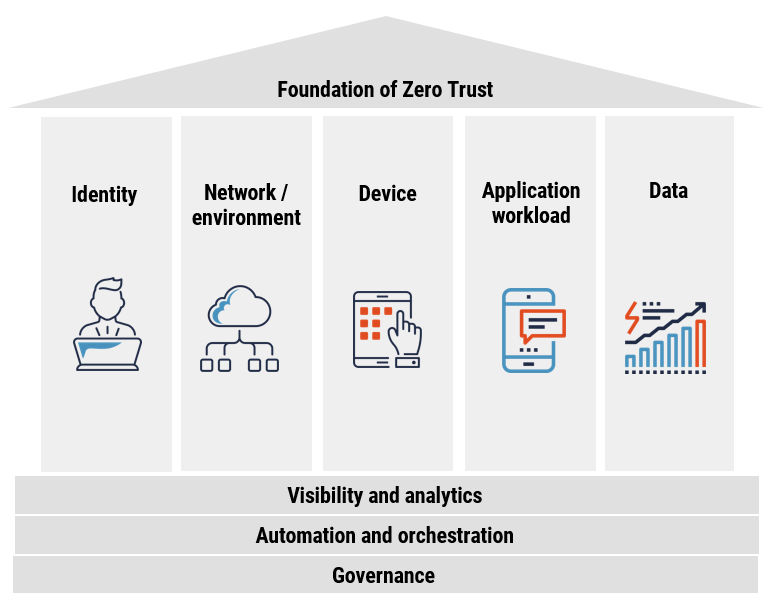
To implement a Zero Trust strategy effectively, organizations must address five key functional areas. Each pillar works in concert with the others to create a comprehensive security posture.
Identity Security
As mentioned, identity is the cornerstone of Zero Trust. This involves robust Identity and Access Management (IAM) systems. Multi-Factor Authentication (MFA) is a non-negotiable requirement, but modern Zero Trust goes further with “Adaptive MFA.” This uses risk-based signals to determine when a user should be prompted for additional verification. For instance, if a device is recognized and the location is standard, a simple push notification might suffice. If the risk profile changes, the system might require a biometric scan or a hardware-based security key.
Device Security
In a Zero Trust world, the health and security posture of a device are just as important as the identity of the user. Before granting access, the system must verify that the device is managed, patched, and free of malware. Unified Endpoint Management (UEM) tools are often used to check for compliance. If a device has an outdated operating system or has disabled its firewall, it is denied access to corporate resources until it is remediated.
Network Security and Micro-segmentation
Traditional networks are “flat,” meaning once you are in, you can see almost everything. Zero Trust replaces this with micro-segmentation. This involves breaking the network into small, isolated zones. Each zone has its own access policies. Even if a hacker compromises one server, they are trapped within that specific micro-segment and cannot “jump” to other parts of the data center. Zero Trust Network Access (ZTNA) is the technology that replaces traditional VPNs, providing secure, encrypted tunnels to specific applications rather than the whole network.
Workload Security
Workloads refer to the applications, containers, and virtual machines that run an organization’s business logic. In modern cloud environments, these workloads often communicate with each other via APIs. Zero Trust ensures that these “machine-to-machine” interactions are authenticated and authorized. This prevents a compromised application from being used as a staging ground to attack other services.
Data Security
Ultimately, the goal of all cyber security is to protect data. Zero Trust focuses on data-centric security. This involves classifying data based on its sensitivity (e.g., Public, Internal, Confidential, Restricted) and applying encryption and access controls accordingly. Data Loss Prevention (DLP) tools are integrated to monitor data movement and prevent unauthorized exfiltration, ensuring that even if an attacker gains access to the network, the most valuable data remains unreadable or inaccessible.
Implementing Zero Trust: From Strategy to Execution
Implementing Zero Trust is a journey, not a destination. It is a multi-year process that requires cultural changes as much as technical ones. The transition usually follows a structured roadmap.
Assessment and Asset Discovery
You cannot protect what you do not know exists. The first step is to identify all users, devices, applications, and data sets. Organizations must map their data flows to understand how information moves across the network. This “shadow IT” discovery is crucial, as many departments may be using cloud services that the IT department is unaware of.
Selecting the Right Technology Stack
Zero Trust requires a shift from siloed security tools to an integrated ecosystem. Key technologies include:
- Next-Generation Firewalls (NGFW): To handle internal micro-segmentation.
- Identity Providers (IdP): To serve as the “source of truth” for user identities.
- Policy Decision Points (PDP): Engines that evaluate access requests against established policies.
- Policy Enforcement Points (PEP): The gateways (like ZTNA proxies) that actually block or allow traffic.
Gradual Rollout and Optimization
Most organizations begin their Zero Trust journey by securing their most critical assets or their most vulnerable users (like third-party contractors). By starting small, IT teams can refine their policies and ensure that security measures do not hinder employee productivity. As the model matures, organizations move toward continuous diagnostics and mitigation, where the system automatically adjusts access levels based on real-time threat intelligence.

The Future of Zero Trust: AI, Automation, and Global Trends
As cyber threats become more sophisticated, Zero Trust is evolving to include artificial intelligence and machine learning. Manual policy management is becoming impossible at scale; therefore, AI-driven “Identity Analytics” are being used to detect subtle patterns that might indicate a compromised account. These systems can analyze millions of login events per second, identifying deviations from a user’s “normal” baseline that a human analyst would never notice.
Furthermore, the integration of Automation and Orchestration (SOAR) allows for near-instantaneous response. If a Zero Trust system detects a high-risk anomaly, it can automatically revoke a user’s session, isolate their device, and trigger an incident report without human intervention.
In conclusion, Zero Trust is the necessary evolution of cyber security in a hyper-connected, cloud-first world. By removing the assumption of trust and focusing on continuous, granular verification, organizations can build a resilient infrastructure capable of withstanding the complexities of the modern threat landscape. While the shift requires significant investment and a change in organizational mindset, the result is a security posture that is proactive, adaptive, and significantly more effective at protecting an organization’s most vital digital assets.
aViewFromTheCave is a participant in the Amazon Services LLC Associates Program, an affiliate advertising program designed to provide a means for sites to earn advertising fees by advertising and linking to Amazon.com. Amazon, the Amazon logo, AmazonSupply, and the AmazonSupply logo are trademarks of Amazon.com, Inc. or its affiliates. As an Amazon Associate we earn affiliate commissions from qualifying purchases.