
In the realm of mechanical engineering and industrial technology, few inventions have maintained such enduring relevance as the Zerk fitting. Often overlooked due to its diminutive size, this small hardware component is a cornerstone of mechanical maintenance, facilitating the longevity and efficiency of nearly every piece of moving machinery on the planet. From the heavy-duty actuators found in robotic manufacturing arms to the suspension systems of modern automotive fleets, the Zerk fitting—technically known as a grease nipple—serves as the critical interface between a lubrication tool and a mechanical bearing.
To understand what a Zerk fitting is, one must view it not merely as a piece of hardware, but as a vital technological solution to the problem of friction and heat. In a world increasingly dominated by software and digital interfaces, the Zerk fitting remains a physical “app” for hardware health, ensuring that metal-on-metal contact does not lead to catastrophic structural failure.
The Evolution of Lubrication Technology and Industrial Design
The history of the Zerk fitting is a masterclass in how a simple technological breakthrough can revolutionize an entire industry. Patented in 1929 by Oscar Zerk, an Austrian-born inventor, the Zerk fitting replaced the messy, inefficient methods of lubrication that preceded it. Before Zerk’s innovation, machinery often required teardowns for lubrication, or relied on simple oil holes that invited contaminants into sensitive bearing surfaces.
The Legacy of Oscar Zerk’s Innovation
The “Zerk” system was a leap forward in maintenance tech because it introduced a standardized, high-pressure connection point. The design allows a grease gun to snap onto the fitting, creating a leak-proof seal that permits lubricant to be injected at high pressures. This pressure is essential for forcing old, contaminated grease out of a bearing while simultaneously packing it with fresh lubricant. This mechanical logic—using pressure to clean and protect—remains the gold standard in industrial maintenance almost a century later.
Oscar Zerk’s contribution to the automotive and manufacturing sectors cannot be overstated. By standardizing the interface, he allowed for the mass production of specialized maintenance tools, creating an ecosystem where one grease gun could service thousands of different machines. This early form of “tech standardization” paved the way for modern modular manufacturing.
Material Science in Modern Fittings
While the basic design has remained relatively consistent, the materials used to manufacture Zerk fittings have evolved alongside modern metallurgical trends. Early fittings were often simple steel or brass. Today, fittings are engineered using high-grade stainless steel, Monel, or zinc-plated carbon steel to withstand extreme environments.
In the tech-heavy sectors of aerospace and maritime engineering, Zerk fittings must resist corrosive salt spray and extreme pressure differentials. Modern coatings like clear zinc chromate are applied using advanced electroplating techniques to ensure the fitting does not seize or corrode over a 20-year lifecycle. This focus on material durability reflects a broader trend in technology: the move toward “fit and forget” components that minimize human intervention in hazardous environments.
Technical Specifications and Engineering Principles
The Zerk fitting is a marvel of fluid dynamics. Its primary function is to act as a one-way valve, allowing lubricant to enter under pressure while preventing it from leaking back out—all while keeping dust, water, and grit away from the internal moving parts of the machine.
The Anatomy of a High-Pressure Seal
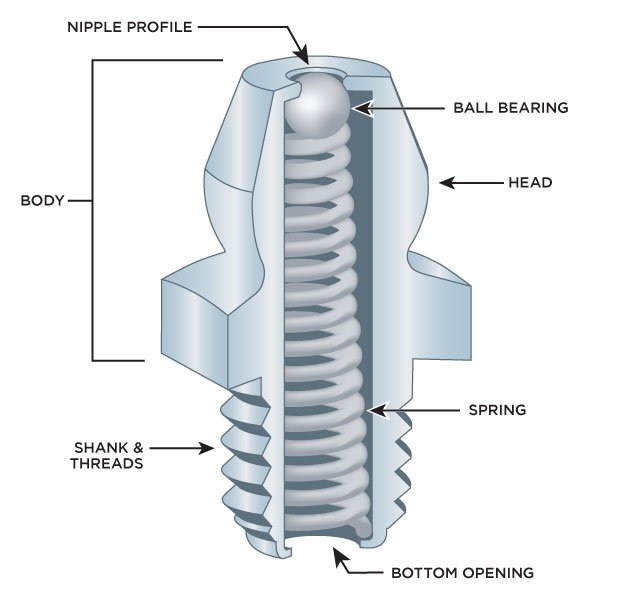
The internal architecture of a Zerk fitting consists of three main components: the body, a small steel ball, and a coil spring. When the nozzle of a grease gun is applied to the fitting, the pressure of the grease pushes the ball against the spring, opening a path into the bearing. As soon as the pressure is released, the spring forces the ball back into its seat, creating a hermetic seal.
This “check valve” mechanism is a precursor to the sophisticated valve technologies used in modern hydraulics and fuel injection systems. The precision with which the ball and seat are machined is critical; even a microscopic gap could allow pressurized grease to seep out, leading to lubrication failure. Engineering these components requires high-tolerance CNC machining to ensure that every fitting performs identically under loads of up to 10,000 PSI.
Standardizing Threads and Connection Interfaces
In the world of mechanical tech, compatibility is everything. Zerk fittings come in various thread patterns, including NPT (National Pipe Thread), Metric, and SAE-LT (Lubrication Thread). Identifying the correct thread is a technical skill essential for any maintenance professional.

Beyond thread sizes, the “head” of the fitting is standardized to allow for universal coupling. However, specialized tech requirements have led to the development of different shapes:
- Straight Fittings: Used when the bearing is easily accessible.
- Angled Fittings (45° or 90°): Essential for tight geometries where a straight grease gun nozzle cannot reach.
- Button-Head Fittings: Larger, flatter fittings used for high-volume grease delivery in heavy industrial equipment.
- Flush-Type Fittings: Designed for rotating parts where a protruding nipple would create a snag hazard or aerodynamic drag.
The Digital Frontier: Smart Lubrication and IoT Integration
As we transition into the era of Industry 4.0, the humble Zerk fitting is undergoing a digital transformation. The traditional “manual grease gun and a rag” approach is being replaced by sophisticated systems that integrate with software platforms to monitor equipment health in real-time.
Automated Lubrication Systems (ALS) and Software Monitoring
Modern industrial facilities are increasingly moving away from manual lubrication in favor of Automated Lubrication Systems (ALS). In these setups, a central pump is connected to a network of Zerk-style injection points. A software controller manages the timing and volume of grease delivered to each fitting.
This shift represents a significant trend in industrial technology: the move from reactive maintenance (fixing things when they break) to preventative and predictive maintenance. These software-driven systems ensure that every bearing receives the exact amount of lubricant required based on its operating hours and load conditions, eliminating human error and significantly extending the lifespan of multimillion-dollar assets.
Predictive Maintenance: Transitioning from Manual to Digital
The cutting edge of Zerk fitting technology involves the integration of IoT (Internet of Things) sensors. Some “smart” fittings are now equipped with pressure and flow sensors that transmit data wirelessly to a centralized maintenance dashboard.
If a fitting becomes clogged or a bearing begins to overheat, the system triggers an automated alert. This integration of mechanical hardware with digital security and monitoring software allows facility managers to view the “health” of their entire plant from a tablet or smartphone. It turns the Zerk fitting from a passive metal nipple into an active data node in a large-scale industrial network.
Maintenance Protocols and Technical Troubleshooting
Despite the rise of automation, manual maintenance remains a critical skill set in the gadgetry and hardware world. Understanding how to interact with Zerk fittings is essential for anyone managing mechanical technology.
Proper Greasing Techniques for Longevity
The most common mistake in maintenance tech is over-lubrication or the use of contaminated tools. A single grain of sand introduced through a Zerk fitting can act like a grinding paste, destroying a precision bearing in hours. Professional protocols require cleaning the tip of the fitting with a lint-free cloth before every application.
Furthermore, the “tech” of grease itself has changed. Maintenance professionals must ensure that the chemical composition of the new grease is compatible with what is already inside the bearing. Mixing lithium-based grease with polyurea-based grease, for example, can cause a chemical reaction that hardens the lubricant, rendering the Zerk fitting useless and leading to mechanical seizure.
Diagnosing and Replacing Faulty Fittings
Even the best-engineered hardware can fail. Zerk fittings can become “frozen” when old grease hardens inside the valve or when the internal spring loses its tension. Troubleshooting this involves using a specialized “fitting cleaner” tool—a gadget that uses hydraulic shock to force light oil through the blockage—or simply replacing the fitting entirely.
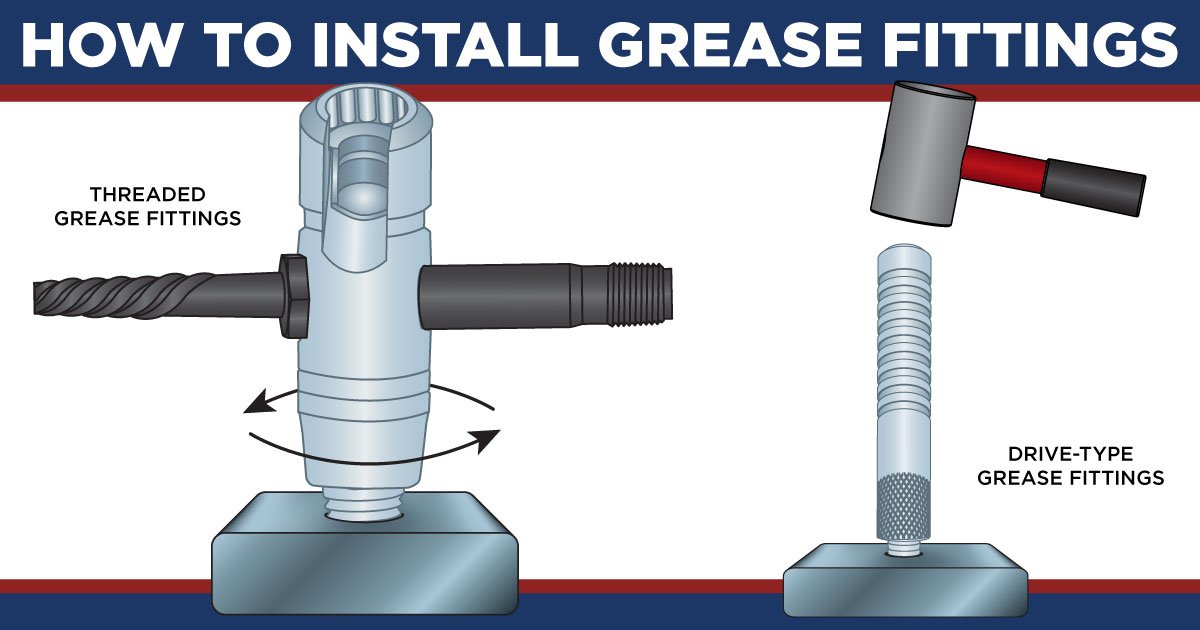
The replacement process is a standard “tutorial” in mechanical upkeep. It involves unscrewing the old fitting with a deep-well socket, cleaning the internal threads of the housing, and installing a new, high-quality Zerk fitting with the appropriate thread sealant. For businesses, mastering this simple technical task is the difference between a five-minute fix and a week of downtime for a broken machine.
In conclusion, the Zerk fitting is a perfect example of how fundamental mechanical technology supports the complex digital and industrial world we live in. While we often focus on AI, software, and high-level gadgets, these technologies are ultimately reliant on the physical machines that build and move them. By providing a reliable, standardized method for maintaining those machines, the Zerk fitting remains one of the most successful and essential technical innovations of the modern age. Whether it is a manual nipple on a vintage tractor or a sensor-monitored node in a smart factory, the Zerk fitting is the silent guardian of mechanical efficiency.
aViewFromTheCave is a participant in the Amazon Services LLC Associates Program, an affiliate advertising program designed to provide a means for sites to earn advertising fees by advertising and linking to Amazon.com. Amazon, the Amazon logo, AmazonSupply, and the AmazonSupply logo are trademarks of Amazon.com, Inc. or its affiliates. As an Amazon Associate we earn affiliate commissions from qualifying purchases.