
In the realm of mathematics, certain fundamental principles serve as the bedrock upon which more complex theories are built. Among these, the concept of any non-zero number raised to the power of zero, often represented as $x^0$, holds a unique and sometimes perplexing position. While it might seem counterintuitive at first glance, understanding why $x^0 = 1$ is crucial for grasping various mathematical operations and their applications, particularly in fields like computer science, data analysis, and financial modeling – domains where precision and a deep understanding of foundational principles are paramount.
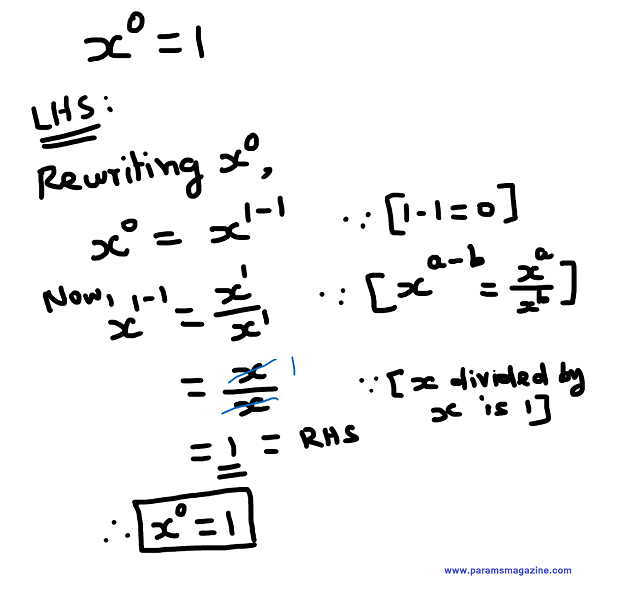
This article will delve into the “why” behind this seemingly simple rule, exploring its logical underpinnings through mathematical patterns and established properties. We will examine how this concept integrates with broader mathematical frameworks and illuminate its practical significance.
The Pattern of Exponents: Unveiling the Logic
The most intuitive way to understand why $x^0 = 1$ is by observing the pattern inherent in exponentiation. Consider a base number, say 2, and examine its values as the exponent decreases.
Decreasing Exponents Reveal the Trend
Let’s start with a clear exponent and progressively decrease it:
- $2^4 = 2 times 2 times 2 times 2 = 16$
- $2^3 = 2 times 2 times 2 = 8$
- $2^2 = 2 times 2 = 4$
- $2^1 = 2$
Notice the relationship between consecutive terms: to get from $2^4$ to $2^3$, we divide by 2. Similarly, from $2^3$ to $2^2$, we divide by 2, and from $2^2$ to $2^1$, we again divide by 2. This consistent pattern suggests a division by the base for each unit decrease in the exponent.
If we continue this pattern, what should $2^0$ be? Following the established trend, we should divide the previous term ($2^1$, which is 2) by the base (2).
$2^0 = frac{2^1}{2} = frac{2}{2} = 1$
This observation strongly suggests that any non-zero number raised to the power of zero should equal 1. This pattern holds true regardless of the base chosen. For instance:
- $3^3 = 27$
- $3^2 = 9$
- $3^1 = 3$
- $3^0 = frac{3^1}{3} = frac{3}{3} = 1$
The Role of Division in Exponent Patterns
This pattern is intimately linked to the properties of exponents, specifically the rule for dividing powers with the same base: $frac{x^a}{x^b} = x^{a-b}$.
Let’s consider the case where $a = b$. According to this rule, $frac{x^a}{x^a} = x^{a-a} = x^0$.
However, we also know that any non-zero number divided by itself is equal to 1. Therefore, $frac{x^a}{x^a} = 1$ (provided $x neq 0$).
By equating these two expressions, we arrive at the fundamental conclusion:
$x^0 = 1$
This derivation, rooted in the consistent behavior of exponentiation and the rules of division, provides a robust mathematical justification for the concept. It’s not an arbitrary rule but a logical extension of how exponents function.
Mathematical Properties Supporting $x^0 = 1$
Beyond observing patterns, several fundamental properties of exponents solidify the definition of $x^0$ as 1. These properties are essential for algebraic manipulations and ensure consistency across mathematical operations.
The Product of Powers Rule
The product of powers rule states that when multiplying two exponential expressions with the same base, you add their exponents: $x^a times x^b = x^{a+b}$.
Let’s consider what happens when we multiply a number by itself raised to the power of zero. Using the product of powers rule, we can write:
$x^a times x^0 = x^{a+0} = x^a$
Now, for this equation to hold true, the term $x^0$ must be the multiplicative identity. The multiplicative identity is a number that, when multiplied by any other number, does not change that other number. In mathematics, the multiplicative identity is 1.
Therefore, for the equation $x^a times x^0 = x^a$ to be valid, $x^0$ must equal 1. This property demonstrates that defining $x^0$ as 1 maintains the integrity and predictability of the product of powers rule.
The Quotient of Powers Rule (Revisited)
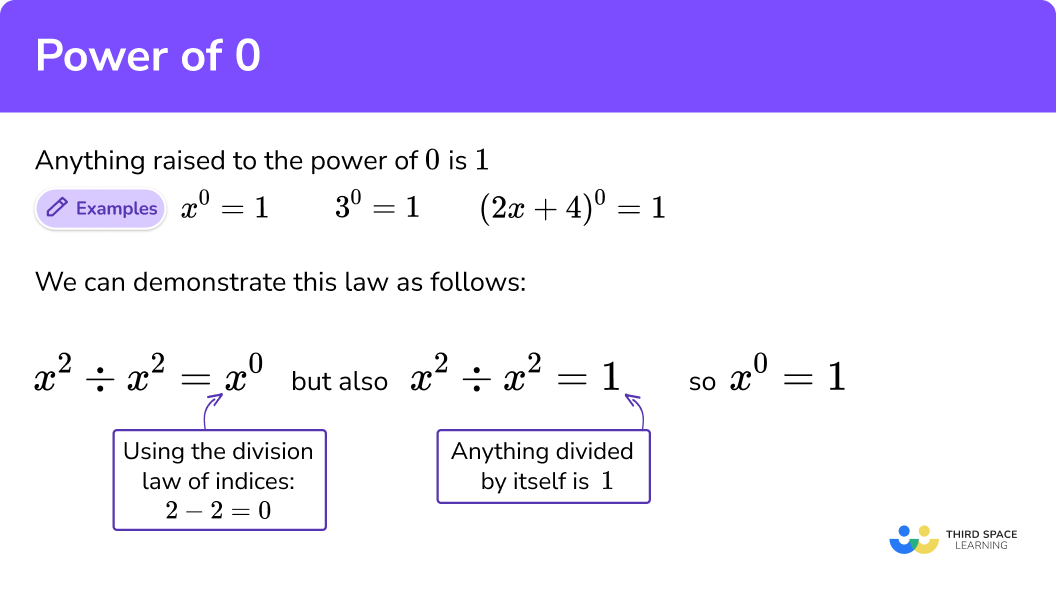
We touched upon this earlier, but it’s worth reiterating its significance. The quotient of powers rule states that when dividing two exponential expressions with the same base, you subtract their exponents: $frac{x^a}{x^b} = x^{a-b}$.
If we set $a = 0$ and $b > 0$, we get:
$frac{x^0}{x^b} = x^{0-b} = x^{-b}$
However, if we consider the numerical value of $frac{x^0}{x^b}$, and we assume $x^0 = 1$, then:
$frac{1}{x^b} = x^{-b}$
This result aligns perfectly with the definition of negative exponents, where $x^{-n} = frac{1}{x^n}$. This consistency reinforces that $x^0 = 1$ is not just a standalone rule but an integral part of the broader system of exponent rules.
The Special Case: What About $0^0$?
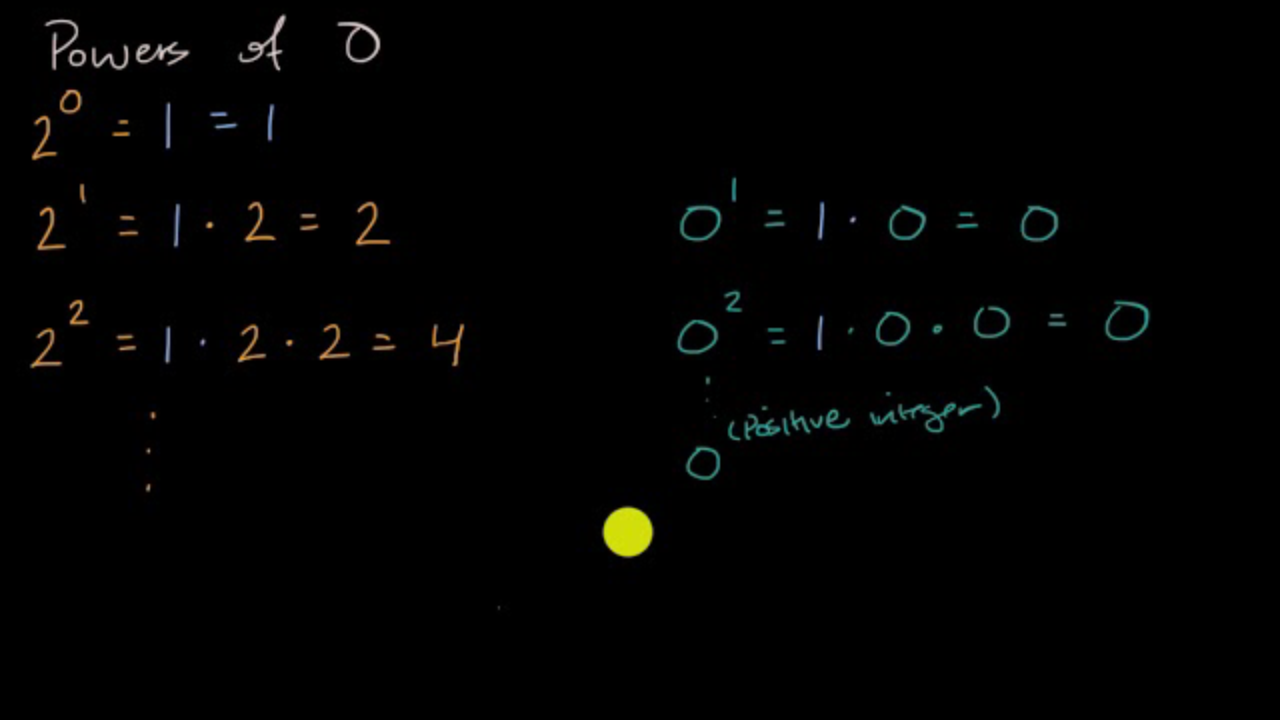
While we’ve established that for any non-zero number $x$, $x^0 = 1$, the case of $0^0$ is more complex and often considered an indeterminate form.
Indeterminate Forms in Mathematics
An indeterminate form is an expression that, when evaluated using standard rules, does not have a single, well-defined value. Examples include $frac{0}{0}$, $frac{infty}{infty}$, and $0 times infty$. The value of an indeterminate form depends on the specific context and the functions leading to it.
The expression $0^0$ falls into this category. There are arguments that could lead to different conclusions:
- Argument for 1: Following the pattern $x^0 = 1$ for all $x neq 0$, one might assume $0^0 = 1$. This interpretation is often useful in combinatorial mathematics and computer science, where $0^0 = 1$ can simplify formulas and algorithms. For example, in the binomial theorem, $(a+b)^n = sum_{k=0}^n binom{n}{k} a^{n-k} b^k$. If $a=0$ and $n=0$, the term for $k=0$ is $binom{0}{0} 0^0 b^0$. With $binom{0}{0}=1$ and $b^0=1$, we need $0^0=1$ for the formula to work correctly in this edge case.
- Argument for Undefined: Alternatively, if we consider the definition of $0^n$ for $n > 0$, which is $0 times 0 times … times 0$ ($n$ times), the result is always 0. If we try to extend the rule $x^0=1$ to $x=0$, we are trying to define $0^0$ based on a rule derived for non-zero bases.
Practical Implications and Conventions
Due to this ambiguity, $0^0$ is often treated differently depending on the mathematical context:
- In Calculus and Limits: When $0^0$ arises as a limit, it is considered an indeterminate form, meaning further analysis (like using L’Hôpital’s Rule) is required to determine its actual value, which could be 0, 1, or another number entirely, depending on how the numerator and denominator approach zero.
- In Algebra and Computer Science: For pragmatic reasons, especially in discrete mathematics, combinatorics, and many programming languages, $0^0$ is frequently defined as 1. This convention simplifies many mathematical formulas and avoids special case handling in algorithms. For instance, the power function in many programming languages (like Python’s
pow(0, 0)or0**0) returns 1.
Therefore, while $x^0 = 1$ is a robust rule for any non-zero $x$, the value of $0^0$ is contextual and depends on whether it’s being treated as a strict mathematical definition or a practical convention for simplifying calculations.
Applications of $x^0 = 1$ in Various Fields
The seemingly simple rule $x^0 = 1$ has profound implications and finds widespread application across numerous disciplines, particularly those heavily reliant on mathematical rigor and computational power.
In Computer Science and Algorithms
In computer science, exponents are fundamental to understanding data structures, algorithms, and computational complexity.
- Base Cases in Recursion: Many recursive algorithms use $x^0=1$ as a base case. For example, in calculating powers iteratively or recursively, the stopping condition often involves the exponent reaching zero, where the result is defined as 1.
- Polynomial Representations: Polynomials, which are ubiquitous in computer graphics, signal processing, and machine learning, are expressed using powers of variables. For instance, $ax^2 + bx^1 + cx^0$. The $cx^0$ term simplifies to $c$, representing the constant term of the polynomial. Without $x^0=1$, this representation would be awkward.
- Combinatorics and Counting: In combinatorics, the number of ways to choose zero items from a set of $n$ items (denoted as $binom{n}{0}$) is 1. This is a direct application where $n^0=1$ is implicitly used in some combinatorial identities.
- Big O Notation: In analyzing the efficiency of algorithms, Big O notation is used to describe the upper bound of an algorithm’s runtime or space complexity. For instance, $O(1)$ represents constant time complexity, which can be thought of as a function where the input size raised to the power of 0 is involved, signifying that the time taken does not grow with the input size.
In Financial Mathematics and Economics
The precision offered by mathematical principles, including exponent rules, is crucial in financial modeling, risk assessment, and economic forecasting.
- Present Value and Future Value Calculations: Formulas for calculating present and future values of money involve exponential growth or decay. For instance, the present value (PV) of a single future sum is $PV = frac{FV}{(1+r)^n}$, where $FV$ is the future value, $r$ is the interest rate, and $n$ is the number of periods. If $n=0$ (i.e., calculating the present value of a sum received immediately), the formula becomes $PV = frac{FV}{(1+r)^0} = frac{FV}{1} = FV$, which is correct – the value of money today is its face value.
- Compound Interest: The compound interest formula, $A = P(1+r)^n$, where $A$ is the amount, $P$ is the principal, $r$ is the rate, and $n$ is the number of periods, also relies on this rule. When $n=0$, $A = P(1+r)^0 = P$, indicating that after zero periods, the amount is just the initial principal.
- Economic Growth Models: Various economic models, from simple growth projections to complex macroeconomic simulations, utilize exponential functions. The base case of zero growth or zero time elapsed naturally leads to situations where an exponent of zero is encountered.
In Scientific Notation and Measurement
Scientific notation is a standardized way to express very large or very small numbers. The use of powers of 10 is central to this system.
- Unit Prefixes: In the metric system and SI units, prefixes like “kilo” (10^3), “mega” (10^6), and “nano” (10^-9) represent powers of 10. When dealing with a base unit, it can be thought of as being multiplied by 10^0. For example, 1 meter is $1 times 10^0$ meters.
- Logarithmic Scales: Many scientific measurements, such as pH, decibels, and Richter scale magnitudes, are based on logarithms, which are inverse operations of exponentiation. The base of these logarithms is often 10. A value of 0 on such a scale often corresponds to $10^0$, which signifies a baseline or neutral point (e.g., neutral pH is 7, which is $-log_{10}(10^{-7})$).
In conclusion, the rule $x^0 = 1$ is not merely an isolated mathematical curiosity. It is a fundamental principle that ensures the consistency and coherence of mathematical systems, enabling precise calculations and elegant solutions across a vast spectrum of technological, financial, and scientific applications. Understanding its origins and applications is a key step in mastering the quantitative aspects of our modern world.
aViewFromTheCave is a participant in the Amazon Services LLC Associates Program, an affiliate advertising program designed to provide a means for sites to earn advertising fees by advertising and linking to Amazon.com. Amazon, the Amazon logo, AmazonSupply, and the AmazonSupply logo are trademarks of Amazon.com, Inc. or its affiliates. As an Amazon Associate we earn affiliate commissions from qualifying purchases.