
When consumers ask, “What is WD-40 made of?” they are rarely looking for a periodic table breakdown of aliphatic hydrocarbons and petroleum-based base oils. While the chemical composition is a marvel of 1950s engineering, the true “ingredients” of WD-40 are far more complex. From a brand strategy perspective, WD-40 is composed of three parts mystery, two parts utility, and a generous pour of nostalgic brand equity.
For over seven decades, the blue and yellow can has occupied a singular space in the global marketplace. It is more than a lubricant; it is a cultural shorthand for “fixing things.” To understand what WD-40 is truly made of, we must look beyond the liquid inside and examine the masterclass in brand strategy, corporate identity, and marketing psychology that has kept the company relevant in a rapidly changing world.
The Power of Mystery: How a “Secret Formula” Built a Multi-Billion Dollar Brand
In the world of corporate identity, nothing is as potent as a well-kept secret. Much like the recipe for Coca-Cola or the herbs and spices of KFC, the WD-40 formula is a trade secret, not a patented invention. This distinction is the cornerstone of the brand’s marketing strategy.
The Coca-Cola Comparison: Marketing the Unknown
A patent requires a company to disclose its ingredients to the public in exchange for a limited period of exclusivity. By choosing the path of the trade secret, the Rocket Chemical Company (now the WD-40 Company) ensured that the exact makeup of their product would remain a mystery indefinitely. This “unknown” factor creates a narrative of uniqueness. When a consumer buys WD-40, they aren’t just buying a water displacer; they are buying a proprietary solution that “the competitors can’t quite match.” This perceived exclusivity is a powerful driver of brand loyalty.
The Narrative of the 40th Attempt
The very name “WD-40” is a branding gift. Standing for “Water Displacement, 40th Formula,” the name tells a story of persistence, engineering excellence, and the scientific method. From a brand strategy standpoint, this narrative humanizes the product. It suggests a history of trial and error, positioning the liquid as the “perfected” version of a long journey. When consumers use the product, they are participating in the success of that 40th attempt, reinforcing the idea that this is the definitive solution to their problem.
Visual Identity and Consistency: Why the Blue and Yellow Can Never Changes
In an era of frequent “rebrandings” and “logo refreshes,” WD-40 stands as a monument to visual consistency. The iconic blue and yellow shield logo, set against a bright yellow background, has remained largely unchanged since its inception. This consistency is not a lack of innovation; it is a calculated brand strategy designed to anchor consumer trust.
Brand Recognition in a Saturated Market
The hardware store aisle is a chaotic environment filled with hundreds of competing products. In this high-noise environment, the WD-40 can acts as a visual lighthouse. Because the brand has maintained its visual identity for decades, it has achieved “instant recall.” A customer can identify a can of WD-40 from across a large warehouse without even reading the label. This level of brand penetration is the holy grail of corporate identity, reducing the “cognitive load” on the consumer and making the purchase decision nearly automatic.
Psychological Anchoring: The “Fix-It” Color Palette
The choice of colors—primary blue and bright yellow—conveys a sense of industrial reliability and optimism. Blue is psychologically associated with trust and stability, while yellow evokes energy and clarity. Together, they create a “Fix-It” color palette that signals to the brain: This product works. By refusing to chase modern design trends like minimalism or matte finishes, WD-40 preserves its status as a timeless tool, much like a hammer or a screwdriver, rather than a disposable chemical product.
Positioning and Utility: From Aerospace Specialty to Household Essential
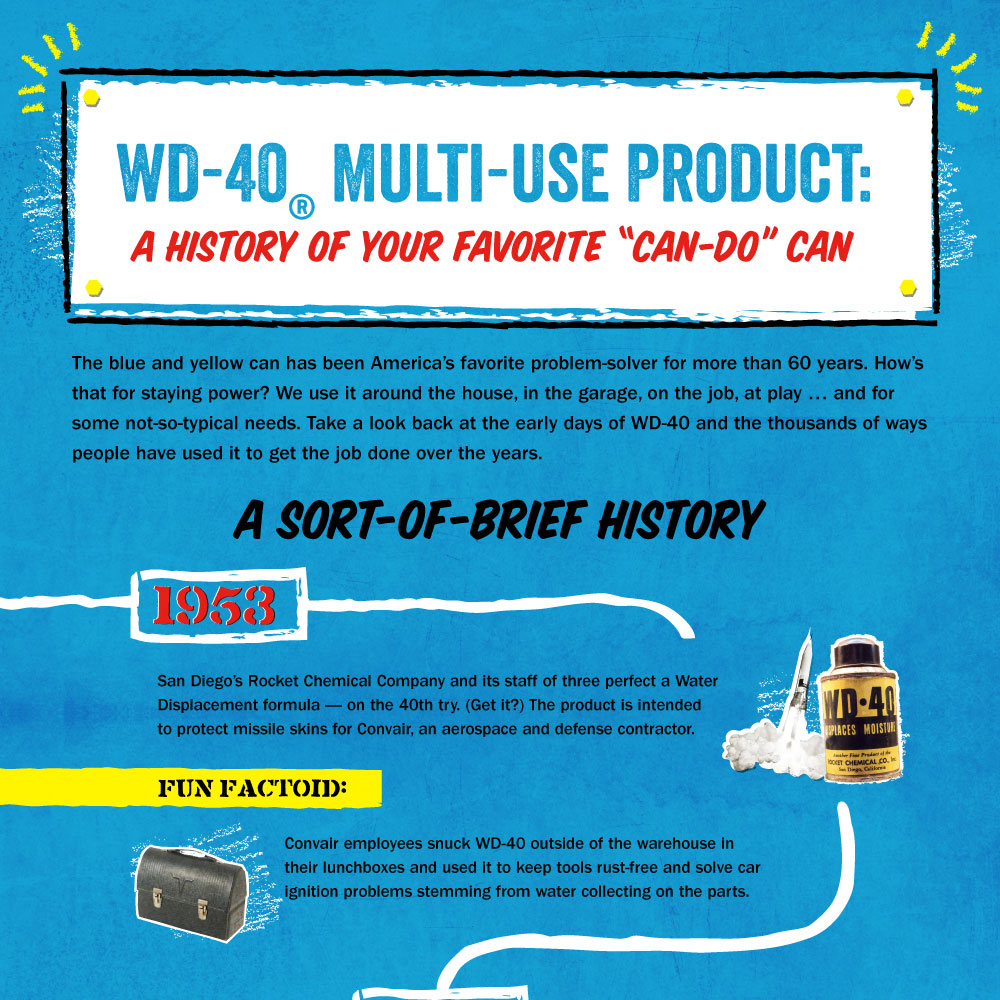
What WD-40 is “made of” changed significantly when the brand moved from the industrial sector to the consumer pantry. Originally developed for the aerospace industry to protect the outer skin of the Atlas Missile from rust and corrosion, the product’s journey into the American home is a classic case study in market positioning and utility expansion.
Expanding the Use Case Through Community Engagement
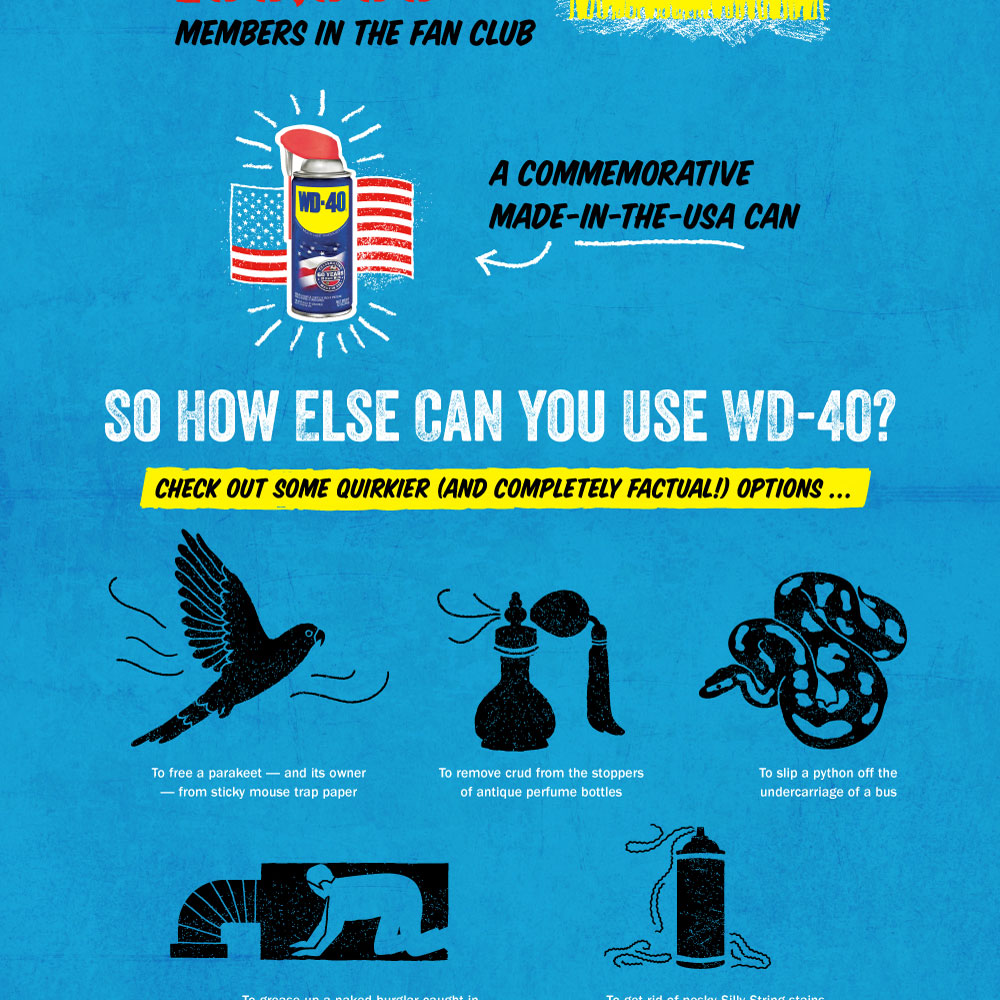
A brand is only as strong as its utility. While many products have a single use, WD-40 is marketed as the “Swiss Army Knife” of aerosols. The company has brilliantly leveraged “User-Generated Content” (UGC) long before the term existed. By encouraging fans to share unusual uses for the product—from cleaning crayon marks off walls to lubricating prosthetic limbs—the brand shifted from a niche industrial tool to an essential household “hack.”
The “List of 2,000 Uses” as a Content Marketing Strategy
One of the most effective marketing assets in the company’s history is the “List of 2,000 Uses.” This list isn’t just a document; it’s a brand promise. It transforms the product from a “water displacer” into a “problem solver.” By documenting and publicizing these thousands of uses, WD-40 ensures that the product never becomes obsolete. If you don’t have a squeaky door today, you might have a stuck zipper tomorrow, or a rusted bicycle chain next week. This versatility keeps the product in the consumer’s “active” inventory, preventing it from being pushed to the back of the shelf.
Intellectual Property Strategy: Why Trade Secrets Often Beat Patents
From a business finance and strategy perspective, the decision regarding “what WD-40 is made of” is a lesson in intellectual property management. The company’s refusal to patent the formula is one of the most successful defensive brand strategies in history.
The Strategic Choice Against Patenting
If the founders had patented WD-40 in 1953, the patent would have expired in the 1970s. At that point, competitors would have been legally allowed to manufacture the exact same formula, likely at a lower price point. By keeping it a trade secret, the company maintained a permanent competitive advantage. This strategy requires immense internal security—the formula is allegedly locked in a bank vault in San Diego—but the payoff is a brand that cannot be truly “genericized.”
Safeguarding the Formula in the Modern Age
In an age of reverse engineering and chemical analysis, maintaining a trade secret is harder than ever. However, the WD-40 Company has integrated this challenge into its brand narrative. They lean into the “mystery” of the formula, making the secrecy part of the product’s allure. Even if a competitor managed to replicate the liquid exactly, they would lack the “Blue and Yellow Can” and the 70 years of trust that accompany it. This proves that a brand’s most valuable asset isn’t just the product’s physical makeup, but the proprietary “story” that surrounds it.
Brand Longevity and the Future of WD-40
As we move toward a more environmentally conscious marketplace, what WD-40 is “made of” is coming under new scrutiny. The brand’s ability to adapt its “ingredients”—both physical and strategic—will determine its success in the next century.
Adapting to Modern Environmental Standards Without Losing Identity
The brand has successfully navigated the transition to low-VOC (Volatile Organic Compound) formulas and non-aerosol delivery systems (like the “Big Blast” and “Smart Straw”) without compromising its core identity. This is a delicate balancing act in brand management: evolving the product to meet modern regulatory and consumer demands while ensuring the user experience (the smell, the texture, the results) remains consistent with the “original” formula.

Conclusion: The Brand is the Ingredient
Ultimately, when someone asks what WD-40 is made of, the answer lies in the intersection of chemical utility and emotional connection. It is made of the smell of a grandfather’s workshop; it is made of the satisfaction of a squeak finally silenced; it is made of the reliability of a shield logo that never changes.
The WD-40 Company doesn’t just sell a lubricant; they sell “Peace of Mind in a Can.” By focusing on a secret formula, a consistent visual identity, and a near-infinite list of use cases, they have built a brand that is resistant to competition and immune to the passage of time. In the world of branding, that is the most powerful formula of all.
aViewFromTheCave is a participant in the Amazon Services LLC Associates Program, an affiliate advertising program designed to provide a means for sites to earn advertising fees by advertising and linking to Amazon.com. Amazon, the Amazon logo, AmazonSupply, and the AmazonSupply logo are trademarks of Amazon.com, Inc. or its affiliates. As an Amazon Associate we earn affiliate commissions from qualifying purchases.