
In an era where cyber threats are becoming increasingly sophisticated and frequent, organizations of all sizes are searching for robust, scalable, and cost-effective ways to protect their digital assets. Traditional security tools often operate in silos, leaving gaps in visibility that attackers can exploit. This is where Wazuh enters the conversation. As a free, open-source security platform, Wazuh has emerged as a powerhouse in the world of cybersecurity, combining the capabilities of a Security Information and Event Management (SIEM) system with Extended Detection and Response (XDR).
This guide explores the technical intricacies of Wazuh, its architecture, its core functionalities, and why it has become a staple for security operations centers (SOCs) globally.
Understanding Wazuh: More Than Just an IDS
To understand what Wazuh is today, one must look at its technical evolution and its classification within the security software ecosystem. While many categorize it simply as an intrusion detection system (IDS), its modern iteration provides a far more holistic approach to digital security.
The Evolution of Wazuh from OSSEC
Wazuh began its life as a fork of OSSEC (Open Source HIDS Security), a popular host-based intrusion detection system. While OSSEC was revolutionary for its time, the developers of Wazuh recognized the need for better integration, a more intuitive user interface, and expanded capabilities to handle modern cloud environments. Over the years, Wazuh has evolved independently, introducing a massive rule set, a powerful web dashboard (based on OpenSearch/Kibana), and a more resilient communication protocol between its components. Today, it is recognized not just as a successor to OSSEC but as a comprehensive platform that rivals expensive proprietary security suites.
SIEM and XDR: A Dual Approach to Security
Wazuh effectively bridges the gap between SIEM and XDR. As a SIEM, it excels at collecting, aggregating, and analyzing log data from across an entire infrastructure—including servers, network devices, and cloud services. It provides the “single pane of glass” visibility required for regulatory compliance and historical incident investigation.
As an XDR platform, Wazuh goes a step further by providing active response capabilities. It doesn’t just alert a technician that a breach is occurring; it can be configured to take automated actions, such as blocking an IP address at the firewall or killing a malicious process on an endpoint. This dual approach allows tech teams to move from a reactive posture to a proactive defense strategy.
Core Architecture and Components
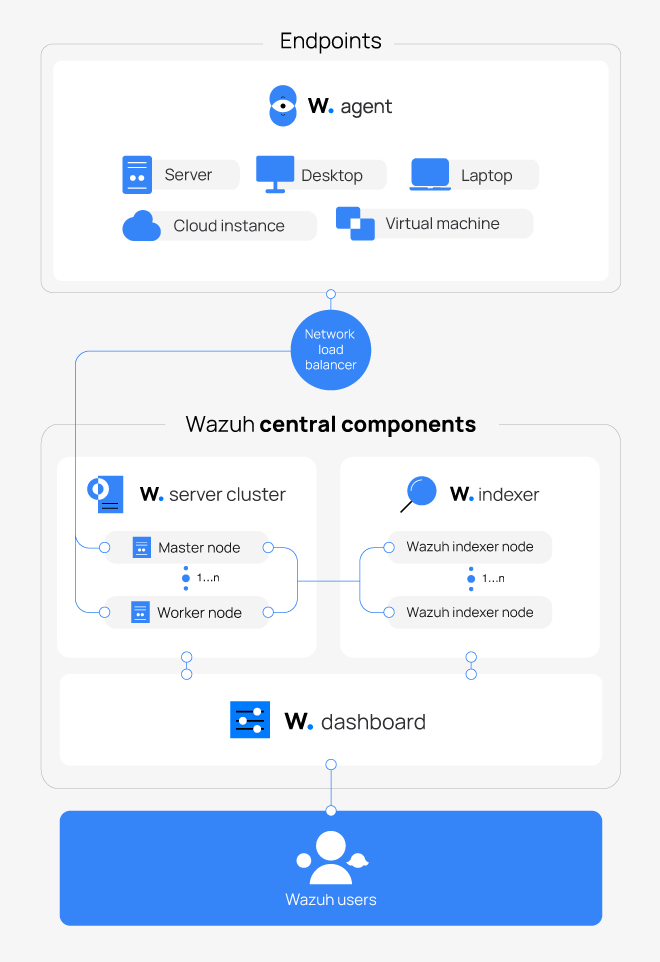
The effectiveness of Wazuh lies in its distributed architecture. It is designed to be highly scalable, allowing it to monitor thousands of endpoints across geographically dispersed data centers or cloud providers.
The Wazuh Agent: The Eyes and Ears of the System
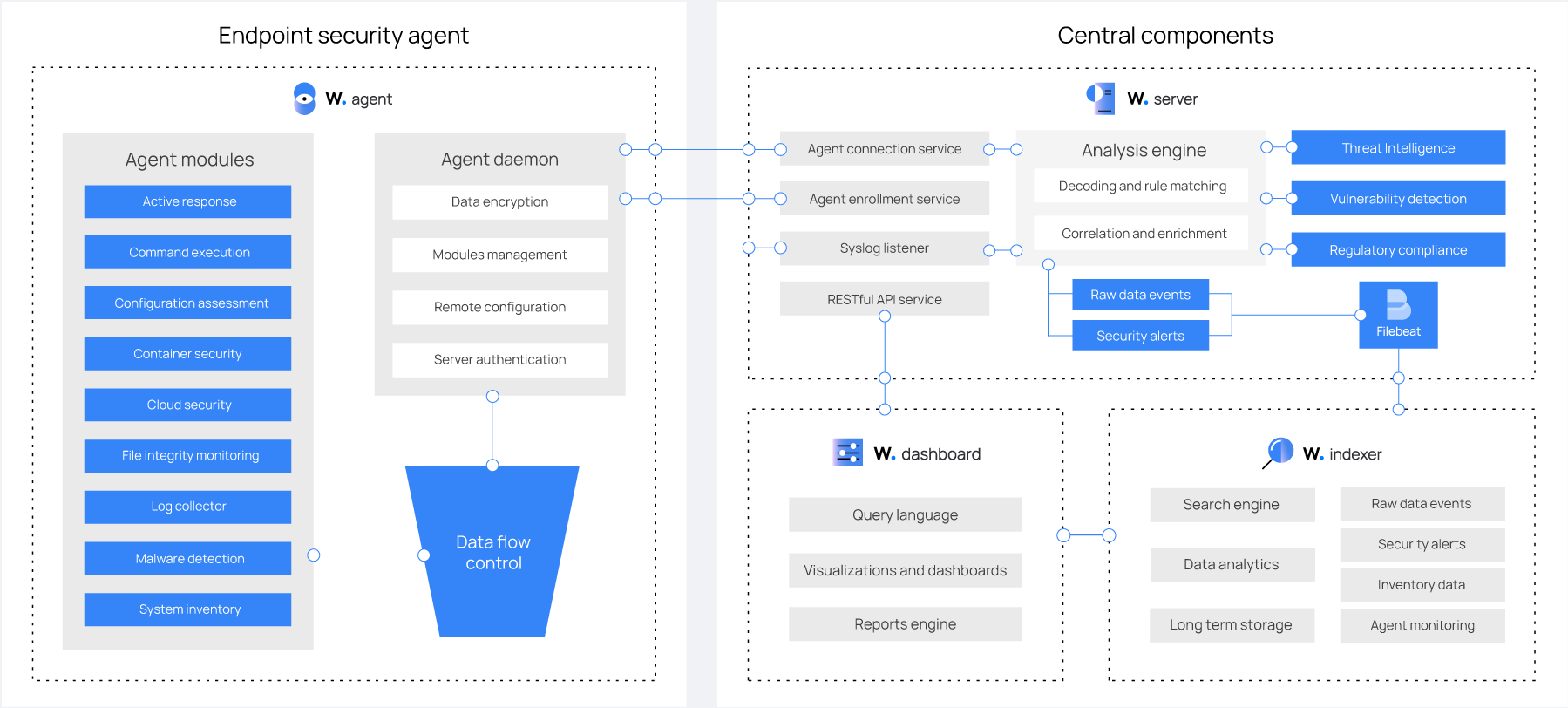
The Wazuh agent is a lightweight, multi-platform software component installed on the endpoints—such as Windows, Linux, macOS, Solaris, or AIX systems. Its primary role is to monitor the host’s activity and send telemetry data back to the central server. The agent is designed to have a minimal footprint on system resources, ensuring that security monitoring does not degrade the performance of critical applications. It performs tasks such as log collection, file integrity monitoring, rootkit detection, and configuration assessment, acting as the frontline sensor for the entire security stack.
The Wazuh Server: The Central Intelligence Hub
The server (or manager) is the brain of the operation. It receives data from the agents, decodes the information, and runs it through a massive engine of correlation rules. If a log entry matches a known threat pattern or violates a security policy, the server generates an alert. The server also manages agent registration, remote configuration, and status monitoring. In large-scale enterprise environments, multiple Wazuh servers can be clustered together to provide high availability and load balancing, ensuring that security monitoring never goes offline.
Indexing and Visualization with the Elastic Stack
Raw security data is only useful if it can be searched and visualized effectively. Wazuh integrates deeply with the Elastic Stack (Elasticsearch, Logstash, and Kibana) or its open-source alternative, OpenSearch. The Wazuh Indexer stores the alerts and events in a searchable format, while the Wazuh Dashboard provides a rich, graphical interface. Security analysts use this dashboard to view real-time threat maps, drill down into specific alerts, and generate reports for stakeholders. This visualization layer is critical for identifying trends, such as a sudden spike in failed login attempts that might indicate a brute-force attack.
Key Features and Capabilities
Wazuh is packed with features that cover almost every aspect of modern endpoint protection and network security. Its versatility makes it suitable for diverse use cases, from protecting small web servers to securing massive enterprise clouds.
Intrusion Detection and Log Data Analysis
At its core, Wazuh is an expert at log analysis. It can ingest logs from almost any source—operating systems, applications, firewalls, and web servers. By using sophisticated decoders and rules, Wazuh identifies anomalies that would be impossible for a human to spot manually. For example, it can correlate a suspicious login attempt on a VPN with a subsequent unusual file access on a database server, alerting the security team to a potential lateral movement within the network.
Vulnerability Detection and Configuration Assessment
Modern security is as much about prevention as it is about detection. Wazuh agents periodically scan the host systems to identify installed software and compare version numbers against known CVE (Common Vulnerabilities and Exposures) databases. This allows administrators to see exactly which servers need patching before an attacker can exploit them. Additionally, Wazuh performs Security Configuration Assessment (SCA) by checking system settings against industry benchmarks like CIS (Center for Internet Security). It identifies misconfigured services or “leaky” permissions that could serve as an entry point for malware.
File Integrity Monitoring (FIM) and Regulatory Compliance
One of the most powerful features of Wazuh is its File Integrity Monitoring (FIM). It tracks changes to critical system files, directories, and registry keys in real-time. If a system file is modified, deleted, or created, Wazuh captures the details, including who made the change and what exactly was altered. This is a mandatory requirement for many regulatory frameworks. Wazuh includes built-in modules to help organizations meet compliance standards such as PCI DSS (for credit card data), HIPAA (for healthcare), GDPR (for privacy), and SOC2.
Why Organizations Choose Wazuh
The shift toward open-source security tools is not just about saving money; it is about control, transparency, and agility. Wazuh offers several advantages that make it a compelling choice over proprietary alternatives.
Open Source Flexibility vs. Proprietary Costs
The most immediate benefit of Wazuh is its open-source nature. Organizations can deploy the full-featured version of the platform without paying per-agent licensing fees, which can be prohibitively expensive in large environments. This “no-vendor-lock-in” approach allows tech teams to invest their budget into hardware, cloud infrastructure, or skilled personnel rather than software licenses. Furthermore, because the source code is public, it can be audited for security and customized to fit highly specific technical requirements.
Scalability for Enterprise Environments
Wazuh is built for the cloud era. It can be deployed in containers using Docker and orchestrated with Kubernetes, making it easy to scale security alongside application workloads. Whether an organization is monitoring ten servers or ten thousand, Wazuh’s clustered architecture ensures that it can handle the data ingestion load. Its ability to monitor multi-cloud environments (AWS, Azure, and Google Cloud) and on-premise hardware simultaneously makes it a perfect fit for hybrid infrastructure strategies.
Active Community and Integration Ecosystem
The strength of an open-source project is often measured by its community. Wazuh boasts a vibrant ecosystem of contributors and users who share custom rules, integration scripts, and troubleshooting tips. This community-driven model ensures that the platform evolves quickly to address new threats. Additionally, Wazuh integrates seamlessly with other tech tools like Slack for alerting, Jira for incident management, and various Threat Intelligence feeds, allowing it to fit perfectly into an existing DevOps or SecOps workflow.
Getting Started and Future Outlook
As the digital landscape shifts toward remote work and decentralized infrastructure, the role of comprehensive security platforms like Wazuh becomes even more critical.
Deployment Options: Cloud vs. On-Premise
Tech teams have several ways to deploy Wazuh. For those who want full control over their data and infrastructure, an on-premise installation on Linux servers is the standard approach. For organizations that prefer a managed experience, Wazuh offers a Cloud service (SaaS), where they handle the maintenance, scaling, and updates of the server and indexer, allowing the user to focus solely on monitoring their agents. The installation of agents is generally straightforward, often involving a single command line or an MSI package for Windows environments.
The Future of Wazuh in the Age of AI and Automation
Looking ahead, the development of Wazuh is increasingly focused on automation and artificial intelligence. Future iterations are expected to include more advanced machine learning modules to detect “zero-day” threats that do not yet have a signature or rule. By analyzing behavioral patterns rather than just static logs, Wazuh aims to stay one step ahead of attackers. As the platform continues to mature, its integration of automated response and sophisticated data analytics will likely solidify its position as the go-to open-source solution for modern cybersecurity.
In conclusion, Wazuh is a versatile, powerful, and essential tool for any tech professional tasked with securing a digital environment. By combining the best aspects of SIEM and XDR into an open-source package, it democratizes high-level security, making enterprise-grade protection accessible to everyone.
aViewFromTheCave is a participant in the Amazon Services LLC Associates Program, an affiliate advertising program designed to provide a means for sites to earn advertising fees by advertising and linking to Amazon.com. Amazon, the Amazon logo, AmazonSupply, and the AmazonSupply logo are trademarks of Amazon.com, Inc. or its affiliates. As an Amazon Associate we earn affiliate commissions from qualifying purchases.