
In the early days of networking, physical boundaries defined digital boundaries. If a department needed a private network, it required dedicated switches, separate cabling, and isolated hardware. However, as enterprise environments scaled and the density of devices exploded, this hardware-centric approach became unsustainable. Enter the Virtual Local Area Network (VLAN).
At the heart of modern network virtualization is a process known as VLAN tagging. It is the invisible “sorting office” of a network, ensuring that data packets from different departments, security zones, or applications can share the same physical wires without ever leaking into one another. For IT professionals, network architects, and digital security experts, understanding VLAN tagging is not just a technical requirement—it is the foundation of building a scalable, secure, and efficient infrastructure.

The Core Mechanics: How VLAN Tagging Operates
To understand VLAN tagging, one must first understand the Ethernet frame. In a standard, non-vlan environment, an Ethernet frame travels from source to destination containing basic information: MAC addresses, data payloads, and error-checking sequences. However, when we introduce multiple virtual networks onto a single physical switch, the switch needs a way to identify which “virtual” bucket a frame belongs to.
The IEEE 802.1Q Standard
The industry standard for VLAN tagging is IEEE 802.1Q, often referred to as “Dot1Q.” When a frame is “tagged,” the switch inserts a 32-bit (4-byte) field into the original Ethernet frame header. This tag acts as a digital passport. It tells every subsequent switch or router along the path exactly which VLAN the packet is authorized to traverse.
Within this 32-bit tag, the most critical component is the VLAN Identifier (VID). The VID is a 12-bit field, which allows for 4,096 unique VLANs. This might seem like a large number, but in massive data centers, even this limit has pushed the industry toward newer protocols like VXLAN.
Anatomy of a Tagged Frame
The 802.1Q tag is composed of several sub-fields that provide more than just identification:
- Tag Protocol Identifier (TPID): A 16-bit field set to 0x8100 to identify the frame as an 802.1Q tagged frame.
- Priority Code Point (PCP): A 3-bit field used for Quality of Service (QoS), prioritizing critical traffic like VoIP or video over standard web browsing.
- Drop Eligible Indicator (DEI): Used in conjunction with PCP to indicate frames that can be dropped during periods of congestion.
- VLAN ID (VID): The specific ID (1 to 4094) of the VLAN.
Access Ports vs. Trunk Ports
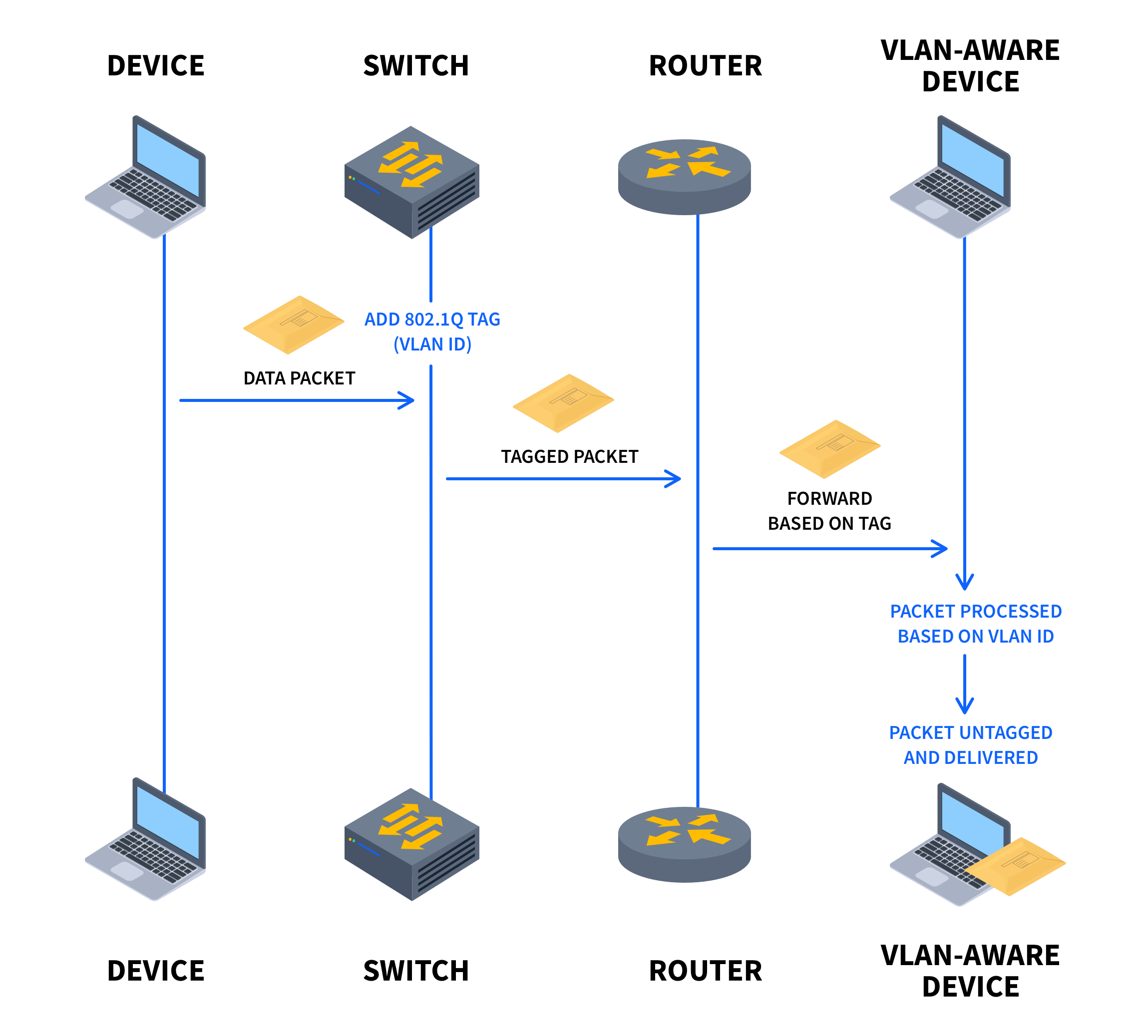
In the world of tagging, ports play two distinct roles. An Access Port is typically connected to an end-device (like a laptop or printer) that doesn’t understand VLAN tags. The switch receives an untagged frame, applies the tag internally to move it through the network, and strips the tag off before it reaches the destination device.
A Trunk Port, conversely, is the highway. Trunk ports connect switches to other switches or routers. They are configured to carry traffic for multiple VLANs simultaneously, maintaining the tags so that the receiving device knows exactly how to handle the data.
Strategic Advantages of Implementing VLAN Tagging
VLAN tagging is not merely an organizational tool; it is a strategic asset that directly impacts the performance and security posture of an organization. By logically partitioning a network, administrators can solve several physical limitations.
Enhanced Security and Traffic Isolation
The primary driver for VLAN tagging is security. Without VLANs, any device plugged into a switch can potentially “see” all broadcast traffic on that segment. In a corporate environment, you do not want a guest in the lobby to have any visibility into the servers housing HR payroll or intellectual property.
VLAN tagging allows for strict isolation. Even though the Guest Wi-Fi and the Finance Department use the same physical switches and fiber uplinks, their traffic is encapsulated in different tags. Without a Layer 3 device (a router or multilayer switch) to bridge those VLANs, there is no way for data to cross those boundaries, creating a “Zero Trust” environment at the hardware level.
Reduction of Broadcast Storms
In a large, flat network (one without VLANs), broadcast traffic—such as ARP requests—must be sent to every single device on the network. As the number of devices grows, this “broadcast noise” can consume significant bandwidth and CPU cycles, leading to what is known as a broadcast storm.
VLAN tagging breaks down a single large broadcast domain into several smaller ones. A broadcast sent on VLAN 10 will never be heard by devices on VLAN 20. This containment significantly improves overall network throughput and prevents localized issues from crashing the entire enterprise network.
Simplified Resource Management and Mobility
In the modern workplace, teams are often spread across different floors or even different buildings. VLAN tagging allows for “logical” grouping rather than geographical grouping. An engineer can move from the third floor to the fifth floor, and by simply changing the VLAN assignment on their new switch port, they remain on the Engineering VLAN with access to all their specific resources, without the need for physical rewiring.
Deep Dive into Tagged vs. Untagged Traffic and Native VLANs
A common point of confusion for those new to networking is the management of “untagged” traffic on a trunk line. This is where the concept of the Native VLAN becomes essential.
The Role of the Native VLAN
On any trunk link, there is one designated VLAN for which traffic is sent without a tag. This is the Native VLAN. By default, on most hardware, this is VLAN 1. If a switch receives an untagged frame on a trunk port, it assumes that frame belongs to the Native VLAN.
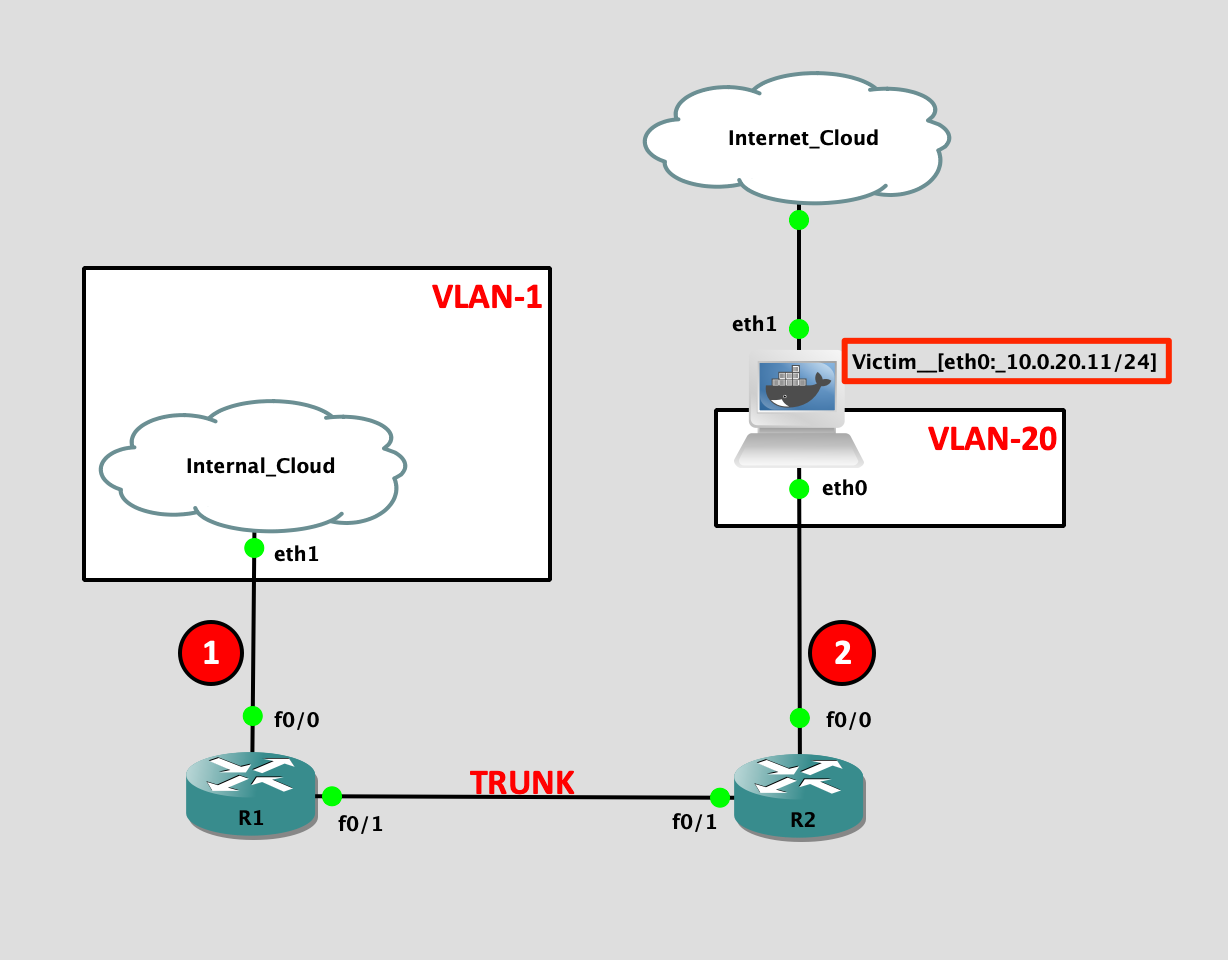
While this facilitates compatibility with older equipment, it presents a significant security risk known as “VLAN Hopping.” In a VLAN hopping attack, a malicious actor sends a double-tagged packet. The first switch strips the outer tag (the Native VLAN tag) and forwards the packet to the second switch with the inner tag still intact, allowing the attacker to “hop” into a restricted VLAN. To mitigate this, professional network standards dictate changing the Native VLAN to an unused ID and ensuring it is consistent across all interconnected devices.
Quality of Service (QoS) and Tagging
Because the 802.1Q header includes the Priority Code Point (PCP) field, VLAN tagging is the primary mechanism for implementing QoS. In a converged network where voice, video, and data coexist, the switch uses the tag to prioritize the delivery of packets. For instance, voice traffic (VLAN 50) can be tagged with a higher priority than bulk data transfers (VLAN 10), ensuring that a large file download doesn’t cause a CEO’s video conference to lag or drop.
Practical Deployment: Configuration and Inter-VLAN Routing
Implementing VLAN tagging requires a shift from Layer 2 (switching) to Layer 3 (routing) logic. Once you have tagged your traffic and isolated your networks, those networks can no longer communicate with each other by default. To allow them to talk—under controlled circumstances—you need inter-VLAN routing.
Router-on-a-Stick vs. Layer 3 Switching
The traditional method of inter-VLAN routing is the “Router-on-a-Stick” configuration. A single physical interface on a router is connected to a trunk port on a switch. The router interface is divided into “sub-interfaces,” each assigned to a specific VLAN tag. The router then acts as the gateway, moving traffic between the tagged segments.
In high-performance environments, this can become a bottleneck. Modern enterprises use Layer 3 Switches (or Multilayer Switches). These devices perform tagging and routing at the hardware level (ASIC), allowing for near-instantaneous routing between VLANs without the traffic ever needing to leave the switch fabric.
Troubleshooting Common Tagging Issues
The most frequent cause of network failure in a VLAN-enabled environment is a “VLAN Mismatch.” If Switch A expects VLAN 10 to be the Native VLAN, but Switch B expects VLAN 20, traffic will be dropped or routed to the wrong destination. Furthermore, if a VLAN is not manually “allowed” on a trunk port, the switch will prune that traffic, leading to connectivity issues that are often difficult to diagnose without looking at the trunk configuration.
Evolution Toward Next-Gen Virtualization: VXLAN and SDN
As we look toward the future of technology trends, standard VLAN tagging is hitting its limits. The 4,096 VLAN limit is insufficient for massive cloud providers like AWS or Azure, who host millions of isolated customer networks.
VXLAN (Virtual Extensible LAN)
To solve the scalability issues of 802.1Q, the industry introduced VXLAN. While standard VLAN tagging operates at Layer 2, VXLAN encapsulates Layer 2 Ethernet frames within Layer 3 UDP packets. This allows for over 16 million unique identifiers (VNIs), effectively extending “VLAN-like” isolation across entire IP networks and even between different geographical data centers.
Software-Defined Networking (SDN)
In the past, tagging was a manual process—an administrator typed commands into a CLI for every switch. Today, Software-Defined Networking (SDN) is automating this. Controllers can now dynamically assign VLAN tags to users based on their identity (via 802.1X authentication). If a user logs in as “Accounting,” the network automatically tags their traffic with the Accounting VLAN ID, regardless of where they plug in.
Conclusion
VLAN tagging is the cornerstone of modern digital infrastructure. By transforming physical hardware into flexible, logical segments, it provides the security, scalability, and performance required in today’s data-driven world. From the simple 802.1Q tag to the complex world of VXLAN and SDN, tagging remains the essential language that switches use to navigate the complexities of the modern enterprise network. For any tech professional, mastering these concepts is the key to building resilient systems that can adapt to the ever-changing demands of the digital landscape.
aViewFromTheCave is a participant in the Amazon Services LLC Associates Program, an affiliate advertising program designed to provide a means for sites to earn advertising fees by advertising and linking to Amazon.com. Amazon, the Amazon logo, AmazonSupply, and the AmazonSupply logo are trademarks of Amazon.com, Inc. or its affiliates. As an Amazon Associate we earn affiliate commissions from qualifying purchases.