
In the landscape of modern employee benefits and personal financial planning, vision insurance often occupies a secondary position behind major medical and dental coverage. However, as the digital age increases our dependency on screens and long-term eye health becomes a significant factor in overall wellness, understanding the financial mechanisms of specialized providers is essential. One of the most prominent names in this sector is the Vision Service Plan, commonly known as VSP.
VSP is not merely a service provider but the largest vision insurance company in the United States, functioning as a doctor-governed not-for-profit organization. From a financial perspective, VSP operates as a managed vision care system, providing a structured framework for individuals and employers to offset the high costs of corrective lenses, annual exams, and preventative eye health services. Understanding what VSP is requires a deep dive into its financial structure, its value proposition for the consumer, and how it integrates into a broader personal finance strategy.
The Financial Structure and Business Model of VSP
Founded in 1955 by a group of optometrists who wanted to provide affordable, high-quality eye care to the public, VSP has grown into a global enterprise. Unlike traditional insurance companies that are often publicly traded and beholden to quarterly earnings for shareholders, VSP’s status as a non-profit allows it to reinvest margins into provider networks and member benefits. This structure is unique in the financial world of healthcare.
Managed Vision Care vs. Indemnity Insurance
VSP operates primarily on a managed care model. In a managed care framework, the insurer negotiates set rates with a network of providers (optometrists and ophthalmologists). For the policyholder, this means that the financial “heavy lifting” is done through the network. When you visit a VSP-contracted doctor, the costs for services are pre-negotiated, significantly lowering the out-of-pocket expense compared to an indemnity plan, which might simply reimburse you a flat, often inadequate, fee after you have already paid the full retail price.
The Role of the Provider Network
The financial viability of a VSP plan depends heavily on its “In-Network” vs. “Out-of-Network” mechanics. VSP maintains one of the largest networks of independent doctors globally. From a personal finance standpoint, utilizing an in-network provider is the most efficient way to maximize the plan’s value. When a member stays in-network, the “allowances”—the fixed amount the plan pays toward frames or contacts—stretch much further because the doctor has agreed to VSP’s lower contractual rates.
Evaluating the Return on Investment (ROI) of a VSP Plan
For many individuals, the decision to enroll in a Vision Service Plan comes down to a simple mathematical equation: Do the annual premiums cost less than the out-of-pocket expenses for eye care? To answer this, one must look at the three primary pillars of vision spending: exams, hardware (frames and lenses), and elective surgery.
The Cost-Benefit Analysis of Annual Exams
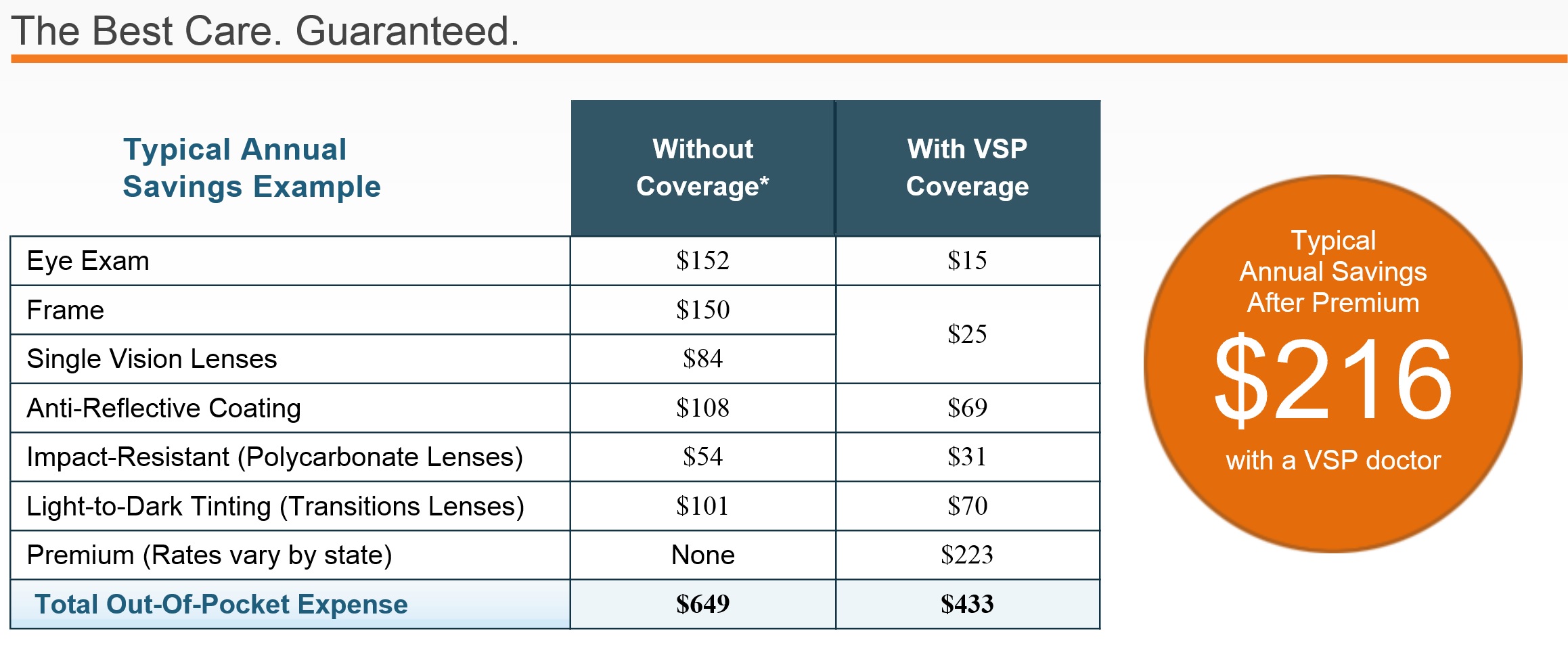
A comprehensive eye exam without insurance can range anywhere from $150 to $250 depending on the region and the complexity of the tests. Most VSP plans provide an annual exam for a small copay, usually between $10 and $25. If an individual’s annual premium is $150, the exam alone nearly justifies the cost of the plan. However, the true financial value lies in the detection of systemic health issues. VSP doctors are trained to spot early signs of chronic conditions like diabetes, high blood pressure, and high cholesterol during a retinal exam. From a long-term financial planning perspective, early detection of these conditions can save tens of thousands of dollars in future medical interventions.
Maximizing Hardware Allowances
The most visible benefit of a VSP plan is the hardware allowance. Most plans offer a retail allowance—typically between $130 and $200—toward the purchase of eyeglass frames or contact lenses.
Furthermore, VSP often includes “wholesale” pricing or significant discounts on lens enhancements. Enhancements such as anti-reflective coatings, progressives, and light-reactive lenses (like Transitions) can easily double or triple the cost of a pair of glasses. VSP members typically pay a fixed, discounted price for these upgrades, which can result in hundreds of dollars in savings per year for families with multiple prescription wearers.
The Impact of Plan Tiers
VSP offers various plan levels, such as VSP Choice, VSP Signature, and VSP EasyOptions. Each tier has a different premium and benefit structure.
- VSP Choice: This is the most common mid-level plan, offering a balance of affordable premiums and solid allowances.
- VSP Signature: Often found in high-end corporate benefit packages, this plan usually offers higher frame allowances and lower copays.
- VSP EasyOptions: This is a newer, more flexible financial product that allows the member to choose which benefit to “boost” at the time of service—such as doubling the frame allowance or opting for premium lenses at no extra cost.
Strategic Financial Integration: HSA, FSA, and Tax Advantages
One of the most overlooked aspects of VSP is how it interacts with other financial tools like Health Savings Accounts (HSA) and Flexible Spending Accounts (FSA). For those looking to optimize their tax strategy, VSP serves as a critical partner.
Leveraging Pre-Tax Dollars
Because VSP premiums are often deducted from a paycheck before taxes (in an employer-sponsored setting), the effective cost of the insurance is reduced by the individual’s marginal tax rate. Furthermore, any out-of-pocket costs not covered by VSP—such as the remaining balance on a designer frame or a high-end lens coating—are eligible expenses for HSA and FSA funds.
By using an HSA to pay for the “gap” between VSP’s coverage and the total bill, a consumer is essentially paying for their vision care with tax-free dollars. This “double-dipping” of insurance benefits and tax-advantaged accounts is a hallmark of sophisticated personal financial management.
The LASIK and Surgical Discount Factor
While most vision plans do not cover elective laser vision correction (LASIK) as a standard benefit, VSP provides significant financial “value-adds” in the form of contracted discounts. VSP members often receive 15% to 25% off the cost of LASIK through a network of specialized centers. Given that LASIK can cost upwards of $4,000 for both eyes, a 25% discount represents a $1,000 saving—a sum that far exceeds the lifetime premiums paid into the plan for many users.
VSP for Business: Corporate Identity and Employee Retention
From a business finance and brand strategy perspective, offering a Vision Service Plan is a calculated move for employers. For a small to mid-sized business, providing VSP is a low-cost way to enhance a benefits package, making the company more competitive in the talent market.
Productivity and the Bottom Line
The financial argument for employers to provide VSP extends to workplace productivity. Digital eye strain is a leading cause of decreased focus and increased headaches among office workers. By providing a plan that encourages annual exams and provides affordable blue-light filtering lenses, a company is essentially investing in its own operational efficiency. The cost of the insurance is frequently offset by the reduction in “presenteeism”—the phenomenon where employees are at work but not fully productive due to physical discomfort or undiagnosed vision issues.
The “Wellness” Brand
For a corporate brand, aligning with VSP reinforces a commitment to holistic employee wellness. Because VSP is a recognized name with a high “trust equity,” employees perceive it as a high-value benefit, even if the actual cost to the employer is relatively low compared to major medical insurance.
Conclusion: Is VSP a Sound Financial Tool?
Ultimately, a Vision Service Plan is more than a simple discount card for glasses; it is a specialized financial instrument designed to manage the predictable and unpredictable costs of eye health. For the individual, it functions as a budgeting tool that smoothes out the spikes in healthcare spending. Instead of facing a $500 bill every two years for new eyewear, the user pays a small monthly premium and a minor copay, keeping their cash flow stable.
When combined with the preventative health benefits and the ability to leverage tax-advantaged accounts, VSP emerges as a cornerstone of a comprehensive personal finance strategy. Whether through an employer or an individual plan, the math typically favors the consumer, provided they utilize the in-network benefits and take advantage of the negotiated rates that VSP’s massive scale provides. In an era where healthcare costs continue to outpace inflation, having a structured, managed plan like VSP is a prudent way to protect both your sight and your savings.
aViewFromTheCave is a participant in the Amazon Services LLC Associates Program, an affiliate advertising program designed to provide a means for sites to earn advertising fees by advertising and linking to Amazon.com. Amazon, the Amazon logo, AmazonSupply, and the AmazonSupply logo are trademarks of Amazon.com, Inc. or its affiliates. As an Amazon Associate we earn affiliate commissions from qualifying purchases.