
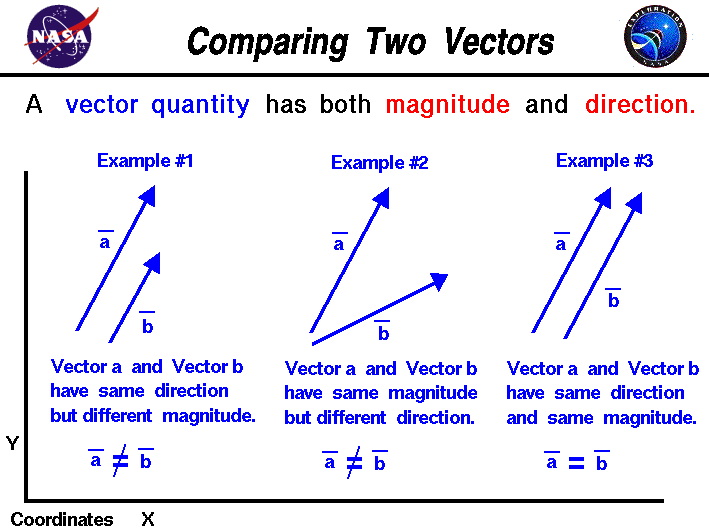
In the rapidly evolving landscape of data science, artificial intelligence, and computer graphics, the concept of a vector is fundamental. However, a vector is not merely a list of numbers or a directional arrow in a coordinate system; it is a mathematical entity defined by two primary characteristics: direction and magnitude. While direction tells us where a vector is pointing, the magnitude tells us the “how much” or the “size” of that vector.
In technical terms, vector magnitude—often referred to as the “norm”—is a scalar value that represents the length of the vector. Whether you are building a recommendation engine for an e-commerce platform, developing a physics engine for a triple-A video game, or training a high-performance Large Language Model (LLM), understanding vector magnitude is essential for optimizing performance and ensuring computational accuracy.
The Mathematical Foundation: Calculating the “Length” of Data
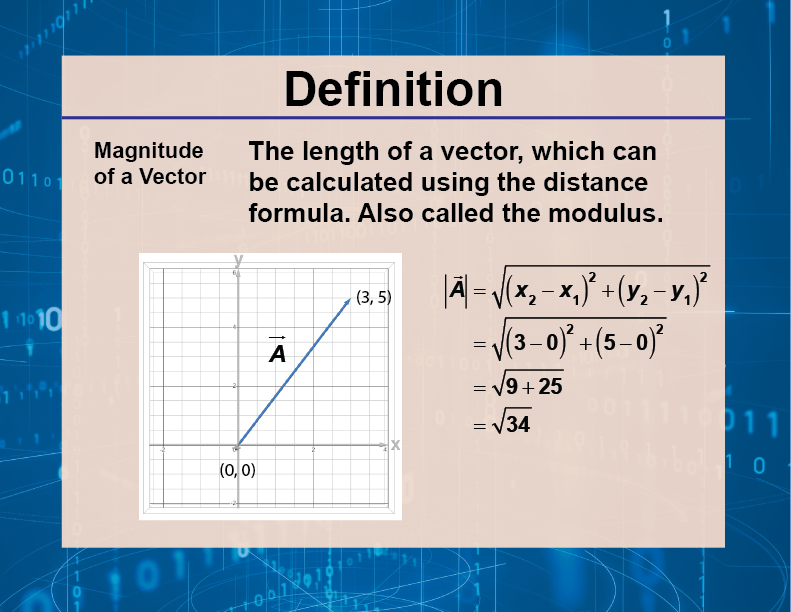
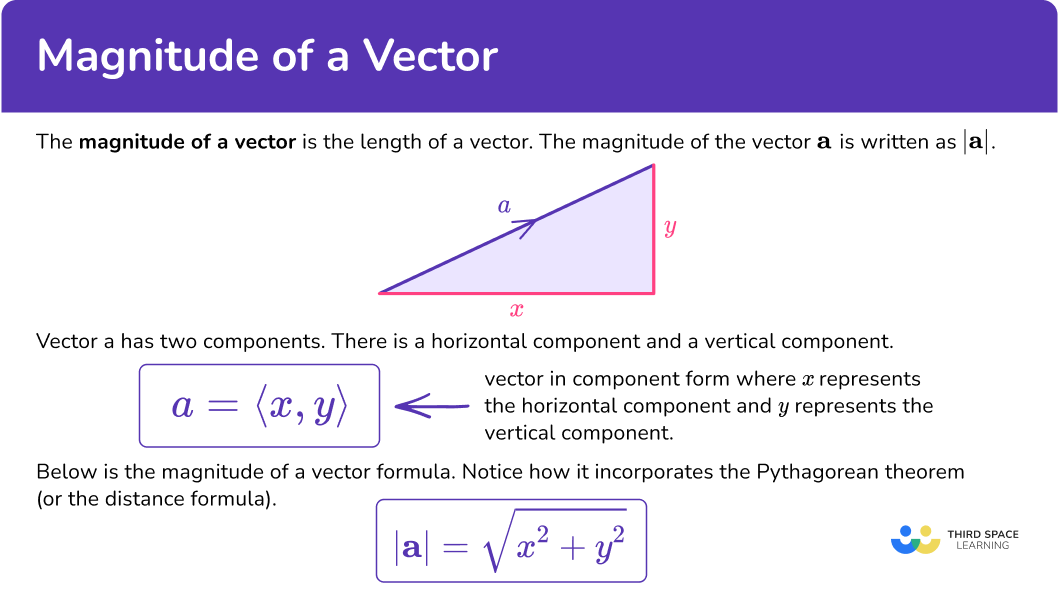
To understand how magnitude functions within a technological framework, one must first understand its geometric and algebraic origins. In a two-dimensional Cartesian plane, a vector is represented as $(x, y)$. The magnitude is the distance from the origin $(0, 0)$ to the point $(x, y)$. This is calculated using the Pythagorean theorem, where the magnitude (denoted as $||v||$) is the square root of the sum of the squares of its components.
Euclidean Norm (L2 Norm)
In most software applications and standard physics simulations, we use the Euclidean norm, also known as the L2 norm. As we move into the realm of data science, vectors are rarely limited to two or three dimensions. Modern AI models operate in high-dimensional spaces, where a single data point might be represented by a vector with thousands of dimensions. The formula remains conceptually the same: the square root of the sum of the squares of all elements in the vector.
In Python-based data science libraries like NumPy or PyTorch, calculating this magnitude is a computationally optimized operation. For a developer, the magnitude provides a sense of the “intensity” of a data point. For instance, in a digital signal processing app, the magnitude of a frequency vector determines the volume or strength of a specific sound wave.
Manhattan and Minkowski Norms
While the Euclidean norm is the standard, other forms of magnitude measurement exist for specific tech use cases. The Manhattan norm (L1 norm) calculates magnitude by summing the absolute values of the vector’s components. This is particularly useful in digital mapping and logistics algorithms where “as the crow flies” distance (Euclidean) is less relevant than “grid-based” distance (Manhattan). Understanding which magnitude calculation to use is a critical decision for software architects designing efficient routing or optimization tools.
Vector Magnitude in Artificial Intelligence and Machine Learning
The explosion of generative AI and machine learning has propelled the concept of vector magnitude into the spotlight of modern software engineering. In AI, data is converted into “embeddings”—numerical vectors that represent the semantic meaning of text, images, or audio.
The Role of Magnitude in Embeddings
When an LLM processes a prompt, it converts words into high-dimensional vectors. The magnitude of these vectors often reflects the “weight” or “importance” of a particular feature within the model’s latent space. If a vector representing a specific concept has a very low magnitude, it may indicate that the feature is less significant or carries less “signal” relative to the “noise” in the dataset.
Cosine Similarity and Normalization
One of the most common operations in AI search engines and vector databases (like Pinecone or Milvus) is determining how similar two vectors are. This is often done using “Cosine Similarity.” The formula for cosine similarity involves dividing the dot product of two vectors by the product of their magnitudes.
Here, vector magnitude acts as a stabilizer. By “normalizing” vectors—adjusting them so their magnitude is exactly 1 (creating a “unit vector”)—developers can compare the direction of data points without being distracted by their scale. This is how a streaming service knows that even if you haven’t watched a specific movie, your “preference vector” points in the same direction as that movie’s “content vector,” regardless of how many movies you’ve watched in total.
Magnitude in Gradient Descent
In the training phase of a neural network, developers monitor the magnitude of “gradients.” Gradients are vectors that tell the model how to adjust its internal weights to reduce error. If the magnitude of these gradients becomes too large (exploding gradients) or too small (vanishing gradients), the AI will fail to learn. Modern AI tools utilize “gradient clipping,” a technique where the magnitude of the gradient vector is forcefully scaled down if it exceeds a certain threshold, ensuring the stability of the software during complex training cycles.
Applications in Computer Graphics and Game Development
Beyond the abstract world of AI, vector magnitude is a practical pillar of computer graphics and real-time simulations. Every movement, light reflection, and collision in a modern video game is governed by vector mathematics.
Physics Engines and Velocity
In a game engine like Unreal Engine or Unity, an object’s movement is represented by a velocity vector. The direction of the vector indicates where the character is moving, while the magnitude of that vector represents the character’s speed. When a developer writes code to “cap” a player’s speed, they are essentially writing a function that checks the magnitude of the velocity vector and prevents it from exceeding a predefined scalar value.
Lighting and Shaders
Modern digital rendering relies heavily on the interaction between light vectors and surface “normals” (vectors perpendicular to a surface). To calculate how light bounces off a 3D object, shaders must frequently normalize vectors to a magnitude of 1. If a light source vector’s magnitude is ignored or calculated incorrectly, the resulting scene may appear unnaturally dark or blown out, as the intensity of the light is directly tied to the mathematical scaling of these vectors.
Collision Detection
Vector magnitude is also used to trigger events in software. For example, in a simulation, a collision might only cause “damage” if the magnitude of the impact vector exceeds a certain limit. By calculating the difference between the velocity vectors of two colliding objects and finding the magnitude of the resulting vector, the software can determine the force of the impact.
Digital Security and Anomaly Detection
In the field of digital security and network monitoring, vector magnitude serves as a sophisticated tool for identifying threats. Security software often treats network traffic patterns as vectors, where components might include packet size, frequency of connection, and data transfer rates.
Behavioral Analysis
By establishing a “baseline” vector of normal user behavior, security AI can monitor real-time activity. If a user’s current activity vector deviates significantly in magnitude from the baseline—perhaps indicating a massive, sudden exfiltration of data—the system can flag it as an anomaly. In this context, magnitude represents the “volume” of a potential security breach.
Cryptography
Vectors also play a role in advanced cryptographic methods, specifically in lattice-based cryptography, which is currently being researched as a “post-quantum” security measure. Here, the “Shortest Vector Problem” (SVP) involves finding a non-zero vector in a lattice with the smallest possible magnitude. The computational difficulty of finding this magnitude is what provides the security layer, protecting data against future quantum computing attacks.
The Future of Vector-Based Computation
As we move toward a future defined by increasingly complex digital ecosystems, the importance of vector magnitude will only grow. We are seeing a shift from traditional scalar-based processing to vector-based processing, exemplified by the rise of GPUs (Graphics Processing Units) and TPUs (Tensor Processing Units) which are designed specifically to handle large-scale vector and matrix mathematics.
Vector Databases and the Knowledge Graph
The next generation of “search” is not based on keywords but on vector proximity. Companies are investing heavily in vector databases that store the magnitude and direction of every piece of corporate data. This allows for “semantic search,” where the software understands the intent behind a query. The magnitude in these systems helps rank the relevance of results, ensuring that the most “potent” matches are delivered to the user.
Robotics and Autonomous Systems
In robotics, magnitude is the difference between a successful maneuver and a mechanical failure. Autonomous drones use vector magnitude to calculate wind resistance and adjust motor thrust in real-time. As edge computing becomes more powerful, the ability to calculate and react to vector magnitudes locally—without needing to send data to the cloud—will be the hallmark of sophisticated autonomous hardware.
Conclusion
Vector magnitude is much more than a classroom math concept; it is the silent engine driving the most sophisticated technologies of the 21st century. From the internal mechanics of a neural network to the fluid motion of a digital character and the robust defenses of a cybersecurity network, magnitude provides the necessary scale and intensity to transform abstract data into actionable digital reality. For any tech professional, mastering the implications of vector magnitude is a prerequisite for navigating the data-driven future.
aViewFromTheCave is a participant in the Amazon Services LLC Associates Program, an affiliate advertising program designed to provide a means for sites to earn advertising fees by advertising and linking to Amazon.com. Amazon, the Amazon logo, AmazonSupply, and the AmazonSupply logo are trademarks of Amazon.com, Inc. or its affiliates. As an Amazon Associate we earn affiliate commissions from qualifying purchases.