
In the vast and often complex world of finance, few institutions command the same level of respect, influence, and sheer scale as The Vanguard Group. For millions of investors worldwide, Vanguard is synonymous with low-cost investing, passive strategies, and a unique client-centric ethos that has fundamentally reshaped how individuals approach wealth building. Understanding “what is Vanguard Group” goes beyond merely identifying it as an investment company; it involves delving into a revolutionary philosophy, a distinctive corporate structure, and a relentless commitment to empowering everyday investors.
Founded by the legendary John C. Bogle in 1975, Vanguard emerged as a disruptive force in an industry historically characterized by high fees, active management, and opaque practices. Bogle’s vision was audacious yet profoundly simple: to put investors first by drastically reducing costs and focusing on broad market indexing rather than trying to beat the market. This radical approach laid the groundwork for a financial powerhouse that now manages trillions of dollars in assets, impacting the personal finance journeys of countless individuals and families across the globe.
This article will explore the core tenets of Vanguard’s identity, its foundational principles, its broad suite of financial offerings, and its enduring impact on the landscape of personal finance and investing. From its groundbreaking corporate structure to its diverse array of investment products and the practical implications for your financial future, we will uncover what makes Vanguard Group a unique and indispensable entity for investors seeking a disciplined, cost-effective path to long-term wealth accumulation.
The Vanguard Philosophy: A Unique Approach to Investing
At the heart of Vanguard’s phenomenal success and lasting influence lies a philosophy meticulously crafted to serve the investor above all else. This distinct operational ethos sets it apart from nearly every other financial services firm and remains the bedrock of its business model.
John Bogle’s Vision: The Birth of Index Investing
John C. Bogle, often hailed as the “father of index investing,” established Vanguard with a singular, transformative insight: most active fund managers fail to consistently outperform the market over the long term, especially after accounting for fees. His groundbreaking idea was to offer investors a way to simply own the market through low-cost index funds, rather than trying to beat it. This wasn’t just a product idea; it was a philosophical declaration challenging the status quo of the mutual fund industry. Bogle argued that the “majesty of the compound return” was often eroded by the “tyranny of compounding costs,” and that by minimizing expenses, investors could capture a larger share of market returns over time. His initial launch of the First Index Investment Trust (now the Vanguard 500 Index Fund) in 1976, derisively called “Bogle’s Folly” by competitors, proved to be one of the most significant innovations in financial history.
The Client-Owned Structure: A Different Kind of Company
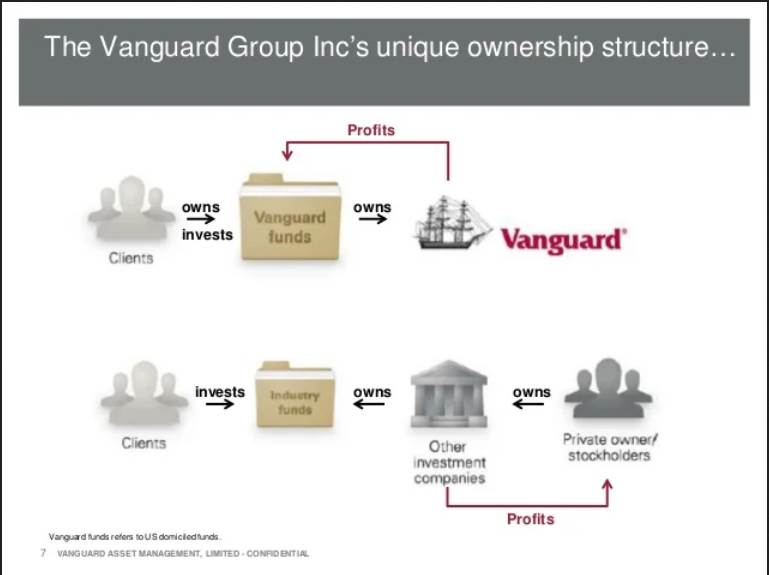
Perhaps the most distinctive feature of The Vanguard Group is its unique client-owned structure. Unlike most publicly traded asset managers or privately held firms, Vanguard is technically owned by its funds, which are, in turn, owned by their investors. This mutual structure means there are no outside shareholders demanding a share of profits. Instead, any profits generated by Vanguard are reinvested back into the company, allowing it to reduce operating costs and, crucially, lower expense ratios for its funds. This direct alignment of interests—where the company’s success is measured by the financial success of its investors—is central to Vanguard’s commitment to low-cost investing and distinguishes it fundamentally from its competitors. It’s a powerful testament to Bogle’s vision of putting the client first, creating a virtuous cycle where lower costs attract more assets, which in turn allows for even lower costs.
Low-Cost Investing: The Cornerstone of Vanguard’s Strategy
The tangible outcome of Vanguard’s client-owned structure and Bogle’s philosophy is its relentless focus on low-cost investing. Vanguard funds consistently boast some of the lowest expense ratios in the industry, often just a fraction of the cost of actively managed funds. These seemingly small differences in fees can have a profound impact on an investor’s long-term returns, as even a 1% difference in annual expenses can erode tens of thousands, or even hundreds of thousands, of dollars in potential wealth over several decades. Vanguard’s strategy is not just about competing on price; it’s about making a philosophical statement that every dollar saved in fees is a dollar kept by the investor, compounding over time to build greater wealth. This commitment has not only benefited Vanguard investors but has also pressured the broader asset management industry to lower its fees, making investing more accessible and affordable for everyone.
Vanguard’s Core Offerings: Empowering Investors
Vanguard’s commitment to low-cost, client-centric investing is manifest in its diverse suite of financial products and services designed to meet a wide range of investment goals and risk tolerances. These offerings empower investors to build robust portfolios aligned with their long-term financial objectives.
Mutual Funds: A Diverse Portfolio of Options
Vanguard rose to prominence on the back of its mutual funds, particularly its index mutual funds. These funds pool money from many investors to invest in a diversified portfolio of stocks, bonds, or other securities, managed by professional fund managers. Vanguard’s strength lies in its extensive selection of index mutual funds that track broad market benchmarks like the S&P 500, total stock market, or total bond market. These funds offer instant diversification at an incredibly low cost, making them ideal for long-term investors who believe in capturing market returns rather than attempting to beat them. Beyond index funds, Vanguard also offers a selection of actively managed funds, though even these often come with lower expense ratios compared to industry averages, reflecting the firm’s overall cost-conscious approach.
Exchange-Traded Funds (ETFs): The Modern Investment Vehicle
In response to evolving market demands and technological advancements, Vanguard has become a dominant player in the Exchange-Traded Fund (ETF) market. ETFs are similar to mutual funds in that they hold a basket of securities, but they trade on stock exchanges throughout the day, much like individual stocks. Vanguard’s ETFs (Vanguard ETFs or VOO, VTI, BND, etc.) are highly popular due to their ultra-low expense ratios, broad diversification, and tax efficiency. They offer the flexibility of stock trading with the diversification of a mutual fund, making them attractive to both institutional and individual investors. Many of Vanguard’s ETFs are simply lower-cost share classes of their existing index mutual funds, providing investors with multiple ways to access the same underlying strategies, often with even lower barriers to entry (e.g., no minimum investment for many ETFs once you own at least one share).
Financial Planning and Advice: Beyond Just Products
While Vanguard is primarily known for its investment products, the company has also expanded its offerings to include financial planning and advisory services. Recognizing that not all investors are comfortable navigating the complexities of portfolio construction on their own, Vanguard provides various levels of guidance. This ranges from automated digital advisory services like Vanguard Digital Advisor, which offers personalized portfolio recommendations and automated rebalancing, to more comprehensive human-advised services through Vanguard Personal Advisor Services. This latter service combines sophisticated algorithms with access to human financial advisors, offering personalized financial plans, ongoing portfolio management, and wealth management strategies. These services aim to provide holistic financial solutions, helping investors with retirement planning, goal setting, tax-efficient investing, and estate planning, all while maintaining Vanguard’s signature low-cost approach.

How Vanguard Impacts Your Personal Finance Journey
Vanguard’s influence on an individual’s personal finance journey is profound, shaping everything from long-term wealth accumulation to retirement security. Its principles offer a clear, actionable path for those committed to financial independence.
Building Wealth Through Simplicity and Discipline
Vanguard champions a philosophy of long-term investing characterized by simplicity and discipline. By advocating for broad market index funds and ETFs, Vanguard empowers investors to embrace a “set it and forget it” approach that minimizes emotional decision-making and costly market timing attempts. This strategy encourages consistent investing over decades, allowing the power of compounding to work its magic. For many, Vanguard simplifies the often-intimidating world of investing, allowing them to focus on saving consistently and staying invested through market fluctuations, rather than getting bogged down in stock picking or complex strategies. This simplicity reduces stress and increases the likelihood of achieving financial goals.
Retirement Planning: A Trusted Partner
For many, Vanguard is an indispensable partner in retirement planning. Its comprehensive suite of low-cost index funds and target-date funds (such as the Vanguard Target Retirement Funds) provides straightforward, diversified solutions specifically designed for long-term retirement savings. Target-date funds, in particular, offer a “fund of funds” approach that automatically adjusts its asset allocation to become more conservative as the investor approaches retirement. This hands-off approach makes them ideal for 401(k)s, IRAs, and other retirement accounts, simplifying asset allocation decisions and ensuring that portfolios remain appropriately diversified throughout an investor’s working life and into retirement. Vanguard’s focus on long-term growth and capital preservation aligns perfectly with the multi-decade horizon of retirement savings.
Overcoming Investment Fees: The Hidden Drag on Returns
One of Vanguard’s most significant contributions to personal finance education is its tireless emphasis on the corrosive impact of investment fees. Through its low-cost structure, Vanguard effectively demonstrates how even seemingly small annual fees (e.g., 1% or 2%) can dramatically reduce an investor’s total returns over time. Bogle famously illustrated this with the concept of the “advisor’s share,” highlighting how a substantial portion of investment returns can be siphoned off by fees if investors are not vigilant. By consistently offering products with expense ratios significantly below the industry average, Vanguard allows investors to retain a larger share of their earnings, directly translating into greater wealth accumulation. This focus has made fee awareness a central tenet of savvy personal finance, prompting investors to scrutinize costs across all their financial products.
Understanding Vanguard’s Place in the Financial Landscape
Vanguard’s impact extends far beyond its direct investors, shaping the broader financial landscape and influencing how the industry operates.
Competing in a Dynamic Market: Innovation and Scale
Vanguard’s success has not gone unnoticed. Its disruptive model has forced competitors, both traditional and new, to adapt. Many rival firms have launched their own low-cost index funds and ETFs, often mimicking Vanguard’s offerings, thereby driving down costs across the entire investment industry. This competitive pressure, largely initiated by Vanguard, has been a net positive for investors worldwide. Despite its colossal size and established reputation, Vanguard continues to innovate, expanding its advisory services, enhancing its digital platforms, and exploring new investment avenues while remaining true to its core principles of low cost and investor focus. Its sheer scale, managing trillions in assets, gives it unparalleled negotiating power with service providers, allowing it to maintain its cost advantage.
The Future of Investing: Vanguard’s Enduring Relevance
As the financial world evolves with new technologies, regulatory changes, and shifting investor preferences, Vanguard’s foundational principles—low cost, diversification, and long-term perspective—remain remarkably relevant. In an era where information overload and speculative trading can be tempting, Vanguard provides a steadying influence, reminding investors of the proven, disciplined path to financial success. Its ongoing growth and market leadership suggest that its client-centric model will continue to be a dominant force, influencing the future of investing by continually advocating for transparency, efficiency, and fairness for the individual investor. The widespread adoption of index investing, once seen as a radical idea, now stands as a testament to Vanguard’s enduring vision and its profound impact on how wealth is built.
Getting Started with Vanguard: Practical Steps for Investors
For those looking to integrate Vanguard’s philosophy and products into their financial strategy, the process is designed to be straightforward and accessible.
Opening an Account: Simplicity and Accessibility
Opening an investment account with Vanguard is a relatively simple process. Investors can choose from various account types, including individual taxable brokerage accounts, traditional and Roth IRAs for retirement savings, 529 college savings plans, and even small business retirement plans. The application process is primarily online, requiring basic personal information, bank details for funding, and electronic signatures. Vanguard’s platform is designed to guide new investors through the process, making it accessible even for those new to investing. While some of its mutual funds have minimum investment requirements (often $3,000 for admiral shares), its ETFs can be purchased with as little as the cost of a single share, lowering the barrier to entry significantly.
Choosing the Right Investments: Matching Goals with Strategies
Once an account is established, the next step is selecting appropriate investments. Vanguard offers tools and resources to help investors match their financial goals, risk tolerance, and time horizon with suitable funds. For hands-off investors, target-date funds provide a diversified, automatically rebalancing portfolio tailored to a specific retirement year. For those who prefer more control, a combination of core index ETFs or mutual funds (e.g., a total stock market fund and a total bond market fund) can form a robust, globally diversified portfolio. Vanguard also provides educational content, investment guidance, and access to financial advisors (for a fee) to help investors make informed decisions, ensuring that their chosen strategy aligns with their long-term financial objectives.
In conclusion, The Vanguard Group is far more than just another financial company. It is a testament to a revolutionary idea that has democratized investing, empowered millions of individuals, and fundamentally shifted the paradigms of wealth management. Through its unique client-owned structure, its unwavering commitment to low costs, and its championing of simple, diversified strategies, Vanguard has carved out a unique and enduring legacy in the world of personal finance, making it an essential resource for anyone seeking a clear, effective, and ethical path to financial well-being.
aViewFromTheCave is a participant in the Amazon Services LLC Associates Program, an affiliate advertising program designed to provide a means for sites to earn advertising fees by advertising and linking to Amazon.com. Amazon, the Amazon logo, AmazonSupply, and the AmazonSupply logo are trademarks of Amazon.com, Inc. or its affiliates. As an Amazon Associate we earn affiliate commissions from qualifying purchases.