
In the intricate world of computer programming, understanding data types is foundational to writing efficient, reliable, and secure code. Among the various data types, integers hold a primary position, used for everything from counting iterations in a loop to representing system-level statuses. Within the realm of integers, a critical distinction exists between “signed” and “unsigned” varieties. While int (or signed integer) is perhaps more commonly encountered by beginners, unsigned int plays an indispensable role, particularly in systems programming, embedded development, and any scenario where negative numbers are irrelevant, and the full positive range of a fixed-size integer is needed.
This article delves into the core concept of unsigned int, exploring its definition, how it functions at a low level, its practical applications, and the crucial considerations for its effective use. By understanding unsigned int, developers can make more informed decisions about data representation, leading to more robust and optimized software solutions.
Understanding Integer Data Types in Programming
At its heart, a computer operates on binary data—sequences of zeros and ones. Every piece of information, whether it’s a character, an image, or a number, must ultimately be translated into this binary format. Integer data types provide a structured way for programmers to work with whole numbers, abstracting away the underlying binary representation while still allowing precise control over how those numbers are stored and manipulated.
The Foundation: Bits and Bytes
The smallest unit of digital information is a “bit,” which can be either 0 or 1. Bits are grouped into larger units, most commonly “bytes,” which consist of 8 bits. The number of bits allocated to store an integer directly determines the range of values it can represent. For instance, an 8-bit integer can represent 2^8 (256) distinct values, while a 32-bit integer can represent 2^32 (over 4 billion) distinct values.
Modern computing architectures often work with 32-bit or 64-bit words, and the standard int type in many programming languages (like C, C++, Java, C#) commonly maps to these sizes, though its exact size can vary depending on the compiler and system architecture. Regardless of the size, the way these bits are interpreted dictates whether the number can be positive, negative, or both.
Signed vs. Unsigned: The Core Distinction
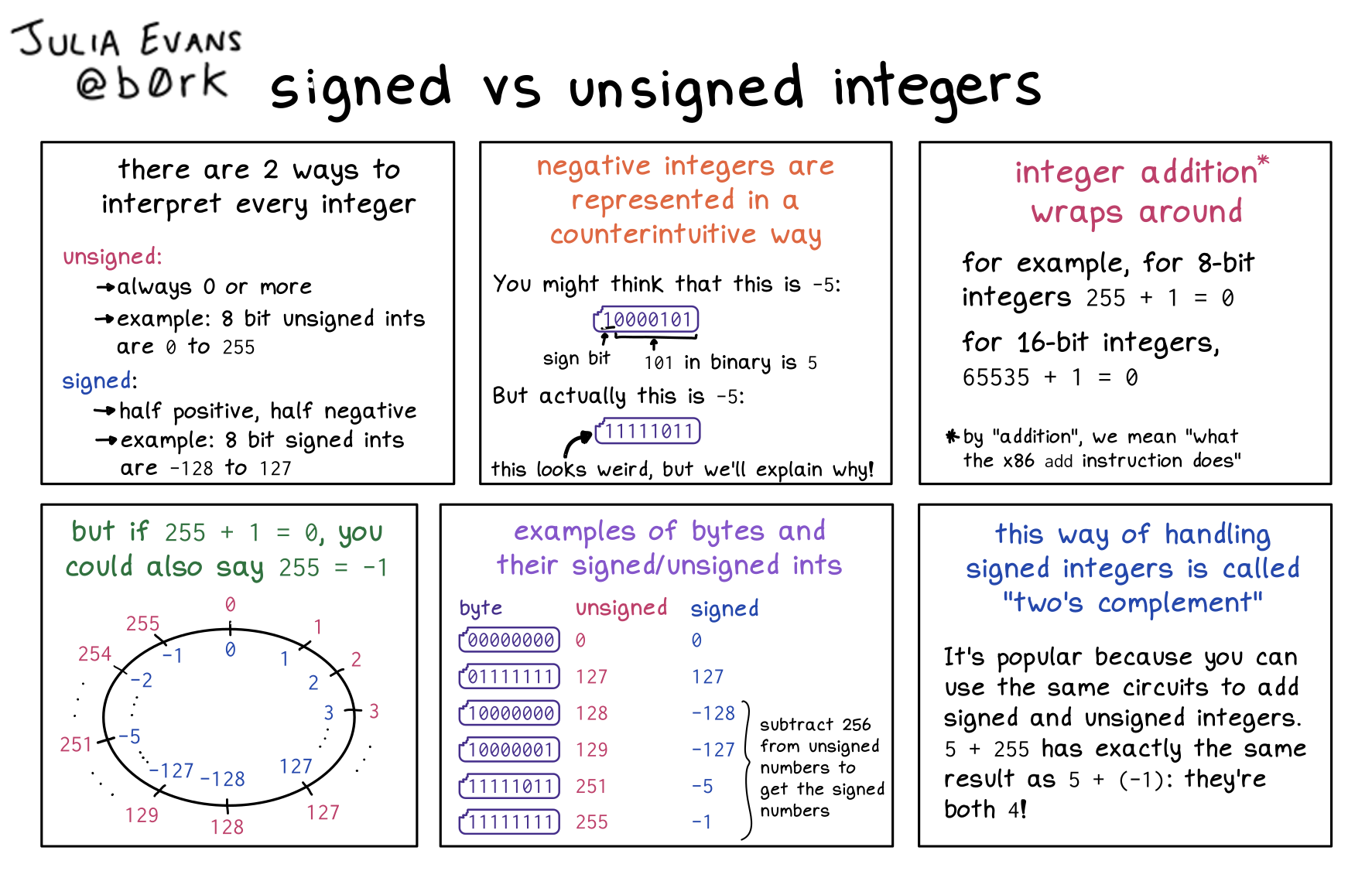
The fundamental difference between signed and unsigned integers lies in how one specific bit—the most significant bit (MSB)—is interpreted.
-
Signed Integers (e.g.,
int): In a signed integer, one bit is reserved to indicate the sign of the number. Typically, this is the MSB. If the MSB is 0, the number is positive. If the MSB is 1, the number is negative. The remaining bits represent the magnitude of the number, often using a system called “two’s complement” for efficient arithmetic operations. This approach allows signed integers to represent both positive and negative values, along with zero, but at the cost of reducing the maximum positive value they can hold compared to an unsigned integer of the same size. For a 32-bit signed integer, the range typically spans from approximately -2 billion to +2 billion. -
Unsigned Integers (e.g.,
unsigned int): In contrast,unsigned intdesignates an integer type where all allocated bits are used to represent the magnitude of the number. There is no sign bit; therefore,unsigned intcan only represent non-negative values (zero and positive integers). By foregoing the sign bit, anunsigned intof a given size can represent a much larger positive range than its signed counterpart. For a 32-bitunsigned int, the range typically spans from 0 to approximately 4 billion (specifically, 2^32 – 1). This crucial difference in range and representation is central to understanding when and why to useunsigned int.
Delving Deeper into unsigned int
The unsigned int data type is not merely an int without a minus sign; it represents a fundamentally different way of interpreting a sequence of bits. This difference has profound implications for how values are stored, the range they cover, and their behavior in various operations.
Definition and Range
An unsigned int is an integer data type that stores only non-negative (zero or positive) whole numbers. Its range is entirely dedicated to magnitudes.
Let’s consider a standard 32-bit system where int and unsigned int are both 32 bits long:
-
int(signed 32-bit integer):- Range: From -2,147,483,648 to 2,147,483,647
- Total distinct values: 2^32
-
unsigned int(unsigned 32-bit integer):- Range: From 0 to 4,294,967,295
- Total distinct values: 2^32
Notice that both types represent the same number of distinct values (2^32), but unsigned int shifts the entire range upwards, dedicating all its capacity to positive values. This makes it ideal for situations where negative numbers are semantically meaningless or where the largest possible positive integer range is required.
How unsigned int Handles Memory
From a memory perspective, both int and unsigned int occupy the same amount of space (e.g., 4 bytes for 32-bit systems). The distinction is purely in how the processor’s arithmetic logic unit (ALU) and the programming language compiler interpret the bit pattern stored in those bytes. When an unsigned int is declared, the compiler essentially instructs the processor to treat all bits as part of the numerical magnitude, without assigning any special meaning to the most significant bit for signing purposes. This simplified interpretation can sometimes lead to slight performance advantages in very specific, low-level bitwise operations, though these are rarely a primary consideration for general-purpose applications.
The Significance of the Most Significant Bit (MSB)
For an unsigned int, the Most Significant Bit (MSB), which is the leftmost bit in its binary representation, simply contributes to the magnitude of the number, just like any other bit. For example, in an 8-bit unsigned integer:
00000001represents 110000000represents 128 (2^7)11111111represents 255 (2^8 – 1)
In contrast, for a signed integer, the MSB would indicate the sign. This difference is crucial for understanding the behavior of operations like bit shifting or type conversions, where the interpretation of the MSB changes the outcome dramatically.
Practical Applications and Use Cases
Understanding the mechanical aspects of unsigned int is important, but its true value emerges in its practical applications. There are specific scenarios where unsigned int is not just an alternative, but often the most appropriate, and sometimes the only correct, data type to use.
Counting and Indexing
One of the most common applications for unsigned int is in counting, iterating, or indexing. When you’re counting items in a list, accessing elements in an array, or measuring the size of a collection, the count or index will inherently never be negative.
- Array Indices: Array indices universally start from 0 and go up to
size - 1. A negative index is usually an error. Usingunsigned intfor indices helps reinforce this semantic constraint. - Loop Counters: Similarly, loop counters that increment from 0 up to a certain limit are naturally positive.
- Sizes and Counts: Variables storing the size of an object, the number of bytes in a file, or the count of elements in a data structure are prime candidates for
unsigned int. The standard library in C++ often usessize_t, which is an unsigned integer type, for such purposes.

Bitwise Operations and Flags
unsigned int is the preferred choice when performing bitwise operations (AND, OR, XOR, NOT, shifts). These operations manipulate individual bits within a number, and the concept of a “sign” bit can interfere with their intended logic.
- Bitmasks: When creating bitmasks to set, clear, or toggle specific bits, or to extract certain flag values, you want every bit to contribute to the pattern, without any sign interpretation. For example,
0x80000000might represent a specific flag, but if stored in a signed integer, it would be interpreted as a negative number. - Hardware Registers: In embedded systems programming,
unsigned intis frequently used to interact with hardware registers, where each bit or group of bits controls a specific hardware feature, and negative values are entirely irrelevant.
Memory Addressing and Hardware Interaction
When dealing with memory addresses, pointers, or directly manipulating hardware registers, unsigned int or other unsigned types (like uintptr_t) are critical. Memory addresses are typically positive offsets from a base address. Negative memory addresses don’t make sense in most architectures. Using unsigned types ensures that the full range of addressable memory can be represented without issues arising from sign interpretation. This is particularly vital in low-level systems programming and operating system development.
Performance Considerations
While unsigned int generally doesn’t offer a significant performance boost over int for most modern processors, there are subtle differences in their underlying machine code instructions. Some processors might have slightly faster instructions for unsigned arithmetic in specific scenarios, especially for operations like multiplication and division. However, these differences are usually negligible for high-level application development and should not be the primary driver for choosing unsigned int. The main reasons remain semantic clarity and range requirements.
Potential Pitfalls and Best Practices
While unsigned int offers distinct advantages, its use is not without potential pitfalls. Misunderstanding its behavior, especially when interacting with signed integers, can lead to subtle bugs that are difficult to diagnose.
Mixed Type Expressions and Implicit Conversions
One of the most common sources of errors with unsigned int arises when it is used in expressions with signed integers. In many programming languages (especially C and C++), when a signed and an unsigned integer are involved in an operation, the signed integer is often implicitly converted to an unsigned integer before the operation is performed. This can lead to unexpected results, particularly if the signed integer was negative.
Consider this C++ example:
int a = -10;
unsigned int b = 5;

if (a < b) { // Expected: true (-10 is less than 5)
    // This block might not execute!
}
Due to implicit conversion, a (which is -10) is converted to an unsigned int. On a 32-bit system, -10 represented as a signed integer is 0xFFFFFFF6. When this bit pattern is interpreted as an unsigned int, it becomes 4294967286, which is a very large positive number. So, the comparison effectively becomes 4294967286 < 5, which evaluates to false. This kind of behavior can introduce severe logical errors.
Best Practice: Be explicit with type conversions using static_cast<unsigned int>(a) when mixing signed and unsigned types, or better yet, avoid mixing them in sensitive comparisons altogether. Ensure both operands are of the same signedness when performing comparisons.
Underflow and Overflow Behavior
unsigned int exhibits “wraparound” behavior when its maximum or minimum limits are exceeded.
- Overflow: If you increment an
unsigned intthat already holds its maximum possible value (e.g.,4294967295for a 32-bitunsigned int), it “wraps around” to 0.
cpp

unsigned int max_val = 4294967295U; // U suffix for unsigned literal

max_val++; // max_val now becomes 0
- Underflow: If you decrement an
unsigned intthat holds 0, it wraps around to its maximum possible value.
cpp

unsigned int zero_val = 0;

zero_val--; // zero_val now becomes 4294967295U
This wraparound is well-defined behavior in C and C++ (unlike signed integer overflow, which is undefined behavior). While predictable, it can still lead to logical errors if not accounted for. For instance, an index calculation that underflows could suddenly jump to a massive positive number, causing an out-of-bounds access.
Best Practice: Always check for potential overflows and underflows, especially when performing arithmetic operations on unsigned int variables that are close to their limits.
Choosing the Right Integer Type
The decision between int and unsigned int should be driven by the semantic meaning of the data you are storing:
- Use
unsigned intwhen the value cannot logically be negative (e.g., counts, sizes, indices, bitmasks, memory addresses). - Use
intwhen the value can logically be negative (e.g., temperature, balance, differences, quantities that can decrease below zero).
Prioritizing semantic correctness improves code readability and helps prevent entire classes of bugs. Modern C++ (since C++11) also provides fixed-width integer types like uint8_t, uint16_t, uint32_t, and uint64_t (and their signed counterparts) in the <cstdint> header. These types guarantee a specific number of bits, providing even greater control and portability, and are often preferred for clarity, especially in low-level or network programming where exact bit-widths are crucial.
A Comparison: int vs. unsigned int
To solidify the understanding of unsigned int, a direct comparison with its signed counterpart, int, is helpful. This comparison highlights their respective strengths and ideal use cases.
Range Differences Illustrated
Let’s summarize the range difference for a typical 32-bit system:
| Feature | int (Signed Integer) |
unsigned int (Unsigned Integer) |
|---|---|---|
| Bit Interpretation | MSB indicates sign (0=positive, 1=negative); remaining bits magnitude (two’s complement). | All bits represent magnitude. |
| Value Range | Approx. -2.1 billion to +2.1 billion. | Approx. 0 to +4.2 billion. |
| Can Store Negative? | Yes. | No. |
| Overflow/Underflow Behavior | Undefined behavior for overflow (C/C++); wraps around for signed types in some languages. | Well-defined wraparound (0 to MAX, MAX to 0). |
| Primary Use Cases | General-purpose numbers, quantities that can be negative. | Counts, sizes, indices, bitmasks, memory addresses. |
The most salient point is the doubling of the positive range for unsigned int by sacrificing the ability to represent negative numbers. This trade-off is the core decision point.

Semantic Intent and Code Clarity
Choosing between int and unsigned int isn’t just about the range; it’s also about expressing the intent of your code. When a variable is declared as unsigned int, it immediately signals to anyone reading the code that this variable will never, and should never, hold a negative value. This semantic clarity can be invaluable for debugging and maintaining code.
For example, a function signature that takes int count might imply that a negative count could be valid (perhaps indicating an error condition or a special flag). However, a function taking unsigned int count explicitly states that count must be non-negative. If a negative value accidentally gets passed to unsigned int count, the compiler or runtime behavior will reflect this misuse, often in a more predictable way (like wrapping around to a large positive number) than with signed types. This can help catch logical errors earlier in the development cycle.
In conclusion, unsigned int is a powerful and essential data type in programming. While int serves as the general-purpose integer, unsigned int fills a crucial niche where non-negative values are required, and the extended positive range is beneficial or necessary. By understanding its characteristics, applications, and potential pitfalls, developers can leverage unsigned int to write more robust, efficient, and semantically clear code. Always consider the nature of the data you are representing and choose the integer type that best aligns with its inherent properties and constraints.