
In a world brimming with choices, from the cereal aisle to complex investment portfolios, making informed decisions often hinges on one fundamental concept: the unit rate. While it might sound like a term confined to a math textbook, understanding what unit rate means is a powerful financial superpower that can save you money, boost your investments, and sharpen your business acumen. At its core, unit rate is a measure that simplifies comparisons by expressing a quantity per single unit of another quantity. It allows us to cut through the noise of different sizes, packages, or timeframes, revealing the true cost or value of an item or service.

In the realm of personal finance, business strategy, and investment decisions, a clear grasp of unit rate isn’t just helpful – it’s indispensable. It’s the secret weapon that empowers you to differentiate between genuine value and cleverly disguised expense, ensuring that every dollar you earn and spend works harder for you. This article delves deep into the significance of unit rate, specifically within the “Money” niche, demonstrating how this seemingly simple mathematical tool can transform your financial decision-making, from everyday purchases to long-term wealth building.
The Core Concept of Unit Rate and Its Financial Foundation
To truly appreciate the power of unit rate, we must first establish a clear understanding of what it is and why it forms such a critical foundation for financial literacy. It’s more than just a number; it’s a perspective shift.
Defining Unit Rate: The “Per Unit” Principle
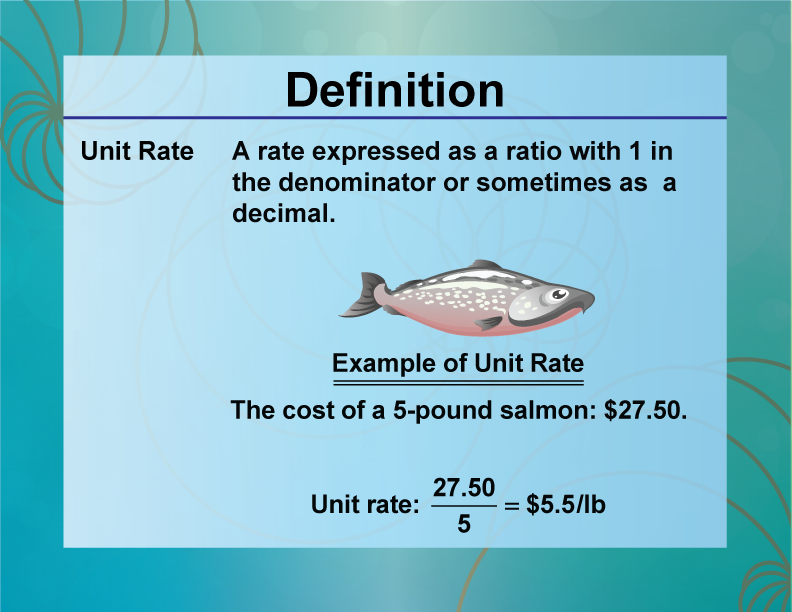
Simply put, a unit rate describes how many units of the first type of quantity correspond to one unit of the second type of quantity. It’s always expressed as “X per Y,” where Y is a single unit. For example:
-
Miles per hour (mph): How many miles are covered in one hour.
-
Dollars per pound ($/lb): How many dollars an item costs for one pound.
-
Clicks per impression (CTR): How many clicks occur for every one impression.
-
Interest per dollar per year: The cost of borrowing or earning on one dollar over one year.
The beauty of the unit rate lies in its standardization. By converting different quantities to a common base of “one unit,” we eliminate variables and create a level playing field for comparison. Without it, comparing a 10-ounce box of cereal to a 15-ounce box, or a loan with a 5% interest rate over 3 years to another with 6% over 2 years, becomes needlessly complicated.
Why Unit Rate Matters in Money Management
In the financial world, where every dollar counts, the ability to make informed comparisons is paramount. Unit rate provides this capability by:
-
Revealing True Value: It strips away marketing tactics and packaging illusions, showing the actual cost-effectiveness of products and services.
-
Facilitating Smart Budgeting: By understanding the unit cost of various expenditures, you can better allocate funds and identify areas for savings.
-
Optimizing Spending: It guides decisions on whether buying in bulk is truly economical or if a smaller, more expensive option offers better overall value in certain situations.
-
Informing Investment Decisions: Comparing returns, fees, or yields on a per-unit basis helps in selecting the most profitable ventures.
-
Enhancing Business Profitability: Businesses use unit rates extensively to price products, manage costs, and analyze performance.
Ignoring unit rate means leaving money on the table, potentially overpaying for essentials, making suboptimal investment choices, or mismanaging business resources. It’s the bedrock of cost-benefit analysis in almost every financial scenario.
Common Unit Rate Examples in Daily Finance
Let’s ground this concept with everyday financial examples that most people encounter:
-
Grocery Shopping: The most classic example. Comparing two different brands or sizes of rice, you’d look at the price per ounce, pound, or kilogram. A larger package might seem cheaper overall, but its unit rate might be higher than a smaller, on-sale alternative.
-
Utility Bills: Your electricity bill is often calculated based on kilowatt-hours (kWh). Understanding your cost per kWh allows you to track usage and identify ways to reduce consumption, saving money. Similarly, water is often charged per gallon or cubic foot.
-
Fuel Consumption: Miles per gallon (MPG) or kilometers per liter (km/L) is a direct unit rate. It helps you assess the efficiency of different vehicles and calculate fuel costs for trips.
-
Subscription Services: While often a flat monthly fee, comparing internet speeds (Mbps per dollar), streaming library sizes (titles per dollar), or cloud storage (GB per dollar) can help you choose the best value.
These simple examples illustrate how unit rate isn’t an abstract concept but a practical tool embedded in countless financial transactions we make daily.
Unit Rate in Personal Finance: Mastering Everyday Spending and Saving
For individuals, unit rate is a direct pathway to financial empowerment. It’s about more than just saving a few cents; it’s about developing a strategic mindset towards consumption and wealth preservation.
Smarter Shopping: Groceries, Utilities, and Household Goods
Supermarkets are battlegrounds of unit rate. Savvy shoppers instinctively check the price per unit (usually displayed on shelf tags) to determine the best deal. A 12-pack of soda might cost $6, while an 18-pack costs $8. Without unit rate, $8 might seem more expensive. However, at $0.50 per can for the 12-pack ($6/12) and $0.44 per can for the 18-pack ($8/18), the larger pack is the better value per unit. This applies to everything from detergent to paper towels, where larger sizes or bulk purchases often, but not always, offer a lower unit cost.
Beyond groceries, utilities are prime candidates for unit rate analysis. Understanding your cost per kWh for electricity or per therm for natural gas allows you to:
-
Monitor Usage: Identify peak consumption times or appliances that are energy hogs.
-
Compare Providers: If you have a choice, comparing the unit rate from different energy suppliers can lead to significant savings.
-
Justify Investments: Calculate the potential savings from energy-efficient appliances by comparing their lower unit consumption against older models.
Unpacking Subscription Services and Recurring Costs
The rise of the subscription economy has made unit rate analysis even more crucial. Many services offer tiered pricing, and the perceived “best deal” isn’t always obvious. Consider streaming services:
-
Video Streaming: One service might offer 4K quality for $15/month, while another offers 1080p for $10/month. If 1080p is sufficient, the $10 option provides better value for your viewing needs. If you need 4K, you’d compare the number of simultaneous streams or content library size per dollar.
-
Cloud Storage: Providers offer various plans (e.g., 100GB for $1.99, 2TB for $9.99). Calculating the cost per gigabyte ($/GB) reveals which plan is most efficient for your storage needs.
By breaking down subscription costs into their most fundamental units of value, you can ensure you’re not overpaying for features you don’t use or for a service that’s less efficient than a competitor.
Evaluating Loans, Interest Rates, and Credit Products
In the world of credit and debt, unit rate manifests as interest rates, annual percentage rates (APRs), and fees.
-
Interest Rates: Expressed as a percentage per year, this is the unit cost of borrowing money. A 5% annual interest rate means you pay 5 cents for every dollar borrowed per year. Comparing interest rates across different loan products (mortgages, car loans, personal loans) is a direct application of unit rate to find the cheapest borrowing cost.
-
APR (Annual Percentage Rate): This unit rate encompasses not just the interest rate but also other fees associated with a loan, providing a more comprehensive “per year” cost of borrowing. It’s a powerful comparison tool for credit cards and installment loans.
-
Credit Card Rewards: Some cards offer “points per dollar spent” or “cash back percentage,” which are unit rates for earning rewards. Understanding these helps you choose the card that maximizes your benefits based on your spending habits.
Diligent attention to these unit rates is vital for managing debt responsibly and leveraging credit effectively without incurring unnecessary costs.
Applying Unit Rate to Investments and Business Acumen
The utility of unit rate extends far beyond personal spending, becoming a sophisticated analytical tool for investors and business professionals alike.
Assessing Investment Performance: Return Per Dollar
In investing, unit rate is fundamental to evaluating the efficiency and profitability of assets.
-
Return on Investment (ROI): While often expressed as a percentage of the initial investment, at its core, ROI is a measure of return per dollar invested. A 10% ROI means you earned $0.10 for every dollar you put in. Comparing ROIs across different asset classes (stocks, bonds, real estate) helps allocate capital optimally.
-
Dividend Yield: For income-generating stocks, dividend yield is the annual dividend paid per dollar of the stock’s price, expressed as a percentage. It tells you how much income you receive relative to the price of the share.
-
Earnings Per Share (EPS): A crucial metric for stock investors, EPS is a company’s profit allocated to each outstanding share of common stock. It helps assess a company’s profitability on a per-share basis, making comparisons between companies easier.
-
Expense Ratios: For mutual funds and ETFs, the expense ratio is the annual fee charged as a percentage of your investment. It’s the unit cost of managing your fund, and lower expense ratios generally mean more of your money working for you.
By dissecting investment performance into per-unit measures, investors can make more rational and data-driven decisions, focusing on efficiency and actual returns rather than just nominal values.
Business Metrics: Cost Per Acquisition, Revenue Per Unit
Businesses thrive on efficiency, and unit rate is the bedrock of many critical performance indicators.
-
Cost Per Acquisition (CPA): In marketing, CPA is the total cost of acquiring one paying customer. It’s a vital unit rate for evaluating the effectiveness of marketing campaigns. A lower CPA means more efficient customer acquisition.
-
Revenue Per Employee: This metric measures the total revenue generated by a company divided by the number of employees. It’s a unit rate that indicates employee productivity and overall operational efficiency.
-
Cost of Goods Sold (COGS) Per Unit: For manufacturing or retail businesses, understanding the COGS for each product unit is crucial for pricing strategies and calculating gross profit margins.
-
Profit Per Unit: This is perhaps the most critical unit rate for any business, indicating the profitability of each individual product or service sold after accounting for all associated costs.
These unit rates allow businesses to benchmark their performance, identify areas for cost reduction, optimize pricing, and ultimately enhance their bottom line.
Financial Ratio Analysis: Profitability and Efficiency
Many cornerstone financial ratios used in business and investment analysis are, in essence, sophisticated unit rates.
-
Price-to-Earnings (P/E) Ratio: This ratio compares a company’s share price to its earnings per share. It’s a unit rate that tells investors how much they are paying for each dollar of a company’s earnings.
-
Debt-to-Equity Ratio: This measures a company’s total liabilities relative to its shareholder equity. It’s a unit rate indicating financial leverage and risk, showing how much debt is used for every dollar of equity.
-
Inventory Turnover: This ratio measures how many times inventory is sold and replaced over a period. It’s a unit rate of efficiency in inventory management.
These ratios provide standardized units for comparison, allowing analysts and investors to evaluate a company’s financial health, operational efficiency, and market valuation relative to industry peers or its own historical performance.
Beyond the Basics: Advanced Considerations and Potential Pitfalls
While unit rate is a powerful tool, it’s not a silver bullet. Astute financial decision-makers understand its limitations and consider additional factors that influence true value.
The “Hidden Costs” and Quality Conundrum
The lowest unit price doesn’t always translate to the best long-term value.
-
Quality Differences: A cheaper unit of a product might be of inferior quality, leading to more frequent replacements, higher maintenance costs, or a less satisfactory experience. A lower-cost appliance might have a higher cost per year of ownership due to breakdowns.
-
Hidden Fees: Financial products often come with fees not immediately reflected in the primary unit rate. A loan with a low interest rate might have high origination fees, or an investment fund with a low expense ratio might have high transaction costs. Always dig into the fine print.
-
Opportunity Cost: Choosing the lowest unit cost might mean sacrificing convenience, superior customer service, or features that would ultimately save you time or hassle—factors that have an implicit monetary value.
True financial wisdom involves balancing the unit rate with qualitative factors and understanding the total cost of ownership or experience.
Time Value of Money and Long-Term vs. Short-Term Rates
Unit rates often reflect a snapshot in time. However, money itself has a time value – a dollar today is worth more than a dollar tomorrow due to inflation and potential earning capacity.
-
Compounding Interest: A simple annual interest rate (unit rate) doesn’t fully capture the growth of an investment over time if the interest compounds more frequently. For long-term investments, the effective annual rate might be higher than the stated unit rate.
-
Inflation: A unit price of $1.00 today might be $1.03 next year due to inflation. When comparing costs over extended periods, especially for large purchases or retirement planning, adjusting unit rates for inflation provides a more realistic picture.
-
Long-Term Contracts: A service might offer a lower unit rate if you commit to a longer contract. While this can save money, it also reduces flexibility. The “unit rate” of a flexible, month-to-month option might be higher, but it carries a lower long-term commitment risk.
Considering the time value of money adds another layer of sophistication to unit rate analysis, especially for significant, multi-year financial decisions.
The Impact of Scale and Bulk Pricing
While unit rate often highlights the savings from bulk purchases, there are scenarios where scale introduces complexities.
-
Spoilage/Waste: Buying a huge tub of yogurt at a lower unit price isn’t a saving if half of it goes bad before you can eat it. The “effective” unit rate for consumable goods must account for potential waste.
-
Storage Costs: For businesses, buying in massive quantities to reduce unit cost might lead to higher inventory holding costs (warehousing, insurance, obsolescence) that erode the initial savings.
-
Upfront Capital: A lower unit price for a large volume often requires a larger upfront payment. For individuals or small businesses with limited capital, the lower unit price might not be accessible or practical due to cash flow constraints.
Understanding these dynamics ensures that the pursuit of a lower unit rate doesn’t lead to unforeseen financial inefficiencies or burdens.
Practical Strategies for Harnessing Unit Rate in Your Financial Life
Armed with a comprehensive understanding of unit rate, it’s time to integrate this powerful tool into your daily financial habits and long-term planning.
Tools and Techniques for Calculation
You don’t need to be a math genius to use unit rates effectively.
-
Shelf Labels: Many grocery stores already display the unit price (e.g., “$X.XX/oz”) on their shelf tags. Always look for these.
-
Smartphones and Calculators: For items without unit prices, a quick division on your phone or a small calculator is all it takes. (Total Price / Total Quantity = Unit Price).
-
Spreadsheets: For more complex financial comparisons (e.g., comparing investment returns, analyzing business costs), spreadsheets like Excel or Google Sheets are invaluable. You can set up formulas to automatically calculate and compare unit rates across multiple options.
-
Budgeting Apps: Many personal finance apps allow you to track spending, and some even offer features for price comparisons or visualizing cost per unit over time.
Making these calculations a habit will sharpen your financial instincts and ensure you’re always getting the most value.
Developing a Unit Rate Mindset
The most effective strategy isn’t just about calculation; it’s about adopting a “unit rate mindset.”
-
Question “Total Price”: Whenever you see a price, automatically ask yourself, “What am I getting for this price?” and “What is the cost per unit of value?”
-
Think in Terms of Value: Shift your focus from simply “cost” to “value received per dollar spent.” This encourages you to consider quality, longevity, and overall benefit alongside the price tag.
-
Comparison is Key: Always seek out alternatives and compare their unit rates. Whether it’s choosing a brand of coffee or selecting an internet provider, active comparison drives better financial outcomes.
-
Educate Yourself: Continuously learn about the typical unit rates in different industries (e.g., average cost per lead in marketing, typical return on different investment types) to better evaluate offers.
This mindset transforms you from a passive consumer into an active, strategic financial manager.
Making Informed Decisions with Confidence
Ultimately, understanding unit rate is about making better, more confident financial decisions.
-
Empowerment: It removes the guesswork and gives you a tangible metric to justify your choices. You’re no longer guessing which deal is better; you know.
-
Savings: Consistently applying unit rate principles can lead to significant cumulative savings over time, freeing up capital for other financial goals like investing or debt reduction.
-
Optimized Investments: By comparing returns, fees, and efficiency on a per-unit basis, you can build a more robust and profitable investment portfolio.
-
Business Growth: For entrepreneurs and business leaders, unit rate analysis is critical for sustainable growth, competitive pricing, and efficient resource allocation.
In a financially complex world, the ability to distil information down to its most basic comparable unit is a profound advantage. It’s a skill that pays dividends, literally and figuratively, throughout your entire financial journey.

Conclusion
The question “What does unit rate mean?” opens the door to a world of financial clarity and control. Far from being an obscure mathematical concept, unit rate is a practical, powerful tool woven into the fabric of everyday commerce, personal budgeting, investment analysis, and business strategy. From selecting the best value at the grocery store to evaluating the efficiency of a marketing campaign or assessing the profitability of a stock, unit rate provides the standardized metric needed to make informed, intelligent decisions.
By embracing a unit rate mindset, actively calculating and comparing values, and understanding its nuances and limitations, you equip yourself with an indispensable skill. This knowledge empowers you to look beyond initial prices and perceived bargains, revealing the true cost and value of goods, services, and financial products. In doing so, you don’t just save money; you cultivate a deeper understanding of financial dynamics, leading to greater financial confidence, security, and ultimately, a more prosperous financial future. Make unit rate your financial compass, and navigate the complex landscape of money with unwavering insight.
aViewFromTheCave is a participant in the Amazon Services LLC Associates Program, an affiliate advertising program designed to provide a means for sites to earn advertising fees by advertising and linking to Amazon.com. Amazon, the Amazon logo, AmazonSupply, and the AmazonSupply logo are trademarks of Amazon.com, Inc. or its affiliates. As an Amazon Associate we earn affiliate commissions from qualifying purchases.