
In the dynamic and often unpredictable landscape of modern commerce, businesses face an array of risks that can lead to significant financial liabilities. While standard commercial insurance policies — such as General Liability, Commercial Auto, and Employer’s Liability — provide a crucial first line of defense, they inherently come with limits. These limits, while substantial for everyday claims, can prove woefully inadequate in the face of a catastrophic lawsuit or an unforeseen, high-value claim. This is precisely where commercial umbrella coverage steps in, acting as an indispensable financial safeguard that extends and broadens a business’s liability protection beyond the confines of its primary policies. Understanding this critical layer of financial security is not just about compliance; it’s about robust risk management and preserving the long-term solvency and operational continuity of your enterprise.
The Fundamental Role of Commercial Umbrella Insurance
Commercial umbrella insurance is designed to provide an additional layer of liability coverage above and beyond the limits of your underlying primary business insurance policies. Think of it as an expansive net that catches what your other policies might miss or exceed. This supplementary coverage is not a standalone policy that covers new types of risks; rather, it elevates the financial protection for risks already covered by your existing General Liability, Commercial Auto Liability, and Employer’s Liability policies. Its fundamental role is to shield a business from the potentially devastating financial impact of large claims that could otherwise bankrupt an enterprise, forcing it to liquidate assets, or, at minimum, significantly impede its growth and operational stability. It’s an investment in financial resilience, providing peace of mind knowing that an unexpected, high-cost event won’t derail your business.
Bridging the Gaps in Primary Policies
Every commercial insurance policy has a per-occurrence limit and an aggregate limit. For instance, a General Liability policy might offer a $1 million per-occurrence limit and a $2 million aggregate limit. While these figures seem high, a severe incident—such as a major product liability claim, a large-scale property damage lawsuit, or multiple severe auto accidents involving company vehicles—could easily exceed these thresholds. Without an umbrella policy, your business would be directly responsible for any costs that surpass these primary limits. An umbrella policy seamlessly bridges these gaps, kicking in precisely when the underlying policy limits are exhausted, thereby preventing your business from having to pay out-of-pocket for remaining liabilities. This continuity of coverage ensures that your financial protection remains intact, even in the most challenging scenarios.
Safeguarding Against Catastrophic Losses
The primary objective of commercial umbrella insurance is to protect a business from catastrophic losses. In today’s litigious environment, lawsuits can lead to multi-million dollar judgments, especially concerning bodily injury, property damage, or reputational harm. For businesses without adequate umbrella coverage, such a judgment could necessitate liquidating assets, taking on substantial debt, or even declaring bankruptcy. An umbrella policy acts as a buffer, providing millions of dollars in additional coverage to absorb these massive financial shocks. This level of protection is vital for businesses in industries with higher inherent risks, those that deal with the public extensively, or those with significant assets to protect. It transforms a potentially business-ending event into a manageable financial challenge, allowing the company to recover and continue operations.
How Commercial Umbrella Policies Work
The operational mechanism of a commercial umbrella policy is straightforward yet powerful. It functions exclusively as excess liability coverage, meaning it only activates once the limits of your underlying primary policies have been fully exhausted. This tiered approach to insurance coverage ensures that your business’s financial exposure is managed systematically, starting with the immediate coverage from your primary policies and escalating to the broader, higher-limit protection offered by the umbrella policy when needed. It’s not a replacement for your core insurance; rather, it’s an enhancement that provides a critical safety net for extraordinary circumstances.
Excess Liability Coverage
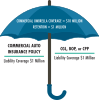
When a covered claim arises that exceeds the limits of your primary commercial general liability, commercial auto liability, or employer’s liability policies, the commercial umbrella policy comes into play. For example, if your General Liability policy has a $1 million limit and a lawsuit results in a $3 million judgment, your primary policy would pay out its $1 million limit. The commercial umbrella policy would then cover the remaining $2 million, up to its own policy limit, which can often range from $5 million to $25 million or more, depending on the policy purchased. This tiered structure ensures that your business is protected against the most severe financial demands, preventing direct financial loss that could cripple operations.
Broader Coverage Scope
Beyond simply extending limits, some commercial umbrella policies can also provide coverage for certain types of claims that might be excluded or not fully covered by your underlying policies, subject to the specific terms and conditions of the umbrella policy. This “drop-down” feature is particularly valuable, as it can offer a wider net of protection for unique or less common liability scenarios, though it often involves a deductible (known as a self-insured retention or SIR) that the business must pay before the umbrella coverage activates for these specific types of claims. This broadened scope adds another layer of financial security, addressing potential blind spots in a business’s overall risk management strategy.
The Underlying Policy Requirement
A crucial aspect of commercial umbrella insurance is that it requires underlying primary policies to be in force with specific minimum limits. Insurers providing umbrella coverage typically mandate that your business carries a certain level of General Liability, Commercial Auto, and Employer’s Liability insurance before they will issue an umbrella policy. This ensures that the umbrella policy truly acts as an excess layer and not as a substitute for foundational coverage. It also implies that the underwriting process for an umbrella policy will involve a thorough review of your existing insurance portfolio, reinforcing the importance of maintaining robust primary coverage.
Key Benefits of Investing in Umbrella Coverage
Investing in commercial umbrella coverage offers a multitude of tangible benefits that extend beyond mere financial protection, contributing to the overall stability, credibility, and long-term viability of a business. It’s a strategic financial decision that reflects a proactive approach to risk management, distinguishing resilient businesses from those perpetually vulnerable to unforeseen financial setbacks.
Enhanced Financial Protection
The most immediate and apparent benefit is the dramatically enhanced financial protection it affords. By extending liability limits into the millions, an umbrella policy shields a business’s assets – including capital, property, and equipment – from being seized or liquidated to satisfy large judgments. This protection is vital for maintaining financial liquidity and ensuring that a single catastrophic event does not lead to insolvency. It safeguards the wealth generated by the business, allowing profits to be reinvested in growth rather than being consumed by legal liabilities.
Peace of Mind for Business Owners
For entrepreneurs and business owners, the burden of potential liability can be immense. An umbrella policy provides significant peace of mind, knowing that a substantial financial safety net is in place. This allows owners to focus more on strategic growth, innovation, and day-to-day operations, rather than being constantly preoccupied with the “what-if” scenarios of worst-case liability claims. This psychological benefit translates into better decision-making and a more confident, forward-looking business approach.
Meeting Contractual Requirements
Many large contracts, particularly with government entities, major corporations, or landlords, often require businesses to carry specific, high levels of liability insurance. Standard primary policies may not meet these elevated requirements. Commercial umbrella insurance provides an efficient and cost-effective way to satisfy these contractual obligations without having to significantly increase the limits on each underlying policy individually. This enables businesses to pursue larger, more lucrative opportunities that would otherwise be inaccessible.
Protecting Business Assets and Longevity
Ultimately, commercial umbrella coverage is about protecting the long-term health and longevity of your business. Without it, a severe accident or lawsuit could wipe out years of hard work, investment, and growth. By insulating the business from these severe financial shocks, an umbrella policy helps ensure that the enterprise can withstand adversity, recover, and continue to serve its customers, employ its staff, and contribute to the economy for years to come. It’s an essential component of a sustainable business finance strategy.
When is Commercial Umbrella Insurance Essential?
While every business can benefit from the added protection of an umbrella policy, certain types of businesses and operational contexts make it not just advisable, but truly essential. Identifying these situations involves a careful assessment of a company’s risk profile, the nature of its operations, and its financial standing. The potential for large-scale financial liabilities varies significantly across industries and business models, dictating the urgency for this enhanced layer of coverage.
High-Risk Industries
Businesses operating in inherently high-risk industries are prime candidates for commercial umbrella insurance. This includes construction companies, manufacturing firms, transportation and logistics businesses, and any operation involving heavy machinery, hazardous materials, or significant public interaction. The higher incidence of accidents, injuries, or property damage in these sectors means a greater likelihood of claims exceeding standard policy limits. An umbrella policy becomes a non-negotiable component of their financial risk management.
Businesses with Significant Public Interaction
Any business that regularly interacts with the public, such as retail stores, restaurants, hospitality venues, event organizers, or service providers that frequently visit client premises, faces an elevated risk of slip-and-fall incidents, foodborne illnesses, or other injuries to customers or visitors. The sheer volume of interactions increases the probability of a liability claim. A large-scale incident involving multiple injured parties, or a single severe injury, can quickly exhaust primary general liability limits, making umbrella coverage a critical necessity.
Companies with Valued Assets or High Exposure
Businesses that have accumulated substantial assets, whether in terms of capital, real estate, or equipment, stand to lose more in the event of an uncovered liability judgment. Similarly, companies that operate in highly visible capacities, have a strong brand presence, or engage in activities that could lead to widespread public impact (e.g., tech companies with software vulnerabilities, media companies with defamation risks) face higher exposure. For these entities, an umbrella policy acts as a shield, protecting their accumulated wealth and mitigating reputation-damaging financial crises.
Growth-Oriented Businesses
As businesses grow, so do their operations, their employee count, their client base, and often, their risk exposure. Expanding into new markets, launching new products, or increasing production volumes inherently amplifies the potential for liability claims. For growth-oriented businesses, securing an umbrella policy is a proactive measure that scales financial protection alongside business expansion, ensuring that success isn’t undermined by unforeseen liabilities. It’s an investment in sustainable growth and future financial security.
Understanding the Cost and Selection Process
The decision to acquire commercial umbrella insurance, like any financial investment, involves understanding its cost and navigating the selection process effectively. While the prospect of additional premiums might seem daunting, the relatively low cost of umbrella coverage compared to the immense protection it provides often makes it one of the most cost-effective risk management tools available to businesses.
Factors Influencing Premiums
Several factors determine the premium for a commercial umbrella policy. These include the nature of your business operations (risk level), the number of employees, your claims history, the limits of your underlying primary policies, and the desired umbrella coverage limits. For instance, a construction company with a history of claims will likely pay more than a consulting firm with a clean record. However, because umbrella policies only kick in after primary limits are exhausted, they are generally less expensive per million dollars of coverage than primary policies. Businesses can often obtain millions of dollars in additional coverage for a relatively modest annual premium, making it a highly attractive investment in financial security.

Working with an Insurance Professional
Selecting the right commercial umbrella policy requires careful consideration and expertise. It is highly recommended that business owners work closely with an experienced commercial insurance broker or agent. A knowledgeable professional can help assess your specific business risks, evaluate the adequacy of your current primary policies, determine appropriate umbrella limits, and compare quotes from various carriers. They can also explain the nuances of policy terms, such as self-insured retentions (SIRs) and specific exclusions, ensuring that the chosen policy provides comprehensive and appropriate coverage for your business’s unique financial landscape. This expert guidance is crucial in tailoring an umbrella solution that truly enhances your business’s financial resilience.
aViewFromTheCave is a participant in the Amazon Services LLC Associates Program, an affiliate advertising program designed to provide a means for sites to earn advertising fees by advertising and linking to Amazon.com. Amazon, the Amazon logo, AmazonSupply, and the AmazonSupply logo are trademarks of Amazon.com, Inc. or its affiliates. As an Amazon Associate we earn affiliate commissions from qualifying purchases.