
In the rapidly evolving landscape of digital infrastructure, the demand for precision, speed, and reliability has never been higher. As we move deeper into the era of Industry 4.0, autonomous vehicles, and complex Internet of Things (IoT) ecosystems, standard Ethernet—once the gold standard for office connectivity—is finding itself pushed to its limits. This is where the TSN (Time-Sensitive Networking) network comes into play.
TSN is not a single technology but a set of standards developed by the IEEE 802.1 working group. It represents a significant evolution of standard Ethernet, transforming it from a “best-effort” communication medium into a deterministic network capable of guaranteeing delivery times for critical data. For professionals in the tech space, understanding TSN is essential for navigating the future of industrial automation, automotive engineering, and professional telecommunications.
The Evolution of Connectivity: From Best-Effort to Deterministic
To appreciate what TSN brings to the table, one must first understand the limitations of standard Ethernet. Historically, Ethernet was designed for flexibility. In a typical office environment, if an email takes an extra 50 milliseconds to arrive, the user doesn’t notice. This is “best-effort” delivery: the network does its best to move data quickly, but there are no guarantees regarding timing or sequence.
The Problem of Latency and Jitter
In industrial or mission-critical environments, “best-effort” is not enough. Imagine an autonomous vehicle’s braking system or a robotic arm in a high-speed assembly line. In these scenarios, data must arrive at an exact moment. If a control signal is delayed by even a fraction of a second due to network congestion, the result could be a mechanical failure or a safety hazard. This variation in delay is known as jitter, and it is the primary enemy of precision engineering.
Moving Beyond Proprietary Solutions
Before the rise of TSN, industries solved this problem by using proprietary “Industrial Ethernet” solutions or specialized fieldbuses. While effective, these systems were often incompatible with one another, creating “data silos” where different machines couldn’t communicate. TSN solves this by providing a standardized, interoperable framework that allows time-critical traffic and regular data traffic to coexist on the same hardware.
The Technical Pillars of TSN: How It Works
The power of a TSN network lies in its ability to manage traffic through a suite of sub-standards. These standards focus on three primary goals: time synchronization, scheduled traffic, and selection of communication paths.
Time Synchronization (IEEE 802.1AS)
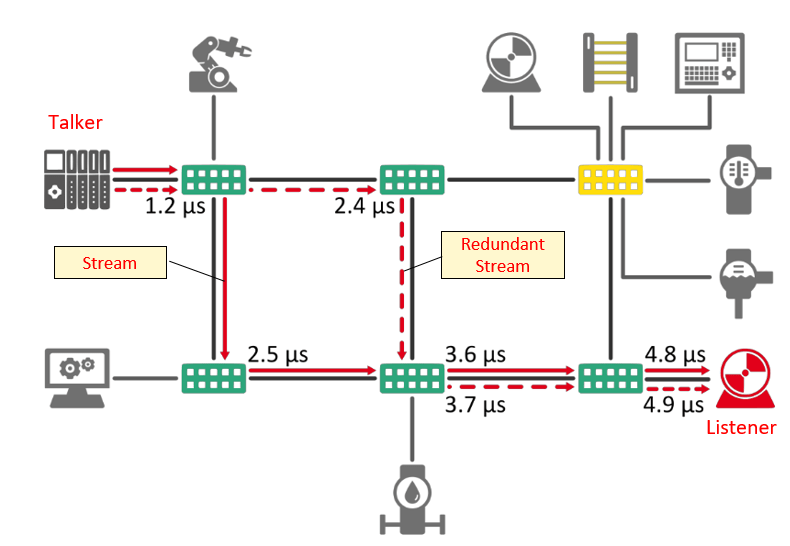
At the heart of any TSN network is a shared sense of time. Without a universal clock, it is impossible to coordinate the movements of multiple devices. The IEEE 802.1AS standard, also known as gPTP (Generalized Precision Time Protocol), ensures that every device on the network is synchronized to within a sub-microsecond range. This synchronization allows devices to execute tasks in perfect harmony, regardless of how many switches or routers sit between them.
Enhancements for Scheduled Traffic (IEEE 802.1Qbv)
One of the most innovative features of TSN is the “Time-Aware Shaper.” This mechanism divides network traffic into different “priority queues.” It uses a time-based gate system to ensure that high-priority, time-sensitive data has an open lane on the network at specific intervals. By blocking non-critical traffic during these “protected windows,” TSN ensures that critical data never has to wait for a large, non-essential file transfer to finish.
Frame Preemption (IEEE 802.1Qbu)
In a standard network, if a large data packet starts transmitting, a smaller, more urgent packet must wait until the large one is finished. TSN introduces “Frame Preemption.” This allows the network to “interrupt” a low-priority data packet in mid-transmission to let a high-priority packet through. Once the critical data has passed, the low-priority packet resumes exactly where it left off. This significantly reduces latency without wasting bandwidth.
Key Benefits: Why TSN is a Game-Changer for Modern Industry
The transition to TSN networking offers more than just technical precision; it provides strategic advantages that redefine how businesses build and scale their digital architecture.
Convergence of IT and OT
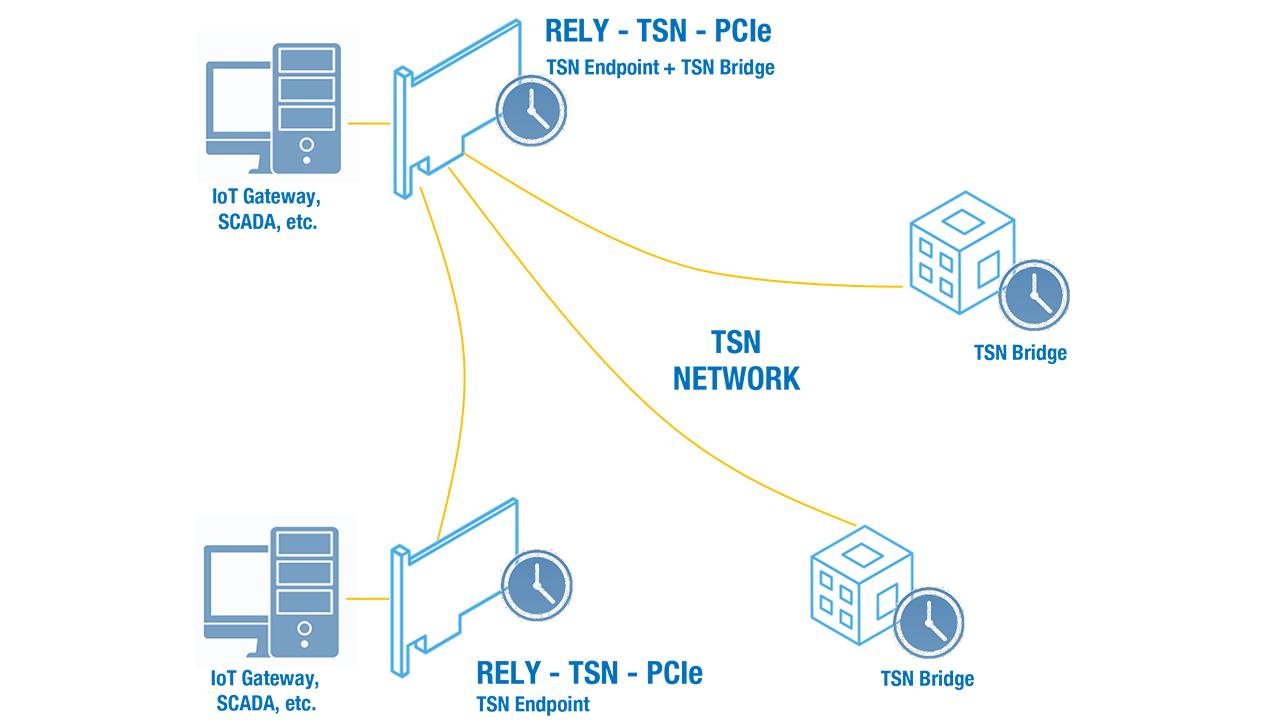
Traditionally, Information Technology (IT) and Operational Technology (OT) operated on separate networks. IT handled emails and databases, while OT handled sensors and motors. TSN allows these two worlds to converge. Because TSN can handle both time-critical and “best-effort” traffic on the same wire, companies can simplify their infrastructure, reducing the cost of cabling, maintenance, and training.
High Bandwidth and Scalability
Unlike older industrial protocols that were limited to 10 or 100 Mbps, TSN operates on standard Ethernet hardware, meaning it can leverage speeds of 1 Gbps, 10 Gbps, and beyond. This high bandwidth is crucial for modern applications like high-definition machine vision, where massive amounts of visual data must be analyzed in real-time to detect defects on a production line.
Future-Proofing Through Interoperability
Because TSN is an open IEEE standard, it is supported by a vast ecosystem of hardware and software vendors. This eliminates “vendor lock-in,” where a company is forced to buy all its equipment from one manufacturer to ensure compatibility. A TSN-compliant sensor from one company will work seamlessly with a TSN-compliant controller from another, fostering innovation and competitive pricing.
Real-World Applications: From Automotive to Smart Factories
The theoretical benefits of TSN are impressive, but its real-world impact is even more significant. Several key sectors are currently leading the adoption of this technology.
The Automotive Revolution
Modern vehicles are essentially data centers on wheels. Between Advanced Driver Assistance Systems (ADAS), infotainment, and engine control units, the internal wiring of a car has become incredibly complex. Automotive manufacturers are turning to TSN to replace heavy, expensive wiring harnesses with a single Ethernet backbone. TSN ensures that a “collision avoidance” signal reaches the brakes instantly, even if the passengers are simultaneously streaming 4K video on the infotainment system.
Industrial Automation and Robotics
In “Smart Factories,” robots must work in close proximity to humans and other machines. TSN enables “isochronous” communication, meaning movements are synchronized with incredible precision. This allows for faster production cycles and higher quality control. Furthermore, TSN’s ability to provide a unified network allows manufacturers to extract data from the factory floor and send it directly to the cloud for AI-driven predictive maintenance.
Professional Audio and Video (Pro AV)
The Pro AV industry was actually one of the earliest adopters of the concepts behind TSN (originally known as Audio Video Bridging or AVB). In live concert settings or broadcast studios, audio and video streams must remain perfectly in sync to avoid “lip-sync” errors. TSN provides the deterministic foundation required to transmit multi-channel, high-fidelity media over standard network switches without the risk of dropouts or lag.
The Future Roadmap: Overcoming Implementation Challenges
While TSN is the future of Ethernet, the transition is not without its hurdles. Implementing a TSN network requires a shift in how network engineers think about connectivity.
Configuration and Management Complexity
One of the primary challenges of TSN is its complexity. Managing a network where every packet is timed down to the microsecond requires sophisticated software tools. Engineers must move away from manual “plug-and-play” setups toward Centralized Network Configuration (CNC) models. As the technology matures, we can expect more automated, AI-driven tools to handle the heavy lifting of TSN scheduling.
Legacy Integration
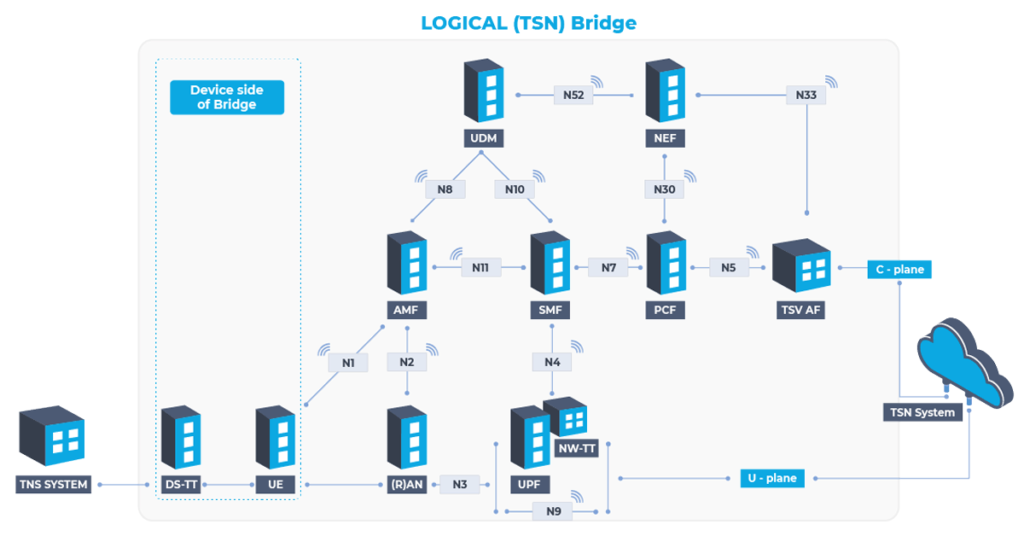
Most industrial facilities are not “greenfield” projects; they are filled with legacy equipment that uses older protocols. The challenge lies in creating “bridges” or gateways that allow these older systems to communicate with a new TSN backbone. While this adds a layer of initial cost, the long-term efficiency gains usually justify the investment.
Conclusion: The Backbone of the Next Digital Frontier
The “TSN network” is far more than a technical upgrade; it is the fundamental infrastructure that will support the next generation of technological breakthroughs. By bringing determinism to Ethernet, TSN bridges the gap between the virtual world of data and the physical world of motion.
Whether it is enabling the safe deployment of self-driving cars, powering the hyper-efficient factories of tomorrow, or ensuring the seamless delivery of high-end media, TSN is the invisible thread connecting our most critical systems. For tech professionals and organizations looking to stay ahead of the curve, the time to engage with TSN is now. The transition from “best-effort” to “guaranteed” communication is not just a trend—it is the new standard for a connected world.
aViewFromTheCave is a participant in the Amazon Services LLC Associates Program, an affiliate advertising program designed to provide a means for sites to earn advertising fees by advertising and linking to Amazon.com. Amazon, the Amazon logo, AmazonSupply, and the AmazonSupply logo are trademarks of Amazon.com, Inc. or its affiliates. As an Amazon Associate we earn affiliate commissions from qualifying purchases.