
As Generative Pre-trained Transformers (GPT) have moved from niche technical experiments to mainstream productivity tools, users have frequently encountered a frustrating technical wall: the response cutoff. Whether you are using ChatGPT to draft a technical manual, summarize a massive dataset, or write a long-form creative piece, understanding the “word limit” is essential for maximizing the tool’s utility.
However, in the world of Large Language Models (LLMs), the concept of a “word limit” is a bit of a misnomer. To truly understand how much ChatGPT can process and generate, we must look under the hood at the technical architecture of OpenAI’s models, specifically focusing on tokens, context windows, and model-specific constraints.

The Core Mechanism: Tokens vs. Words
To understand the capacity of ChatGPT, one must first understand the “token.” Unlike a human who reads words, an AI processes text in chunks of characters called tokens. These tokens can be as short as a single character or as long as one word.
How Tokenization Works
Tokenization is the process by which the model breaks down input text into manageable units. In English, a common rule of thumb is that 1,000 tokens are approximately equal to 750 words. However, this is not a fixed ratio. Common words like “the” or “apple” might be a single token, while complex technical terms, rare proper nouns, or non-English characters might be split into multiple tokens.
This technical nuance is the reason why users often see inconsistent “word counts.” If you ask ChatGPT for a 1,000-word essay, it might stop at 800 words or 1,200 words because its internal logic is tracking the token count, not the word count. The model’s transformer architecture has a finite “context window,” which refers to the total number of tokens it can hold in its active memory at any given time.
The 0.75 Rule of Thumb
For technical planning, developers and power users generally use the 0.75 ratio (1 token ≈ 0.75 words). When a model like GPT-4o claims a 128,000-token context window, it translates to roughly 96,000 words. However, it is crucial to distinguish between the input limit (what you can paste into the chat) and the output limit (what the AI can generate in a single response). While the context window may be vast, the output limit per single message is significantly tighter, usually hovering around 4,000 tokens for most standard GPT-4 iterations.
Breaking Down the Models: GPT-3.5, GPT-4, and GPT-4o
OpenAI has rapidly iterated on its models, and with each generation, the “word limit” has expanded. Understanding which version of the software you are using is the first step in knowing your boundaries.
GPT-3.5 Legacy Limits
GPT-3.5, the model that powered the initial viral success of ChatGPT, has a relatively small context window of 4,096 tokens. This equates to about 3,000 words. This limit includes both your prompt and the model’s response. If you provide a 2,000-word prompt, the model only has about 1,000 words left for its response before it starts “forgetting” the beginning of the conversation. This often leads to the model losing track of instructions or hallucinating details in long threads.
GPT-4 and GPT-4 Turbo’s Massive Expansion
With the release of GPT-4, the architecture saw a significant upgrade. The initial GPT-4 models offered an 8,000-token window, with a specialized 32,000-token version for enterprise users. However, the introduction of GPT-4 Turbo revolutionized this with a 128,000-token context window. This allows the model to process the equivalent of a 300-page book in a single prompt. Despite this massive input capacity, the model still adheres to an output limit (usually 4,096 tokens) to prevent server timeouts and ensure response quality.
GPT-4o: The Current State of the Art
GPT-4o (“o” for Omni) maintains the 128,000-token context window but features improved tokenization efficiency, particularly for non-English languages. Because the model is more efficient at “compressing” information into tokens, users often find they can get slightly more data into the same context window compared to previous versions. Furthermore, GPT-4o is optimized for speed, making the generation of long-form content feel more seamless, even though the fundamental token limits remain similar to GPT-4 Turbo.
Understanding the Context Window
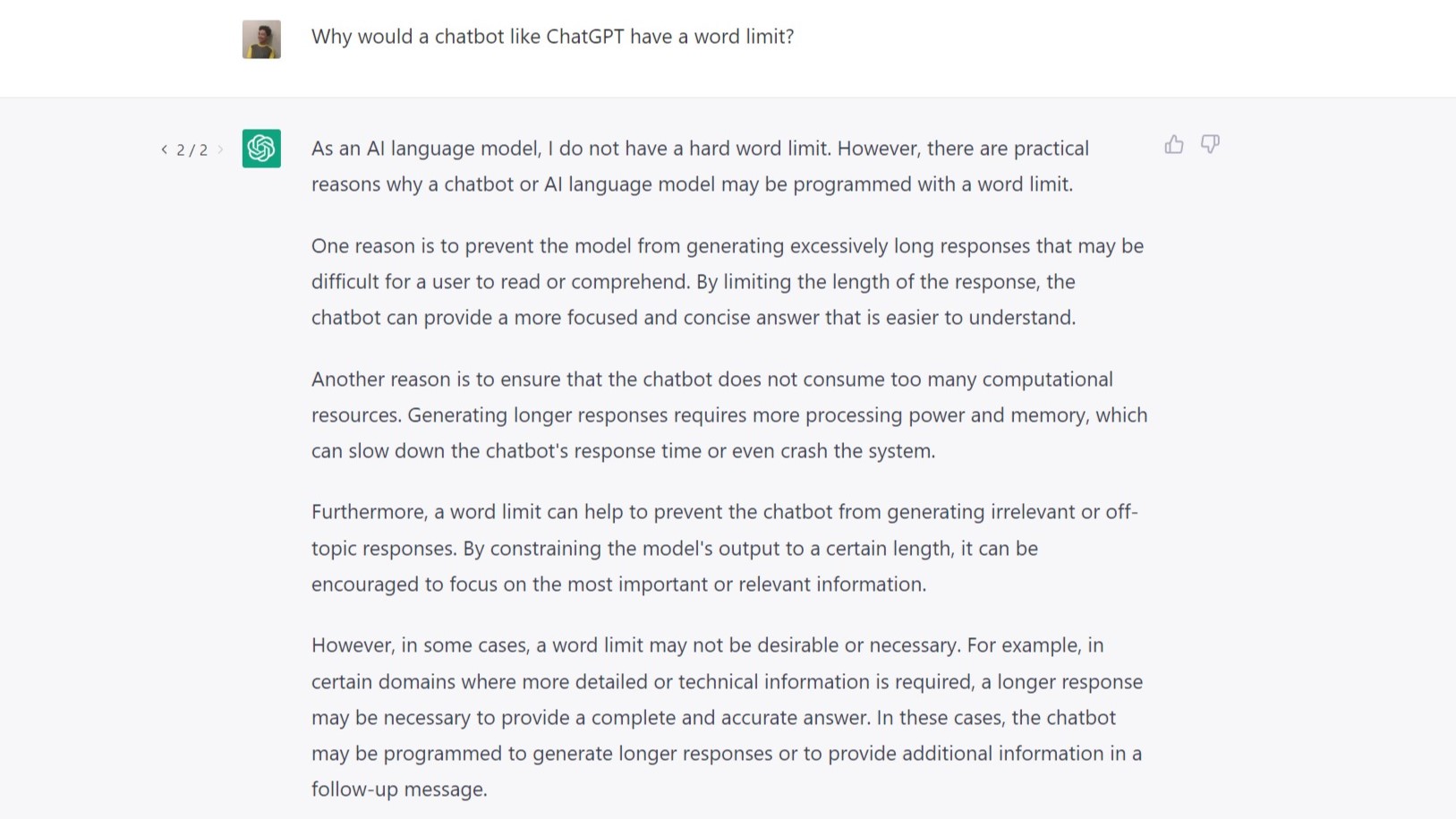
The “context window” is perhaps the most critical concept in modern AI software. It acts as the model’s short-term memory. When you are in a long conversation with ChatGPT, every previous message is fed back into the model to give it context for the next answer.
Input vs. Output Limits
There is a common misconception that if a model has a 128k context window, it can write a 128k-token novel in one go. This is not the case. The context window is shared. If your input (the prompt and previous history) takes up 120,000 tokens, the model only has 8,000 tokens left for its current response.
Moreover, OpenAI imposes a specific “max_tokens” parameter on the output. This is a safety and resource-management feature. Generating 100,000 words in one second would require immense computational power and would likely result in a degradation of logic and grammar. Most users will find that ChatGPT stops generating text after approximately 500 to 1,000 words in a single message, requiring a “Continue” prompt.
The Impact of “Memory” on Longer Conversations
When a conversation exceeds the context window, the model utilizes a “sliding window” approach. It begins to discard the oldest tokens to make room for new ones. In a technical setting, this means if you provide coding requirements at the start of a very long session, the AI may eventually “forget” those requirements as the token count climbs. Keeping track of your token usage is therefore essential for maintaining the integrity of complex, multi-step technical projects.
Practical Strategies for Managing Length Limits
If you are working on a project that requires more than the standard output limit—such as writing a white paper or analyzing a large codebase—you need to employ specific prompting strategies to bypass these technical hurdles.
Prompt Engineering for Long-Form Content
Instead of asking ChatGPT to “write a 5,000-word report,” which will almost certainly fail or result in a truncated response, break the task down. Use a modular approach. Ask the AI to generate a detailed outline first. Once the outline is established, prompt the AI to write each section individually. This ensures that each “module” stays within the high-quality output threshold of the model while allowing the total project to reach your desired length.
Utilizing the “Continue” Feature
In recent updates, OpenAI has integrated a “Continue generating” button that appears when the model hits its token limit mid-sentence. Technically, this works by sending the previous context back to the model and instructing it to pick up exactly where it left off. If the button doesn’t appear, a simple prompt of “Continue” or “Please finish the last paragraph” usually suffices.
Chunking and Sequential Processing
For data analysis or long document summarization, use a technique called “chunking.” If you have a 50,000-word document, split it into 5,000-word segments. Ask the AI to summarize each segment and keep a “running summary” that you update with each new chunk. This prevents the “lost in the middle” phenomenon, where LLMs tend to forget information located in the center of a massive prompt.
Technical Constraints and the Future of Scaling AI
Why is there a limit at all? From a software and hardware perspective, the constraints are a matter of physics and economics.
Computational Costs and Latency
Every token generated requires a pass through the model’s billions of parameters. This requires significant GPU (Graphics Processing Unit) time, primarily using NVIDIA’s H100 or A100 chips. The longer the output, the more electricity and hardware wear are involved. Additionally, latency—the time it takes for the AI to respond—increases as the output grows. To maintain a “chat” experience that feels instantaneous, limits are necessary to keep the data flow manageable.

The Evolution Toward Infinite Context
The trend in AI development is clearly toward larger context windows. We have seen a jump from 4k to 128k in less than two years. Competitors like Google’s Gemini have even introduced 1-million and 2-million token windows. As the technology behind “Linear Attention” and “Flash Attention” matures, we can expect the software to handle even larger datasets with less computational overhead.
In conclusion, while there is no hard “word limit” for ChatGPT, there are strictly defined token limits that dictate how much the model can remember and generate. By understanding the distinction between the 128,000-token context window and the ~4,000-token output limit, users can better architect their prompts and workflows. As AI tools continue to evolve, the bottleneck will likely shift from how much the AI can hold in its head to how effectively we, as users, can structure our requests to utilize that massive digital memory.
aViewFromTheCave is a participant in the Amazon Services LLC Associates Program, an affiliate advertising program designed to provide a means for sites to earn advertising fees by advertising and linking to Amazon.com. Amazon, the Amazon logo, AmazonSupply, and the AmazonSupply logo are trademarks of Amazon.com, Inc. or its affiliates. As an Amazon Associate we earn affiliate commissions from qualifying purchases.