
When planning a digital expedition or a remote work stint in Italy, the technical specifications of the local power grid are often overlooked until a high-end laptop fails to charge or a specialized piece of hardware suffers a catastrophic circuit failure. Understanding the electrical infrastructure of Italy is not merely a matter of convenience; it is a fundamental requirement for hardware maintenance and digital security. For the modern tech professional, the question “what is the voltage in Italy” opens a gateway into a broader discussion about international electrical standards, the physics of power conversion, and the evolution of global charging ecosystems.
1. The Technical Architecture of the Italian Power Grid
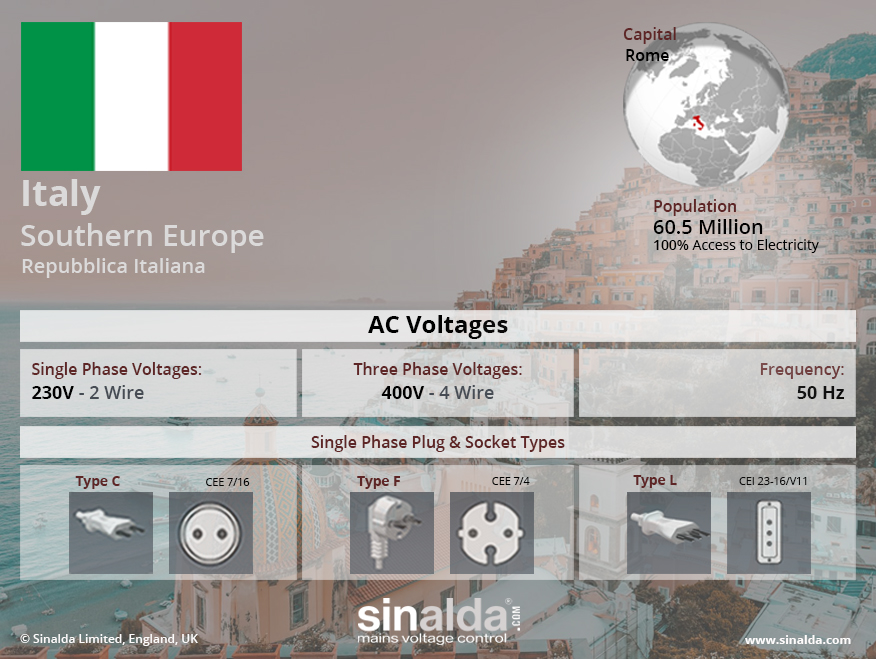
To understand Italy’s electrical landscape, one must look at the standardized European framework. Italy operates on a 230V supply voltage and a 50Hz frequency. For those accustomed to the North American standard of 120V at 60Hz, this represents a significant technical divergence that can impact the performance and lifespan of electronic components.
Understanding the 230V/50Hz Standard
The shift from 220V to 230V was part of a European-wide “harmonization” effort to ensure that electrical equipment could be used across borders without modification. From a technical standpoint, the 230V standard is more efficient for long-distance power distribution than 120V systems, as higher voltage allows for lower current (amperage) to deliver the same amount of power, thereby reducing energy loss through heat in the wiring.
The Significance of Frequency (Hz)
While many modern switching power supplies (like those in your smartphone or laptop) are designed to handle both 50Hz and 60Hz, the frequency difference is critical for devices with AC motors or internal clocks. A 60Hz motor running on a 50Hz Italian circuit will rotate 17% slower, which can lead to overheating and mechanical failure in non-compatible hardware. Digital professionals must verify that their specialized equipment—such as high-end audio monitors or legacy lab equipment—is rated for 50Hz operation.
Tolerances and Stability
The Italian grid is generally stable, but like any infrastructure, it experiences fluctuations. The standard allows for a tolerance of +/- 10%, meaning the actual voltage can swing between 207V and 253V. For sensitive tech gear, these fluctuations necessitate the use of high-quality power delivery (PD) components that can regulate input voltage effectively.
2. Hardware and Interoperability: Navigating Plug Types L, C, and F
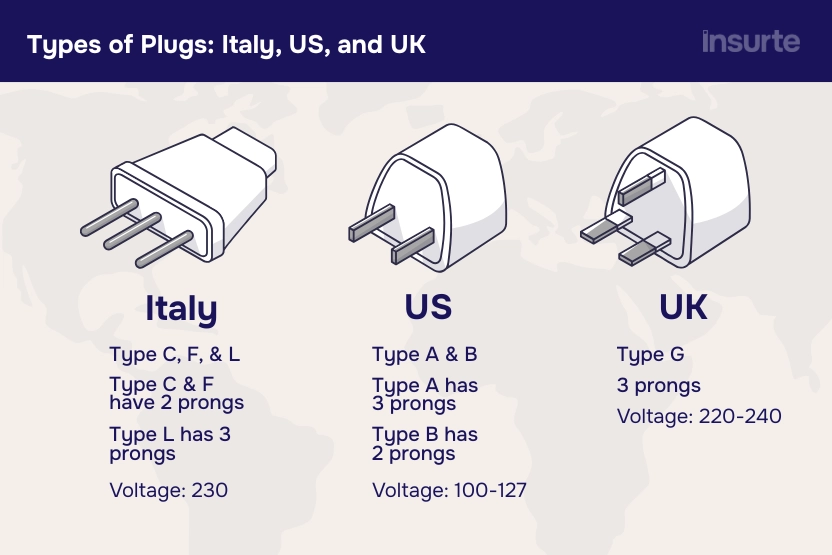
In the realm of hardware connectivity, Italy presents a unique set of challenges. Unlike the relatively uniform plug standards found in the UK or North America, Italy utilizes a triad of plug types that require specific technical consideration.
The Italian Standard: Type L (CEI 23-50)
The Type L plug is the domestic Italian standard. It features three pins in a straight line: two live/neutral pins and a central grounding pin. There are two variations of Type L: a 10-amp version with smaller pins and a 16-amp version with larger, wider-spaced pins. This dual-standard can be a point of friction for tech users, as high-draw devices (like server units or high-powered workstations) may require the 16-amp socket which isn’t available in every wall outlet.
The “Europlug” (Type C) and Schuko (Type F)
While Type L is the native standard, Italy has increasingly integrated the Type C (the slim, two-pin Europlug) and Type F (the “Schuko” plug commonly found in Germany). Type C is the most common for low-power tech gadgets, such as tablets and mobile devices. However, Type C lacks a grounding pin. For expensive hardware with metal chassis—such as a MacBook Pro or a high-end gaming laptop—using an ungrounded Type C plug in a Type L environment can sometimes lead to “stray current,” a tingling sensation on the device’s surface caused by the lack of a path to the ground.
The Role of Grounding in Tech Safety
Grounding is a critical safety feature for digital hardware. In Italy’s Type L system, the center pin serves as the earth connection. When selecting travel adapters or local power strips, tech professionals must ensure that the grounding path is maintained. Using a cheap, two-pin adapter for a three-pin device bypasses the surge protection and grounding mechanisms, leaving sensitive internal circuits vulnerable to electrostatic discharge (ESD).
3. Protecting Digital Assets: Power Surges and Voltage Regulation
For those carrying thousands of dollars in tech equipment, the Italian power grid should be treated with professional caution. While the grid is modern, the age of many Italian buildings—particularly in historic centers like Rome or Florence—means that internal wiring may not always meet the latest standards for surge suppression.
Power Converters vs. Travel Adapters
It is a common technical misconception that a simple plug adapter changes the voltage. It does not. An adapter merely changes the physical shape of the pins. If you plug a 120V-only device into a 230V Italian outlet using an adapter, the device will likely experience a catastrophic thermal event.
Digital nomads must distinguish between:
- Passive Adapters: Change the plug shape only.
- Active Converters/Transformers: Use induction or solid-state switching to step down 230V to 120V. These are often heavy and can introduce electrical noise, which is detrimental to high-fidelity audio or precision computing.
Dual-Voltage Power Supplies
The majority of modern tech—including hardware from Apple, Dell, Sony, and Samsung—uses “switching” power supplies. These are inherently dual-voltage (100V–240V). Before connecting, always check the “Input” section on the power brick. If it reads “100-240V, 50/60Hz,” the device is globally compatible and only requires a physical plug adapter.
Implementing Surge Protection
When setting up a temporary workstation in Italy, the use of a local surge-protected power strip is highly recommended. High-end surge protectors utilize Metal Oxide Varistors (MOVs) to shunt excess voltage away from your gear. Because North American surge protectors are rated for 120V, they cannot be used in Italy; the MOVs inside would trigger immediately and potentially catch fire. Professionals should purchase local Schuko-compatible surge protectors once on the ground to ensure the clamping voltage is appropriate for a 230V system.
4. The Future of Universal Power: USB-C and GaN Technology
The technical landscape of power in Italy is currently undergoing a massive shift, driven by European Union mandates and advancements in semiconductor technology. This is simplifying the way we interact with Italy’s 230V grid.
The EU USB-C Mandate
The European Parliament has mandated that by the end of 2024, USB-C will be the common charging standard for all mobile phones, tablets, and cameras in the EU. For the tech-savvy traveler in Italy, this is a significant advantage. It means that the specific “Italian voltage” becomes less of a hurdle for the end-user, as the conversion from 230V AC to the required DC voltage happens within a standardized USB-C Power Delivery (PD) wall charger.
Gallium Nitride (GaN) Chargers
The most significant tech trend in portable power is the rise of GaN chargers. Traditional silicon-based chargers are bulky and inefficient at converting high European voltages, often wasting energy as heat. GaN components are much more efficient, allowing for ultra-compact chargers that can output 65W, 100W, or even 140W from a tiny footprint. For a digital professional in Italy, a single multi-port GaN charger is the ultimate solution, as it can handle the 230V input natively and distribute safe, regulated DC power to multiple devices simultaneously.
The Shift Toward “Smart” Power
Modern charging hubs now include internal microprocessors that communicate with the device being charged. This “handshake” ensures that even if the wall outlet is providing 230V, the device only receives the exact wattage it can handle. This layer of digital negotiation is the best defense against the electrical variances of international travel.
5. Practical Implementation: A Tech Checklist for Italy
To ensure a seamless digital experience in Italy, tech professionals should follow a rigorous hardware preparation protocol.
Inventory Audit
Before departure, conduct a technical audit of all power bricks. Look for the “Input” rating. Any device that is “110-120V Only” (common in older hair dryers or specialized desktop peripherals) should be left behind or replaced with a dual-voltage equivalent. Relying on heavy, heat-producing transformers is rarely efficient for modern workflows.
Redundancy and Reliability
When working remotely, “one is none, and two is one.” Carry at least two high-quality Type L or Type F adapters. Look for those with built-in fuses. A fused adapter provides an extra layer of protection, ensuring that an unexpected surge blows the cheap fuse in the adapter rather than the expensive power supply of your workstation.

Remote Work Connectivity
Remember that power standards also affect networking hardware. If you are bringing your own travel router to bridge an Italian ethernet connection to a private Wi-Fi network, ensure its power supply is dual-voltage. In many older Italian villas, thick stone walls can impede Wi-Fi signals; having a properly powered range extender that matches the 230V/50Hz standard is essential for maintaining a stable uplink.
In conclusion, while the question of voltage in Italy seems simple, it encompasses a vital range of technical considerations. By understanding the 230V architecture, respecting the grounding requirements of Type L plugs, and leveraging the latest in GaN and USB-C technology, tech professionals can ensure their hardware remains safe and their digital productivity remains uninterrupted. Italy’s power may be different, but with the right technical approach, it is easily mastered.
aViewFromTheCave is a participant in the Amazon Services LLC Associates Program, an affiliate advertising program designed to provide a means for sites to earn advertising fees by advertising and linking to Amazon.com. Amazon, the Amazon logo, AmazonSupply, and the AmazonSupply logo are trademarks of Amazon.com, Inc. or its affiliates. As an Amazon Associate we earn affiliate commissions from qualifying purchases.