
The 1971 Kennedy Half Dollar represents a pivotal moment in American numismatic history and a fascinating case study for those interested in the intersection of currency, precious metals, and alternative investments. For many casual collectors, finding a half dollar in a jar of change is a novelty; however, for the serious investor and numismatist, the 1971 issue is significant because it marked the definitive end of the silver era for the denomination. Understanding its value requires a deep dive into grading, minting varieties, and the current state of the collectibles market.
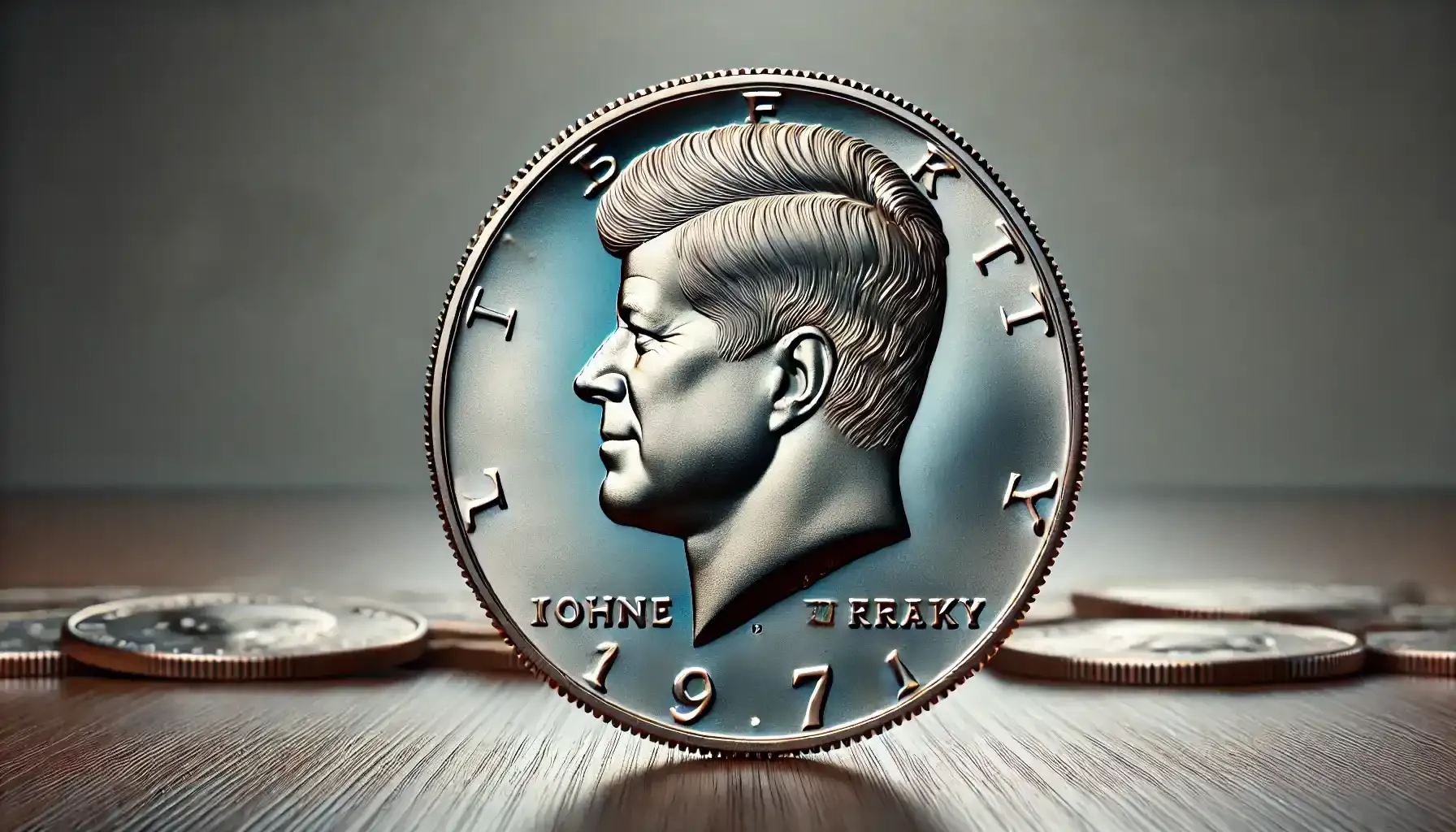
While the face value remains a steady fifty cents, the market value of a 1971 Kennedy Half Dollar can range from its literal denomination to thousands of dollars. This disparity is driven by rarity, the “strike” quality, and the presence of specific minting errors that turn an ordinary piece of pocket change into a high-value financial asset.
The 1971 Transition: From Precious Metal to Clad Composition
To understand the financial profile of the 1971 Kennedy Half Dollar, one must first understand the economic context of its production. From its debut in 1964, the Kennedy Half Dollar was a symbol of national mourning and prestige. In 1964, the coins were minted in 90% silver. As silver prices rose, the United States Mint reduced the silver content to 40% for the years 1965 through 1970.
The year 1971 was a watershed moment. Faced with rising commodity prices and the need for a more sustainable circulating currency, the U.S. government transitioned the Kennedy Half Dollar to a copper-nickel “clad” composition. Specifically, these coins consist of an outer layer of 75% copper and 25% nickel, bonded to a core of pure copper.
From an investment perspective, this transition means that unlike their 1964–1970 predecessors, the 1971 coins have no “melt value” based on silver. Their value is derived entirely from their numismatic appeal—their rarity in high grades and their desirability among collectors. For a personal finance enthusiast, this highlights the difference between investing in bullion (where the metal has intrinsic value) and numismatics (where the value is dictated by market demand and condition).
The Impact of High Mintage on Scarcity
In 1971, the Mint produced a massive volume of these coins to ensure they circulated widely. The Philadelphia Mint (which carried no mint mark in 1971) produced over 155 million units, while the Denver Mint (marked with a ‘D’) produced over 248 million. Because hundreds of millions were released into circulation, a standard, worn 1971 Kennedy Half Dollar found in a bank roll is typically worth only fifty cents.
However, the “Money” angle emerges when we look at the survival rate of these coins in “Mint State” (MS) conditions. Because these were workhorse coins intended for daily commerce, very few were preserved in pristine condition. This creates a supply-and-demand squeeze for top-tier specimens.
Grading and Condition: The Primary Driver of Market Value
In the world of coin investing, “condition is king.” The value of a 1971 Kennedy Half Dollar is exponentially tied to its grade on the Sheldon Scale, a 70-point system used by professional grading services like PCGS (Professional Coin Grading Service) and NGC (Numismatic Guaranty Company).
The Sheldon Scale and Its Financial Impact
For the 1971 issue, the price breaks occur at the following levels:
- MS60 to MS63: These are “Uncirculated” coins but may have “bag marks” or scuffs from being stored in large canvas bags at the Mint. They typically trade for $1 to $5.
- MS65 (Gem Uncirculated): A 1971-P or 1971-D in this grade starts to see a premium, often fetching $20 to $40.
- MS66: At this level, the coin must have original luster and very few distracting marks. Prices can jump to $100 or more.
- MS67 and Above: This is where the 1971 Kennedy Half Dollar becomes a high-end asset. An MS67 specimen is exceptionally rare for this year because the copper-nickel clad material is harder than silver, making it difficult to achieve a “clean” strike. A 1971-D in MS67 condition can command prices upwards of $500 to $1,000 at auction.
The record-breaking sales often involve “MS67+” or “MS68” grades. For example, a 1971-D Kennedy Half Dollar graded MS68 by PCGS once sold for over $6,000. For an investor, the lesson is clear: the cost of professional grading is a necessary expenditure to unlock the true market value of a high-quality find.
Distinguishing Between Business Strikes and Proofs
In addition to the coins intended for circulation, the San Francisco Mint produced “Proof” versions of the 1971 Kennedy Half Dollar. These were struck specifically for collectors using polished dies and planchets, resulting in a mirror-like finish.
The 1971-S Proofs are valued based on their “Cameo” (CAM) or “Deep Cameo” (DCAM) designations. A Deep Cameo coin features a sharp, frosted contrast between the portrait of Kennedy and the reflective background. While a standard 1971-S Proof might only be worth $5, a PR70 (perfect grade) Deep Cameo specimen can be worth several hundred dollars, representing a significant return on investment for those who preserved original Mint Sets from that year.
Rare Varieties and Errors: Finding Hidden Wealth
For many people, the most exciting aspect of the 1971 Kennedy Half Dollar is the “hidden” value found in minting errors. These anomalies occur during the production process and are highly sought after by specialists who are willing to pay significant premiums over the standard market price.
The 1971-D “No FG” Variety
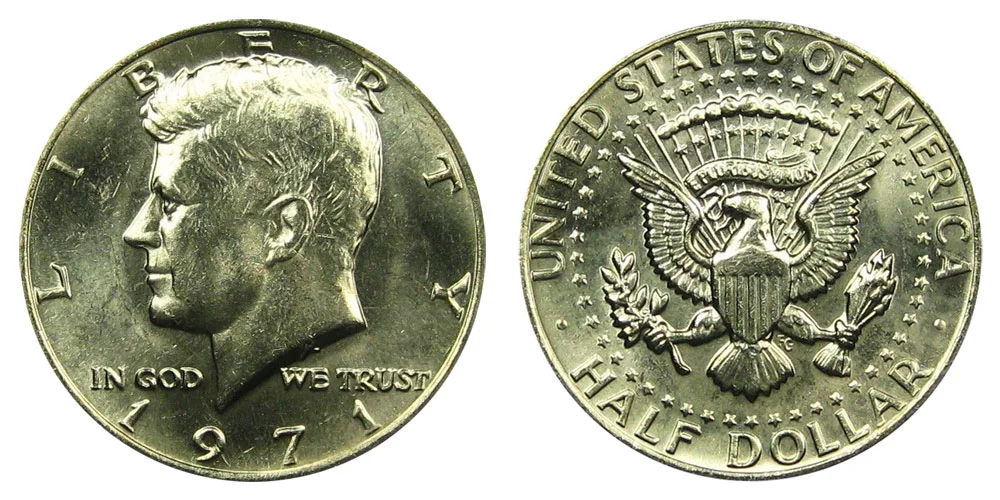
One of the most famous and lucrative varieties for this year is the 1971-D “No FG” Half Dollar. On the reverse of the coin, located between the eagle’s left leg (our right) and the tail feathers, are the initials “FG” for Frank Gasparro, the designer of the reverse.
Due to over-polishing of the dies at the Denver Mint, the initials were sometimes accidentally erased from the die. If you find a 1971-D where the initials are completely missing (and there is no evidence of them being worn away by circulation), you have found a valuable error. Depending on the condition, a “No FG” 1971-D can sell for anywhere from $50 to over $500. This variety serves as a reminder to investors that careful inspection of “common” assets can reveal hidden yield.
Double Dies and Minting Anomalies
While not as prominent as the 1964 or 1974 double dies, 1971 did see some minor doubled die obverse (DDO) and doubled die reverse (DDR) varieties. These are characterized by a slight doubling of the letters or numbers, usually visible under 10x magnification. While these generally command smaller premiums (often in the $20 to $50 range), they contribute to the overall liquidity and interest in the 1971 series.
Other errors to look for include “off-center” strikes or “clipped planchets.” An off-center 1971 Kennedy, where the design is shifted to one side, can be worth $100 or more to an error collector. These pieces are essentially “one-of-a-kind” assets, making them resistant to the broader market fluctuations that might affect more common coins.
The Numismatic Market: Buying, Selling, and Investing
If you have identified a 1971 Kennedy Half Dollar that you believe has value, the next step is navigating the marketplace. Numismatics is a specialized branch of finance, and maximizing your return requires a strategic approach to liquidity.
Where to Realize the Best Returns
The venue through which you sell a coin significantly impacts the final price realized.
- Online Auctions (eBay): Best for mid-range coins (MS63–MS65) or common proofs. The wide audience ensures a fair market price, though seller fees must be accounted for.
- Heritage Auctions or Stack’s Bowers: These high-end auction houses are the preferred venue for MS67+ specimens or rare errors. They attract serious investors and institutional collectors.
- Local Coin Shops: Useful for immediate liquidity, but expect to receive “wholesale” prices (usually 50% to 70% of the retail value), as the dealer needs to make a margin on the resale.

The Long-Term Outlook for Kennedy Half Dollars
As an investment, the 1971 Kennedy Half Dollar is part of a “long-tail” strategy. Unlike gold or stocks, which can be highly volatile, the market for high-grade modern U.S. coinage has shown steady growth. As older collectors pass their collections down and new collectors enter the market through “registry sets” (competitions to own the highest-graded example of every coin in a series), the demand for “Top Pop” (highest population) 1971 coins remains high.
Investors should focus on “quality over quantity.” Owning one 1971-D graded MS67 is a better financial move than owning a hundred 1971-D coins in average uncirculated condition. The high-grade coin is a scarce asset with a documented population, while the others are essentially commodities.
Ultimately, the value of a 1971 Kennedy Half Dollar is a lesson in the fundamentals of finance: scarcity, condition, and historical context. Whether it is a “No FG” error found in a roll of coins or a pristine MS67 specimen purchased as a portfolio diversifier, this coin remains a cornerstone of American numismatics, offering both entry-level hobbyists and sophisticated investors a chance to engage with a unique piece of monetary history.
aViewFromTheCave is a participant in the Amazon Services LLC Associates Program, an affiliate advertising program designed to provide a means for sites to earn advertising fees by advertising and linking to Amazon.com. Amazon, the Amazon logo, AmazonSupply, and the AmazonSupply logo are trademarks of Amazon.com, Inc. or its affiliates. As an Amazon Associate we earn affiliate commissions from qualifying purchases.