
In the landscape of mechanical engineering, aerospace design, and even the development of high-tech consumer electronics, the behavior of materials under stress is a fundamental consideration. At the heart of this behavior lies a specific mathematical value known as the “spring constant.” While it might sound like a relic of high school physics, the spring constant is a pillar of modern technology, dictating everything from the suspension systems in electric vehicles to the haptic feedback mechanisms in your smartphone.
To understand its role in the tech sector, one must first address the foundational question: What is the unit of spring constant, and why does its precision matter in a world increasingly driven by digital simulation and automated manufacturing?

The Fundamentals of Force and Displacement: Defining N/m
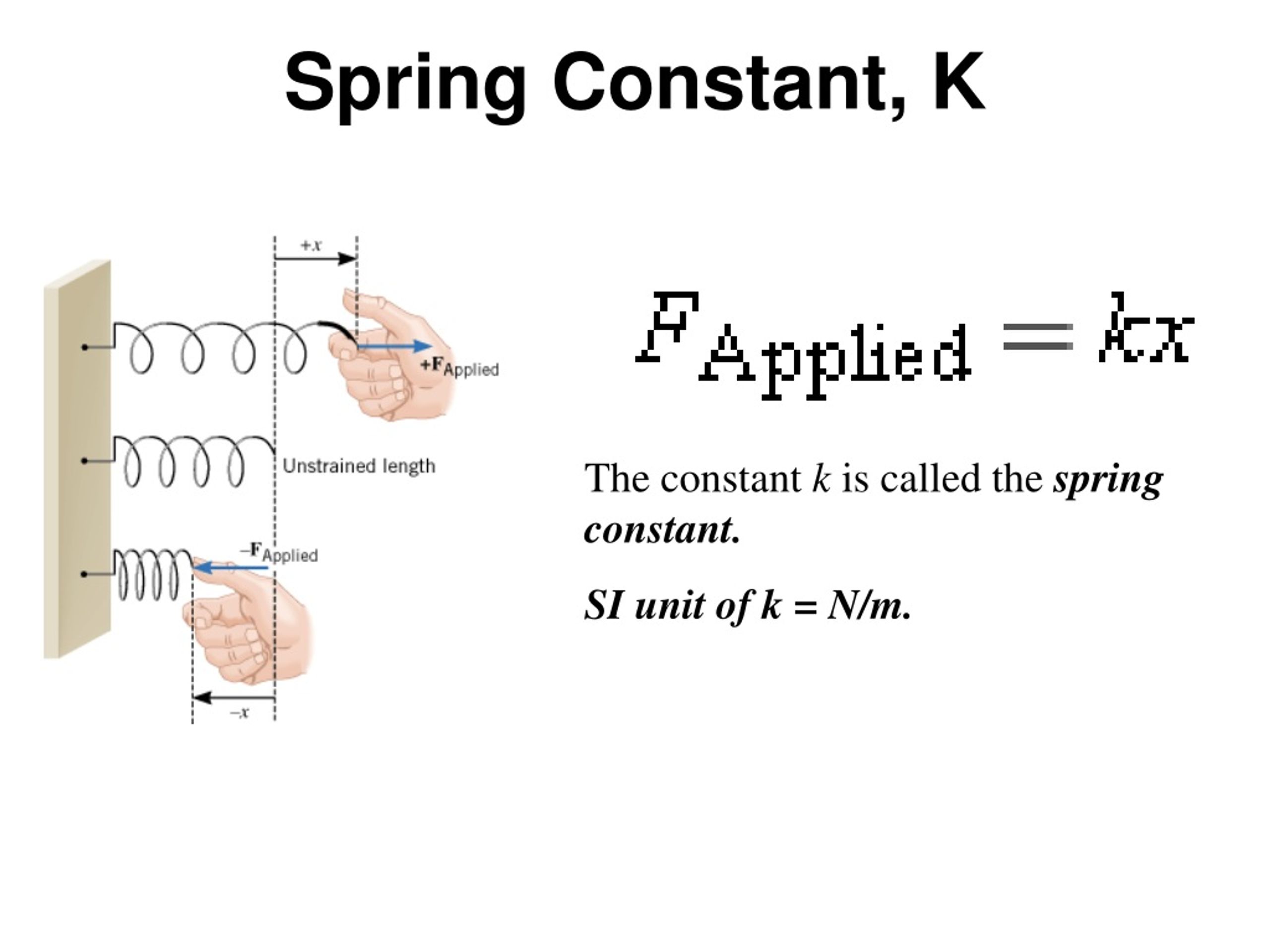
In the scientific community, the spring constant (often denoted by the letter k) is a measure of the stiffness of a spring or an elastic material. According to Hooke’s Law—the governing principle of elasticity—the force needed to extend or compress a spring by some distance is proportional to that distance.
The standard international (SI) unit for the spring constant is the Newton per meter (N/m).
The Mathematical Framework: Hooke’s Law in Digital Simulations
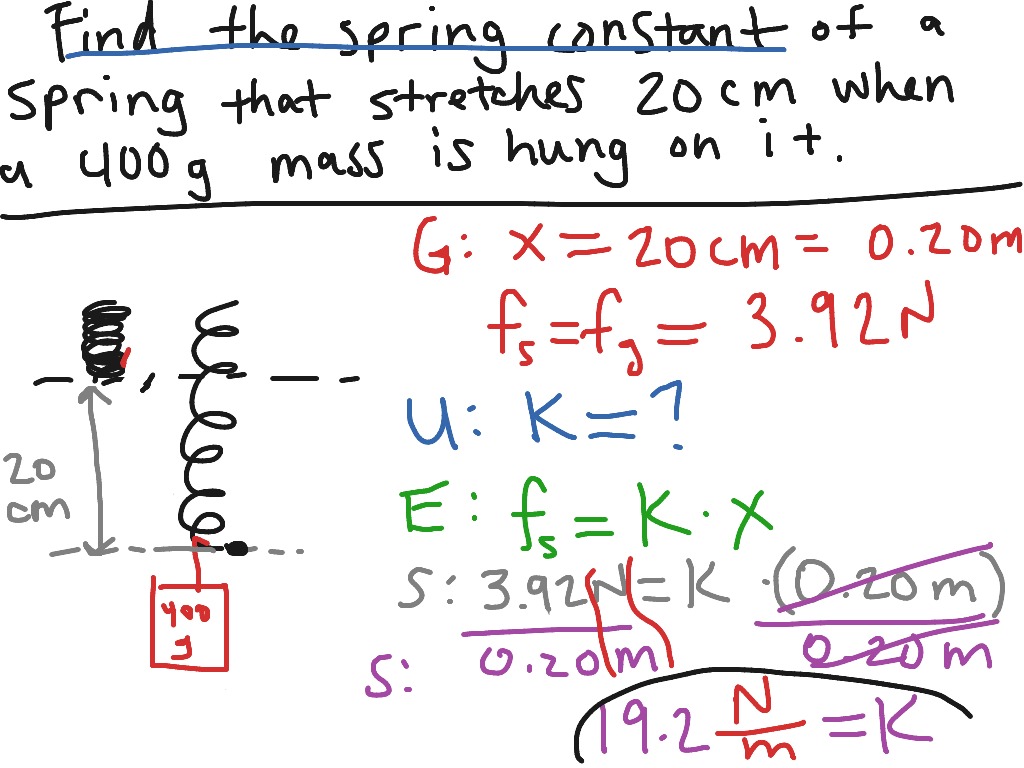
In technical terms, the formula is expressed as $F = kx$, where $F$ is the force applied (measured in Newtons), $k$ is the spring constant (N/m), and $x$ is the displacement or change in length (measured in meters). In the world of tech and software development, this formula is the backbone of physics engines used in Computer-Aided Design (CAD) and Computer-Aided Engineering (CAE) software.
When an engineer uses software like SolidWorks or Ansys to simulate the structural integrity of a new laptop hinge or a drone’s landing gear, the software relies on the N/m unit to calculate how much the material will deform under specific loads. If the spring constant is too low, the device may be too flimsy; if it is too high, the material may become brittle and snap.
SI vs. Imperial Units in Global Engineering Tech
While N/m is the global standard, tech professionals working in North American manufacturing may encounter the pound-force per inch (lb/in). In the high-stakes world of international tech collaboration, the conversion between these units is a critical point of digital security and precision. History is replete with engineering failures caused by “unit mismatch” errors. In the tech industry, modern software tools now include automated unit conversion layers to ensure that a designer in Germany (using N/m) and a manufacturer in the United States (using lb/in) are working on the same mechanical reality.
The Role of Spring Constants in Robotics and Hardware Innovation
As we move toward a future defined by automation, the spring constant has evolved from a static measurement into a dynamic variable in robotics. The “stiffness” of a robotic arm or a localized sensor is what allows a machine to interact safely with the physical world.
Actuators and Sensor Accuracy
In the field of robotics, actuators—the components responsible for moving and controlling a mechanism—frequently incorporate springs to manage energy and provide “compliance.” Compliance is the ability of a robot to yield to external forces, which is essential for collaborative robots (cobots) that work alongside humans.
The spring constant (N/m) determines how the robot reacts to an accidental impact. If a robot’s joint has a precisely calibrated spring constant, the tech behind its sensors can detect a change in displacement and immediately halt the motor, preventing injury. This calibration is what enables high-tech assembly lines to handle delicate components, like silicon wafers or glass screens, without shattering them.
Haptic Feedback and User Interface Design
One of the most ubiquitous applications of the spring constant in consumer tech is haptic feedback. When you press a “virtual” button on a modern smartphone or trackpad, you aren’t moving a mechanical switch. Instead, a linear resonant actuator (LRA) creates a vibration that mimics the feel of a physical click.
Engineers design these LRAs by calculating the spring constant required to create a specific resonant frequency. By fine-tuning the N/m value of the internal suspension within the actuator, tech companies can simulate different textures and pressures, creating a seamless bridge between digital inputs and physical sensations.
Digital Twins and the Simulation of Elasticity
The tech industry is currently undergoing a revolution through “Digital Twins”—virtual replicas of physical assets. These digital models allow companies to predict maintenance needs and test performance under extreme conditions without building physical prototypes.
Finite Element Analysis (FEA) and Structural Integrity
At the core of a Digital Twin is Finite Element Analysis (FEA). This software breaks down a complex object into millions of tiny elements, each assigned specific physical properties, including its spring constant.
For instance, in the development of a new electric vehicle (EV) battery pack, engineers must simulate how the casing will react to the vibrations of the road. By assigning N/m values to every bolt, gasket, and bracket, the simulation can predict where the structure might fail over a ten-year lifespan. This level of tech-driven foresight saves billions in recall costs and ensures the safety of emerging transport technologies.
Physics Engines in Game Development and VR
The application of the spring constant isn’t limited to “hard” engineering; it is also a staple of the software entertainment industry. Modern video games and Virtual Reality (VR) environments rely on real-time physics engines (like Havok or Unreal Engine’s Chaos physics) to create immersion.
When a character in a game jumps onto a bridge or drives a car over a bump, the software calculates the “springiness” of the interaction in real-time. By adjusting the $k$ value in the code, developers can make a world feel “heavy” and realistic or “floaty” and arcade-like. In VR, this is particularly vital; if the spring constant of a virtual object doesn’t match the user’s visual expectation, it can lead to motion sickness or a break in presence.
Nanotechnology and the Future of Elastic Constants
As technology shrinks, the importance of the spring constant moves into the realm of the microscopic. In nanotechnology and Micro-Electro-Mechanical Systems (MEMS), the unit N/m is still used, but the scales are unimaginably small.
Atomic Force Microscopy (AFM) and MEMS
An Atomic Force Microscope (AFM) uses a tiny cantilever with a sharp tip to “feel” the surface of atoms. The spring constant of this cantilever is the most critical factor in its operation. If the $k$ value is known with high precision, the microscope can measure the tiny forces between the tip and the sample. This technology is what allows tech companies to inspect semi-conductors at the atomic level, ensuring that the next generation of CPU chips is free from defects.
Similarly, MEMS technology—the tiny accelerometers and gyroscopes inside your phone that tell it which way is up—rely on microscopic springs. These springs have such low N/m values that they can be moved by the mere tilt of the device, yet they must be durable enough to withstand millions of cycles.
Smart Materials and Variable Spring Constants
The next frontier in tech is the development of “smart materials” whose spring constants can be changed on the fly. Using Shape Memory Alloys (SMAs) or electro-active polymers, engineers are developing components that can become stiffer or more flexible when an electric current is applied.
Imagine a drone wing that can change its stiffness (its N/m value) to adapt to different wind speeds, or a prosthetic limb that adjusts its spring constant based on whether the user is walking or running. This marriage of material science and digital control represents the pinnacle of modern “Tech,” where the ancient principles of physics are optimized by the latest in software and circuitry.
Conclusion: The Precision of N/m in a Digital World
While the “unit of spring constant” might appear to be a simple answer to a physics question, it is actually a fundamental language used by the global tech industry to build the modern world. Whether it is expressed in Newtons per meter in a high-end simulation or coded into the physics engine of a global metaverse, the spring constant is the bridge between the theoretical and the tangible.
As we move deeper into the eras of robotics, nanotech, and digital twins, our ability to measure, simulate, and manipulate this value will determine the reliability and sophistication of the tools we use every day. In the tech sector, precision isn’t just a goal—it is the standard. And that precision begins with a deep understanding of the forces that keep our world in motion.
aViewFromTheCave is a participant in the Amazon Services LLC Associates Program, an affiliate advertising program designed to provide a means for sites to earn advertising fees by advertising and linking to Amazon.com. Amazon, the Amazon logo, AmazonSupply, and the AmazonSupply logo are trademarks of Amazon.com, Inc. or its affiliates. As an Amazon Associate we earn affiliate commissions from qualifying purchases.