
Understanding the surface area of geometric shapes is a fundamental concept with practical applications across various fields. While often encountered in geometry class, the ability to calculate and conceptualize surface area becomes particularly relevant in technical disciplines involving design, engineering, and manufacturing. In the realm of Tech, accurately determining the surface area of complex three-dimensional objects, including polyhedra like triangular pyramids, is crucial for tasks ranging from material estimation in 3D printing to the aerodynamic analysis of components and the optimization of packaging for electronic devices. This article delves into the definition, calculation, and practical technological relevance of the surface area of a triangular pyramid.
Understanding the Triangular Pyramid and its Surface Area
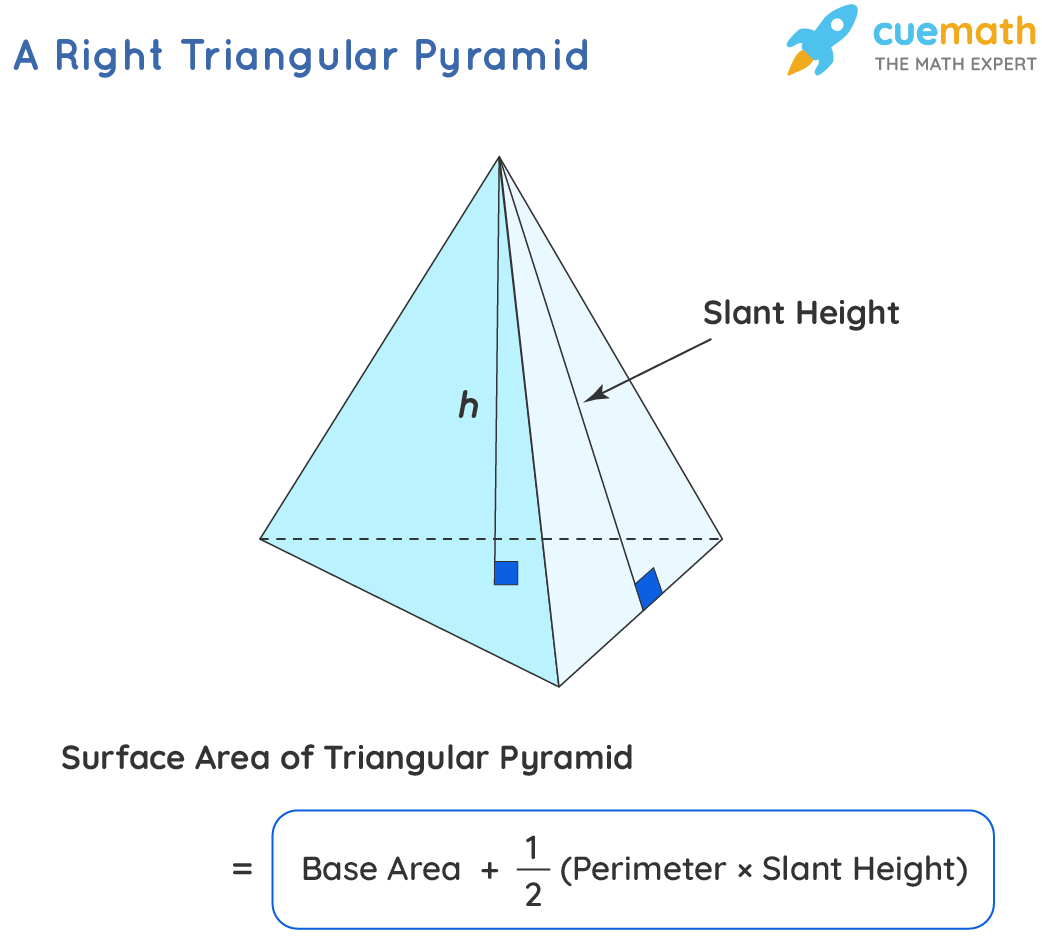
A triangular pyramid, also known as a tetrahedron, is a polyhedron composed of four triangular faces, six edges, and four vertices. When we refer to the “surface area” of any three-dimensional object, we are quantifying the total area of all the external surfaces that enclose it. For a triangular pyramid, this means summing the areas of all four of its triangular faces.
Components of a Triangular Pyramid
To calculate the surface area, it’s essential to understand the different types of triangular pyramids and their constituent parts:
- Base: One of the four triangular faces is designated as the base. The choice of base is often arbitrary, but it helps in visualizing the pyramid as standing on a particular face.
- Lateral Faces: The remaining three triangular faces are called lateral faces. These faces meet at a single point called the apex of the pyramid.
Types of Triangular Pyramids
The nature of the triangular faces significantly influences the complexity of surface area calculations.
- Regular Triangular Pyramid: In a regular triangular pyramid, the base is an equilateral triangle, and all the lateral faces are congruent isosceles triangles. The apex is directly above the centroid of the equilateral base. This symmetry simplifies calculations considerably.
- Irregular Triangular Pyramid: In an irregular triangular pyramid, the base can be any type of triangle (scalene, isosceles, or equilateral), and the lateral faces can be different in size and shape. The apex is not necessarily positioned symmetrically above the base. This type requires calculating the area of each face individually.
- Equilateral Tetrahedron (Regular Tetrahedron): A special case of a triangular pyramid where all four faces are congruent equilateral triangles. In this instance, all edges are of equal length.
Defining Surface Area in the Context of Technology
In technological applications, surface area is not just an abstract mathematical concept. It directly relates to:
- Material Usage: For 3D printing or CNC machining, the surface area of a component dictates the amount of material required, influencing cost and production time. Efficient design often involves minimizing surface area while maintaining structural integrity.
- Heat Dissipation and Transfer: In electronics, the surface area of components is critical for dissipating heat. Larger surface areas facilitate more efficient cooling, preventing overheating and ensuring optimal performance and longevity of devices. Thermal management simulations heavily rely on accurate surface area calculations.
- Aerodynamics and Fluid Dynamics: When designing objects that move through fluids (like drone components, aircraft parts, or even specialized casings for robotic arms), their surface area and shape influence drag and lift. Surface area calculations are vital inputs for computational fluid dynamics (CFD) simulations.
- Signal Strength and Reception: In antenna design, the surface area and geometry of radiating elements directly impact their ability to transmit and receive electromagnetic signals.
Calculating the Surface Area of a Triangular Pyramid
The general approach to finding the surface area of any triangular pyramid involves calculating the area of each of its four triangular faces and then summing these areas. The specific formulas used depend on the type of pyramid and the information provided.
Formula for a General Triangular Pyramid
The surface area (SA) of any triangular pyramid is the sum of the area of its base (Abase) and the areas of its three lateral faces (Alateral1, Alateral2, Alateral3):
$SA = A{base} + A{lateral1} + A{lateral2} + A{lateral3}$
The area of a triangle is generally calculated using the formula:
$Area = frac{1}{2} times base times height$
However, applying this directly requires knowing the base and height of each of the four triangular faces. This can be complex for irregular pyramids, especially if only edge lengths are known.
Calculating Surface Area for a Regular Triangular Pyramid
For a regular triangular pyramid, the calculations are streamlined due to the symmetry:
-
Base Area ($A{base}$): The base is an equilateral triangle. If the side length of the equilateral triangle is ‘s’, its area is:
$A{base} = frac{sqrt{3}}{4} s^2$ -
Lateral Face Area ($A{lateral}$): The three lateral faces are congruent isosceles triangles. To find the area of one lateral face, we need its base (which is the side length ‘s’ of the equilateral base) and its slant height (‘l’). The slant height is the height of each lateral triangular face measured from the midpoint of the base edge to the apex.
$A{lateral} = frac{1}{2} times s times l$ -
Total Surface Area (Regular Triangular Pyramid):
$SA = A{base} + 3 times A{lateral}$
$SA = frac{sqrt{3}}{4} s^2 + 3 times (frac{1}{2} s times l)$
$SA = frac{sqrt{3}}{4} s^2 + frac{3}{2} sl$
To find the slant height ‘l’ in a regular triangular pyramid, we can use the Pythagorean theorem. Consider a right-angled triangle formed by the pyramid’s height (h), the apothem of the base (the distance from the center of the equilateral triangle to the midpoint of a side, which is $frac{s}{2sqrt{3}}$), and the slant height ‘l’ as the hypotenuse:
$l^2 = h^2 + (frac{s}{2sqrt{3}})^2$
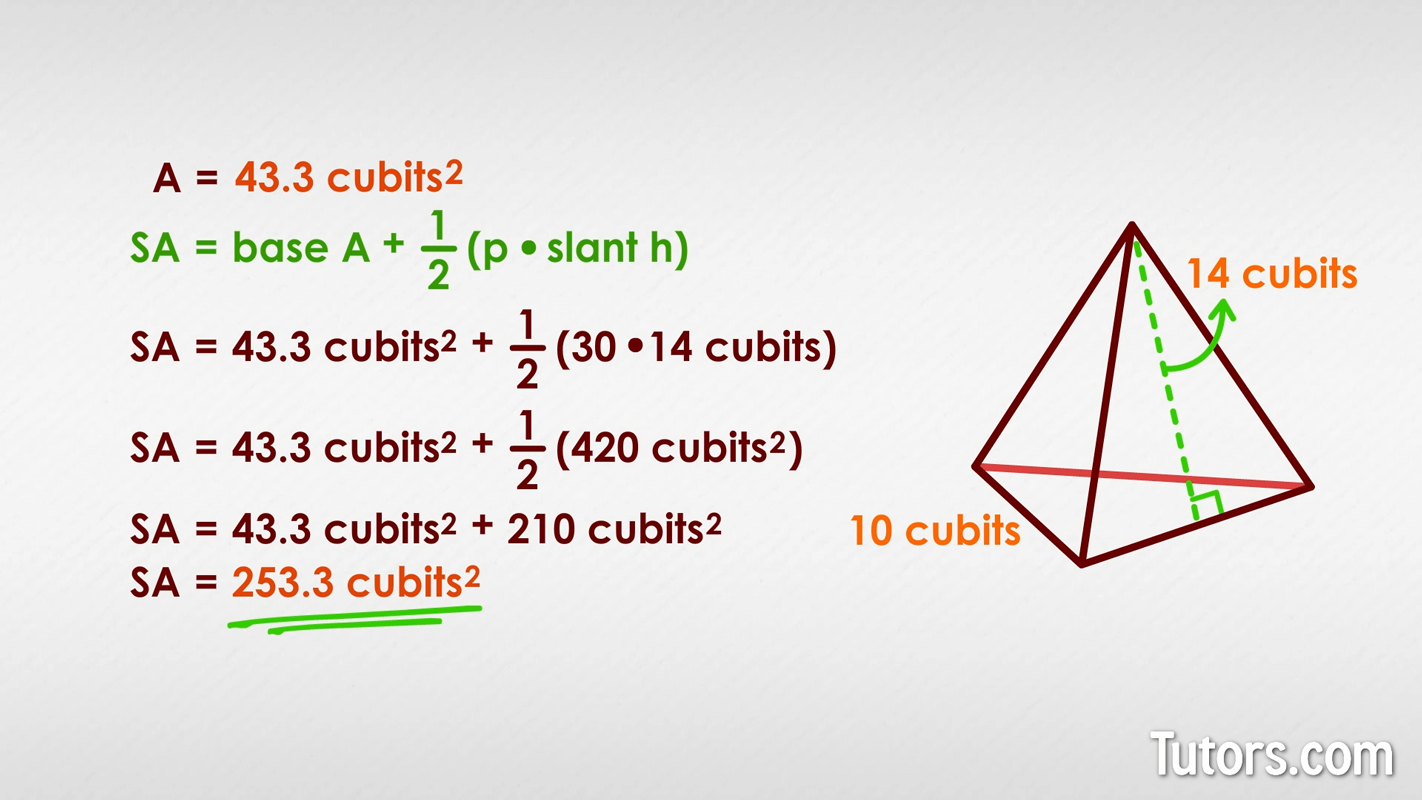
If we know the pyramid’s height and the base side length, we can calculate ‘l’ and then the surface area.
Calculating Surface Area for an Equilateral Tetrahedron
An equilateral tetrahedron is a special case where all four faces are identical equilateral triangles with side length ‘s’.
-
Area of one face:
$A_{face} = frac{sqrt{3}}{4} s^2$ -
Total Surface Area (Equilateral Tetrahedron): Since there are four identical faces:
$SA = 4 times A_{face}$
$SA = 4 times frac{sqrt{3}}{4} s^2$
$SA = sqrt{3} s^2$
This simplified formula highlights the elegance of calculating surface area when dealing with highly symmetrical objects in computational geometry or CAD software.
Technological Applications and Tools for Surface Area Calculation
The accurate and efficient calculation of surface area for triangular pyramids, and more complex polyhedra, is a cornerstone of many technological processes. Software and algorithms are indispensable for handling these calculations, especially when dealing with intricate geometries or large datasets.
Computational Geometry and CAD Software
Computer-Aided Design (CAD) software is a primary tool used by engineers, architects, and product designers. When users create 3D models of objects that can be decomposed into or approximated by polyhedra like triangular pyramids, the software automatically calculates properties such as volume, mass, and surface area.
- Automatic Calculation: For any enclosed 3D model, CAD programs can compute the total surface area by summing the areas of all the polygons (often triangles or quadrilaterals) that define the mesh of the object. This eliminates the need for manual calculations, which would be impractical for complex designs.
- Mesh Generation: In many applications, especially those involving simulations or 3D printing, complex surfaces are approximated by a mesh of smaller polygons, often triangles. The surface area is then calculated by summing the areas of all these triangles. The density and quality of the mesh directly impact the accuracy of the surface area calculation.
- Design Optimization: Designers use CAD tools to iterate on designs. By observing the surface area of a component, they can make adjustments to reduce material usage or improve thermal properties, directly impacting manufacturing costs and performance.
Simulation Software (FEA, CFD)
Finite Element Analysis (FEA) and Computational Fluid Dynamics (CFD) software are heavily reliant on accurate geometric properties, including surface area.
- FEA for Structural Analysis: When analyzing the stress and strain on a component, FEA software discretizes the object into smaller elements (often tetrahedral or hexahedral). The surface area of the external boundaries is crucial for applying loads, boundary conditions, and for understanding how forces are distributed. For objects with triangular pyramid-like features, the calculation of these boundary areas is essential.
- CFD for Fluid Flow and Heat Transfer: In CFD simulations, the surface area of an object exposed to a fluid is critical for calculating drag forces, heat transfer rates, and pressure distributions. For example, when simulating the airflow around a drone with a triangular pyramid-shaped housing for a sensor, the surface area exposed to the air is a key parameter for determining aerodynamic drag and how effectively heat generated by the sensor can dissipate into the surrounding air. The meshing process in CFD also breaks down surfaces into smaller elements, and the sum of their areas approximates the total surface area.
- Material Estimation for Additive Manufacturing: For 3D printing, the volume of material needed is often calculated based on the object’s volume and infill density. However, the surface area can be relevant for estimating the amount of support material required, which is printed to support overhangs and complex geometries. The accurate calculation of these support structures’ surface area can lead to more efficient printing and easier post-processing.
Programming and Algorithmic Approaches
For developers building custom applications or automating engineering workflows, libraries and algorithms for computational geometry are vital.
- Geometric Libraries: Libraries like CGAL (Computational Geometry Algorithms Library) in C++ or SciPy’s spatial module in Python provide functions to compute surface areas of various geometric primitives, including polyhedra. These are used in custom simulation tools, data visualization applications, and in scientific research.
- Procedural Generation: In areas like game development or procedural content creation, algorithms might generate complex shapes. The ability to programmatically calculate the surface area of these generated shapes is necessary for tasks like level design, asset optimization, and physics simulations. For instance, generating terrain features that might incorporate pyramid-like structures requires an understanding of their surface area for rendering and interaction calculations.
Practical Implications in Modern Technology
The ability to accurately compute the surface area of geometric shapes, including triangular pyramids, has direct and significant implications in several cutting-edge technological fields.
3D Printing and Additive Manufacturing
In additive manufacturing, the precise calculation of surface area is crucial for several aspects of the printing process.
- Material Estimation: While the primary driver for material cost is often volume, the surface area plays a role in estimating the amount of support structures needed. Complex geometries, which might involve pyramid-like elements, require careful consideration of overhangs and the support material’s surface area. Optimizing the design to minimize the surface area of necessary supports can lead to faster print times and reduced material waste.
- Post-Processing: The surface finish of a 3D printed object is directly related to its surface area and the resolution of the printing process. For applications requiring a smooth finish, understanding the surface area can help in planning polishing or other post-processing steps, ensuring consistency and quality.
- Structural Integrity: In some advanced applications, surface area can indirectly relate to strength. For instance, a larger surface area might allow for better adhesion between printed layers or a more robust interface for post-assembly bonding.
Robotics and Automation
Robotic systems often interact with their environment, and understanding the geometry of their components and the objects they manipulate is paramount.
- End-Effector Design: Robotic grippers and end-effectors might incorporate complex shapes, some of which could be approximated by polyhedra. The surface area of these tools can affect how they interact with objects – influencing grip strength, friction, and the ability to conform to irregular shapes. Calculating the surface area is vital for designing effective and versatile robotic manipulators.
- Path Planning and Collision Detection: For mobile robots or robotic arms, understanding the surface area of their own bodies and the objects in their workspace is essential for path planning and collision avoidance. While a bounding box or sphere might be used for initial checks, more precise calculations involving polyhedral approximations can improve the accuracy of collision detection algorithms, especially in cluttered environments.
- Aerodynamic Considerations for Drones: Drones, as a prominent example of robotic technology, often have components with non-conventional shapes. Housings for sensors, battery packs, or even structural elements might be designed with aerodynamic efficiency in mind. Triangular pyramid-like shapes can be part of these designs. Calculating their surface area is a prerequisite for CFD simulations to understand drag, stability, and power consumption during flight.

Advanced Materials and Nanotechnology
At the nanoscale, the ratio of surface area to volume becomes extraordinarily important.
- Catalysis: Many chemical reactions are surface-driven. Nanoparticles with high surface area-to-volume ratios, such as those that could be engineered into pyramid-like structures, exhibit enhanced catalytic activity because more of their atoms are exposed and available to participate in reactions. Calculating and controlling this surface area is a key objective in designing efficient catalysts.
- Drug Delivery and Biosensing: Nanomaterials designed for drug delivery or biosensing often rely on their surface properties. The surface area dictates how many drug molecules can be loaded or how effectively they can interact with biological targets. Engineered nanomaterials with specific shapes, including polyhedral forms, are studied for their optimized surface area characteristics.
- Smart Materials: Researchers are developing smart materials that change their properties in response to external stimuli. The surface area of these materials can be a critical factor in their responsiveness, influencing things like adsorption, diffusion, and surface energy. Understanding how to calculate and manipulate the surface area of complex nanoscale architectures, potentially involving pyramid motifs, is an active area of research.
In conclusion, the seemingly simple geometric concept of the surface area of a triangular pyramid extends far beyond academic exercises. In the dynamic landscape of technology, from the precision of 3D printing and the robustness of robotics to the intricate interactions at the nanoscale, the accurate and efficient calculation of surface area is a fundamental enabler of innovation and advancement. Understanding its principles and leveraging the appropriate computational tools empowers engineers and scientists to design, optimize, and create the technologies of the future.
aViewFromTheCave is a participant in the Amazon Services LLC Associates Program, an affiliate advertising program designed to provide a means for sites to earn advertising fees by advertising and linking to Amazon.com. Amazon, the Amazon logo, AmazonSupply, and the AmazonSupply logo are trademarks of Amazon.com, Inc. or its affiliates. As an Amazon Associate we earn affiliate commissions from qualifying purchases.