
The Strategic Defense Initiative (SDI) remains one of the most ambitious and technologically complex endeavors in the history of aerospace and digital security. Launched by U.S. President Ronald Reagan in 1983, it was a program designed to develop a sophisticated ground- and space-based system to protect the United States from strategic nuclear ballistic missiles. While often referred to by the popular moniker “Star Wars,” the program was far more than a cinematic fantasy; it was a massive research and development incubator that pushed the boundaries of computer science, directed energy, and automated sensor technology.

To understand the Strategic Defense Initiative is to understand the pivot point where military hardware began to merge irrevocably with advanced software and autonomous systems. It represented a shift from the doctrine of Mutually Assured Destruction (MAD) toward a tech-centric model of proactive defense.
The Technological Foundation of SDI: From Lasers to Kinetic Kill Vehicles
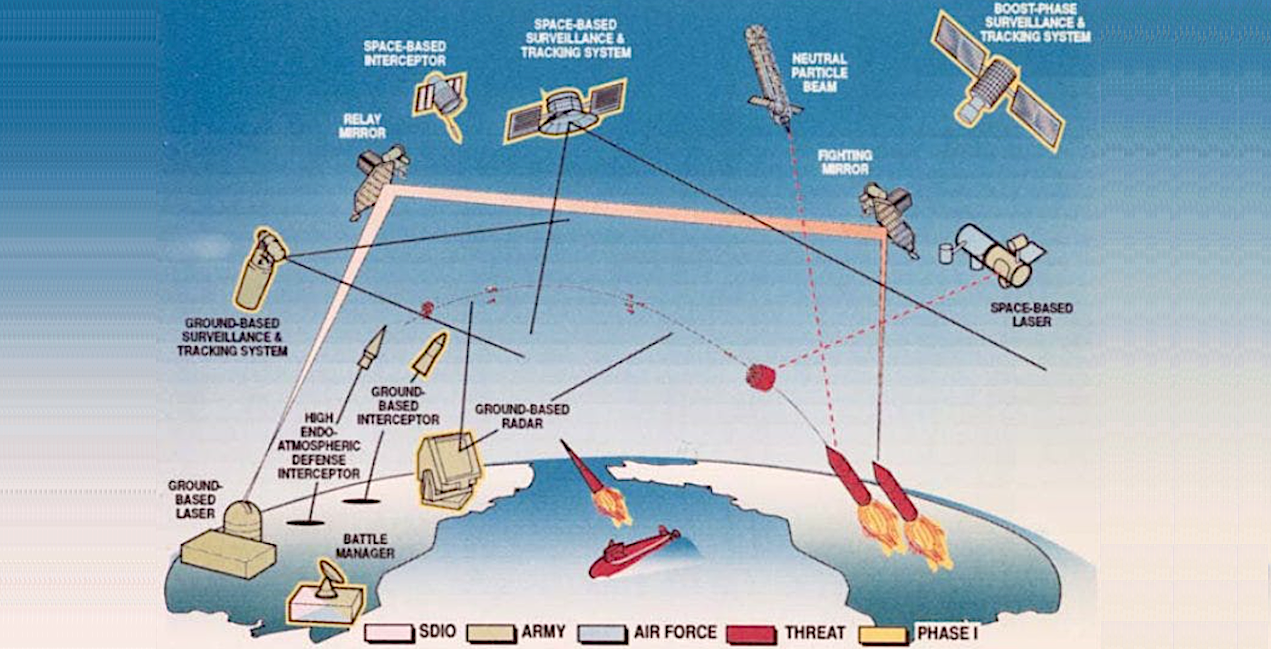
At its core, SDI was a multi-layered defense architecture intended to intercept missiles at various stages of their flight paths. This required a level of precision and speed that was decades ahead of its time. The hardware being developed fell into several revolutionary categories that continue to influence modern tech trends in defense and aerospace.
Directed-Energy Weapons (DEW)
The most futuristic aspect of SDI involved directed-energy weapons, such as chemical lasers, ground-based “free-electron” lasers, and neutral particle beams. The goal was to harness electromagnetic energy to destroy incoming warheads at the speed of light.
One of the most famous projects within this niche was the X-ray laser, powered by a nuclear explosion. Though controversial and ultimately impractical for deployment at the time, the research conducted into high-energy physics paved the way for modern solid-state lasers and fiber lasers used today in everything from industrial manufacturing to short-range drone defense systems. The challenge wasn’t just generating the power, but the precision optics required to focus a beam across thousands of miles of vacuum and atmosphere—a hurdle that led to massive breakthroughs in adaptive optics.
Kinetic Kill Vehicles and “Brilliant Pebbles”
While lasers captured the public imagination, the most viable technology to emerge was kinetic energy interception. Unlike traditional missiles that use explosive fragmentation, kinetic kill vehicles (KKVs) rely on pure velocity and mass to “hit a bullet with a bullet.”
The “Brilliant Pebbles” concept was perhaps the peak of SDI’s hardware innovation. It proposed a constellation of thousands of small, autonomous satellites equipped with high-resolution sensors and maneuvering thrusters. These “pebbles” would act independently, identifying and colliding with ICBMs in the mid-course phase of their flight. This decentralized approach was a precursor to modern small-satellite constellations and demonstrated the potential for distributed autonomous hardware in Earth’s orbit.
Software Engineering and the Challenge of Real-Time Battle Management
The hardware of SDI was impressive, but the software requirements were unprecedented. Many computer scientists of the 1980s argued that the “Battle Management” software required to coordinate thousands of sensors and interceptors was impossible to write or test. SDI forced the tech industry to confront the limitations of software engineering and pushed for new standards in coding and automation.
Distributed Computing and Fault Tolerance
SDI required a system that could process millions of data points in real-time, identifying genuine threats among decoys and chaff, and assigning interceptors to targets within seconds. This necessitated a leap in distributed computing. The system could not have a single point of failure; if one ground station or satellite was destroyed, the rest of the “mesh network” had to adapt instantly.
The research into fault-tolerant systems and parallel processing for SDI directly contributed to the robustness of modern cloud computing architectures and global financial networks. The logic used to manage “nodes” in a space-based defense network is remarkably similar to how modern edge computing handles data across thousands of geographically dispersed servers.
The Role of Early Machine Learning and Sensor Fusion
At the heart of the SDI software challenge was “sensor fusion”—the ability to take data from infrared sensors, radar, and optical cameras and combine them into a single, high-fidelity picture of the battlespace. This required early forms of what we now call machine learning and pattern recognition.
The algorithms had to distinguish between the heat signature of a rocket motor and the cold, dark surface of a decoy. These early attempts at automated target recognition (ATR) laid the groundwork for the computer vision technologies used in contemporary autonomous vehicles and high-end surveillance drones. SDI proved that the bottleneck of defense wasn’t just the speed of the interceptor, but the speed of the data processing.

The Digital Security Legacy: From Cold War to Cyber War
While the Cold War eventually ended and the full vision of SDI was never deployed, the initiative’s influence on digital security and network infrastructure is profound. SDI was the first major program to treat the “information layer” as the primary domain of warfare.
Hardening Infrastructure and Satellite Communication
SDI necessitated the development of secure, jam-resistant communication links between space-based assets and ground control. This led to breakthroughs in encryption and spread-spectrum communications, technologies that are now fundamental to modern digital security and the stability of the Global Positioning System (GPS).
The requirement for “radiation-hardened” electronics—chips that could survive the electromagnetic pulse (EMP) of a nuclear environment—led to a specialized niche in semiconductor manufacturing. Today, these technologies protect our global communication satellites from solar flares and cosmic radiation, ensuring that the digital backbone of our economy remains intact.
The Shift to Cybersecurity and Network-Centric Warfare
As SDI transitioned into the Missile Defense Agency (MDA) in the 1990s and 2000s, the focus shifted from physical shields to digital ones. The realization was that a sophisticated defense system is only as strong as its weakest software link. SDI’s legacy lives on in “Network-Centric Warfare,” where the integration of sensors, shooters, and command-and-control centers creates a “digital shield.”
This transition also highlighted the vulnerabilities of such systems to cyberattacks. The protocols developed to protect the integrity of SDI data transmissions helped define the early standards for high-assurance computing. In the modern era, where state-sponsored hacking and electronic warfare are daily threats, the principles of compartmentalization and automated threat detection born out of the SDI era are more relevant than ever.
Modern Iterations: The Transition to NMD and GMD
In the decades following the initial SDI proposal, the program evolved through various iterations, such as National Missile Defense (NMD) and the current Ground-based Midcourse Defense (GMD). These modern systems are the direct descendants of the “Star Wars” tech stack, utilizing the same core principles of high-velocity kinetic interception and multi-sensor integration.
The Aegis Ballistic Missile Defense System, deployed on U.S. Navy destroyers and cruisers, is perhaps the most successful realization of the SDI vision. It uses sophisticated phased-array radars and the Standard Missile-3 (SM-3) to intercept short- to intermediate-range ballistic missiles. The success of Aegis demonstrates that the “hit-a-bullet-with-a-bullet” philosophy, once thought impossible by many in the 1980s, is now a proven technological reality.
Furthermore, the “Iron Dome” and “Arrow” systems developed by Israel, with significant U.S. technical partnership, utilize the rapid-response algorithms and sensor fusion techniques pioneered during the SDI years. These systems represent the “tutorial” phase of missile defense, protecting against smaller, slower threats, while the ultimate goal remains the protection against intercontinental-class threats.
The Tech Horizon: AI, Hypersonics, and the New Space Race
As we look toward the future, the spirit of the Strategic Defense Initiative is being revived through new technological challenges. The emergence of hypersonic glide vehicles—missiles that travel at five times the speed of sound and maneuver within the atmosphere—has rendered many traditional defense systems obsolete.
To counter these threats, the next generation of defense tech is turning back to space. Low Earth Orbit (LEO) satellite constellations, reminiscent of the “Brilliant Pebbles” concept, are being developed to provide continuous tracking of hypersonic threats. These constellations will rely heavily on AI-driven data processing to predict flight paths that are no longer purely ballistic.
Artificial Intelligence is now the “Battle Management” software of the 21st century. Where the programmers of the 1980s struggled with millions of lines of static code, today’s engineers are utilizing neural networks that can learn and adapt to new threat profiles in real-time. The Strategic Defense Initiative was a premature birth of the digital age; it envisioned a world where software and space-based hardware would define global security. Today, that vision is no longer science fiction—it is the foundational framework of modern technological competition.
In conclusion, the Strategic Defense Initiative was much more than a military program; it was a catalyst for a massive leap in computing power, sensor technology, and digital security. By attempting the impossible, it forced the evolution of the technologies that now define our digital world, proving that the most significant legacy of any great technological endeavor is often the tools we build to achieve it.
aViewFromTheCave is a participant in the Amazon Services LLC Associates Program, an affiliate advertising program designed to provide a means for sites to earn advertising fees by advertising and linking to Amazon.com. Amazon, the Amazon logo, AmazonSupply, and the AmazonSupply logo are trademarks of Amazon.com, Inc. or its affiliates. As an Amazon Associate we earn affiliate commissions from qualifying purchases.