
The question “what is the stock price of AMD” might seem like a simple query, easily answered by a quick search on any financial platform. However, for the discerning investor or financially savvy individual, this seemingly straightforward question opens a door to a much deeper exploration of market dynamics, company valuation, and the intricate world of semiconductor investing. It’s not just about a single number at a given moment; it’s about understanding the forces that drive that number, its implications for your portfolio, and how to interpret it within the broader financial landscape.

Advanced Micro Devices (AMD) stands as a titan in the semiconductor industry, a sector renowned for its innovation, rapid growth, and, consequently, its inherent volatility. For investors, understanding AMD’s stock price means dissecting its business model, competitive landscape, technological advancements, and financial health, all while keeping an eye on macroeconomic trends. This article will delve into the multifaceted nature of AMD’s stock price, offering insights into its significance, the factors that influence it, and how investors can approach this dynamic asset.
Understanding AMD’s Market Valuation
At its core, a stock price represents the market’s collective assessment of a company’s current value and future prospects. For AMD, this valuation is particularly fascinating due to the company’s pivotal role in critical technological advancements, from high-performance computing to artificial intelligence.
A Glimpse into Advanced Micro Devices
Advanced Micro Devices, Inc. (AMD) designs and produces microprocessors for the computer and consumer electronics industries. Its main products include central processing units (CPUs), graphics processing units (GPUs), motherboard chipsets, and other embedded processors. AMD is a direct competitor to Intel in CPUs and Nvidia in GPUs, operating in markets that are fundamental to everything from personal computers and gaming consoles to data centers and supercomputers. Over the past decade, AMD has undergone a significant transformation, evolving from a struggling competitor to a formidable innovator, largely driven by strategic product development under strong leadership. This resurgence has been reflected dramatically in its stock performance, making it a subject of intense interest for growth-oriented investors.
Why Stock Prices Matter
The stock price of AMD, or any publicly traded company, serves multiple crucial functions. For existing shareholders, it represents the real-time value of their investment, fluctuating with market sentiment, company news, and broader economic indicators. For potential investors, it’s a critical data point in deciding whether to buy, sell, or hold shares. Beyond individual transactions, the stock price also reflects the company’s market capitalization (share price multiplied by the number of outstanding shares), which is often used as a benchmark for its size and influence within the industry. A rising stock price generally indicates investor confidence and often correlates with strong financial performance and future growth expectations, while a declining price can signal concerns about profitability, competitive pressures, or economic headwinds. Moreover, AMD’s stock price is a bellwether for the semiconductor industry, as its performance can often reflect broader trends in technology spending and innovation.
Real-Time vs. Historical Data
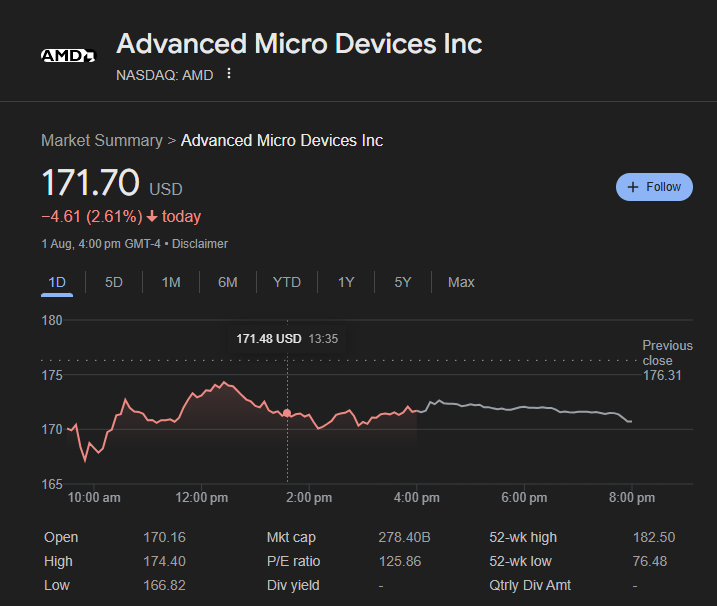
When asking “what is the stock price of AMD,” one typically refers to the real-time, live trading price. This figure is constantly in flux during market hours, reflecting the immediate supply and demand dynamics from millions of traders and algorithms. However, a solitary real-time quote provides limited insight. True understanding comes from examining historical data: the stock’s opening, closing, high, and low prices over various timeframes (daily, weekly, monthly, annually), along with trading volume. This historical context allows investors to identify trends, volatility patterns, support and resistance levels, and the impact of past events (e.g., product launches, earnings reports, executive changes) on the stock’s valuation. Analyzing charts over several years can reveal AMD’s growth trajectory and its resilience during market downturns, providing a more informed perspective than any single snapshot can offer.
Factors Influencing AMD’s Stock Performance
AMD’s stock price is not static; it’s a dynamic reflection of numerous interdependent factors. These influences can be broadly categorized into company-specific events, industry trends, and broader macroeconomic forces.
Technological Innovation and Product Cycles
For a technology company like AMD, innovation is the lifeblood of its existence and the primary driver of its stock performance. The success of its CPU architectures (like Zen) and GPU designs (like RDNA and CDNA) directly translates into market share gains, revenue growth, and ultimately, investor confidence. Product launch cycles are critical events. A highly anticipated new chip series, if well-received by critics and consumers, can send the stock soaring. Conversely, delays, manufacturing issues, or underperforming products can lead to significant pullbacks. The ability of AMD to consistently deliver cutting-edge technology that meets or exceeds market expectations, particularly in lucrative segments like data centers, gaming, and AI, is paramount to its long-term stock appreciation. The company’s strategic acquisitions, such as Xilinx, also play a vital role in expanding its technological capabilities and market reach, with investors closely watching for synergy realization.
Market Competition and Industry Trends
The semiconductor industry is intensely competitive, with AMD constantly vying for market share against formidable rivals like Intel and Nvidia. Intel has historically dominated the CPU market, while Nvidia holds a strong lead in high-end discrete GPUs and increasingly in AI accelerators. AMD’s ability to innovate and execute against these giants directly impacts its competitive positioning and, by extension, its financial outlook. Any shift in market share, patent disputes, or technological leapfrogs by competitors can significantly sway investor sentiment towards AMD. Furthermore, broader industry trends, such as the increasing demand for high-performance computing in AI and machine learning, the proliferation of cloud computing, and the evolution of gaming platforms, provide both opportunities and challenges for AMD. A booming demand for servers, for instance, can boost AMD’s data center segment, while a slowdown in PC sales might temper its consumer CPU and GPU revenue.
Macroeconomic Conditions and Geopolitical Factors
Beyond company-specific and industry-specific influences, AMD’s stock price is also susceptible to broader economic forces. General economic health, reflected in GDP growth, inflation rates, interest rates, and consumer spending, can profoundly impact demand for electronic devices and corporate IT investments. During periods of economic expansion, technology companies generally thrive, as businesses invest more in infrastructure and consumers upgrade their gadgets. Conversely, economic downturns can lead to reduced spending and declining revenues. Geopolitical factors also play an increasingly significant role. Trade tensions, especially between major tech-producing and consuming nations, can disrupt supply chains, increase manufacturing costs, or restrict market access, directly affecting AMD’s profitability. Regulatory changes, export controls, and global semiconductor shortages (as seen in recent years) are all external variables that investors must consider when assessing AMD’s risk profile and stock valuation.
Financial Performance and Investor Sentiment
Ultimately, a company’s financial performance provides the fundamental basis for its stock valuation. Key metrics like revenue growth, gross margins, operating income, earnings per share (EPS), and free cash flow are scrutinized by analysts and investors. Strong, consistent growth in these areas, coupled with efficient cost management, signals a healthy and profitable business. AMD’s quarterly earnings reports are pivotal events, where the company’s actual performance is compared against analyst expectations. Beating these expectations often leads to a positive stock reaction, while missing them can trigger a sell-off. Beyond raw numbers, investor sentiment — the collective attitude of investors towards a particular stock or market — plays a huge role. Positive sentiment can create upward momentum, even in the absence of groundbreaking news, while negative sentiment can exacerbate declines. This sentiment is often influenced by management guidance, analyst ratings, news articles, and social media discussions surrounding AMD.
Analyzing AMD for Potential Investment
For individuals considering an investment in AMD, a deeper financial analysis is essential, moving beyond just the daily price quote to understand the intrinsic value and potential risks.

Key Financial Metrics to Consider
When evaluating AMD, investors typically look at a range of financial metrics. Revenue growth indicates the company’s ability to expand its sales base. Gross margin reveals how efficiently AMD turns sales into profit before operating expenses. Net income and Earnings Per Share (EPS) show the ultimate profitability attributable to shareholders. Price-to-Earnings (P/E) ratio compares the current stock price to its EPS, providing a common valuation multiple. Price-to-Sales (P/S) ratio is useful for growth companies, especially if earnings are volatile. Debt-to-Equity ratio assesses financial leverage and risk. Return on Equity (ROE) measures how effectively management uses shareholders’ capital to generate profits. For a capital-intensive industry like semiconductors, capital expenditures (CapEx) and free cash flow (FCF) are also critical, indicating the company’s investment in future growth and its ability to generate cash after these investments. Analyzing trends in these metrics over several quarters and years provides a comprehensive picture of AMD’s financial health and operational efficiency.
Valuation Methods for Tech Stocks
Valuing a tech growth stock like AMD can be complex, as traditional valuation models might struggle to fully capture its future potential. Besides relative valuation (comparing AMD’s P/E or P/S to its peers like Intel or Nvidia), investors often employ intrinsic valuation methods. The Discounted Cash Flow (DCF) model estimates the present value of AMD’s projected future free cash flows. This requires making assumptions about future growth rates, profit margins, and the company’s cost of capital, which can be challenging for a rapidly evolving tech company. Other approaches might consider Sum-of-the-Parts valuation, especially after acquisitions, where different segments (e.g., CPU, GPU, embedded, data center) might be valued separately. Given the substantial R&D investments in semiconductors, metrics like Enterprise Value to Sales (EV/Sales) can sometimes offer a more complete picture than P/S, as EV accounts for debt and cash. The key is to use a combination of methods and critically assess the underlying assumptions.
The Role of Analyst Ratings and Market News
Financial analysts from investment banks and independent research firms constantly track AMD, publishing reports and assigning ratings (e.g., “Buy,” “Hold,” “Sell”) along with price targets. While these ratings should not be the sole basis for investment decisions, they can offer valuable insights and often reflect collective expert opinion. They frequently highlight specific catalysts or risks that might not be immediately apparent to individual investors. Similarly, market news – ranging from product reviews and industry reports to economic forecasts and geopolitical developments – can quickly influence AMD’s stock price. Staying informed through reputable financial news sources, company press releases, and SEC filings (like 10-K and 10-Q reports) is crucial for understanding the immediate and long-term implications for your investment. However, always exercise critical judgment and perform your own due diligence rather than blindly following headlines or analyst recommendations.
Navigating the Volatility: Risks and Opportunities
Investing in AMD, like many semiconductor companies, comes with its own set of inherent risks and exciting opportunities, demanding a balanced and informed approach from investors.
The Dynamic Nature of Semiconductor Stocks
Semiconductor stocks are famously cyclical and volatile. This dynamism stems from several factors: the rapid pace of technological change leading to short product lifecycles, the capital-intensive nature of manufacturing (requiring massive investment in foundries and R&D), intense competition, and sensitivity to global economic cycles. AMD’s stock can experience significant swings based on quarterly earnings, new product announcements, supply chain issues, or even a competitor’s strategic move. While this volatility can present opportunities for savvy traders, it also necessitates a higher risk tolerance and a long-term perspective for most investors. Understanding these cyclical patterns and the industry’s sensitivity to macro trends is crucial for setting realistic expectations.
Long-Term Growth Potential vs. Short-Term Fluctuations
Despite short-term fluctuations, AMD’s long-term growth potential remains a compelling narrative for many investors. The company operates at the nexus of several megatrends: the explosive growth of artificial intelligence, the ever-increasing demand for data center compute power, the expanding gaming market, and the digitalization of various industries. As these trends continue, AMD, with its strong product portfolio and expanding market share, is well-positioned to benefit. However, realizing this long-term potential requires weathering short-term market noise, which can be driven by temporary dips in consumer demand, minor product delays, or broader market corrections. A long-term investor focuses on the company’s fundamental strength, strategic vision, and ability to innovate, rather than reacting to daily price movements.
Risk Management Strategies for AMD Investors
Given AMD’s inherent volatility, effective risk management is paramount. Diversification is key: avoid putting all your investment capital into a single stock, no matter how promising it seems. Balancing AMD with investments in different sectors and asset classes can mitigate the impact of any single stock’s poor performance. Dollar-cost averaging, investing a fixed amount regularly regardless of the stock price, can help reduce the risk of buying at a market peak. Setting stop-loss orders can protect against significant downside moves, though it’s important to understand their limitations in volatile markets. Perhaps most importantly, conduct thorough due diligence before investing and periodically reassess your investment thesis. Understand your own risk tolerance and investment horizon. For those uncomfortable with direct stock ownership, investing in semiconductor-focused ETFs (Exchange Traded Funds) can provide diversified exposure to the sector, including AMD, with potentially lower individual stock risk.
How to Track and Invest in AMD Stock
For those ready to move beyond just asking about the stock price to actively monitoring or investing in AMD, practical steps are required.
Platforms for Stock Tracking and Trading
Tracking AMD’s stock price and historical data is straightforward using various platforms. Reputable financial websites like Yahoo Finance, Google Finance, Bloomberg, Reuters, and dedicated brokerage platforms offer real-time quotes, interactive charts, financial statements, news feeds, and analyst reports. Many of these also provide mobile apps for on-the-go monitoring. To invest in AMD stock, you will need a brokerage account. Online discount brokers (e.g., Fidelity, Charles Schwab, E*TRADE, Robinhood, Interactive Brokers) offer convenient and often low-cost ways to buy and sell shares. When choosing a broker, consider factors like trading fees, research tools, customer service, and the availability of different account types (e.g., taxable brokerage, IRA).
Diversification and Portfolio Strategy
While AMD can be an exciting growth stock, it should ideally be part of a well-diversified investment portfolio. A comprehensive portfolio typically includes a mix of stocks from different industries and geographies, bonds, and potentially other asset classes like real estate or commodities. This diversification helps to smooth out returns and reduce overall portfolio risk. For example, if AMD experiences a downturn, other investments in your portfolio might perform well, cushioning the impact. Your asset allocation—the percentage of your portfolio allocated to different asset classes—should align with your individual financial goals, time horizon, and risk tolerance. Regularly rebalancing your portfolio ensures it stays aligned with your strategic allocation.
Consulting Financial Professionals
For complex financial situations, or if you feel unsure about making investment decisions independently, consulting a qualified financial advisor can be highly beneficial. A financial professional can help you define your financial goals, assess your risk tolerance, develop a suitable investment strategy, and construct a diversified portfolio that aligns with your needs. They can provide personalized advice on whether AMD stock fits into your overall financial plan, explain tax implications, and help you navigate market complexities. While there are fees associated with financial advice, the long-term benefits of a well-structured and professionally managed portfolio can often outweigh the costs, offering peace of mind and potentially better outcomes.
In conclusion, understanding “what is the stock price of AMD” is merely the first step on a journey into informed investing. It requires delving into the company’s technological prowess, competitive landscape, financial health, and the broader economic environment. For those willing to do the research and adopt a strategic approach, AMD offers a fascinating case study in the dynamic world of semiconductor investing, blending both significant growth opportunities with the inherent volatilities of a high-tech, high-stakes industry.
aViewFromTheCave is a participant in the Amazon Services LLC Associates Program, an affiliate advertising program designed to provide a means for sites to earn advertising fees by advertising and linking to Amazon.com. Amazon, the Amazon logo, AmazonSupply, and the AmazonSupply logo are trademarks of Amazon.com, Inc. or its affiliates. As an Amazon Associate we earn affiliate commissions from qualifying purchases.