
As the tax landscape continuously evolves, understanding the nuances of deductions and credits becomes paramount for every taxpayer, especially for those navigating the financial complexities of retirement. For individuals aged 65 and older, the standard deduction often plays a pivotal role in determining their overall tax liability. It represents a significant financial lever, offering a simplified path to reduce taxable income without the need to itemize specific expenses. In 2024, these figures, adjusted for inflation, are particularly important for seniors to understand, as they can directly impact disposable income and financial planning. This article delves into the specifics of the 2024 standard deduction for those over 65, providing a clear and insightful guide to help you optimize your tax strategy and ensure financial well-being in your golden years.
Understanding the Standard Deduction Landscape
The standard deduction is a set dollar amount that taxpayers can subtract from their adjusted gross income (AGI) to arrive at their taxable income. It’s designed to simplify the tax filing process for many individuals, offering an alternative to itemizing deductions like mortgage interest, state and local taxes, and charitable contributions. For seniors, this choice often carries particular weight due to unique financial circumstances and specific tax provisions.
The Basics of Standard vs. Itemized Deductions
Every taxpayer faces a fundamental decision when filing their federal income tax return: whether to take the standard deduction or to itemize their deductions.
-
Standard Deduction: This is a fixed dollar amount determined by the IRS based on your filing status (single, married filing jointly, head of household, etc.). It’s a “no-questions-asked” reduction, meaning you don’t need to keep records of specific expenses to claim it. For many, especially those without significant itemizable expenses, the standard deduction simplifies tax preparation and often results in a lower tax bill.
-
Itemized Deductions: This option allows taxpayers to deduct specific eligible expenses, such as medical expenses (exceeding a certain percentage of AGI), state and local taxes (SALT, capped at $10,000), home mortgage interest, and charitable contributions. To take itemized deductions, you must meticulously track and document these expenses.
The optimal choice between the two depends on which method results in a larger total deduction. Generally, if your total eligible itemized expenses are less than your standard deduction amount, you would choose the standard deduction.
The Role of Age and Blindness in Standard Deductions
One of the most significant provisions benefiting older taxpayers is the additional standard deduction amount for those who are age 65 or older, and/or blind. The IRS recognizes that seniors often face unique financial considerations, and this additional deduction aims to provide some relief.
-
Age 65 or Older: If you are age 65 or older by the last day of the tax year (December 31st), you qualify for an additional standard deduction amount. This amount is added on top of the base standard deduction for your filing status. The “65 or older” criterion applies to each individual taxpayer on a return. So, for a married couple filing jointly, if both spouses are 65 or older, they would claim two additional deductions.
-
Blindness: Similarly, if you are legally blind by the last day of the tax year, you also qualify for an additional standard deduction amount, regardless of your age. Like the age deduction, this can be claimed per individual on a joint return.
These additional amounts are cumulative. For example, if you are single, 67 years old, and legally blind, you would claim your base standard deduction plus an additional amount for being over 65, and another additional amount for being blind. This makes the standard deduction particularly attractive for many seniors, often surpassing what they could claim through itemizing.
Navigating Inflationary Adjustments
The IRS is mandated to adjust many tax provisions annually for inflation. This includes the standard deduction amounts, as well as the additional amounts for age and blindness. These adjustments ensure that the tax code keeps pace with the rising cost of living, preventing “bracket creep” and erosion of purchasing power. The 2024 figures reflect these adjustments, and it’s crucial for taxpayers to refer to the most up-to-date information, as relying on previous years’ numbers could lead to inaccurate tax calculations. These regular updates underscore the importance of staying informed and reviewing your tax strategy annually.
Delving into the 2024 Standard Deduction Amounts for Seniors
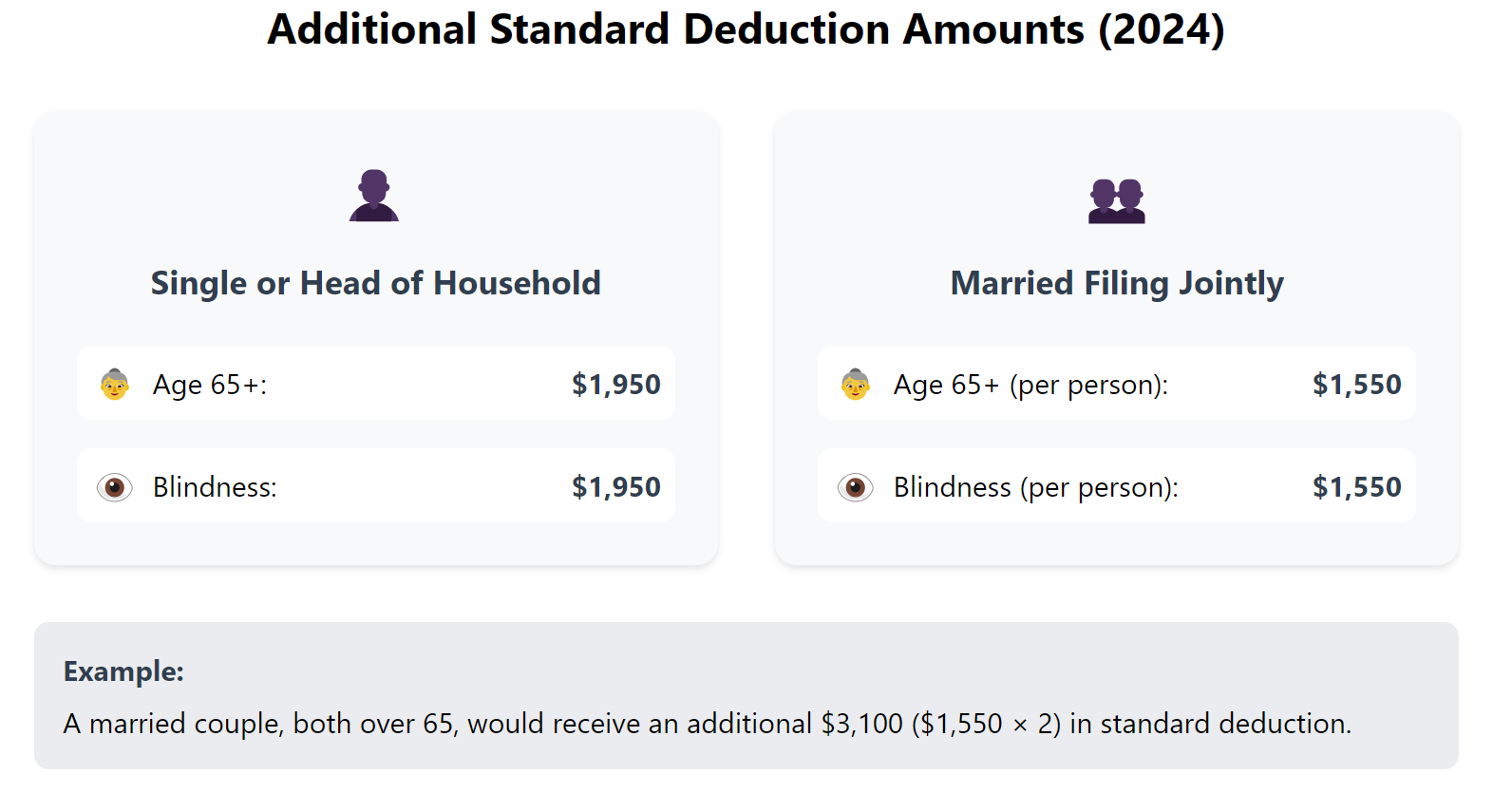
For the 2024 tax year (taxes filed in 2025), the standard deduction amounts have been adjusted to reflect inflationary changes. These figures are crucial for seniors to consider when planning their taxes. The additional amounts for age and blindness are fixed for 2024 at $1,950 for single or head of household filers, and $1,550 for married individuals (whether filing jointly or separately).
Single Filers Over 65
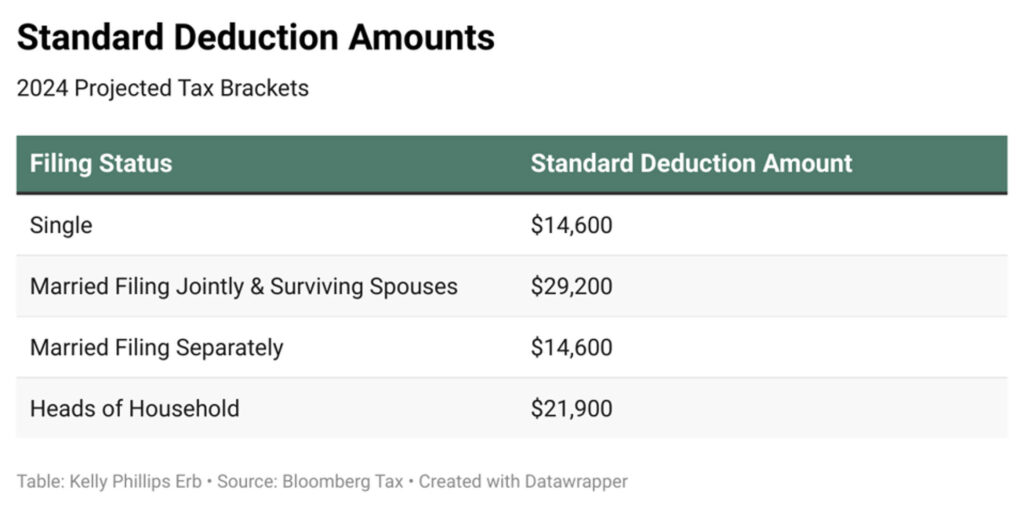
For a single individual who is under 65 and not blind, the standard deduction for 2024 is $14,600.
However, if you are a single filer and aged 65 or older (and not blind), you are entitled to the base standard deduction plus the additional amount for age.
-
Base Standard Deduction (Single): $14,600
-
Additional Standard Deduction (Over 65): $1,950
-
Total Standard Deduction for Single, Over 65: $16,550
If a single filer is also blind, they would add another $1,950, bringing their total to $18,500.
Married Filing Separately (MFS) Over 65
For individuals who are married but filing separately, the standard deduction rules apply somewhat differently for the additional amounts.
-
Base Standard Deduction (MFS): $14,600
-
Additional Standard Deduction (Over 65, MFS): $1,550
-
Total Standard Deduction for MFS, Over 65: $16,150
If an MFS filer is also blind, they would add another $1,550, for a total of $17,700.
Married Filing Jointly (MFJ) with One or Both Spouses Over 65
The married filing jointly status often presents the largest standard deduction amount. For 2024, the base standard deduction for MFJ is $29,200. The additional deduction for age applies to each qualifying spouse.
-
If one spouse is 65 or older (and not blind):
-
Base Standard Deduction (MFJ): $29,200
-
Additional Standard Deduction (one spouse over 65): $1,550
-
Total Standard Deduction: $30,750
-
-
If both spouses are 65 or older (and not blind):
-
Base Standard Deduction (MFJ): $29,200
-
Additional Standard Deduction (both spouses over 65): $1,550 + $1,550 = $3,100
-
Total Standard Deduction: $32,300
-
Similar calculations apply if one or both spouses are also blind, adding $1,550 per qualifying condition per spouse.
Head of Household (HoH) Over 65
The Head of Household filing status applies to unmarried individuals who pay more than half the cost of keeping up a home for a qualifying person.
-
Base Standard Deduction (HoH): $21,900
-
Additional Standard Deduction (Over 65): $1,950
-
Total Standard Deduction for HoH, Over 65: $23,850
If a Head of Household filer is also blind, they would add another $1,950, bringing their total to $25,800.
The Impact of Blindness for Seniors
The additional standard deduction for blindness is a separate, cumulative benefit. This means that if you are both 65 or older AND legally blind, you get to add both additional amounts to your base standard deduction. For instance, a single individual who is 67 and legally blind would add $1,950 for age and another $1,950 for blindness to their base $14,600, resulting in a total standard deduction of $18,500. This provision significantly boosts the non-itemized deduction for those with both qualifications, offering substantial tax relief.
Strategic Tax Planning for Seniors: Standard Deduction Considerations
Choosing between the standard deduction and itemized deductions isn’t always straightforward. For seniors, a careful assessment of their financial situation and potential itemizable expenses is crucial to make the most advantageous decision.
When to Choose the Standard Deduction
For many seniors, the expanded standard deduction amounts, particularly with the added benefit for age and/or blindness, make it the optimal choice. You should strongly consider taking the standard deduction if:
-
Your total itemized deductions are less than your expanded standard deduction. This is the most fundamental reason. Calculate your potential itemized deductions first, and if they don’t exceed your standard deduction, then the standard deduction is the better option.
-
You prefer simplicity. The standard deduction significantly streamlines tax preparation, eliminating the need to track and document numerous expenses.
-
You have limited deductible expenses. Many retirees have paid off their mortgages, reducing or eliminating a major itemized deduction (mortgage interest). Similarly, their state and local tax deductions might be below the $10,000 SALT cap, and medical expenses might not meet the AGI threshold.
Common Itemized Deductions Seniors Might Consider
While the standard deduction is often advantageous, some seniors may still find it beneficial to itemize if they have substantial deductible expenses. Common itemized deductions that might push seniors past the standard deduction threshold include:
-
Medical and Dental Expenses: Taxpayers can deduct the amount of medical and dental expenses that exceed 7.5% of their Adjusted Gross Income (AGI). For many seniors, healthcare costs can be significant, potentially making this a substantial deduction. This includes premiums for Medicare Parts B and D, prescription drugs, doctor visits, and certain long-term care insurance premiums.
-
State and Local Taxes (SALT): This includes property taxes and either state income taxes or sales taxes. However, this deduction is capped at $10,000 per household ($5,000 for married filing separately), which can limit its impact for those in high-tax states.
-
Home Mortgage Interest: If you still have a mortgage, the interest paid on it can be a significant itemized deduction.
-
Charitable Contributions: Donations to qualified charitable organizations can be itemized. For those who are philanthropic, these contributions can add up. It’s important to keep records of all contributions, especially for non-cash donations.
It is crucial to accurately calculate your total itemized deductions to compare them directly against your applicable standard deduction.
Beyond the Standard Deduction: Other Tax Benefits for Seniors
While the standard deduction is a key component of tax planning, seniors should also be aware of other tax benefits and considerations:
-
Retirement Account Distributions: Strategic planning of withdrawals from IRAs, 401(k)s, and other retirement accounts can impact your AGI and potentially reduce the taxation of Social Security benefits. Qualified Charitable Distributions (QCDs) from IRAs can be particularly beneficial for charitable seniors.
-
Social Security Taxation: A portion of Social Security benefits may be taxable depending on your “provisional income” (AGI + tax-exempt interest + 50% of Social Security benefits). Careful income planning can help minimize this taxation.
-
Tax Credits: Seniors may qualify for certain tax credits, such as the Credit for the Elderly or the Disabled, which directly reduce tax liability dollar-for-dollar, offering an even more impactful benefit than deductions.
-
Property Tax Relief Programs: Many states and local municipalities offer property tax relief or “circuit breaker” programs specifically for seniors, which can reduce housing costs.
Maximizing Your Financial Well-being in Retirement
Effective tax planning for seniors goes beyond merely calculating deductions; it encompasses a holistic approach to managing finances, understanding legal requirements, and seeking expert guidance. Maximizing your financial well-being in retirement requires diligence and proactive engagement.
The Importance of Record-Keeping
Regardless of whether you choose to itemize or take the standard deduction, maintaining meticulous records is fundamental to sound financial management and tax compliance.
-
For Itemizers: Detailed records of medical expenses, charitable donations, property taxes, and mortgage interest are essential to substantiate your claims in the event of an audit.
-
For Standard Deduction Takers: Even when taking the standard deduction, good records of all income sources (Social Security, pensions, IRA distributions, investment income), tax payments, and any deductible items you might consider itemizing in future years are prudent. These records are also vital for other financial planning purposes.
-
General Financial Health: Well-organized records allow you to track your spending, understand your financial position, and make informed decisions about your budget and investments.
Seeking Professional Tax Advice
While this guide provides valuable information, it cannot replace personalized advice from a qualified tax professional. Tax laws are complex and constantly changing, and individual financial situations vary greatly.
-
Complexity of Finances: If you have multiple income streams, various investments, significant deductions, or are navigating estate planning, a tax professional can offer tailored strategies.
-
Optimizing Benefits: A professional can help you identify all applicable deductions and credits, ensuring you’re not leaving money on the table.
-
Navigating Changes: They stay up-to-date with the latest tax laws and can advise you on how changes impact your specific situation.
-
Peace of Mind: Knowing your taxes are prepared accurately and optimally by an expert can provide significant peace of mind.
Look for a Certified Public Accountant (CPA), an Enrolled Agent (EA), or another qualified tax preparer with experience in senior tax issues.
Proactive Financial Review and Adjustments
Retirement is a dynamic phase of life, and your financial circumstances can change year to year. Proactive and regular review of your financial plan and tax strategy is critical.
-
Annual Review: Each year, revisit your income sources, expenses, investment performance, and any life changes (e.g., healthcare needs, living situation) that could affect your tax situation.
-
Adjusting Strategies: Based on your review, adjust your withdrawal strategies from retirement accounts, charitable giving plans, or investment portfolio to optimize tax efficiency.
-
Estate Planning: Integrate tax considerations into your estate planning to ensure your assets are distributed according to your wishes with minimal tax burden on your heirs.
-
Health and Long-Term Care: Factor in potential future health care costs and long-term care needs, as these can have significant tax implications and impact your overall financial security.
Conclusion
The 2024 standard deduction for individuals over 65 offers a significant opportunity to reduce taxable income and simplify the tax filing process. With base amounts tailored to filing status and additional deductions for age and blindness, many seniors will find the standard deduction to be their most advantageous choice. Understanding these specific amounts—like the $16,550 for a single filer over 65 or up to $32,300 for a married couple both over 65—is the first step toward informed tax planning.
However, the decision to take the standard deduction or itemize should always be based on a thorough comparison of your specific financial situation. By maintaining meticulous records, seeking professional tax advice, and proactively reviewing your financial plan, seniors can navigate the complexities of the tax system with confidence. Maximizing these benefits not only ensures compliance but also contributes significantly to a stable and comfortable financial future in retirement.
aViewFromTheCave is a participant in the Amazon Services LLC Associates Program, an affiliate advertising program designed to provide a means for sites to earn advertising fees by advertising and linking to Amazon.com. Amazon, the Amazon logo, AmazonSupply, and the AmazonSupply logo are trademarks of Amazon.com, Inc. or its affiliates. As an Amazon Associate we earn affiliate commissions from qualifying purchases.