
In the world of finance, few terms are uttered with as much frequency or reverence as “the S&P.” Whether you are watching a nightly news broadcast, reading a quarterly 401(k) statement, or listening to a financial podcast, the S&P 500 is the omnipresent yardstick used to measure the health of the American economy. But for many individual investors, the index remains a vague concept—a collection of numbers that go up or down without a clear explanation of what is happening under the hood.
The S&P 500, or the Standard & Poor’s 500 Index, is far more than just a list of stocks. It is a market-capitalization-weighted index of 500 of the largest publicly traded companies in the United States. It serves as a cornerstone of modern portfolio theory and the primary benchmark against which professional money managers are judged. Understanding how it works, what it represents, and how you can utilize it to build long-term wealth is essential for anyone serious about their financial future.
Decoding the S&P 500: The Mechanics of the Index
To understand the S&P 500, one must first understand that it is not a “market” in itself, but a curated selection. Created in its current 500-company format in 1957, the index is maintained by S&P Dow Jones Indices. Unlike the Dow Jones Industrial Average, which only tracks 30 companies and uses a price-weighted system, the S&P 500 offers a much broader and more mathematically sound representation of the equity market.
Eligibility and Selection Criteria
A common misconception is that the S&P 500 simply consists of the 500 largest companies in America. In reality, a committee determines which companies make the cut based on strict eligibility criteria. To be included, a company must be a U.S. corporation, have a market capitalization of at least $15.8 billion (this figure is adjusted periodically), and maintain high liquidity.
Most importantly, the company must demonstrate financial viability. Specifically, the sum of its most recent four consecutive quarters of earnings must be positive, as must the most recent quarter. This “profitability rule” acts as a quality filter, ensuring that the index represents established, successful enterprises rather than speculative startups that might have high valuations but no actual income.
Market-Cap Weighting Explained
The S&P 500 is a “float-adjusted market-capitalization-weighted” index. This means that companies with the highest total market value have the greatest impact on the index’s performance. For example, a 1% move in the stock price of a multi-trillion-dollar giant like Apple or Microsoft will move the entire index significantly more than a 1% move in a smaller constituent like a regional utility company.
While some critics argue this creates a “top-heavy” index, proponents suggest that market-cap weighting is the most logical way to reflect the reality of the economy. It rewards success; as a company grows and becomes more valuable, its influence within the index grows accordingly. Conversely, companies that shrink or fail eventually lose their influence and are eventually removed from the index entirely.
Why the S&P 500 is the Ultimate Economic Barometer
The S&P 500 is often referred to as the “heartbeat” of American capitalism. Because it covers approximately 80% of the available market capitalization of the U.S. equity market, it provides an incredibly accurate snapshot of the business climate. When the S&P 500 is trending upward, it generally indicates corporate expansion, high consumer confidence, and a healthy investment environment.
Reflecting the Strength of the US Economy
The index is unique because it captures the global reach of American business. While the companies are based in the U.S., a significant portion of their revenue—often 40% or more—is generated internationally. Therefore, when you invest in the S&P 500, you are not just betting on domestic growth; you are participating in the growth of the global middle class and international trade.
The index’s movement also influences consumer psychology. For many Americans, their primary source of wealth is tied to the stock market through retirement accounts. When the S&P 500 performs well, the “wealth effect” takes hold: people feel richer, they spend more, and the economy receives a secondary boost.
Sector Diversification: More Than Just Tech
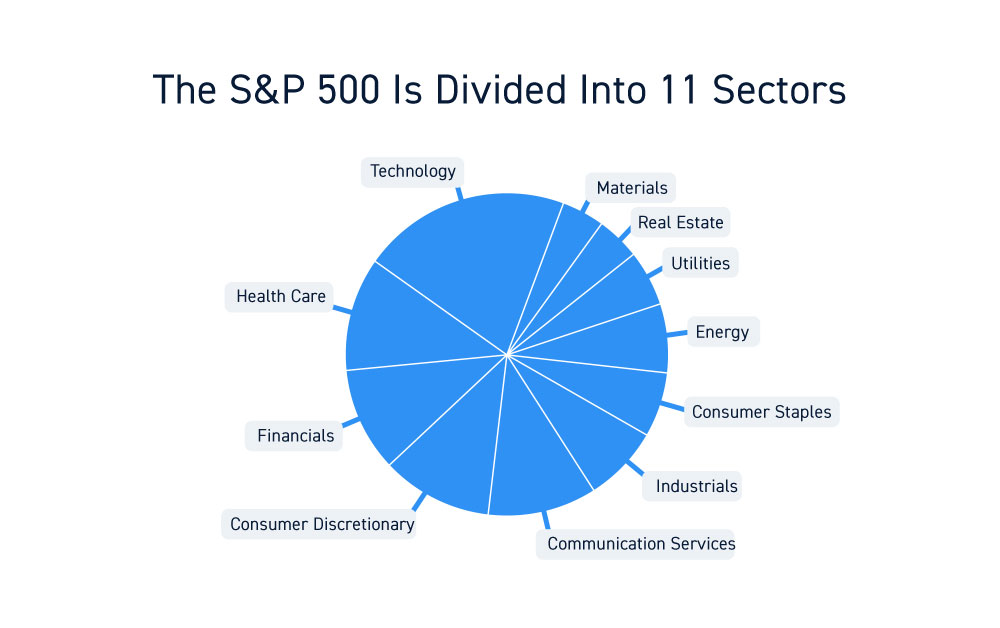
While the “Magnificent Seven” tech giants often dominate the headlines, the S&P 500 is actually highly diversified across eleven different GICS (Global Industry Classification Standard) sectors. These include:
- Information Technology: Software, hardware, and semiconductors.
- Financials: Banks, insurance companies, and investment firms.
- Healthcare: Pharmaceuticals, biotech, and hospital systems.
- Consumer Discretionary: Retail, travel, and automotive.
- Communication Services: Media, social networks, and telecom.
- Industrial, Energy, Utilities, and Real Estate.
This diversity ensures that the index is resilient. If the tech sector faces a downturn, the stability of consumer staples or the dividend payments from the energy sector can often help mitigate the losses. This balance is what makes the S&P 500 the preferred benchmark for institutional investors.
Historical Performance and the Power of Compounding
The most compelling argument for the S&P 500 is its track record. While the market is volatile in the short term, its long-term trajectory has been remarkably consistent. Since its inception, the index has provided an average annual return of approximately 10% (before inflation).

Long-Term Returns vs. Short-Term Volatility
The 10% average is a powerful figure, but it is rarely achieved in a straight line. In any given year, the S&P 500 might be up 30% or down 20%. However, the probability of a positive return increases the longer an investor holds the index. Historically, there has never been a 20-year period where the S&P 500 has yielded a negative total return.
This reliability makes it an ideal vehicle for the “buy and hold” strategy. By ignoring the daily noise of the financial news cycle and staying invested through market corrections, investors allow the power of compounding to work its magic. A $10,000 investment that grows at 10% annually doubles roughly every seven years. Over a 30-year career, that single investment could grow into over $170,000 without the investor ever having to pick a single winning stock.
Dividends: The Silent Growth Engine
When people discuss the S&P 500, they usually focus on the “Price Return”—how much the index value itself has increased. However, “Total Return” is the metric that truly builds wealth. Total return includes the dividends paid out by the companies within the index.
Many of the companies in the S&P 500 are “Dividend Aristocrats” or “Dividend Kings,” having increased their payouts for decades. When an investor reinvests these dividends back into the index, they are essentially buying more shares for “free,” which then generate their own dividends. Over long periods, reinvested dividends can account for nearly half of the total wealth generated by the index.
How to Invest in the S&P 500
One of the greatest innovations in modern finance is that you don’t have to be a millionaire to own the S&P 500. In fact, you can own a piece of all 500 companies with a single transaction for as little as a few dollars.
Index Funds vs. ETFs
There are two primary ways to gain exposure to the index: Mutual Funds and Exchange-Traded Funds (ETFs).
- Index Mutual Funds: These are priced once at the end of the day. They are excellent for automatic, recurring investments (like a 401k contribution).
- ETFs: These trade like stocks throughout the day on an exchange. Popular S&P 500 ETFs include the SPDR S&P 500 ETF Trust (SPY), the Vanguard S&P 500 ETF (VOO), and the iShares Core S&P 500 ETF (IVV).
ETFs are generally preferred by modern investors due to their high liquidity and tax efficiency. They allow you to enter or exit a position instantly during market hours.
Low Fees and Passive Management Advantages
The primary benefit of S&P 500 investing is the low cost. Traditional actively managed funds often charge 1% or more in annual fees (the “expense ratio”) to pay for a team of analysts trying to “beat the market.” Statistics show that over 80% of these professional managers fail to outperform the S&P 500 over a 10-to-15-year period.
In contrast, an S&P 500 index ETF like VOO has an expense ratio as low as 0.03%. This means for every $10,000 invested, you pay only $3 per year in fees. Over a lifetime of investing, this difference in fees can result in hundreds of thousands of dollars more in your pocket rather than your broker’s.
Common Misconceptions and Risks
While the S&P 500 is a powerful tool, it is not without risks. An informed investor must understand what the index is not and where its vulnerabilities lie.
Concentration Risk in the Top Holdings
Because the index is market-cap weighted, it has become increasingly concentrated in a few massive technology companies. As of 2024, the top ten companies in the index represent a significant percentage of its total value. If the tech sector experiences a systemic bubble or a regulatory crackdown, the S&P 500 will suffer more than a more equally weighted index would. This is known as “concentration risk.” While you are technically diversified across 500 companies, a handful of them are “wagging the dog.”
Indexing vs. Active Stock Picking
The S&P 500 provides “beta,” which is the return of the overall market. It does not provide “alpha,” which is an excess return above the market. If you only invest in the S&P 500, you will never “beat” the market because you are the market. For some, the desire to find the next Amazon or Tesla leads them away from the index toward individual stock picking. However, for the vast majority of people, the consistency of the S&P 500 is a safer and more reliable path to financial independence than trying to find a needle in a haystack.

Conclusion
The S&P 500 represents the collective ingenuity, productivity, and resilience of the American corporate landscape. It is a dynamic entity that evolves with the times—removing the laggards of the past and embracing the innovators of the future. By understanding the mechanics of the index, the importance of its sector diversification, and the historical power of its returns, investors can approach the market with confidence.
Investing in the S&P 500 is not about getting rich quick; it is about participating in the long-term growth of the world’s most powerful economy. Whether through a workplace retirement plan or a personal brokerage account, the S&P 500 remains one of the most effective, low-cost, and transparent tools ever created for building personal wealth. In the world of money, sometimes the simplest strategy—owning the market—is the most sophisticated strategy of all.
aViewFromTheCave is a participant in the Amazon Services LLC Associates Program, an affiliate advertising program designed to provide a means for sites to earn advertising fees by advertising and linking to Amazon.com. Amazon, the Amazon logo, AmazonSupply, and the AmazonSupply logo are trademarks of Amazon.com, Inc. or its affiliates. As an Amazon Associate we earn affiliate commissions from qualifying purchases.