
For many individual investors, the world of finance can often feel like a dizzying array of numbers, acronyms, and shifting tickers. However, if there is one term that stands above the rest as the definitive “pulse” of the American economy, it is the S&P 500. Often cited on nightly news broadcasts and analyzed by the world’s most sophisticated hedge fund managers, the S&P 500 is more than just a list of companies; it is the primary benchmark for the U.S. equity market and a cornerstone of modern wealth-building strategies.

Understanding what the S&P 500 is, how it functions, and why it holds such prestige is essential for anyone looking to navigate the world of personal finance and long-term investing. This guide will break down the mechanics of the index, the criteria for its composition, and how you can use it to secure your financial future.
Understanding the Foundations of the S&P 500
At its core, the S&P 500 (Standard & Poor’s 500) is a stock market index that tracks the performance of 500 of the largest publicly traded companies in the United States. While there are thousands of stocks traded on the New York Stock Exchange (NYSE) and the Nasdaq, the S&P 500 represents approximately 80% of the total available market capitalization in the U.S. This makes it a highly accurate reflection of the overall health of the American corporate landscape.
A Brief History and Purpose
The index was launched in its current form in 1957 by Standard & Poor’s, a financial services company. Before its inception, tracking the “market” was a fragmented process. The S&P 500 revolutionized this by providing a diversified, real-time snapshot of industrial, financial, and consumer-driven sectors. Its primary purpose is to serve as a benchmark. When an investor asks, “How did the market do today?” they are almost always referring to the movement of the S&P 500.
The Mechanism: Float-Adjusted Market Capitalization
Unlike the Dow Jones Industrial Average, which is “price-weighted” (meaning a higher stock price gives a company more influence), the S&P 500 uses a float-adjusted market capitalization weighting system.
Market capitalization is calculated by multiplying a company’s current share price by its total number of outstanding shares. “Float-adjusted” means the index only counts the shares available to the public, excluding those held by insiders or government agencies. In this system, the largest companies—such as Apple, Microsoft, and Amazon—have a significantly larger impact on the index’s performance than the smaller companies at the bottom of the list. This reflects the reality of the economy: the movements of a trillion-dollar tech giant matter more to the global financial system than those of a regional mid-sized retailer.
Selection Criteria: How Companies Join the Index
One of the most common misconceptions is that the S&P 500 simply consists of the 500 largest companies in America. In reality, the index is “curated” by a committee at S&P Dow Jones Indices. To be included, a company must meet rigorous eligibility requirements, ensuring that the index remains a high-quality representation of the leading edge of the economy.
Financial Viability and Liquidity
The selection committee does not just look at size; they look at health. To be eligible for the S&P 500, a company must typically meet the following criteria:
- Market Cap Threshold: As of 2024, a company must have an unadjusted market cap of at least $15.8 billion (this number is adjusted periodically).
- Profitability: The sum of the company’s earnings over the previous four consecutive quarters must be positive, as must the most recent quarter. This prevents “speculative” companies with high valuations but no profits from distorting the index.
- Liquidity: The stock must be highly liquid, meaning it is easily bought and sold without causing massive price fluctuations. This is measured by the ratio of annual dollar value traded to the float-adjusted market cap.
The Role of the Index Committee
Because the S&P 500 is maintained by a committee, it possesses a human element that purely algorithmic indexes lack. The committee meets monthly to review the index’s composition. They consider sector balance to ensure the index isn’t overly concentrated in one area of the economy, although technology has naturally come to dominate in recent years. When a company fails to meet the criteria or is acquired by another firm, the committee selects a replacement from a “buffer” list of eligible candidates. This process ensures that the S&P 500 remains a living, breathing document of American corporate evolution.
Why the S&P 500 Matters to Your Portfolio

For the individual investor, the S&P 500 is perhaps the most important tool in the pursuit of financial independence. It has historically been the “gold standard” against which all other investments are measured. If a professional fund manager cannot beat the returns of the S&P 500 over a 10-year period, their fees are often seen as unjustifiable.
A Barometer for the U.S. Economy
The S&P 500 is a leading economic indicator. When the index is in a “Bull Market” (rising prices), it generally signals corporate optimism, high consumer spending, and economic growth. Conversely, a “Bear Market” (a drop of 20% or more) often precedes or accompanies economic recessions. By tracking the index, investors gain insight into the collective sentiment of millions of market participants, providing a macro view of the financial world that individual stocks cannot offer.
Historical Performance and Wealth Creation
Historically, the S&P 500 has delivered an average annual return of approximately 10% before inflation. While there are years where the index might drop significantly (such as 2008 or 2022), the long-term trajectory has been consistently upward. This power of compounding makes the S&P 500 a favorite for retirement accounts. An investor who puts $500 a month into an S&P 500 index fund starting at age 25 could potentially see their portfolio grow to over $3 million by age 65, assuming historical averages. It turns the volatile stock market into a predictable engine for wealth.
How to Invest in the S&P 500
You cannot “buy” the S&P 500 index itself, as it is merely a mathematical calculation. However, you can invest in funds that are designed to track it perfectly. These are known as index funds or Exchange-Traded Funds (ETFs).
Index Funds and ETFs
For most people, the easiest way to gain exposure is through an S&P 500 ETF. These funds hold all 500 companies in the index in the exact same proportions as the index itself. Some of the most famous examples include:
- SPY (SPDR S&P 500 ETF Trust): The oldest and most liquid S&P 500 ETF.
- VOO (Vanguard S&P 500 ETF): Known for its extremely low expense ratio (the fee you pay the fund manager).
- IVV (iShares Core S&P 500 ETF): Another highly efficient and low-cost option.
The primary advantage of these funds is “diversification.” By buying a single share of an S&P 500 ETF, you are instantly becoming a partial owner of 500 different companies. If one company goes bankrupt, it represents only a tiny fraction of your total investment, significantly reducing your risk compared to buying individual stocks.
The Passive Investing Revolution
The rise of S&P 500 investing has led to what is known as the “Passive Investing Revolution.” Legendary investor Warren Buffett has famously argued that for the average person, a low-cost S&P 500 index fund is the best investment they can make. By avoiding the high fees of active money managers and simply “buying the market,” investors often end up with higher net returns over the long run.
The Evolution of the Index in the Modern Financial Landscape
The S&P 500 of 2024 looks very different from the S&P 500 of 1970. In the past, the index was dominated by oil, manufacturing, and transportation companies. Today, it is heavily weighted toward Information Technology and Communication Services.
Sector Diversification and Tech Dominance
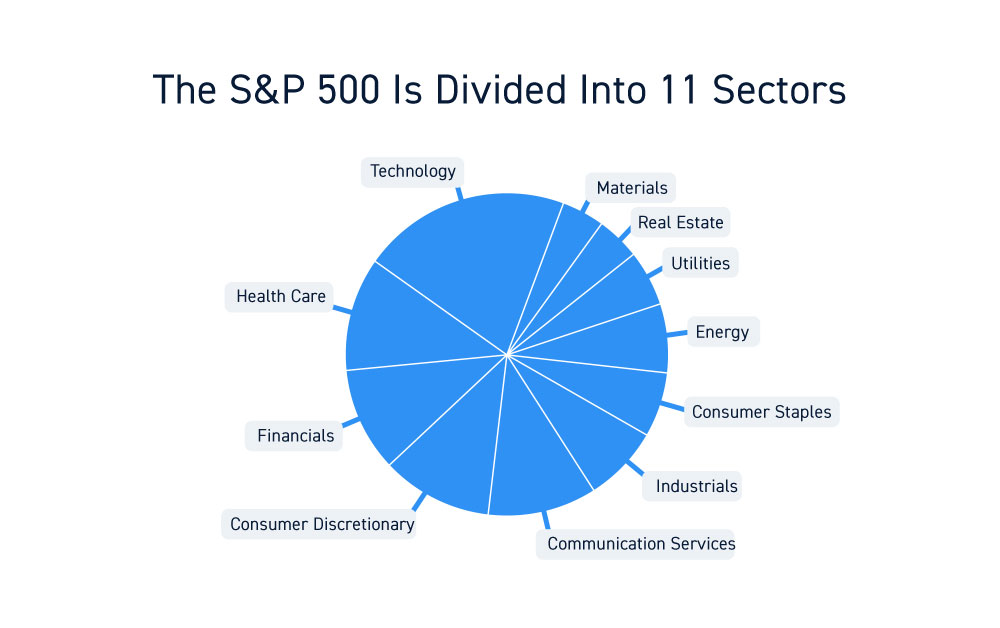
As software and AI have become the primary drivers of global productivity, companies like Nvidia, Apple, and Alphabet (Google) have grown to occupy massive portions of the index. This has led to some debate about whether the S&P 500 is “too top-heavy.” While the index is technically diversified across 11 sectors (including Healthcare, Energy, and Consumer Staples), the top 10 companies now account for a record-high percentage of the total index value. Investors should be aware that when they buy the S&P 500, they are making a significant bet on the continued dominance of Big Tech.
Staying the Course: The Investor’s Mindset
The S&P 500 is not a “get rich quick” scheme. Its true value is realized over decades, not days. The biggest risk to an S&P 500 investor is not market volatility, but emotional decision-making. Selling during a market downturn locks in losses and prevents the investor from participating in the eventual recovery.
In conclusion, the S&P 500 is the ultimate tool for personal finance. It democratizes the stock market, allowing anyone with a brokerage account to own a piece of the most successful companies in history. By understanding its structure, its selection process, and its historical resilience, you can move from being a spectator of the economy to an active participant in the growth of global wealth. Whether you are saving for a first home or building a retirement nest egg, the S&P 500 remains the most reliable benchmark for long-term financial success.
aViewFromTheCave is a participant in the Amazon Services LLC Associates Program, an affiliate advertising program designed to provide a means for sites to earn advertising fees by advertising and linking to Amazon.com. Amazon, the Amazon logo, AmazonSupply, and the AmazonSupply logo are trademarks of Amazon.com, Inc. or its affiliates. As an Amazon Associate we earn affiliate commissions from qualifying purchases.