
For anyone beginning their journey into the world of finance, the term “S&P 500” is likely one of the first things they encounter. Often cited on nightly news broadcasts and financial apps as a shorthand for “the stock market,” the S&P 500 is much more than a simple list of companies. It is a sophisticated financial instrument, a barometer for the American economy, and one of the most effective wealth-building tools ever created for the average investor.
In the realm of personal finance and investing, understanding the S&P 500 is fundamental. Whether you are managing a 401(k), building a brokerage account, or simply trying to understand how global markets function, this index serves as the North Star. This guide will break down the mechanics, the significance, and the practical application of the S&P 500 within a modern investment portfolio.

Understanding the Mechanics of the S&P 500
The S&P 500, short for the Standard & Poor’s 500 Index, is a stock market index that tracks the performance of 500 of the largest publicly traded companies in the United States. Launched in its current form in 1957, it was the first companion to the older, price-weighted Dow Jones Industrial Average, offering a more comprehensive look at the health of the broader market.
Market Capitalization Weighting Explained
Unlike some indices that average the stock prices of their members, the S&P 500 is a “float-adjusted market-capitalization-weighted” index. This means that companies with larger market values have a greater impact on the index’s performance. “Market cap” is calculated by multiplying the current stock price by the number of outstanding shares.
For example, a 1% move in a trillion-dollar company like Apple or Microsoft will shift the index far more significantly than a 1% move in a company with a $20 billion market cap. This structure is designed to reflect the actual economic weight of these companies in the real world.
The Selection Committee and Eligibility Criteria
A common misconception is that the S&P 500 is simply the 500 largest companies in America. In reality, the index is “curated” by a committee at S&P Dow Jones Indices. To be eligible, a company must meet specific criteria:
- Market Cap: It must have a minimum unadjusted market cap (currently around $15.8 billion).
- Liquidity: The stock must be highly liquid, meaning it is easy to buy and sell.
- Profitability: The sum of the company’s earnings over the most recent four consecutive quarters must be positive.
- Public Float: At least 50% of the company’s shares must be available for public trading.
How the Index is Calculated and Rebalanced
The index is not static. The committee meets quarterly to rebalance the index, adding new rising stars and removing companies that no longer meet the criteria (often due to declining market value or mergers). This ensures that the S&P 500 remains a “survivorship-biased” vehicle; it inherently sheds losers and replaces them with winners, which is a major reason for its long-term upward trajectory.
Why the S&P 500 is the Gold Standard for Investors
For professional money managers and retail investors alike, the S&P 500 is the ultimate benchmark. If an actively managed mutual fund or a hedge fund cannot “beat the S&P,” investors often question why they are paying higher fees for that management.
A Reflection of the US Economy
The S&P 500 covers approximately 80% of the available market capitalization of the US equity market. Because it spans a vast array of industries—from healthcare and energy to consumer staples and technology—it is widely considered the most accurate gauge of the U.S. economy’s health. When the S&P 500 is rising, it generally signals corporate profitability, consumer confidence, and economic expansion.
Historical Performance and Long-term Growth
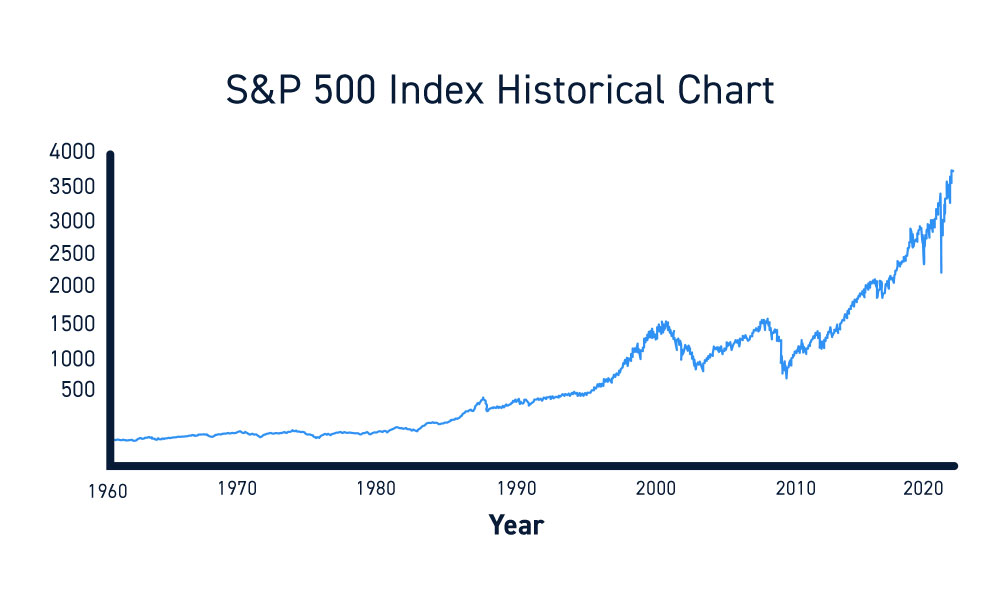
Historically, the S&P 500 has delivered an average annual return of approximately 10% (before inflation) over long periods. While there are years of significant decline (such as 2008 or 2022), the index has a remarkable track record of recovery. For the long-term investor, the S&P 500 represents the power of American corporate ingenuity. By owning the index, you are betting on the collective ability of the 500 most powerful companies in the world to innovate and grow.
Diversification Across 11 Key Sectors
The S&P 500 provides instant diversification. It categorizes its members into 11 Global Industry Classification Standard (GICS) sectors:
- Information Technology
- Health Care
- Financials
- Consumer Discretionary
- Communication Services
- Industrials
- Consumer Staples
- Energy
- Real Estate
- Materials
- Utilities
By investing in the index, you are not putting all your eggs in one basket. If the energy sector struggles due to falling oil prices, the growth in the technology or healthcare sectors can help offset those losses.

How to Invest in the S&P 500
You cannot “buy” the S&P 500 index itself, as it is just a mathematical list. However, you can buy financial products that track the index with near-perfect precision.
Index Funds vs. Exchange-Traded Funds (ETFs)
There are two primary ways to gain exposure:
- Index Mutual Funds: These are priced once at the end of the trading day. They are excellent for automatic, recurring investments through a bank account or employer-sponsored plan.
- Exchange-Traded Funds (ETFs): These trade like stocks throughout the day. They are often more tax-efficient and have become the preferred choice for many modern investors due to their low costs and flexibility.
The Role of Passive Investing
The rise of the S&P 500 is synonymous with the “Passive Investing Revolution” started by John Bogle, the founder of Vanguard. The philosophy is simple: instead of trying to find the “needle in the haystack” (the next hot stock), just buy the entire “haystack.” This approach minimizes the risk of individual stock failure and significantly reduces management fees, which can eat into long-term returns.
Top S&P 500 Investment Vehicles
Several major brokerage firms offer “best-in-class” S&P 500 trackers with extremely low expense ratios (the fee you pay for the fund’s management):
- SPY (SPDR S&P 500 ETF Trust): The oldest and most liquid S&P 500 ETF.
- VOO (Vanguard S&P 500 ETF): Known for its incredibly low expense ratio.
- IVV (iShares Core S&P 500 ETF): Another highly efficient and popular choice from BlackRock.
- FXAIX (Fidelity 500 Index Fund): A popular mutual fund option for those within the Fidelity ecosystem.
Risks and Limitations of S&P 500 Investing
While the S&P 500 is a cornerstone of sound financial planning, it is not without risks. An informed investor must understand the nuances of what they own.
Concentration Risk in “Big Tech”
Because the index is market-cap weighted, the largest companies have a disproportionate influence. In recent years, a handful of technology giants (the so-called “Magnificent Seven,” including Apple, Microsoft, Amazon, and Alphabet) have come to represent nearly 30% of the entire index. This means that if the tech sector experiences a bubble or a sharp correction, the entire S&P 500 will suffer, regardless of how well the other 490+ companies are performing.
Market Volatility and Economic Cycles
The S&P 500 is an “equity” investment, meaning it carries the risk of loss. During recessions or black swan events (like the 2020 pandemic), the index can drop 20%, 30%, or even 50% in value. Investors must have the stomach to stay invested during these downturns to realize the long-term gains. It is not a “get rich quick” scheme; it is a “get wealthy slowly” strategy.
The Difference Between the Index and the “Stock Market”
It is important to remember that the S&P 500 does not include small-cap or mid-cap companies, nor does it include international stocks. While the S&P 500 companies often have global operations, an investor who only owns the S&P 500 is missing out on the growth of emerging markets and smaller, more agile domestic companies.
Integrating the S&P 500 into Your Financial Strategy
Understanding what the S&P 500 is represents the first step; the second is knowing how to use it to achieve financial independence.
Dollar-Cost Averaging (DCA)
One of the most effective ways to invest in the S&P 500 is through dollar-cost averaging. This involves investing a fixed amount of money at regular intervals (e.g., $500 every month), regardless of whether the market is up or down. This strategy removes the emotional component of “timing the market” and allows you to buy more shares when prices are low and fewer when prices are high.
Rebalancing and Retirement Planning
For most investors, the S&P 500 should be the “core” of their portfolio. As you age, your financial advisor might suggest shifting some of your S&P 500 holdings into more conservative assets like bonds to protect your capital. However, for those with a decades-long time horizon, the S&P 500 remains one of the most reliable engines for growth.
Conclusion: The Power of Compound Interest
The S&P 500 is the ultimate testament to the power of compound interest. By reinvesting the dividends paid out by these 500 companies and allowing the capital appreciation to stack over decades, even modest monthly contributions can grow into a significant nest egg. In the world of money and finance, the S&P 500 isn’t just an index—it is a vehicle for democratization, allowing any individual with a brokerage account to own a piece of the most successful corporations on the planet.
aViewFromTheCave is a participant in the Amazon Services LLC Associates Program, an affiliate advertising program designed to provide a means for sites to earn advertising fees by advertising and linking to Amazon.com. Amazon, the Amazon logo, AmazonSupply, and the AmazonSupply logo are trademarks of Amazon.com, Inc. or its affiliates. As an Amazon Associate we earn affiliate commissions from qualifying purchases.