
The humble sheet of printer paper, a cornerstone of both analog and digital workflows, is a surprisingly nuanced subject when viewed through a technological lens. While seemingly straightforward, its dimensions are deeply intertwined with historical standards, global adoption, and the very engineering of the devices designed to process it. Understanding printer paper sizes isn’t just about trivia; it’s about appreciating the underlying technological infrastructure that facilitates communication, documentation, and creative expression in our increasingly digital world. This article delves into the technical intricacies of printer paper sizes, exploring the prevalent standards, their origins, and their impact on technology and design.

The Reign of ISO 216: A Global Standard for Precision
The vast majority of the world operates under a standardized system for paper sizes, a testament to international cooperation and the need for interoperability. This system, known as ISO 216, is a cornerstone of modern printing and document handling, influencing everything from office equipment design to the way digital files are prepared for print.
Genesis and Principles of the ISO 216 Standard
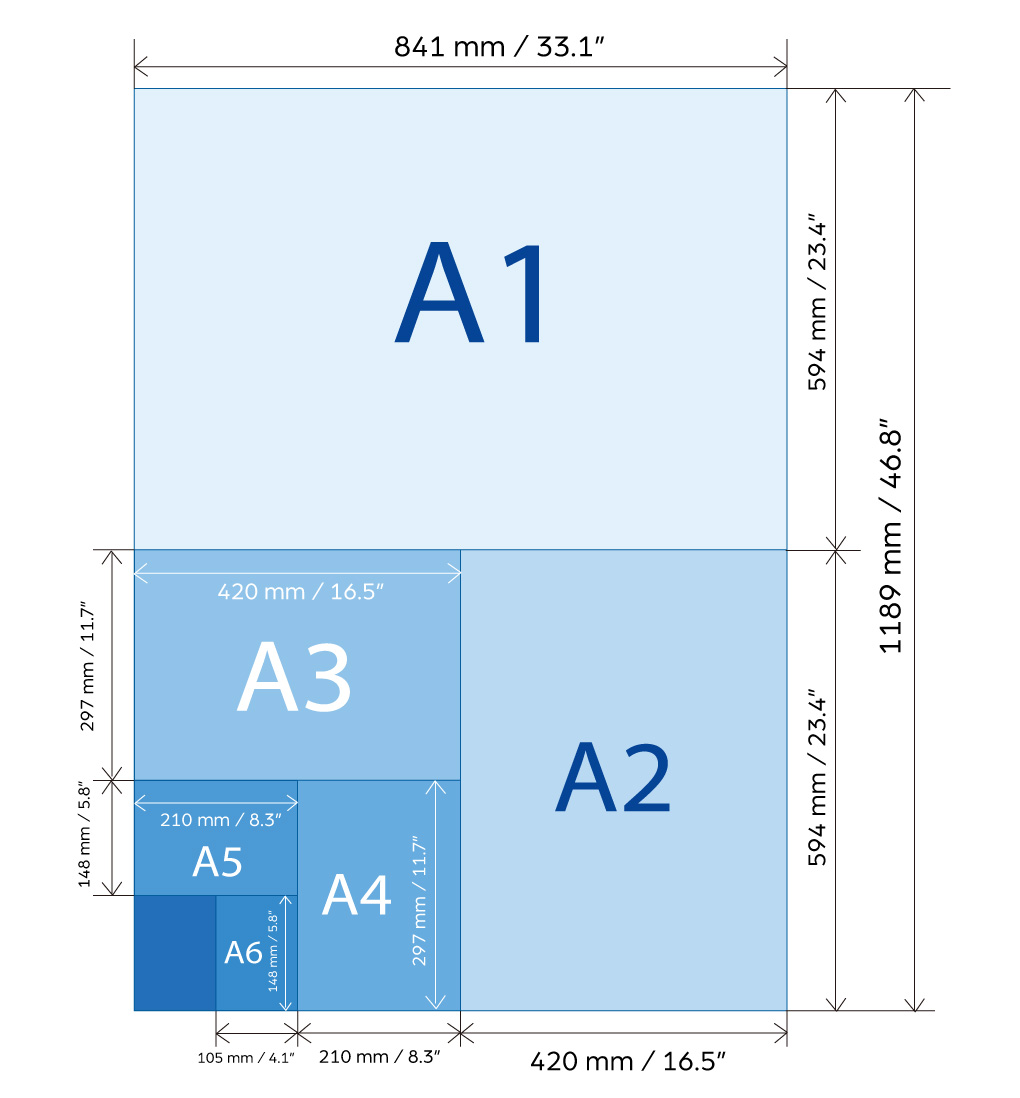
The ISO 216 standard, officially published by the International Organization for Standardization, is derived from the German DIN 476 standard, which was developed in 1922. The core principle behind ISO 216 is elegantly simple yet remarkably effective: each successive paper size in a series has an area exactly half that of the next larger size. This is achieved through a consistent aspect ratio, where the ratio of the longer side to the shorter side is approximately the square root of 2 (√2 ≈ 1.414).
This mathematical relationship is crucial. When you fold a sheet of ISO paper in half parallel to its shorter side, you get a new sheet with the same aspect ratio as the original. For example, taking an A0 sheet (the largest in the A series) and folding it in half yields an A1 sheet, which has the same proportions. This property makes it incredibly efficient for resizing documents without distortion. If you scale a digital image or document down by 50% using this principle, it will perfectly fit the next smaller paper size. This has profound implications for graphic design, layout software, and even the way we share digital documents intended for printing.
The A series is the most widely recognized and used series within ISO 216. It begins with A0, which has an area of exactly one square meter. Subsequent sizes are denoted by increasing numbers: A1, A2, A3, and so on. The dimensions of each size are calculated precisely:
- A0: 841 mm × 1189 mm
- A1: 594 mm × 841 mm
- A2: 420 mm × 594 mm
- A3: 297 mm × 420 mm
- A4: 210 mm × 297 mm
- A5: 148 mm × 210 mm
Of these, A4 is the most common for everyday documents, letters, and reports globally. Its dimensions are well-suited for typical document creation and fitting comfortably within standard folders and envelopes. The ubiquity of A4 has led to the global standardization of office equipment, including printers, scanners, and copiers, all designed to accommodate this particular paper size.
The B Series: Bridging the Gap
While the A series is predominant, ISO 216 also includes a B series. The B series provides intermediate sizes between the A series. The B series is defined such that the B series paper has an area that is the geometric mean of two successive A series papers. For instance, B1 has an area between A0 and A1. The B series is often used for posters, charts, and other applications where slightly larger formats are required than what the A series typically offers.
- B0: 1000 mm × 1414 mm
- B1: 707 mm × 1000 mm
- B2: 500 mm × 707 mm
- B3: 353 mm × 500 mm
- B4: 250 mm × 353 mm
- B5: 176 mm × 250 mm
The B series, though less common than A in everyday office settings, finds its niche in specific printing applications where precise scaling and larger formats are essential. Its existence underscores the systematic approach to paper dimensions, ensuring a logical progression and calculable relationships between sizes.
The C Series: Envelopes Engineered for ISO Paper
Complementing the A and B series is the C series, which is specifically designed for envelopes. The C series is defined such that a C series envelope has dimensions that are the geometric mean of an A series paper and the next larger B series paper. This means that an A4 sheet of paper will fit perfectly inside a C4 envelope without folding. Similarly, an A5 sheet fits comfortably within a C5 envelope.
- C0: 917 mm × 1297 mm
- C1: 648 mm × 917 mm
- C2: 458 mm × 648 mm
- C3: 324 mm × 458 mm
- C4: 229 mm × 324 mm (designed to fit A4)
- C5: 162 mm × 229 mm (designed to fit A5)
- C6: 114 mm × 162 mm (designed to fit A6)
The thoughtful design of the C series ensures that stationery manufacturers and mail services can operate efficiently, with standardized envelope sizes that precisely accommodate their intended paper content. This interconnectedness of paper and envelope dimensions highlights the integrated nature of the ISO standard in facilitating seamless communication.
The Legacy of North American Paper Sizes: A Different Dimension
While the ISO 216 standard has achieved near-global dominance, a significant portion of the world, particularly the United States, Canada, and parts of Mexico, continues to utilize a distinct set of paper dimensions. These are often referred to as “North American” or “Imperial” paper sizes, rooted in historical units of measurement and distinct technological development trajectories.
Understanding Letter and Legal Sizes
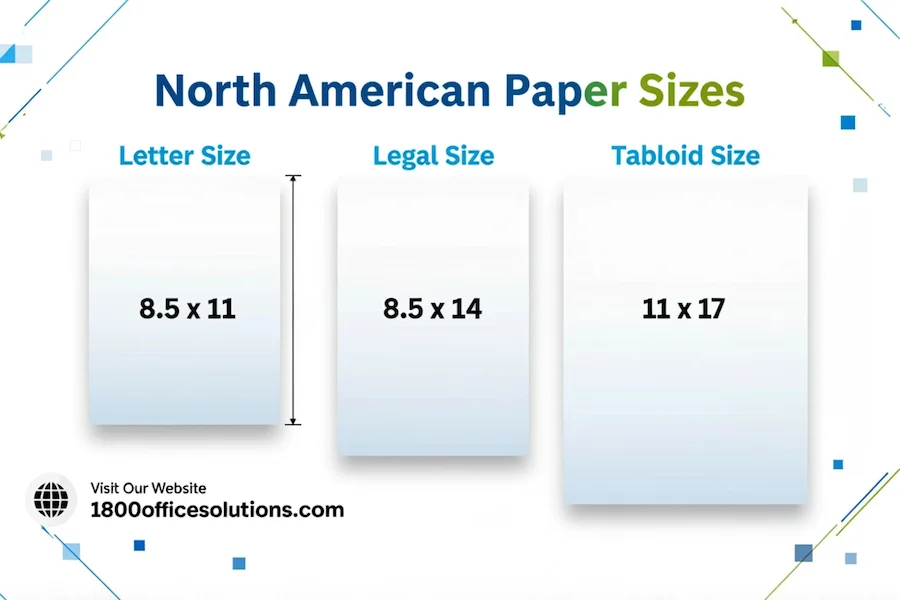
The most commonly encountered North American paper sizes are Letter and Legal. These sizes, though seemingly commonplace, represent a divergence from the mathematical precision of the ISO system.
- Letter: 8.5 inches × 11 inches (approximately 216 mm × 279 mm)
Letter size is the de facto standard for most personal and business correspondence, documents, and general printing in North America. It is the default paper size set in most software applications and operating systems originating from this region.
- Legal: 8.5 inches × 14 inches (approximately 216 mm × 356 mm)
Legal size is longer than Letter size and is often used for legal documents, contracts, and forms where more space is required.
The dimensions of Letter and Legal paper do not adhere to the halving-area principle of the ISO standard. Their aspect ratios are different, and scaling documents between North American and ISO sizes can introduce unwanted cropping or letterboxing if not handled carefully. This is a common technical challenge when collaborating internationally or when sharing digital files intended for different print environments.
Other North American Sizes and Their Applications
Beyond Letter and Legal, other North American paper sizes exist, catering to specific needs:
- Tabloid (Ledger): 11 inches × 17 inches (approximately 279 mm × 432 mm)
This size is essentially double the size of a Letter sheet and is often used for larger documents, spreadsheets, architectural drawings, and creative projects. It is comparable in area to ISO A3 but with different proportions.
- Executive: 7.25 inches × 10.5 inches (approximately 184 mm × 267 mm)
Executive size is a smaller, more compact format, often used for professional correspondence, notepads, and personal organizers.
The persistence of these North American sizes presents a continuous technical consideration for developers of printing hardware and software. Printers designed exclusively for ISO paper may not fully accommodate North American sizes, and vice-versa. Similarly, digital document creation tools must offer robust options for specifying and outputting to these different standards to ensure compatibility.
Technological Implications: From Printer Engineering to Software Design
The seemingly simple question of paper size has profound implications for the design and functionality of the technology we use daily. From the mechanical engineering of printers to the algorithms governing graphic design software, paper dimensions are a fundamental technical constraint and enabler.
Printer Hardware and Paper Handling
Printers are engineered with specific paper pathways, rollers, and sensors designed to handle particular paper sizes and thicknesses. The physical dimensions of a printer’s paper tray, internal guides, and output mechanisms are all calibrated to accommodate the standard paper sizes it supports.
For example, a printer designed for A4 paper will have trays and internal components optimized for its dimensions. If you attempt to print on a larger or smaller size without proper settings, the paper might jam, be misfed, or print incorrectly. Conversely, a printer designed for Letter size will have similar considerations. Dual-standard printers, which support both ISO and North American sizes, require more complex mechanical designs and often involve adjustable trays and guides that can be reconfigured by the user.
The paper feed mechanism itself is a marvel of engineering, using sensors to detect the leading and trailing edges of the paper, ensuring precise alignment as it moves through the printing process. The motor speed, roller pressure, and ink/toner deposition are all timed based on the paper’s progress. Subtle differences in paper size can affect these timings, leading to print quality issues.
Software and Digital Document Creation
In the realm of software, paper size is a critical parameter in document creation, layout, and printing. Word processors, desktop publishing software, and image editing tools all require users to specify the target paper size for their output.
- Layout and Design: When a designer creates a poster or brochure, they will typically select the intended paper size (e.g., A3, Tabloid) within their software. This sets the canvas dimensions and influences how elements are laid out on the page. The aspect ratios of different paper sizes mean that a design optimized for A4 might appear stretched or compressed if printed on Letter size without adjustment.
- Scaling and Resolution: The resolution at which a digital document is created and saved is directly tied to its intended print size. A higher resolution is generally required for larger print formats to maintain clarity and detail. Software needs to manage this relationship, ensuring that when a user scales a document from one paper size to another (e.g., from A4 to A3), the resolution is appropriately adjusted to avoid pixellation.
- Print Dialogs and Driver Settings: The print dialog boxes presented to users are a direct interface with the printer’s capabilities. They allow users to select paper size, orientation, and other settings. The printer driver software acts as a translator between the operating system and the printer hardware, ensuring that the print job is correctly formatted for the chosen paper size and printer model. Mismatched settings here are a common cause of printing errors.
The existence of two dominant paper sizing systems creates a layer of complexity in software development. Developers must ensure that their applications provide comprehensive support for both ISO and North American standards, offering clear options for users and handling conversions gracefully. This is particularly important for global software distribution and for applications that facilitate cross-border document sharing.
The Future of Paper Size: Interplay with Digital Workflows
While the digital revolution has transformed how we create and consume information, paper remains a significant medium. The future of printer paper sizes will likely be shaped by an ongoing interplay between traditional standards and the evolving demands of digital workflows and emerging technologies.
Standardization and Interoperability in a Globalized World
As businesses and individuals increasingly operate on a global scale, the need for interoperability in document handling becomes paramount. The inherent mathematical elegance and efficiency of the ISO 216 standard make it a strong candidate for continued and possibly expanded adoption. The simplicity of its halving-area principle and consistent aspect ratio simplifies scaling and reduces waste in printing and reproduction processes.
However, the deeply entrenched nature of North American paper sizes, particularly in the legal and business sectors, means that a complete global shift is unlikely in the immediate future. Instead, we are likely to see continued development of technologies that facilitate seamless conversion and compatibility between the two systems.
Emerging Technologies and Niche Applications
Emerging technologies may also influence the future of paper sizes. For instance, advancements in digital printing allow for variable data printing and on-demand sizing, which could potentially lead to more customized paper dimensions for specific applications. However, the cost-effectiveness and widespread availability of standard paper sizes will likely keep them dominant for the foreseeable future.
Niche applications will continue to drive the demand for specialized paper sizes. In fields like photography, fine art printing, and specialized publishing, photographers and artists often work with non-standard formats that allow for unique aesthetic expressions or optimal presentation of their work. These demands push the boundaries of both paper manufacturing and printing technology.
The growing emphasis on sustainability also plays a role. The ISO standard’s design facilitates efficient use of paper by allowing for easy resizing without significant material waste. As environmental concerns continue to grow, the technical advantages of the ISO system in terms of material efficiency may become an even more compelling factor in its favor.
In conclusion, the size of printer paper, while seemingly a mundane detail, is a critical component of our technological landscape. From the meticulous engineering of printers to the sophisticated algorithms in design software, paper dimensions shape how we interact with information and how technology facilitates our communication. Understanding the technical underpinnings of ISO 216 and North American standards provides valuable insight into the global infrastructure that underpins our modern, information-driven world. As technology evolves, the relationship between digital workflows and the physical medium of paper will undoubtedly continue to adapt, ensuring that these seemingly simple dimensions remain a technically relevant and fascinating aspect of our lives.
aViewFromTheCave is a participant in the Amazon Services LLC Associates Program, an affiliate advertising program designed to provide a means for sites to earn advertising fees by advertising and linking to Amazon.com. Amazon, the Amazon logo, AmazonSupply, and the AmazonSupply logo are trademarks of Amazon.com, Inc. or its affiliates. As an Amazon Associate we earn affiliate commissions from qualifying purchases.