
When people ask, “How is the market doing today?” they are rarely referring to the thousands of individual stocks traded on global exchanges. Instead, they are usually looking for a pulse check on the S&P 500. For over 60 years, the Standard & Poor’s 500 Index has served as the definitive barometer for the health of the U.S. economy and the primary benchmark for investment performance. Whether you are a novice investor opening your first brokerage account or a seasoned financial professional, understanding the mechanics, history, and strategic importance of the S&P 500 is fundamental to building long-term wealth.

Understanding the Architecture of the S&P 500
The S&P 500 is a stock market index that tracks the performance of 500 of the largest companies listed on stock exchanges in the United States. Unlike other indices that might focus on a specific niche or price movement, the S&P 500 is designed to reflect the risk and return characteristics of the large-cap universe. However, it is not a simple list of the 500 “biggest” companies by revenue; it is a curated selection maintained by a committee.
Eligibility and Selection Criteria
To be included in the S&P 500, a company must meet strict eligibility requirements set by the S&P Dow Jones Indices. First, the company must be a U.S. corporation. Second, it must have an unadjusted market capitalization of at least $15.8 billion (this threshold is periodically adjusted for inflation and market conditions). Third, the company must be highly liquid, meaning its shares are easily traded.
Perhaps most importantly, the index requires a “financial viability” component: the sum of the company’s earnings over the most recent four consecutive quarters must be positive, as must the earnings of the most recent quarter. This ensures that the index represents the elite of the corporate world, weeding out speculative startups that may have high valuations but no history of profitability.
Market-Cap Weighting Explained
The S&P 500 is a float-adjusted, market-capitalization-weighted index. This means that companies with higher market values have a greater impact on the index’s performance. “Market cap” is calculated by multiplying the share price by the number of shares outstanding. “Float-adjusted” means the index only counts the shares available to the public, excluding those held by insiders or government agencies.
Because of this weighting, the “Mega-Cap” companies—such as Apple, Microsoft, and Amazon—exert a massive influence. If a small company at the bottom of the index rises by 10%, the index barely moves. However, if Apple moves by 2%, the entire index feels the shift. This reflects the reality of the economy: larger companies have a deeper impact on the financial landscape than smaller ones.
Rebalancing and Reconstitution
The S&P 500 is not static. It is managed by a committee that meets regularly to review the index’s composition. Rebalancing occurs quarterly (in March, June, September, and December). During these windows, companies that no longer meet the criteria are removed, and rising stars that have proven their mettle are added. This constant “pruning” is one of the index’s greatest strengths; it automatically removes failing businesses and replaces them with the winners of the next generation, effectively doing the hard work of portfolio management for the investor.
Why the S&P 500 is the Gold Standard for Investors
There is a reason why legendary investor Warren Buffett famously directed that, upon his passing, his estate be invested primarily in an S&P 500 index fund. The index offers a unique combination of diversification, transparency, and a track record of growth that is difficult for even the most sophisticated hedge funds to beat consistently.
Diversification Across 11 Sectors
While the index is often associated with “Big Tech,” it actually provides exposure to the entire breadth of the American economy. The S&P 500 is divided into 11 Global Industry Classification Standard (GICS) sectors:
- Information Technology
- Health Care
- Financials
- Consumer Discretionary
- Communication Services
- Industrials
- Consumer Staples
- Energy
- Real Estate
- Materials
- Utilities
This diversification protects investors. If the tech sector faces a downturn, the healthcare or energy sectors may provide a cushion. By owning the S&P 500, you are essentially owning a slice of everything from the iPhone in your pocket to the gasoline in your car and the bank that holds your mortgage.
Historical Performance and Long-Term Wealth Building
Historically, the S&P 500 has delivered an average annual total return of approximately 10% (before inflation) over long periods. While there are years where the index drops significantly—such as during the 2008 financial crisis or the 2022 inflationary period—the long-term trajectory has been consistently upward.
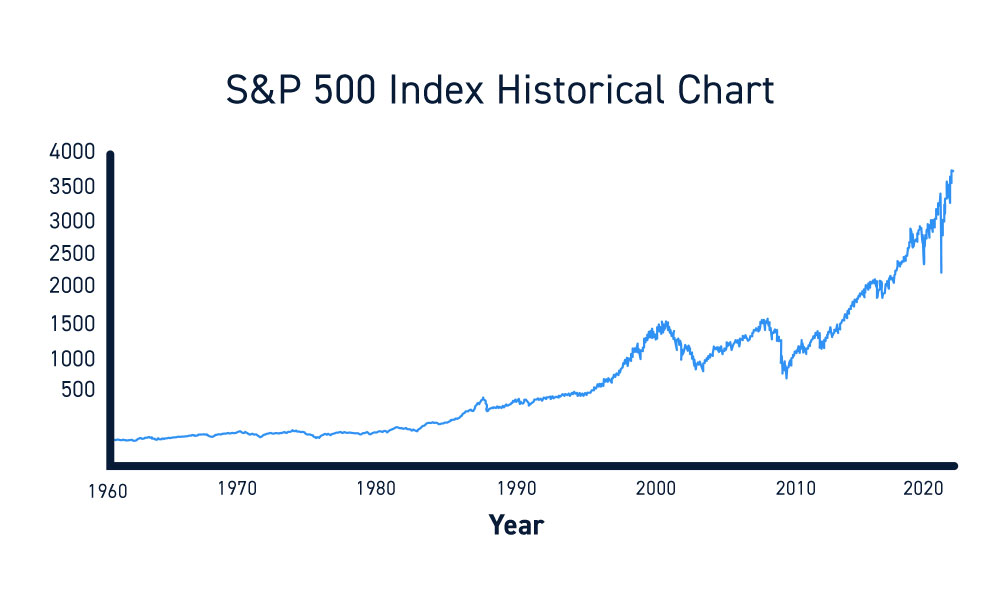
For the individual investor, the S&P 500 turns the power of compound interest into a wealth-generating machine. An investment of $10,000 into an S&P 500 index fund 30 years ago would be worth significantly more today, provided the dividends were reinvested. It represents a bet on American ingenuity and the continued growth of corporate productivity.
Comparison with the Dow and Nasdaq
To truly appreciate the S&P 500, one must compare it to its peers. The Dow Jones Industrial Average (DJIA) only tracks 30 companies and is “price-weighted,” meaning a higher stock price—regardless of the company’s actual size—gives a company more influence. This is often seen as an antiquated method. The Nasdaq Composite, on the other hand, is heavily tilted toward technology and growth stocks, making it more volatile. The S&P 500 sits in the “Goldilocks” zone: broad enough to be representative but large-cap enough to offer stability.
How to Invest in the S&P 500
You cannot “buy” the S&P 500 directly because it is an index (a mathematical concept). However, you can invest in funds that aim to replicate its performance. The rise of “passive investing” has made it easier and cheaper than ever to gain exposure to these 500 companies.
Index Funds vs. ETFs
There are two primary vehicles for S&P 500 investing: Mutual Funds and Exchange-Traded Funds (ETFs).
- ETFs: These are the most popular choice for modern investors. They trade on an exchange like a regular stock, meaning you can buy or sell them throughout the trading day. Popular examples include the SPDR S&P 500 ETF Trust (SPY), the iShares Core S&P 500 ETF (IVV), and the Vanguard S&P 500 ETF (VOO).
- Index Mutual Funds: These are typically used in 401(k) plans. They are priced only once at the end of the day. Vanguard’s S&P 500 Index Fund (VFIAX) is a classic example.
Low-Cost Investing and Expense Ratios
One of the most significant advantages of S&P 500 funds is their low cost. Because the fund simply follows a predetermined list of stocks, there is no need for expensive active managers or “stock pickers.” This results in extremely low expense ratios. For instance, some S&P 500 ETFs have expense ratios as low as 0.03%. This means for every $10,000 invested, you only pay $3 a year in fees. Keeping costs low is one of the most reliable ways to increase your net return over decades.
The Power of Dividend Reinvestment
Many companies within the S&P 500 pay dividends—a portion of their profits distributed to shareholders. While these payments might seem small individually, they are a critical component of total return. Most brokerage platforms allow for “DRIP” (Dividend Reinvestment Plan), which automatically uses your dividends to buy more shares of the fund. Over time, this increases your share count and accelerates the effects of compounding, especially during market downturns when your dividends are buying shares at “discounted” prices.
Risks and Considerations for the Modern Investor
No investment is without risk, and the S&P 500 is no exception. While it is safer than picking individual stocks, investors must remain aware of the macro forces that can impact their portfolios.
Concentration Risk and the “Magnificent Seven”
In recent years, the S&P 500 has become increasingly “top-heavy.” A small group of tech giants—often called the “Magnificent Seven” (Apple, Microsoft, Alphabet, Amazon, Nvidia, Meta, and Tesla)—now accounts for a significant percentage of the index’s total value. This creates concentration risk: if the tech sector experiences a systemic crash, the S&P 500 will drop significantly, even if the other 493 companies are performing well. Investors should be aware that when they buy the “500,” they are currently making a very large bet on the continued dominance of Silicon Valley.
Volatility and Market Cycles
The S&P 500 does not move in a straight line. It is subject to market cycles, including bull markets (rising prices) and bear markets (falling prices of 20% or more). Economic recessions, geopolitical tensions, and changes in consumer sentiment can lead to periods of high volatility. The key for the “Money-minded” investor is time horizon. The S&P 500 is an unsuitable vehicle for money you might need in six months, but it is historically one of the most reliable vehicles for money you won’t need for ten years.
Macroeconomic Factors
Finally, the index is sensitive to broader economic policy. Interest rate hikes by the Federal Reserve typically make borrowing more expensive for corporations, which can slow growth and hurt stock prices. Similarly, high inflation can erode corporate profit margins. Understanding that the S&P 500 is inextricably linked to the global economy is vital for maintaining a professional and realistic outlook on your investment journey.
Conclusion: The Cornerstone of a Modern Portfolio
The S&P 500 remains the most efficient way for the average person to participate in the growth of the global economy. It captures the innovation of tech leaders, the stability of consumer giants, and the resilience of the American financial system. By focusing on low-cost index funds, maintaining a long-term perspective, and understanding the underlying mechanics of market-cap weighting, you can utilize the S&P 500 as the foundational engine of your personal financial success. In the world of money, simplicity often beats complexity, and there is perhaps no simpler or more effective strategy than owning the 500 most influential companies in the world.
aViewFromTheCave is a participant in the Amazon Services LLC Associates Program, an affiliate advertising program designed to provide a means for sites to earn advertising fees by advertising and linking to Amazon.com. Amazon, the Amazon logo, AmazonSupply, and the AmazonSupply logo are trademarks of Amazon.com, Inc. or its affiliates. As an Amazon Associate we earn affiliate commissions from qualifying purchases.