
Navigating the landscape of retirement planning involves more than just accumulating assets; it requires a sophisticated understanding of how to draw down those assets in compliance with federal regulations. One of the most critical components of this drawdown phase is the Required Minimum Distribution (RMD). For many investors, the RMD represents the transition from the wealth-accumulation phase of life to the distribution phase, where the Internal Revenue Service (IRS) mandates that you begin withdrawing a portion of your tax-deferred savings. Understanding the nuances of RMDs is essential for maintaining tax efficiency and avoiding some of the most punitive penalties in the U.S. tax code.

Understanding the Fundamentals of Required Minimum Distributions (RMDs)
At its core, a Required Minimum Distribution is the minimum amount a retirement account owner must withdraw annually from their accounts once they reach a specific age. These rules apply to most employer-sponsored retirement plans—including 401(k), 403(b), and 457(b) plans—as well as Traditional IRAs, SEP IRAs, and SIMPLE IRAs. The fundamental purpose of the RMD is to ensure that individuals do not use these tax-advantaged accounts as permanent tax shelters or estate-planning tools to pass untaxed wealth to heirs indefinitely.
The Legal Basis for RMDs
The concept of the RMD is rooted in the “tax-deferred” nature of traditional retirement accounts. When you contribute to a Traditional IRA, you often receive a tax deduction in the year of the contribution, and the investments grow without being taxed annually on dividends or capital gains. However, this tax benefit is a deferral, not an exemption. The IRS mandates RMDs to ensure that the deferred taxes are eventually paid as the funds are distributed and treated as ordinary income.
Why the Government Mandates Distributions
The U.S. government provides tax incentives for retirement savings to encourage self-sufficiency in old age. However, the Treasury also requires revenue. By forcing a minimum distribution, the government guarantees that the tax-deferred “seed” and its subsequent growth are eventually brought into the taxable income stream of the account holder. This prevents the indefinite accumulation of wealth within a vehicle that bypasses the standard annual income tax system.
The Mechanics of RMD Calculation and Timing
Calculating an RMD is not a one-size-fits-all process. It depends on several factors, including the fair market value of the account, the age of the account holder, and the specific life expectancy tables provided by the IRS.
Determining Your Beginning Date
The “starting gun” for RMDs has moved in recent years due to significant legislative changes. Under the SECURE Act of 2019, the RMD age was raised from 70½ to 72. More recently, the SECURE 2.0 Act of 2022 further increased the age to 73, effective January 1, 2023. For individuals born in 1960 or later, the RMD age is slated to rise to 75.
Your first RMD must generally be taken by April 1 of the year following the year you reach the milestone age. For every year thereafter, the RMD must be taken by December 31. It is important to note that if you delay your first RMD until April 1, you will be required to take two distributions in that same tax year—one for the previous year and one for the current year—which could potentially push you into a higher tax bracket.
How to Calculate the Distribution Amount
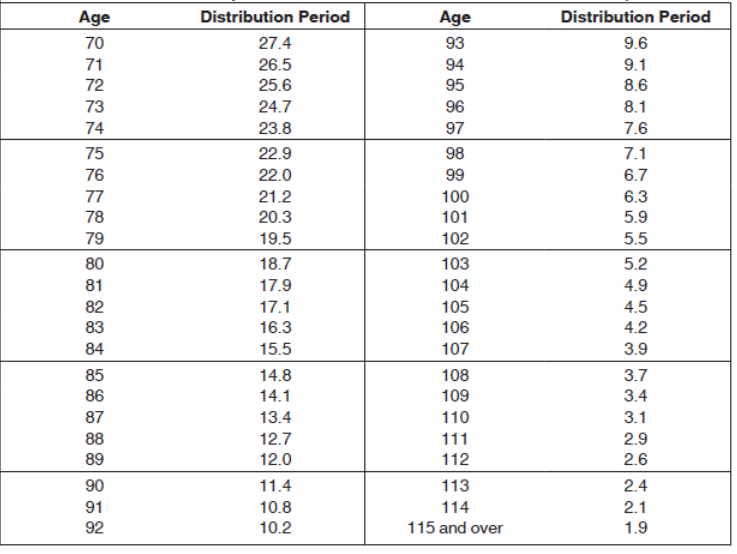
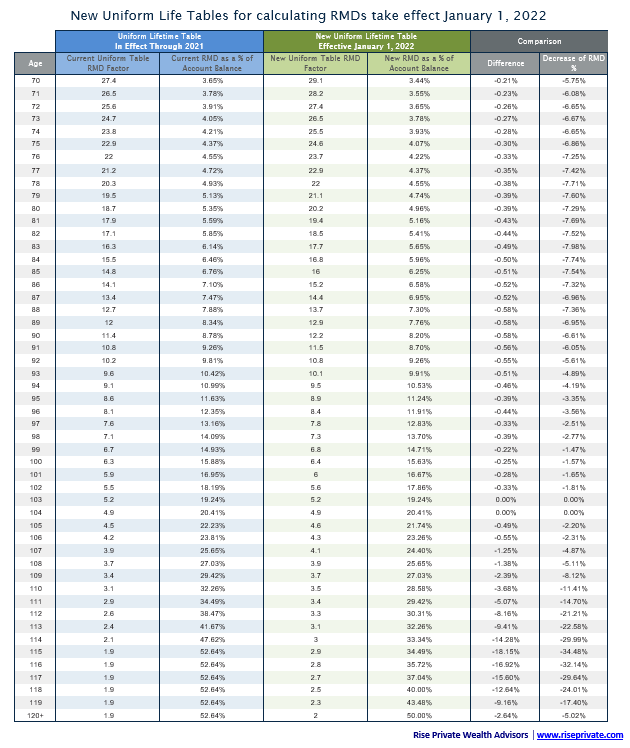
To determine the RMD for a specific year, you take the account balance as of December 31 of the previous year and divide it by a distribution period, or life expectancy factor. The IRS provides three primary tables for this purpose:
- The Uniform Lifetime Table: Used by most unmarried account owners, married owners whose spouses are not more than 10 years younger, and married owners whose spouses are not the sole beneficiaries.
- The Joint Life and Last Survivor Expectancy Table: Used if the sole beneficiary is a spouse who is more than 10 years younger than the account owner.
- The Single Life Expectancy Table: Primarily used for beneficiaries of inherited IRAs.
As you age, the distribution period decreases, which means the percentage of the account you must withdraw increases each year.
The Impact of SECURE Act 2.0 on RMD Ages
The SECURE 2.0 Act represents a significant shift in retirement policy, providing savers more time to allow their investments to grow tax-deferred. By pushing the RMD age to 73 and eventually 75, the legislation acknowledges increasing life expectancies and the reality that many individuals are working longer. This delay allows for additional years of compounding, which can significantly impact the longevity of a retirement portfolio.
Tax Consequences and Financial Planning Strategies
RMDs are generally taxed as ordinary income at your current federal income tax rate. If you have “basis” in your IRA—meaning you made non-deductible contributions—a portion of your RMD may be tax-free, calculated using IRS Form 8606. However, for most retirees, the entire distribution is taxable.
How RMDs Are Taxed and the “Tax Torpedo”
A common challenge for retirees is the “tax torpedo,” where RMDs increase the total provisional income, potentially triggering taxes on Social Security benefits. Furthermore, higher RMDs can lead to an increase in Medicare Part B and Part D premiums through the Income Related Monthly Adjustment Amount (IRMAA). Proper financial planning involves looking at the total picture: how an RMD affects your marginal tax bracket, your Social Security, and your healthcare costs.
Strategies to Minimize the Tax Bite
Sophisticated investors often use strategies to mitigate the impact of RMDs:
- Roth Conversions: By converting portions of a Traditional IRA to a Roth IRA before reaching RMD age, you pay taxes now at potentially lower rates to avoid mandatory distributions later. Roth IRAs (for the original owner) do not have RMD requirements.
- Qualified Longevity Annuity Contracts (QLACs): SECURE 2.0 allows individuals to invest up to $200,000 of their IRA balance into a QLAC. The amount invested in the QLAC is excluded from the RMD calculation, effectively deferring taxes on that portion until as late as age 85.
- Charitable Lead Trusts: While more complex, these can be used as part of a broader estate plan to offset the income generated by RMDs.
Qualified Charitable Distributions (QCDs)
One of the most effective tools for managing RMDs is the Qualified Charitable Distribution (QCD). If you are 70½ or older, you can direct up to $105,000 (indexed for inflation) per year directly from your IRA to a qualifying 501(c)(3) charity. This distribution counts toward your RMD for the year but is excluded from your adjusted gross income (AGI). This is often more tax-efficient than taking the RMD and then claiming a charitable deduction, as it keeps your AGI lower, potentially protecting you from IRMAA surcharges and Social Security taxation.
Penalties and Compliance: Navigating the Risks
The IRS takes RMD compliance very seriously. Historically, the penalty for failing to take an RMD was one of the most draconian in the tax code: 50% of the amount that should have been withdrawn but wasn’t.
The High Cost of Non-Compliance
Under the SECURE 2.0 Act, this penalty has been reduced to 25%. Furthermore, if the error is corrected in a timely manner (generally within two years), the penalty may be further reduced to 10%. Despite this reduction, a 10% or 25% penalty on a large distribution is still a significant financial loss that can derail a retirement plan.
Correcting Missed RMDs
If you realize you have missed an RMD, the best course of action is usually to withdraw the funds immediately and file IRS Form 5329. You can request a waiver of the penalty if the shortfall was due to “reasonable error” and you are taking reasonable steps to remedy the situation. Documenting the cause—such as a serious illness or a financial institution’s clerical error—is vital when requesting a waiver.
Planning for the Future: RMDs and Your Overall Estate
RMDs do not just affect your own financial life; they have profound implications for your heirs. The rules for “Inherited IRAs” were substantially changed by the original SECURE Act, which eliminated the “Stretch IRA” for most non-spouse beneficiaries.
Most non-spouse beneficiaries must now fully distribute the inherited IRA within 10 years of the original owner’s death. If the original owner was already taking RMDs, the beneficiary may also be required to take annual distributions during that 10-year period, depending on the current interpretation of IRS regulations. This can create a significant tax burden for heirs who may be in their peak earning years when they inherit the account.
Managing RMDs is a balancing act. While they represent a forced depletion of retirement assets, they are also a predictable part of a long-term financial strategy. By understanding the timing, the math, and the available tax-reduction strategies like QCDs and Roth conversions, you can maintain control over your financial legacy and ensure that your retirement savings serve your needs rather than simply creating an unnecessary tax burden. In the complex world of personal finance, proactive RMD planning is not just about compliance—it is about optimizing the wealth you have worked a lifetime to build.
aViewFromTheCave is a participant in the Amazon Services LLC Associates Program, an affiliate advertising program designed to provide a means for sites to earn advertising fees by advertising and linking to Amazon.com. Amazon, the Amazon logo, AmazonSupply, and the AmazonSupply logo are trademarks of Amazon.com, Inc. or its affiliates. As an Amazon Associate we earn affiliate commissions from qualifying purchases.