
In the vast and interconnected world of technology, from the simplest light bulb to the most complex supercomputer, two fundamental forces are always at play: voltage and current. These aren’t just abstract concepts for electrical engineers; they are the very lifeblood of every electronic device we interact with daily. Understanding their intricate relationship is not merely an academic exercise; it’s key to comprehending how technology works, how circuits are designed, and why some gadgets power up while others don’t.
At its core, the relationship between voltage and current dictates the behavior of electricity in a circuit. It’s a dance governed by physics, a partnership that, when understood, unlocks the secrets of power delivery, data transmission, and the efficiency of modern electronics. Without voltage, there is no push; without current, there is no flow. Together, they enable the incredible technological advancements that define our era, making them indispensable concepts for anyone delving into the heart of tech.
The Fundamental Forces of Electricity: Defining Voltage and Current
To truly grasp their relationship, we must first understand voltage and current individually, much like understanding the two sides of a dynamic partnership. They are distinct yet inseparable, each playing a crucial role in the movement of electrical energy.
Voltage: The Electrical Pressure
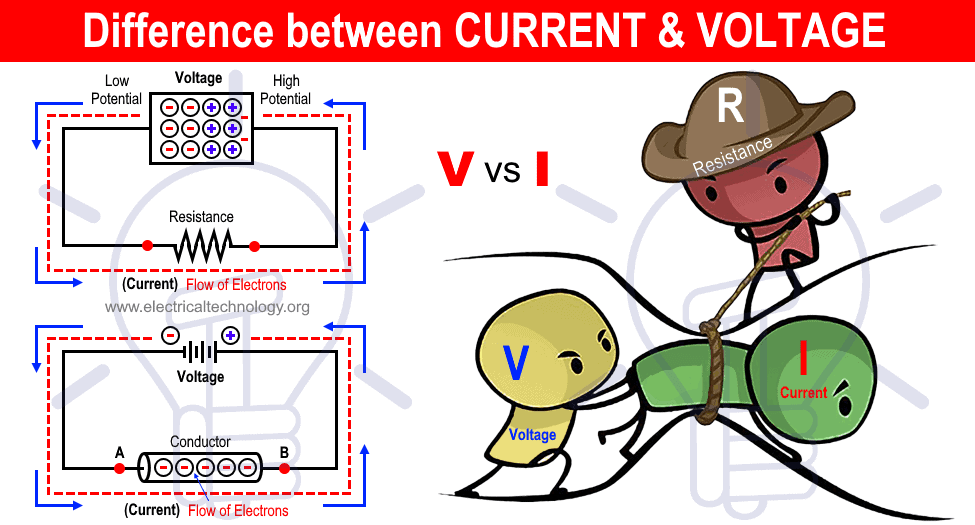
Imagine a water pipe. For water to flow, there must be a difference in pressure between two points in the pipe. Similarly, voltage, often referred to as electromotive force (EMF) or potential difference, is the “electrical pressure” or the “push” that drives electric charge through a circuit. It represents the potential energy difference per unit of charge between two points.
Think of it this way: electrons naturally want to move from an area of higher potential energy to an area of lower potential energy. Voltage is the measure of how much potential energy each unit of charge possesses to make that move. A higher voltage means a greater “push,” indicating more potential energy available to do work.
- Units: Voltage is measured in volts (V), named after the Italian physicist Alessandro Volta, who invented the voltaic pile (the precursor to the modern battery).
- Role: Voltage doesn’t flow; it exists between two points and causes current to flow. It’s the motive force behind all electrical activity.
In the context of technology, different components require specific voltages to operate correctly. A microprocessor might need 1.2V, while a USB port typically supplies 5V. Providing the wrong voltage can either prevent a device from working or, worse, destroy it.
Current: The Flow of Charge
If voltage is the pressure, then current is the actual “flow” of electric charge. It’s the rate at which electrons (or, conventionally, positive charge) move past a given point in a circuit. Going back to our water analogy, if voltage is the water pressure, then current is the volume of water flowing through the pipe per second.
Current is essentially the movement of charge carriers (usually electrons in metals) from one point to another. Without a voltage difference to provide the push, there would be no sustained flow of current.
- Units: Current is measured in amperes (A), often shortened to “amps,” named after the French physicist André-Marie Ampère. One ampere is defined as one coulomb of charge passing a point per second.
- Role: Current is what actually performs the work in a circuit, whether it’s lighting an LED, powering a motor, or processing data in a microchip.
From powering your smartphone to transmitting data through fiber optics, every technological marvel relies on the controlled flow of electric current. Too much current can generate excessive heat and damage components, while too little might not provide enough power for a device to function.
Ohm’s Law: The Cornerstone Relationship
The relationship between voltage and current is not arbitrary; it’s governed by a fundamental principle known as Ohm’s Law. This law, formulated by German physicist Georg Simon Ohm, provides the mathematical framework that ties voltage, current, and a third critical element—resistance—together.
Unpacking the Formula (V=IR)
Ohm’s Law states that the current flowing through a conductor between two points is directly proportional to the voltage across the two points and inversely proportional to the resistance between them. This relationship is elegantly expressed in the following formula:
V = I * R
Where:
- V = Voltage (measured in Volts)
- I = Current (measured in Amperes)
- R = Resistance (measured in Ohms)
Let’s break down the third variable: Resistance (R).
Resistance is the opposition to the flow of electric current. Every material offers some level of resistance to current flow. Conductors (like copper wires) have low resistance, allowing current to flow easily, while insulators (like rubber or plastic) have very high resistance, effectively blocking current.
- Units: Resistance is measured in ohms (Ω), symbolized by the Greek letter omega.
- Role: Resistance limits the amount of current that can flow for a given voltage. It’s the “narrowness” or “friction” in our water pipe analogy.
In practical tech applications, resistors are components specifically designed to introduce a known amount of resistance into a circuit, used for purposes like limiting current to sensitive components (e.g., LEDs), creating voltage dividers, or setting operating points for transistors.
Direct and Inverse Proportionality
Ohm’s Law beautifully illustrates the proportionalities at play:
- Voltage and Current (Directly Proportional): For a fixed resistance, if you increase the voltage, the current will increase proportionally. If you double the voltage across a resistor, you double the current through it. This makes intuitive sense: a greater electrical “push” will result in a greater “flow” if the path remains the same.
- Resistance and Current (Inversely Proportional): For a fixed voltage, if you increase the resistance, the current will decrease. If you double the resistance, the current will be halved. This also makes sense: a narrower or more resistive path will impede the flow, reducing the current even with the same electrical pressure.
Understanding these proportionalities is crucial for anyone working with electronics. It allows engineers to predict how a circuit will behave under different conditions, troubleshoot problems, and design systems that operate reliably and efficiently. From ensuring the correct current reaches a delicate integrated circuit to sizing wires for power transmission, Ohm’s Law is the bedrock of electrical design.

Beyond Ohm’s Law: Power and Energy in Electrical Systems
While Ohm’s Law defines the fundamental interaction between voltage, current, and resistance, it doesn’t tell the whole story of what electricity does. For that, we need to introduce the concepts of power and energy, which represent the work being done and the total work accumulated over time, respectively. These are vital for understanding the performance, efficiency, and consumption of any technological device.
Electrical Power (P=VI): The Workhorse
Electrical power is the rate at which electrical energy is converted from electrical form into another form, such as heat, light, or mechanical motion. It’s essentially how much “work” is being done by the electricity per unit of time.
The relationship between power, voltage, and current is given by another fundamental formula:
P = V * I
Where:
- P = Power (measured in Watts)
- V = Voltage (measured in Volts)
- I = Current (measured in Amperes)
This equation reveals that both voltage and current contribute to the power delivered. A high voltage across a component and a high current flowing through it will result in significant power dissipation or consumption.
- Units: Power is measured in watts (W), named after the Scottish inventor James Watt.
- Importance: Power is a crucial metric in technology. A CPU’s “TDP” (Thermal Design Power) indicates its maximum heat output in watts. The brightness of an LED is related to the power it consumes. The power rating on a charger tells you how quickly it can deliver energy to your device. Understanding power helps engineers manage heat dissipation, optimize battery life, and ensure components operate within their safe limits.
Electrical Energy: The Stored Potential
While power is the rate of energy conversion, electrical energy is the total amount of work done or the total amount of power consumed over a period of time. It’s the accumulated “cost” of running a device.
The relationship is straightforward:
Energy = Power * Time
- Units: The standard unit for energy is the joule (J). However, in practical applications, especially for billing electricity consumption, a more common unit is the kilowatt-hour (kWh), which represents the energy consumed by a 1-kilowatt device running for 1 hour.
- Importance: Electrical energy is what you pay for on your electricity bill. For portable devices, it determines battery life. A battery rated in milliampere-hours (mAh) essentially describes how much current it can supply for a certain duration, which, combined with its voltage, gives its total energy capacity.
When designing efficient gadgets or large-scale data centers, engineers meticulously manage both power consumption and total energy usage. Reducing power means a device runs cooler and drains less battery; optimizing energy usage leads to lower operating costs and a smaller environmental footprint.
Practical Applications and Real-World Implications in Technology
The theoretical relationships between voltage, current, resistance, and power aren’t confined to textbooks; they are the bedrock upon which all modern technology is built. From the smallest chip to the largest grid, these principles dictate design choices, operational efficiency, and safety.
Designing Circuits: Balancing V, I, R, and P
Every circuit designer lives by these fundamental laws. When selecting components for a printed circuit board (PCB), considerations include:
- Voltage Ratings: Ensuring components can withstand the applied voltage without breaking down.
- Current Ratings: Making sure components can handle the expected current without overheating or failing. For example, an LED requires a specific current (e.g., 20mA) to light up brightly without burning out, which is achieved by placing a resistor in series to limit the current based on the supply voltage.
- Resistance Values: Choosing appropriate resistors to control current flow, create specific voltage levels, or discharge capacitors.
- Power Dissipation: Calculating the power dissipated by components (especially resistors, transistors, and integrated circuits) to ensure they don’t overheat. Heat sinks are often used to manage power dissipation in high-power components.
Furthermore, safety devices like fuses and circuit breakers are designed based on current limits. A fuse contains a thin wire that melts and breaks the circuit if the current exceeds a safe threshold, preventing damage to the device or even fires.
Powering Our Gadgets: Adapters and Batteries
Take a look at any power adapter for a laptop, smartphone, or tablet. You’ll notice output specifications for both voltage (e.g., 5V, 9V, 12V, 19V) and current (e.g., 1A, 2.4A, 3A).
- Voltage Mismatch: Using an adapter with the wrong voltage for a device is risky. Too low, and the device might not power on or function correctly; too high, and it can fry the internal circuitry.
- Current Capacity: The current rating of an adapter indicates how much current it can supply. A device will draw only the current it needs (as determined by its internal resistance and the applied voltage). Using an adapter with a higher current rating than needed is generally safe (the device will only draw what it needs), but using one with too low a current rating might mean the adapter can’t deliver enough power, potentially overheating the adapter itself or failing to charge the device effectively.
Batteries are another excellent example. Their voltage (e.g., 3.7V for a typical Li-ion cell) provides the electrical push, and their capacity (e.g., 3000mAh for a phone battery) describes how much current they can supply over time. These specifications directly relate to how long your device will run on a single charge.
Emerging Technologies and Future Trends
The optimization of voltage and current is central to ongoing technological evolution:
- High-Voltage Power Transmission: For transmitting electricity over long distances, utility companies use very high voltages (e.g., hundreds of kilovolts). This is because for a given amount of power (P=VI), increasing voltage allows current to be reduced. Lower current means less energy loss due to resistance (P_loss = I²R) in the transmission lines, making the grid more efficient.
- Low-Power IoT Devices: The proliferation of Internet of Things (IoT) devices often relies on extremely low-power operation. Engineers design these devices to draw minimal current and operate at low voltages to maximize battery life, sometimes lasting years on a single coin cell. This requires sophisticated power management integrated circuits that precisely control voltage and current delivery to various components.
- Semiconductor Miniaturization: As transistors on microchips shrink to nanometer scales, managing voltage and current becomes incredibly challenging. Tiny variations can lead to performance issues or failures. Research into new materials and architectures is constantly pushing the boundaries of how effectively we can control these fundamental electrical properties at microscopic levels.
Conclusion
The relationship between voltage and current is not merely a dry subject confined to physics textbooks; it is the living language of all technology. From the initial spark of an idea to the complex dance of electrons within our most sophisticated gadgets, voltage provides the essential “push,” and current delivers the tangible “flow.” Ohm’s Law and the power formula (P=VI) offer the mathematical keys to understanding this dynamic, dictating how circuits are designed, how devices are powered, and how energy is conserved or consumed.
In an increasingly electrified and interconnected world, appreciating this fundamental relationship empowers us not just to understand the technology around us, but also to innovate, to build more efficient systems, and to navigate the complexities of power in our digital age. It is a timeless principle that will continue to underpin every technological leap, making its comprehension an indispensable tool for anyone engaged with the future of tech.
aViewFromTheCave is a participant in the Amazon Services LLC Associates Program, an affiliate advertising program designed to provide a means for sites to earn advertising fees by advertising and linking to Amazon.com. Amazon, the Amazon logo, AmazonSupply, and the AmazonSupply logo are trademarks of Amazon.com, Inc. or its affiliates. As an Amazon Associate we earn affiliate commissions from qualifying purchases.