
The drivetrain of an automobile is a complex assembly of mechanical components designed to deliver power from the engine to the wheels. While most drivers understand the basic concept of shifting gears and accelerating, the intricate engineering that allows a vehicle to turn corners smoothly is often overlooked. Central to this mechanical ballet is the rear differential. Understanding its function, mechanics, and maintenance is essential for any vehicle owner looking to grasp the fundamentals of automotive technology and performance engineering.
The Mechanical Foundation of the Rear Differential
At its core, the rear differential is a sophisticated gearbox located between the two rear wheels. Its primary purpose is to receive power from the engine via the driveshaft and distribute it to the wheels, all while allowing those wheels to rotate at different speeds. Without a differential, a vehicle would be nearly impossible to drive around a corner, as the outside wheel must travel a longer distance than the inside wheel during a turn.

Torque Distribution and Speed Variation
When a vehicle enters a turn, the outside wheel is forced to travel a wider arc, requiring more rotations than the inside wheel. If both wheels were locked to a single axle moving at the same speed, one tire would inevitably skip, drag, or lose traction, leading to significant tire wear and erratic handling. The differential solves this by utilizing a series of gears—the pinion, ring, and spider gears—that allow the wheels to “differentiate” their rotational speeds while still receiving equal amounts of torque under normal driving conditions.
Components of the Assembly
The rear differential housing acts as a protective shell, often filled with specialized gear oil to lubricate the moving parts. Inside, the pinion gear, connected to the driveshaft, meshes with the larger ring gear. The ring gear is attached to the differential carrier, which holds the spider gears. These spider gears are the true genius of the system; they can spin on their own axes to compensate for differences in wheel speed, effectively splitting the power delivered by the pinion gear to each axle shaft.
Types of Rear Differentials in Modern Vehicles
Not all differentials are created equal. Depending on the vehicle’s intended purpose—be it fuel-efficient commuting, high-performance track driving, or heavy-duty off-roading—manufacturers employ different designs to manage traction and power delivery.
Open Differentials
The open differential is the most common setup found in everyday passenger cars. It is simple, cost-effective, and perfectly suited for standard road use. In an open differential, the system always sends equal torque to both wheels. However, it suffers from a significant limitation: if one wheel loses traction—for example, on ice or loose gravel—the differential will send all the available power to the wheel with the least resistance. Consequently, the wheel on the slick surface spins uselessly, while the wheel with grip receives no power.
Limited-Slip Differentials (LSD)
Limited-slip differentials are a step up from the open variety, designed to bridge the gap between efficiency and performance. An LSD uses clutches or mechanical gear mechanisms to restrict the speed difference between the wheels. If one wheel begins to slip, the differential “limits” the amount of energy that can be sent to that wheel and redirects the torque back to the wheel with the most traction. This provides better handling in adverse weather and improved acceleration during spirited driving.
Locking Differentials
Popular among off-road enthusiasts, the locking differential allows the driver to manually or automatically “lock” the two wheels together. When locked, the differential acts as a solid axle, forcing both wheels to turn at exactly the same speed regardless of the terrain. This is invaluable when traversing deep mud, rock crawling, or navigating steep, uneven inclines where one wheel might be completely off the ground.
The Role of Differential Oil and Maintenance
Because the rear differential is a high-load, high-friction environment, it relies heavily on proper lubrication. The gears operate under immense pressure, and the heat generated during extended highway driving or towing can break down standard lubricants quickly.
The Importance of Gear Lubricant
Differential oil, often referred to as gear oil, is significantly thicker than standard engine oil. It is engineered with high-pressure additives to prevent metal-on-metal contact between the gear teeth. Over time, heat and microscopic metal shavings produced by normal wear contaminate this fluid, reducing its protective capabilities. Neglecting to change this oil can lead to gear pitting, excessive play in the drivetrain, and eventually, catastrophic failure of the differential assembly.
Signs of Differential Wear
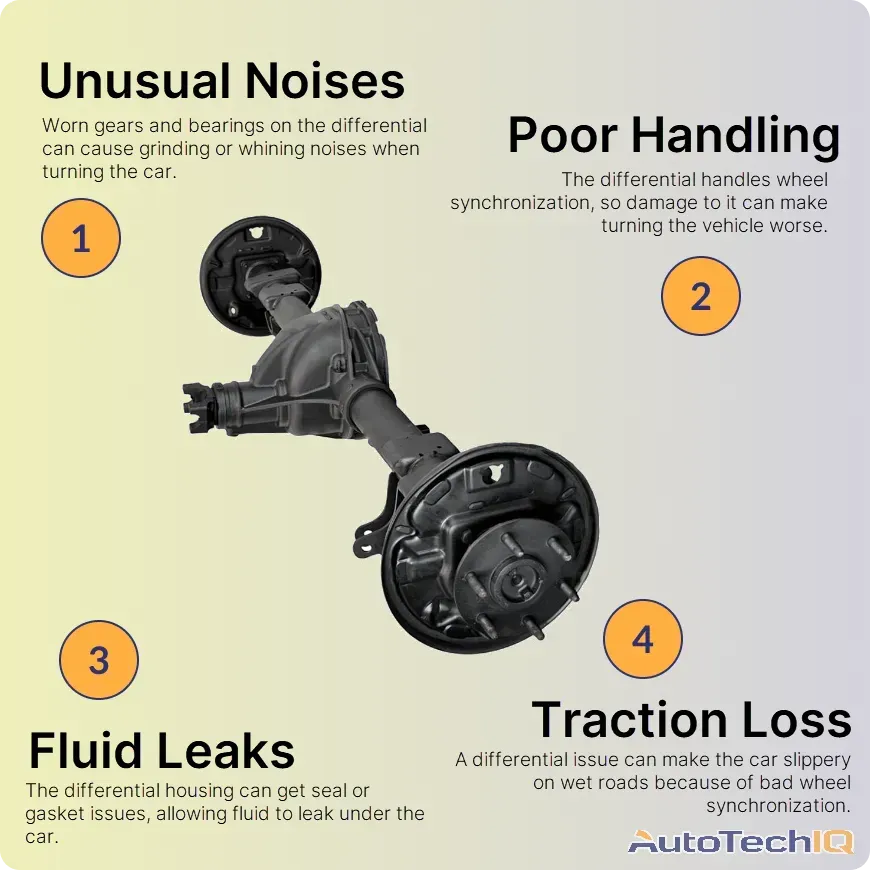
Vehicles often provide auditory cues when a differential is struggling. A common symptom is a “whine” or “hum” that changes in intensity depending on whether the driver is accelerating or coasting. This sound usually indicates worn bearings or improperly meshed gears. A loud “clunking” noise when shifting from park to drive or during initial acceleration may point to loose internal components or worn universal joints. Regular inspections by a qualified technician can identify these issues before they turn into costly mechanical breakdowns.
Impact on Vehicle Performance and Fuel Efficiency
The design of the rear differential directly influences the personality of the vehicle. Performance vehicles often utilize sophisticated electronic differentials (e-diffs) that integrate with stability control systems to adjust power delivery in milliseconds based on sensor data. This ensures that the car remains balanced and predictable even when approaching the limits of tire adhesion.
Drivetrain Drag and Parasitic Loss
From an engineering standpoint, the differential is a source of parasitic power loss. Because of the friction between the spinning gears and the churning oil, a small percentage of the engine’s horsepower is consumed just by rotating the differential components. Automotive engineers are constantly working to minimize this loss through improved gear cutting precision and the development of low-friction synthetic lubricants. For the consumer, this translates to better fuel economy and a smoother, more refined driving experience.

The Future of Differentials in EVs
The rise of electric vehicles (EVs) is transforming the role of the differential. Many modern EVs use individual electric motors for each wheel, effectively eliminating the need for a traditional mechanical differential. By using software to control the torque of each motor independently—a process known as torque vectoring—manufacturers can achieve performance levels that were once impossible with mechanical systems. While this shift marks a significant departure from century-old mechanical designs, the principles of distributing power for stability and traction remain the cornerstone of automotive motion control.
The rear differential is a silent workhorse. It operates largely unnoticed, yet it performs the essential duty of harmonizing power delivery with the physics of motion. Whether it is navigating a tight city corner or climbing a jagged mountain trail, the differential is the mediator between the engine’s raw output and the road’s unpredictable surface. By appreciating the complexity of this component, drivers gain a deeper understanding of the technology that powers their daily journeys and the importance of regular maintenance in ensuring long-term vehicle health.
aViewFromTheCave is a participant in the Amazon Services LLC Associates Program, an affiliate advertising program designed to provide a means for sites to earn advertising fees by advertising and linking to Amazon.com. Amazon, the Amazon logo, AmazonSupply, and the AmazonSupply logo are trademarks of Amazon.com, Inc. or its affiliates. As an Amazon Associate we earn affiliate commissions from qualifying purchases.