
The exchange rate between the Euro (EUR) and the United States Dollar (USD)—often referred to in trading circles as “The Fiber”—is the most heavily traded currency pair in the global foreign exchange market. Representing the world’s two largest economic blocs, this rate serves as a vital barometer for global economic health, investor sentiment, and geopolitical stability. Understanding what the rate is, how it is determined, and why it fluctuates is essential for investors, business owners, and international travelers alike.
At its core, the EUR/USD exchange rate tells you how many U.S. dollars are needed to purchase one Euro. If the rate is 1.10, it means one Euro is worth 1.10 Dollars. While the numerical value changes every second during market hours, the underlying forces driving those changes are a complex mix of monetary policy, inflation data, and international trade balances.

The Fundamental Drivers of the EUR/USD Exchange Rate
To understand the current rate, one must look at the push-and-pull dynamic between the European Central Bank (ECB) and the Federal Reserve (Fed). These two institutions hold the levers that control the supply and demand of their respective currencies.
Monetary Policy and Interest Rate Differentials
The most significant driver of the Euro-to-Dollar rate is the difference in interest rates between the Eurozone and the United States. Generally, capital flows toward the currency offering higher returns. If the Federal Reserve raises interest rates while the ECB remains stagnant, the U.S. Dollar typically strengthens because investors can earn a higher yield on U.S. Treasury bonds and other dollar-denominated assets. This increased demand for dollars drives the price of the Euro down relative to the greenback. Conversely, when the ECB adopts a “hawkish” stance—raising rates to combat inflation—the Euro tends to appreciate.
Inflation and Purchasing Power Parity
Inflation acts as a silent architect of exchange rates. According to the theory of Purchasing Power Parity (PPP), the exchange rate should eventually adjust so that a basket of goods costs the same in both regions. When inflation in the Eurozone is significantly higher than in the U.S., the purchasing power of the Euro erodes, leading to a natural depreciation of the currency. Markets watch the Consumer Price Index (CPI) and Harmonised Index of Consumer Prices (HICP) data releases with intense scrutiny, as these figures signal whether central banks will be forced to adjust their policy rates.
GDP Growth and Economic Resilience
The relative strength of the underlying economies also dictates the rate. If the U.S. economy is expanding rapidly with low unemployment, it attracts foreign direct investment, bolstering the Dollar. If the Eurozone, led by powerhouses like Germany and France, shows signs of stagnation or recession, investors often move their capital into the more resilient U.S. market. The “safe-haven” status of the U.S. Dollar also plays a role; during times of global uncertainty or conflict, the rate often drops (favoring the Dollar) as investors flee “riskier” assets in favor of the perceived security of the U.S. financial system.
Historical Context and the Significance of Parity
Looking back at the history of the EUR/USD provides a framework for understanding current fluctuations. Since its physical introduction in 2002, the Euro has seen dramatic swings against the Dollar, reflecting the changing tides of global finance.
From Launch to the Great Financial Crisis
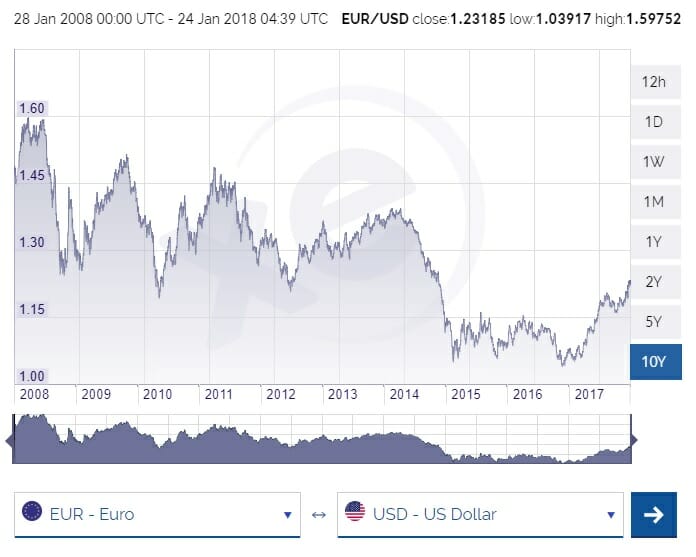
In its early days, the Euro was actually weaker than the Dollar, trading below the $1.00 mark. However, as the Eurozone solidified, the currency gained strength, reaching an all-time high of nearly $1.60 in July 2008. During this era, the Euro was viewed as a potential rival to the Dollar’s status as the world’s primary reserve currency.
The Phenomenon of Parity
One of the most significant psychological and economic milestones in the EUR/USD relationship is “parity”—the point where 1 Euro equals exactly 1 Dollar. For much of the decade following the 2008 crisis, the Euro maintained a comfortable lead over the Dollar. However, in 2022, the pair hit parity for the first time in twenty years. This shift was driven by a combination of the energy crisis in Europe following the invasion of Ukraine and the Federal Reserve’s aggressive interest rate hikes to combat post-pandemic inflation. When the rate drops to or below parity, it signals a profound shift in market confidence and has immediate repercussions for international trade.
The Role of Geopolitics in Rate Volatility
Europe’s geographical proximity to conflict zones and its historical reliance on imported energy make the Euro more susceptible to geopolitical shocks than the Dollar. Energy prices, specifically natural gas, are often priced in Dollars on international markets. When energy prices spike, Eurozone countries must sell Euros to buy Dollars to pay for their energy needs, creating a downward pressure on the Euro.
Tools and Strategies for Monitoring the Rate
For those managing personal finance or business operations, simply knowing the daily “spot rate” is not enough. Understanding how to track and analyze the rate is crucial for timing transactions.
Utilizing Real-Time Financial Platforms
The most accurate way to monitor the rate is through professional financial news outlets and trading platforms. Tools like Bloomberg, Reuters, and specialized Forex platforms provide “tick-by-tick” data. It is important to distinguish between the “mid-market rate”—the real-time rate used by banks to trade with each other—and the “retail rate” offered by consumer banks or currency exchange kiosks, which usually includes a significant markup or “spread.”
Technical Analysis vs. Fundamental Analysis
Traders use two primary methods to predict where the rate is headed:
- Fundamental Analysis: This involves tracking economic calendars, central bank speeches, and macroeconomic data (such as Non-Farm Payrolls in the U.S. or ZEW Sentiment in Germany).
- Technical Analysis: This focuses on price charts and historical patterns. Analysts look for “support” levels (prices where the Euro has historically stopped falling) and “resistance” levels (prices where it struggles to rise above). Indicators like Moving Averages and the Relative Strength Index (RSI) help identify whether a currency is “overbought” or “oversold.”
The Practical Impact on Personal and Business Finance
The rate of the Euro to the Dollar is not just a number on a screen; it has tangible effects on the wallets of individuals and the balance sheets of corporations.
Impacts on Travel and Tourism
For the individual traveler, the exchange rate dictates the cost of a vacation. A strong Dollar (a lower EUR/USD rate) makes a trip to Rome or Paris significantly cheaper for Americans, as their currency buys more coffee, hotel nights, and museum tickets. Conversely, when the Euro is strong, European travelers find their money goes much further in New York or Miami.
International Investing and Diversification
Investors with diversified portfolios must account for currency risk. If an American investor owns stocks in a German company, the value of that investment is dual-dependent: it depends on the company’s stock price and the EUR/USD exchange rate. If the Euro weakens against the Dollar, the investment may lose value in Dollar terms, even if the stock price remains the same. Understanding these fluctuations allows investors to use hedging strategies, such as currency futures or options, to protect their gains.
Corporate Profitability and Global Trade
For businesses, the exchange rate is a critical factor in competitiveness. A weak Euro makes European exports—such as luxury cars, machinery, and wine—cheaper and more attractive to American buyers. However, it also makes the raw materials that European companies import (which are often priced in Dollars) more expensive. Multi-national corporations often employ dedicated treasury teams to manage “FX exposure,” ensuring that a sudden swing in the Euro-to-Dollar rate doesn’t wipe out their quarterly profit margins.

Navigating Future Volatility
The rate of the Euro to the Dollar will remain a centerpiece of global finance as both regions navigate the challenges of the 21st century. As the world moves toward digital currencies and shifts away from traditional manufacturing toward AI-driven services, the factors influencing the EUR/USD pair will continue to evolve.
For the savvy financial observer, the key is to look beyond the daily fluctuations and understand the structural trends. Whether it is the ECB’s transition toward a “Digital Euro” or the U.S. government’s management of its national debt, every major policy shift will eventually reflect in the exchange rate. By staying informed on interest rate trajectories and economic indicators, one can better anticipate the movements of the world’s most important currency pair, turning market volatility into a manageable aspect of a broader financial strategy.
aViewFromTheCave is a participant in the Amazon Services LLC Associates Program, an affiliate advertising program designed to provide a means for sites to earn advertising fees by advertising and linking to Amazon.com. Amazon, the Amazon logo, AmazonSupply, and the AmazonSupply logo are trademarks of Amazon.com, Inc. or its affiliates. As an Amazon Associate we earn affiliate commissions from qualifying purchases.