
In the vast and intricate world of database management systems, where information is meticulously organized, stored, and retrieved, certain concepts stand as foundational pillars. Among these, the “primary key” reigns supreme as a cornerstone of data integrity, relational modeling, and efficient data handling. Far from being a mere technical term, the primary key is the lynchpin that ensures the uniqueness, reliability, and interconnectivity of data, making it an indispensable element in the design and functionality of virtually every modern software application and digital service.
At its core, a primary key is a special relational database table column, or a set of columns, that uniquely identifies each record (or row) in that table. Imagine a library where every book has a unique identification number; that number allows you to distinguish one book from all others, even if they have the same title or author. In a database, the primary key serves precisely this purpose, providing an unwavering point of reference for every piece of information stored. Without a primary key, a database would descend into chaos, rife with ambiguity, redundancy, and inconsistencies that would render the data virtually unusable. This article delves into the critical role, characteristics, types, and best practices surrounding the primary key, illuminating its profound impact on the robustness and efficiency of technology systems.
The Fundamental Role of Primary Keys in Database Systems
The significance of primary keys extends far beyond simple identification. They are instrumental in maintaining the structural integrity of a database, facilitating efficient operations, and underpinning the very nature of relational databases.
Ensuring Data Uniqueness
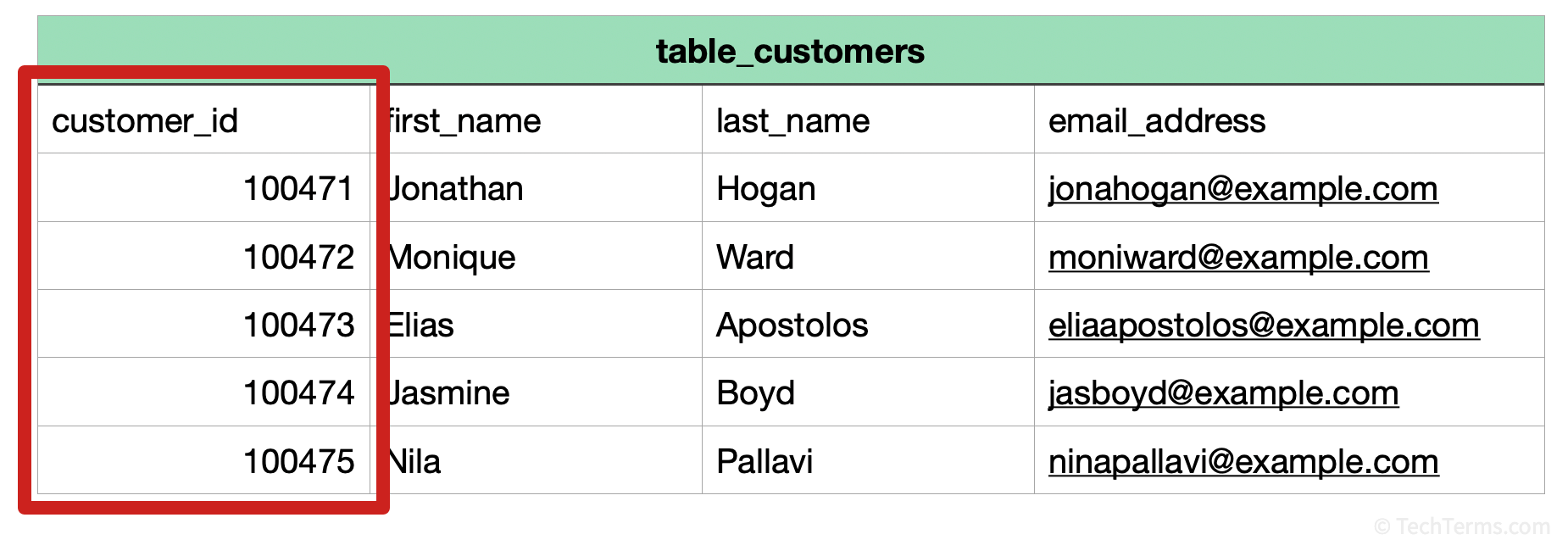
The most intuitive and crucial role of a primary key is to guarantee that every single record within a table is uniquely identifiable. This means that no two rows can ever have the same primary key value. For example, in a Customers table, a customer_id column designated as a primary key ensures that each customer entry is distinct. Even if two customers share the same name or address, their unique customer_id will differentiate them unequivocally. This uniqueness constraint is vital for preventing duplicate records, which could lead to inaccurate data analysis, faulty transactions, and general data pollution. In an era where data-driven decisions are paramount, maintaining a clean and unique dataset is non-negotiable, and primary keys are the frontline defense against data redundancy.
Maintaining Data Integrity
Data integrity refers to the overall completeness, accuracy, and consistency of data. Primary keys play a pivotal role in upholding these standards. By enforcing uniqueness and requiring a non-null value (as we’ll discuss later), primary keys prevent malformed or ambiguous data from entering the system. This not only keeps the data reliable for internal operations but also ensures that any reports, analytics, or external systems relying on this data receive consistent and trustworthy information. For instance, if a primary key were allowed to be null or contain duplicates, a query asking for a specific record might return multiple ambiguous results or fail to find a record at all, compromising the integrity of the data interaction. This fundamental guarantee underpins trust in the data, which is critical for everything from financial transactions to scientific research.
Facilitating Efficient Data Retrieval
Beyond their role in data integrity, primary keys are also critical for optimizing database performance, particularly in data retrieval operations. Modern database management systems (DBMS) automatically create an index on primary key columns. An index is a special lookup table that the database search engine can use to speed up data retrieval. Instead of scanning the entire table row by row (a full table scan), which becomes incredibly slow for large datasets, the DBMS can quickly locate specific records by traversing the primary key index.
Consider a phone book: if it wasn’t organized alphabetically by name, finding a specific person would require reading every single entry. An index on a primary key is akin to organizing the phone book, allowing the DBMS to jump directly to the desired record. This efficiency is paramount for applications that frequently query individual records or join multiple tables together, ensuring snappy response times and a smooth user experience, which are essential for high-performance software and scalable systems.
Characteristics and Constraints of a Primary Key
To effectively fulfill its roles, a primary key must adhere to several strict characteristics and constraints that define its behavior within a database. Understanding these is crucial for proper database design.
Uniqueness Constraint
As previously highlighted, the uniqueness constraint is the defining characteristic of a primary key. Every value in the primary key column(s) must be unique across all rows in the table. This is automatically enforced by the DBMS. If an attempt is made to insert a new row with a primary key value that already exists, the database will reject the operation, typically issuing an error. This robust enforcement ensures that each record remains distinctly identifiable at all times.
Not Null Constraint
Another critical constraint is that a primary key column cannot contain NULL values. This is often referred to as entity integrity. If a primary key could be NULL, it would violate the very purpose of unique identification, as a NULL value signifies an unknown or missing value, making the record unidentifiable. Every record must have a definite primary key value assigned to it, ensuring that no record is left without an identifier, and therefore, every record is addressable. This strict rule is fundamental to preventing ambiguity and maintaining the integrity of data relationships.
Immutability (Generally)
While not a hard-coded constraint enforced by all DBMS, a primary key should ideally remain immutable once it has been assigned to a record. Changing a primary key value can be a complex and resource-intensive operation, particularly if that primary key is referenced by foreign keys in other tables (as part of relational integrity). Such changes necessitate cascading updates across all related tables, which can introduce performance overhead and potential for errors if not handled meticulously. Therefore, a good practice in database design is to select primary keys that are stable and unlikely to change over the lifespan of the data they represent, thus promoting data consistency and reducing system complexity.
Simplicity and Irreducibility
A well-designed primary key should be simple and irreducible. Simplicity means it should be as concise as possible, often a single column if sufficient for uniqueness. Irreducibility means that no column can be removed from a composite primary key without losing its uniqueness property. For example, if a (first_name, last_name, date_of_birth) composite key is used to identify a person, but (first_name, last_name) alone could uniquely identify them, then the former is not irreducible. Simple, irreducible keys are easier to manage, take up less storage space, and are more efficient for indexing and foreign key relationships.
Types of Primary Keys
Database designers typically choose between different approaches when selecting or creating primary keys, each with its own advantages and disadvantages.
Natural Keys
A natural key is a primary key composed of one or more existing attributes that inherently identify a record. These are real-world attributes that are part of the business domain. Examples include a Social Security Number (SSN) for a person, an ISBN for a book, a Vehicle Identification Number (VIN) for a car, or an email address for a user (if uniqueness is strictly enforced and guaranteed).
Pros:
- They carry inherent meaning and are often familiar to users.
- They avoid the need for an additional, artificial identifier column.
Cons:
- Natural keys can sometimes be long or complex (e.g., a combination of multiple columns).
- They might be subject to change over time (e.g., a person’s name, or even an email address). If a natural key changes, it can be problematic due to the immutability preference.
- They may not always guarantee absolute uniqueness in all contexts or might contain business logic that could change.
- Privacy concerns (e.g., using SSN).
Surrogate Keys
A surrogate key (also known as an artificial key, system-generated key, or auto-incrementing key) is an artificially generated identifier that has no intrinsic meaning related to the business data it identifies. These are typically simple integer values that are incremented automatically by the database system (e.g., AUTO_INCREMENT in MySQL, IDENTITY in SQL Server, SERIAL in PostgreSQL, sequences in Oracle) or globally unique identifiers (GUIDs/UUIDs).

Pros:
- Simplicity and Stability: They are typically small (integers), never change, and are entirely independent of business logic. This makes them ideal for primary keys.
- Guaranteed Uniqueness: The database system ensures their uniqueness automatically.
- Privacy: They don’t expose sensitive business data or personal information.
- Performance: Being small and simple, they are highly efficient for indexing and joining operations.
Cons:
- They have no business meaning, so users cannot infer information directly from the key.
- Can obscure data context in some raw data views.
- GUIDs are larger and less human-readable than integers, potentially impacting performance slightly in comparison to simple integer keys, though they excel in distributed systems.
For most modern database designs, surrogate keys are the preferred choice due to their stability, simplicity, and performance benefits, especially in complex relational models where business rules might evolve.
Composite Keys
A composite key is a primary key that consists of two or more columns whose values, when combined, uniquely identify each record in a table. No single column in a composite key is sufficient to guarantee uniqueness on its own. For example, in a Order_Items table, you might have (order_id, product_id) as a composite primary key, because an order_id alone isn’t unique for an item (an order can have many items), and a product_id alone isn’t unique (many orders can contain the same product). But the combination (order_id, product_id) uniquely identifies a specific product within a specific order. Composite keys are often found in “junction” or “many-to-many” relationship tables.
Pros:
- Naturally fits the data model in certain scenarios, especially for relational tables.
- Can sometimes act as a natural key.
Cons:
- More complex to manage and query than single-column keys.
- Can be larger, potentially affecting indexing and join performance if not well-designed.
Primary Keys vs. Other Key Types
While the primary key is paramount, it’s crucial to understand its relationship and differentiation from other types of keys in a relational database.
Candidate Keys
A candidate key is any column or set of columns that can uniquely identify a row in a table. All candidate keys must satisfy the uniqueness and non-null constraints. From the set of all candidate keys, one is chosen to be the primary key. For example, in a Users table, both user_id (a surrogate key) and email_address (if unique and non-null) could be candidate keys. The database designer then selects one of these as the primary key, typically the one that is most stable and efficient.
Unique Keys
A unique key (or unique constraint) is similar to a primary key in that it ensures all values in a column or set of columns are unique. However, there are a few key differences:
- Nulls: A primary key cannot contain NULL values, whereas a unique key can typically contain one NULL value (though this can vary slightly by DBMS implementation).
- Number per Table: A table can have only one primary key, but it can have multiple unique keys.
- Indexing: Both primary keys and unique keys are typically indexed for performance, but the primary key is the default and often the clustered index (physical storage order) in some DBMS.
Unique keys are useful for ensuring uniqueness on other important attributes that aren’t chosen as the primary identifier, such as email_address or username in a Users table.
Foreign Keys
A foreign key is a column or set of columns in one table that refers to the primary key (or a unique key) in another table. Foreign keys establish and enforce a link between the data in two tables, ensuring referential integrity. For example, in an Orders table, the customer_id column might be a foreign key that references the customer_id primary key in the Customers table. This link ensures that an order can only be placed by an existing customer and that if a customer record is deleted, related orders can be handled (e.g., deleted, set to null, or prevented from deletion) according to defined referential actions. Foreign keys are the mechanism through which relational databases maintain relationships and consistency across their schema.
Best Practices for Primary Key Design
Effective primary key design is a critical aspect of building robust, scalable, and maintainable database systems. Adhering to best practices can prevent numerous issues down the line.
Choose Stable and Unique Identifiers
Always select a primary key that is guaranteed to be unique for every record and is unlikely to change over time. Stability is paramount; a key that changes requires complex cascading updates and can introduce errors.
Prefer Surrogate Keys for Most Tables
For the vast majority of tables, especially transactional or master data tables, surrogate keys (like auto-incrementing integers or UUIDs) are the preferred choice. They offer simplicity, stability, performance, and independence from business logic, making them highly resilient to business rule changes.
Keep Them Simple and Short
Shorter, simpler primary keys (e.g., an integer) are more efficient. They consume less storage space, are faster to index, and improve the performance of joins and foreign key lookups. While GUIDs are effective for distributed systems, integer keys are often more performant in single-instance databases.
Avoid Using Business-Dependent Attributes if Prone to Change
Resist the temptation to use natural keys that might change, such as names, addresses, or even some product codes. If a business rule changes, and that attribute is your primary key, you face a significant data migration and consistency challenge. If a natural key is stable and guaranteed unique (e.g., an ISBN for published books), it can be considered, but carefully weigh the risks.
Consider Performance Implications (Indexing)
Understand that the DBMS will typically index the primary key. This is a performance benefit, but complex primary keys (e.g., large composite keys or long string keys) can make these indexes larger and potentially slower to traverse than simple integer indexes. Design with performance in mind.

Conclusion
The primary key is not merely a technical detail; it is a foundational concept underpinning the entire edifice of relational database management systems. Its core function of uniquely identifying records is expanded by its critical roles in ensuring data integrity, maintaining referential consistency across tables via foreign keys, and significantly boosting query performance through indexing. From preventing data duplication to enabling complex data relationships, the primary key is indispensable for the creation of reliable, efficient, and scalable software applications.
Whether opting for the stability of surrogate keys or judiciously employing natural or composite keys, careful consideration of primary key design is a hallmark of good database architecture. By adhering to established best practices and understanding the nuances of different key types, developers and database administrators can lay a robust groundwork for data storage that truly empowers the technology systems that depend on it. In an increasingly data-centric world, mastering the concept and application of the primary key remains an essential skill for anyone involved in building and maintaining digital infrastructure.
aViewFromTheCave is a participant in the Amazon Services LLC Associates Program, an affiliate advertising program designed to provide a means for sites to earn advertising fees by advertising and linking to Amazon.com. Amazon, the Amazon logo, AmazonSupply, and the AmazonSupply logo are trademarks of Amazon.com, Inc. or its affiliates. As an Amazon Associate we earn affiliate commissions from qualifying purchases.