
For decades, Intel Corporation (NASDAQ: INTC) stood as the undisputed titan of the semiconductor industry, a bellwether for the broader technology sector and a staple in many long-term investment portfolios. However, the current price of Intel stock reflects a company in the midst of a historic transformation. To understand the price of Intel today is to understand the intersection of complex manufacturing turnarounds, geopolitical shifts in supply chains, and the relentless evolution of artificial intelligence. For investors, the question of Intel’s value is no longer just about its quarterly earnings per share, but about its ability to execute one of the most ambitious corporate pivots in modern financial history.
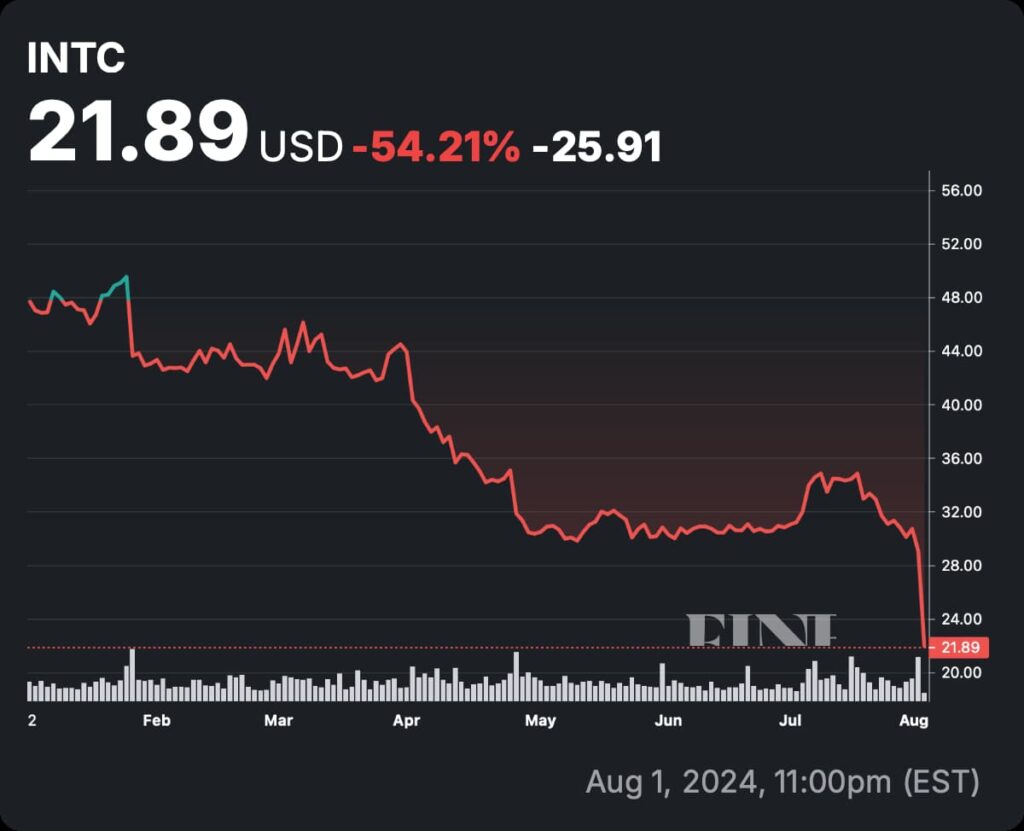
Understanding Intel’s Current Market Valuation
The market capitalization of Intel has experienced significant volatility over the last several years, diverging sharply from the meteoric rises seen by competitors like NVIDIA and AMD. To evaluate the price of Intel stock effectively, investors must look beyond the daily ticker symbol and analyze the underlying valuation metrics that dictate its movement. Historically, Intel was valued as a high-margin cash cow; today, the market treats it more like a high-stakes turnaround play.
Price-to-Earnings and Fundamental Metrics
When assessing the price of Intel stock, the Price-to-Earnings (P/E) ratio often presents a skewed picture due to the company’s massive capital expenditure (CapEx) requirements. As Intel invests billions into new fabrication plants (fabs) across the United States and Europe, its net income has been pressured, often leading to elevated or inconsistent P/E ratios. Investors are increasingly looking at Price-to-Book (P/B) and Enterprise Value-to-Sales (EV/Sales) to gauge whether the stock is undervalued relative to its physical assets and market reach.
Historical Price Context and Cyclicality
Semiconductor stocks are notoriously cyclical, sensitive to both the global macroeconomic environment and the specific “silicon cycle.” Intel’s price has historically tracked the demand for personal computers (PCs) and data center infrastructure. However, the current price reflects a decoupling from historical norms as the company navigates a transition from a “fab-less” heavy market toward a dual-threat model of designing and manufacturing chips. This transition has led to a period of price consolidation as the market waits for proof of execution.
The Impact of Dividend Policy on Stock Price
For years, Intel was a darling of dividend growth investors. However, the recent reduction in its dividend payout was a pivotal moment for the stock price. While the cut was necessary to preserve capital for the “IDM 2.0” strategy, it led to an immediate repricing as income-focused institutional investors exited their positions. The current stock price now reflects a leaner, more growth-oriented focus, where capital appreciation has replaced quarterly yield as the primary driver of investor interest.
Key Drivers Influencing the Price of Intel Stock
The price of any equity is a reflection of future expected cash flows, discounted back to the present. For Intel, these cash flows are tied to several high-stakes strategic initiatives. Understanding these drivers is essential for any investor trying to determine if the current price represents a “value trap” or a generational buying opportunity.
The IDM 2.0 Strategy and Foundry Services
The most significant driver of Intel’s stock price is the success of its Integrated Device Manufacturing (IDM) 2.0 model. Under CEO Pat Gelsinger, Intel is not only manufacturing its own chips but also opening its factories to outside customers—competing directly with Taiwan Semiconductor Manufacturing Company (TSMC). The market is currently pricing in a high degree of skepticism regarding this transition. If Intel can successfully secure major external “foundry” customers, the potential for a massive upward revision in the stock price is substantial, as foundry businesses often command higher valuation multiples due to their recurring nature and high barriers to entry.
The “Five Nodes in Four Years” Roadmap
In the semiconductor world, technical leadership translates directly to pricing power and profit margins. Intel’s ambitious goal to achieve five process nodes in four years is a critical benchmark for the stock. Each successful milestone reached—such as the transition to Intel 18A—acts as a catalyst for the share price. Conversely, any delay in this roadmap has historically led to sharp sell-offs, as it signals that Intel is falling further behind its competitors in the race for transistor density and energy efficiency.
Government Subsidies and the CHIPS Act
Geopolitics now plays a fundamental role in Intel’s financial health. The U.S. CHIPS and Science Act, along with similar initiatives in the European Union, provides Intel with billions of dollars in grants and tax credits. These inflows are crucial because they offset the staggering costs of building modern semiconductor facilities. The market monitors these announcements closely; every billion dollars in government backing effectively de-risks Intel’s balance sheet, providing a floor for the stock price during periods of market uncertainty.
Fundamental Analysis: Financial Performance and Revenue Streams

To determine if the price of Intel stock is “fair,” one must dissect the company’s revenue segments. Intel is no longer a monolithic entity; it is a conglomerate of businesses with varying growth profiles and margin structures.
The Client Computing Group (CCG)
Despite the focus on AI and foundries, the Client Computing Group remains Intel’s primary engine of cash flow. This segment, which includes processors for laptops and desktops, dictates the company’s short-term liquidity. When PC demand surged during the transition to remote work, Intel’s stock saw support. As the market enters the “AI PC” era, the ability of the CCG to command premium pricing for new NPU-integrated (Neural Processing Unit) chips will be a major factor in whether the stock can break out of its current trading range.
Data Center and AI (DCAI)
This is perhaps the most scrutinized segment of Intel’s financial reports. While NVIDIA has dominated the AI training market, Intel is fighting for a share of the AI inference and CPU-based data center market. The price of Intel stock is heavily sensitive to the adoption rates of its Gaudi AI accelerators and Xeon processors. Investors are looking for signs that Intel can reclaim market share from AMD and prevent further erosion of its margins in the lucrative enterprise server space.
Gross Margin Pressure and Capital Allocation
One of the most important figures for Intel investors is the adjusted gross margin. Historically, Intel enjoyed margins north of 60%. As the company invests in new technology and handles the lower yields associated with new manufacturing processes, these margins have compressed. A rising stock price will likely require a clear trajectory back toward the 50-60% margin range, signaling that the company’s manufacturing “flywheel” is once again spinning efficiently.
Risk Factors and Market Sentiment
No analysis of Intel’s stock price is complete without a rigorous look at the risks that could lead to further devaluation. Investing in Intel at its current price involves betting against several prevailing market trends.
Competitive Pressures and Market Share Erosion
Intel faces a “two-front war.” In the design space, it is being challenged by AMD’s high-performance Ryzen and EPYC processors and the rise of ARM-based architecture in both laptops (Apple Silicon) and data centers (Amazon’s Graviton). In the manufacturing space, it must prove it can match the reliability and scale of TSMC. If Intel fails to stem the tide of market share loss, the stock price could face a “death by a thousand cuts,” where even good news is overshadowed by a shrinking total addressable market.
Execution Risk in Advanced Manufacturing
Building a semiconductor fab is one of the most complex engineering feats on the planet. Any delays in equipment delivery (such as High-NA EUV machines from ASML) or labor shortages can lead to multi-billion dollar write-downs. The market currently applies an “execution discount” to the price of Intel stock, meaning the shares trade lower than they might otherwise because investors are waiting to see if Intel can actually deliver on its promises.
Macroeconomic and Interest Rate Sensitivity
As a capital-intensive business, Intel is sensitive to interest rates. Higher rates increase the cost of the debt used to fund its expansion. Additionally, a global recession would dampen demand for consumer electronics and enterprise IT spending, hitting Intel’s core revenue streams. The stock price often moves in tandem with broader economic indicators, making it a higher-beta play than more software-centric tech stocks.

Long-Term Investment Outlook: Value Play or Value Trap?
The current price of Intel stock places it in a unique category. It is a “turnaround story” with the scale of a Fortune 100 company. For the patient investor, the investment thesis rests on the “foundry of the West” concept. In a world where supply chain resilience and domestic production are paramount, Intel is the only Western company capable of manufacturing at the leading edge.
If Intel succeeds, the stock is currently trading at a fraction of its future potential value. The eventual spin-off or IPO of various business units (like the successful Altera or Mobileye moves) could also unlock shareholder value. However, the path to that valuation is fraught with technical hurdles and intense competition.
In conclusion, the price of Intel stock today is a reflection of a company in a cocoon stage. It has shed its old identity as a dominant, high-margin monopoly but has not yet fully emerged as a diversified foundry and AI competitor. For those analyzing the “Money” aspect of Intel, the focus should remain on three things: the stability of CCG cash flows, the progress of the 18A manufacturing node, and the ability to maintain a healthy balance sheet through the most expensive transformation in the company’s history. Only by tracking these variables can an investor determine if Intel’s current price represents an entry point for a long-term recovery or a reflection of a giant that has passed its prime.
aViewFromTheCave is a participant in the Amazon Services LLC Associates Program, an affiliate advertising program designed to provide a means for sites to earn advertising fees by advertising and linking to Amazon.com. Amazon, the Amazon logo, AmazonSupply, and the AmazonSupply logo are trademarks of Amazon.com, Inc. or its affiliates. As an Amazon Associate we earn affiliate commissions from qualifying purchases.