
In the world of industrial and commercial electrical systems, efficiency is not merely a goal; it is a financial imperative. Every facility manager, plant operator, and business owner understands that electricity is a significant operating expense. However, many remain unaware of a hidden drain on their budget: the inefficient use of power caused by a low power factor. Power Factor Correction (PFC) is the engineering solution designed to optimize electrical consumption, reduce utility penalties, and extend the lifespan of infrastructure. By understanding the mechanics of PFC, businesses can transform wasted energy into tangible bottom-line savings.

Understanding the Physics of Electrical Efficiency
To grasp power factor correction, one must first distinguish between the two types of power present in an Alternating Current (AC) circuit: Active Power and Reactive Power.
Active Power vs. Reactive Power
Active Power (measured in kilowatts, kW) is the “workhorse” of the system. It is the energy that actually performs the useful task—turning a motor, lighting a lamp, or heating a resistor. Reactive Power (measured in kilovolt-amperes reactive, kVAR), on the other hand, does not perform useful work. It is required by inductive loads—such as electric motors, transformers, and fluorescent lighting ballasts—to create the magnetic fields necessary for their operation.
Apparent Power (measured in kVA) is the combination of these two. The Power Factor (PF) is the ratio of Active Power to Apparent Power. A PF of 1.0 (unity) means all electricity consumed is being converted into useful work. A PF of less than 1.0 indicates that a portion of the current is being “wasted” in the form of reactive power oscillating back and forth between the source and the load.
The Consequences of Low Power Factor
When a facility operates with a low power factor, the electrical distribution system—including transformers, switchgear, and cables—is forced to carry more current than is strictly necessary to do the useful work. This leads to several issues:
- Higher Energy Bills: Many utility companies impose “power factor penalties” on industrial users whose PF falls below a certain threshold (usually 0.90 or 0.95), reflecting the burden placed on the grid.
- Voltage Drop: Excessive current flow can cause voltage drops across the system, leading to flickering lights or the malfunctioning of sensitive electronic equipment.
- Overloaded Infrastructure: Cables and transformers reach their thermal limits faster, forcing unnecessary upgrades or shortening the operational lifespan of the equipment due to heat stress.
Implementing Power Factor Correction Systems
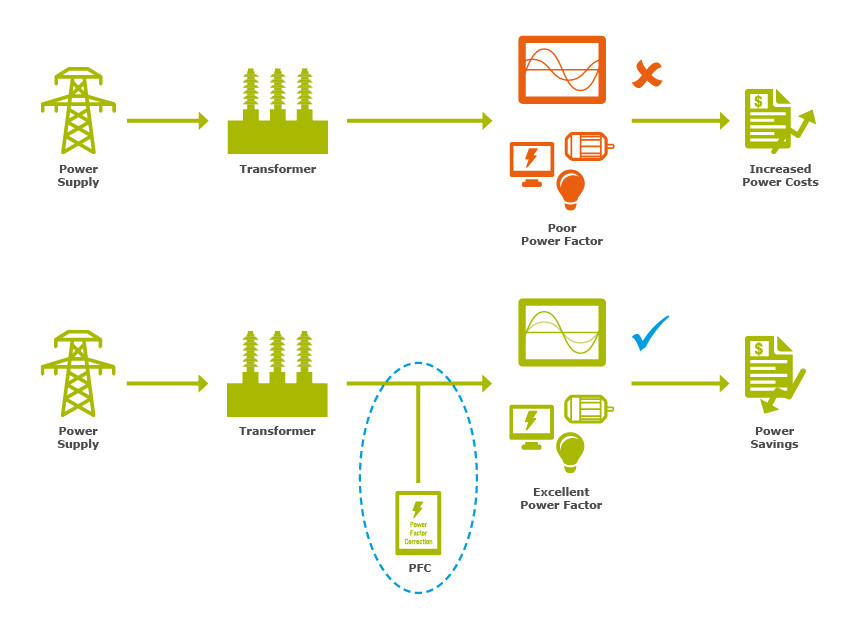
Power Factor Correction is the process of compensating for reactive power by installing specialized equipment. The most common method involves the introduction of capacitors, which act as a reservoir for reactive energy.
Capacitor Banks: The Standard Solution
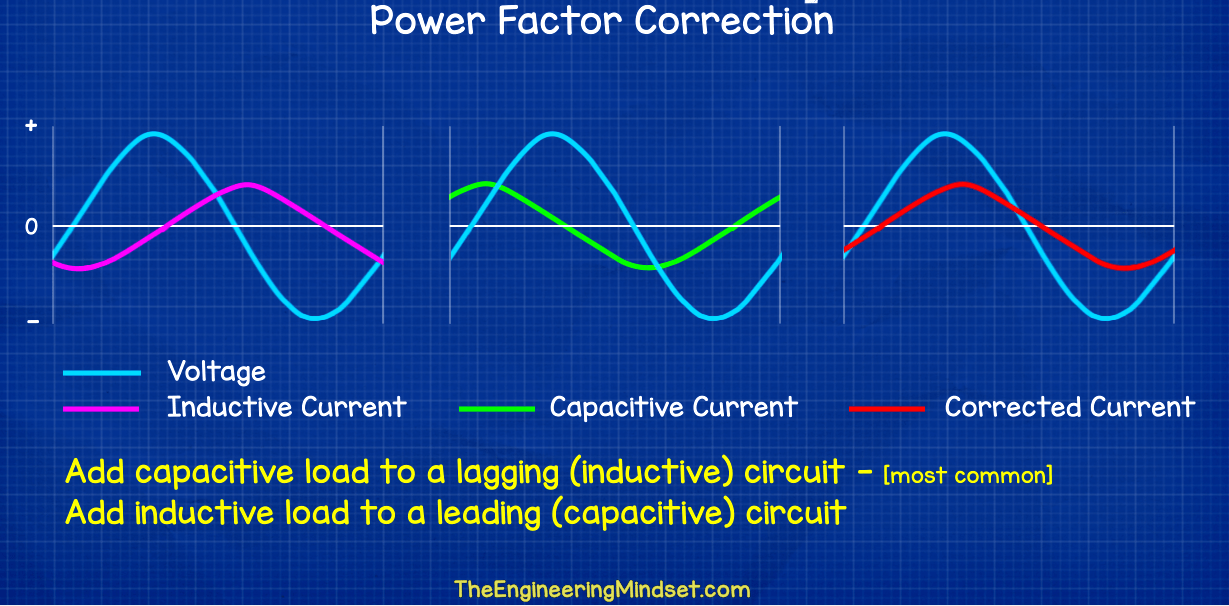
Capacitor banks provide a leading reactive current to neutralize the lagging reactive current produced by inductive loads. By placing capacitors near the inductive load or at the main distribution board, the reactive power no longer needs to be drawn from the utility grid. Instead, it is supplied locally by the capacitor bank.
Modern PFC systems are often “automatic.” They use a controller that continuously monitors the reactive power demand of the building. As loads switch on and off throughout the day, the controller adds or subtracts individual capacitor steps to maintain an optimal power factor, ensuring the system never over-corrects (which could lead to a leading power factor, causing its own set of technical problems).
Active Harmonic Filtering
In modern environments, the presence of non-linear loads—such as Variable Frequency Drives (VFDs), LED lighting, and computers—introduces “harmonics” into the electrical system. Harmonics are distortions of the standard 50Hz or 60Hz waveform. Standard capacitors can sometimes resonate with these harmonics, leading to catastrophic equipment failure.
In these environments, businesses must employ Active Harmonic Filters alongside or instead of traditional capacitor banks. These advanced systems use power electronics to inject current that cancels out both reactive power and harmonic distortion, providing a cleaner, more efficient electrical environment.
The Financial and Operational Advantages
Investing in power factor correction is rarely just a technical decision; it is a strategic financial move. When a business eliminates its reactive power demand, it experiences immediate and long-term economic benefits.
Eliminating Utility Penalties
Utility companies have to size their generation and transmission infrastructure based on Apparent Power (kVA). When a customer’s power factor is low, the utility must supply more current than is being billed as Active Power (kW). To discourage this, utilities bill for the extra capacity or apply surcharges. By installing PFC equipment, a facility can typically eliminate these penalties entirely, often resulting in a return on investment (ROI) within 12 to 24 months.
Optimizing Internal Distribution
Beyond the utility bill, PFC benefits the internal electrical infrastructure. When a facility reduces the total current (Amperes) flowing through its circuits, it reduces the $I^2R$ (current squared times resistance) losses. This means less energy is lost as heat in the facility’s own cabling and transformers.
Furthermore, by reducing the kVA demand, the existing transformers and cables have more “headroom.” This allows a business to add new machinery or expand operations without the massive capital expenditure of upgrading the site’s electrical service or transformer capacity. It effectively allows a facility to “do more with less.”
Sustainability and Environmental Impact
In an era where Corporate Social Responsibility (CSR) and ESG (Environmental, Social, and Governance) targets are critical, PFC is an essential tool for reducing a company’s carbon footprint. Every kilowatt-hour saved through increased electrical efficiency is a kilowatt-hour that does not need to be generated at a power plant. By reducing the load on the grid, businesses contribute to lower overall transmission losses across the utility’s network, supporting a more sustainable and reliable energy infrastructure.
Selecting the Right Approach for Your Facility
Achieving an optimal power factor is not a “one-size-fits-all” endeavor. It requires a systematic approach to auditing, planning, and implementation.
The Power Quality Audit
The first step is a professional power quality audit. Using data loggers installed at the main electrical service entrance, engineers can capture the facility’s power factor profile over a period of weeks. This data reveals the patterns of reactive power consumption, identifying when the demand peaks and whether harmonics are a significant concern. This analysis is crucial for sizing the PFC equipment correctly.
Installation and Integration
Once the audit is complete, the design phase determines whether the correction should be “fixed” (for constant loads) or “automatic” (for variable loads). Proper installation is vital. Capacitor banks must be protected by appropriate circuit breakers and thermal monitoring devices. In some cases, detuned reactors are added to capacitor banks to prevent harmonic resonance, ensuring the system remains stable even in electrically noisy environments.
Maintenance and Monitoring
Power Factor Correction equipment is not “set it and forget it.” Capacitors degrade over time, losing their ability to provide reactive power. A proactive maintenance schedule—including thermal imaging of connections and capacity testing of capacitor stages—is essential. If a PFC unit fails, the reactive power charges will return to the utility bill immediately, potentially going unnoticed until the next billing cycle. Modern digital controllers can often be integrated into Building Management Systems (BMS), sending alerts if the system detects a drop in performance or a component failure.
In conclusion, power factor correction remains one of the most effective ways to bridge the gap between electrical demand and operational efficiency. By neutralizing reactive power, businesses can simultaneously lower their energy costs, protect their infrastructure, and support grid stability. Whether driven by the desire to avoid utility penalties or the need to maximize the capacity of existing electrical systems, the implementation of PFC is a clear, data-driven step toward a more efficient and profitable future.
aViewFromTheCave is a participant in the Amazon Services LLC Associates Program, an affiliate advertising program designed to provide a means for sites to earn advertising fees by advertising and linking to Amazon.com. Amazon, the Amazon logo, AmazonSupply, and the AmazonSupply logo are trademarks of Amazon.com, Inc. or its affiliates. As an Amazon Associate we earn affiliate commissions from qualifying purchases.